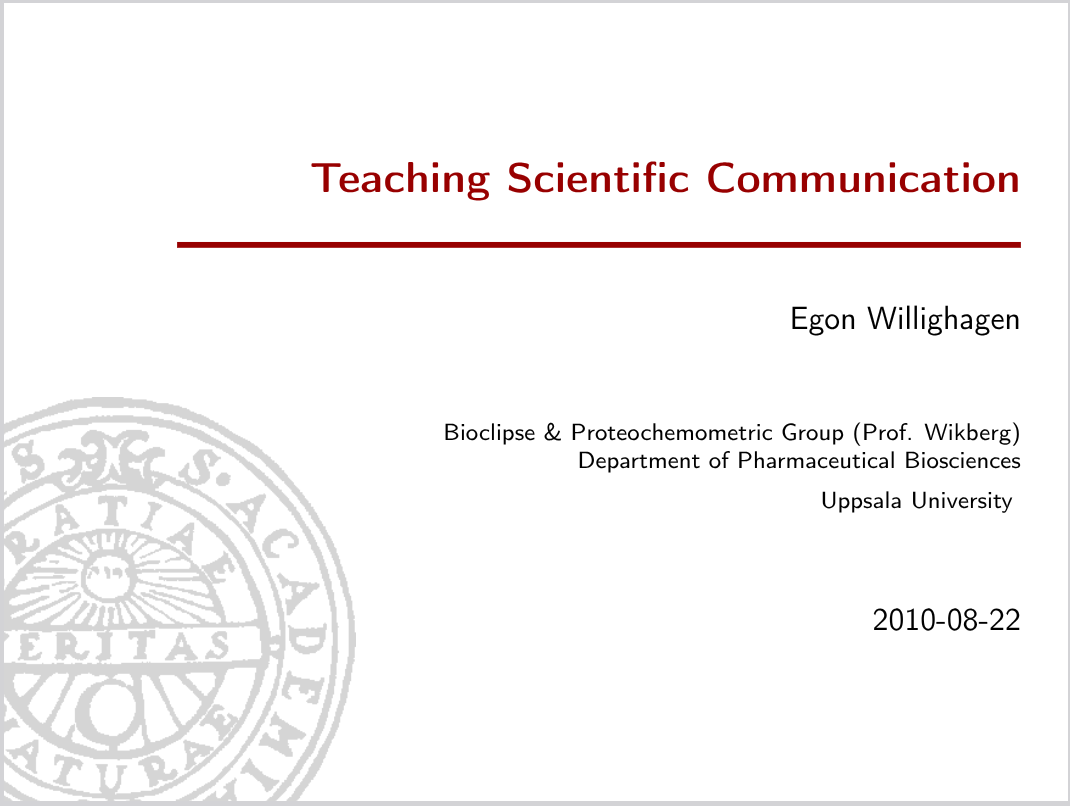
<?xml version="1.0" encoding="utf-8"?><feed xmlns="http://www.w3.org/2005/Atom" ><generator uri="https://jekyllrb.com/" version="4.3.4">Jekyll</generator><link href="http://egonw.github.io/blog/feed/by_tag/acs.xml" rel="self" type="application/atom+xml" /><link href="http://egonw.github.io/blog/" rel="alternate" type="text/html" /><updated>2026-11-17T07:22:51+00:00</updated><id>http://egonw.github.io/blog/feed/by_tag/acs.xml</id><title type="html">chem-bla-ics</title><subtitle>Chemblaics (pronounced chem-bla-ics) is the science that uses open science and computers to solve problems in chemistry, biochemistry and related fields.</subtitle><author><name>Egon Willighagen</name></author><entry><title type="html">Second #acs_boston talk: teaching scientific communication</title><link href="http://egonw.github.io/blog/2010/09/08/second-acsboston-talk-teaching.html" rel="alternate" type="text/html" title="Second #acs_boston talk: teaching scientific communication" /><published>2010-09-08T00:00:00+00:00</published><updated>2010-09-08T00:00:00+00:00</updated><id>http://egonw.github.io/blog/2010/09/08/second-acsboston-talk-teaching</id><content type="html" xml:base="http://egonw.github.io/blog/2010/09/08/second-acsboston-talk-teaching.html"><![CDATA[<p>Below are the slides of my ACS CHED talk in Boston:</p>

<p><a href="https://doi.org/10.5281/zenodo.3563519"><img src="/blog/assets/images/acs2010_teaching_talk.png" alt="" /></a></p>]]></content><author><name>Egon Willighagen</name></author><category term="acs" /><category term="education" /><category term="github" /><category term="myexperiment" /><category term="cito:citesAsEvidence:10.5281/ZENODO.3563519" /><summary type="html"><![CDATA[Below are the slides of my ACS CHED talk in Boston:]]></summary><media:thumbnail xmlns:media="http://search.yahoo.com/mrss/" url="http://egonw.github.io/blog/blog/assets/images/acs2010_teaching_talk.png" /><media:content medium="image" url="http://egonw.github.io/blog/blog/assets/images/acs2010_teaching_talk.png" xmlns:media="http://search.yahoo.com/mrss/" /></entry><entry><title type="html">Third #acs_boston talk: the Orbital Development Kit</title><link href="http://egonw.github.io/blog/2010/08/25/third-acsboston-talk-orbital.html" rel="alternate" type="text/html" title="Third #acs_boston talk: the Orbital Development Kit" /><published>2010-08-25T00:00:00+00:00</published><updated>2010-08-25T00:00:00+00:00</updated><id>http://egonw.github.io/blog/2010/08/25/third-acsboston-talk-orbital</id><content type="html" xml:base="http://egonw.github.io/blog/2010/08/25/third-acsboston-talk-orbital.html"><![CDATA[<p>The source code is available under LGPL 2.1 at <a href="https://github.com/egonw/odk">my GitHub account</a>.</p>

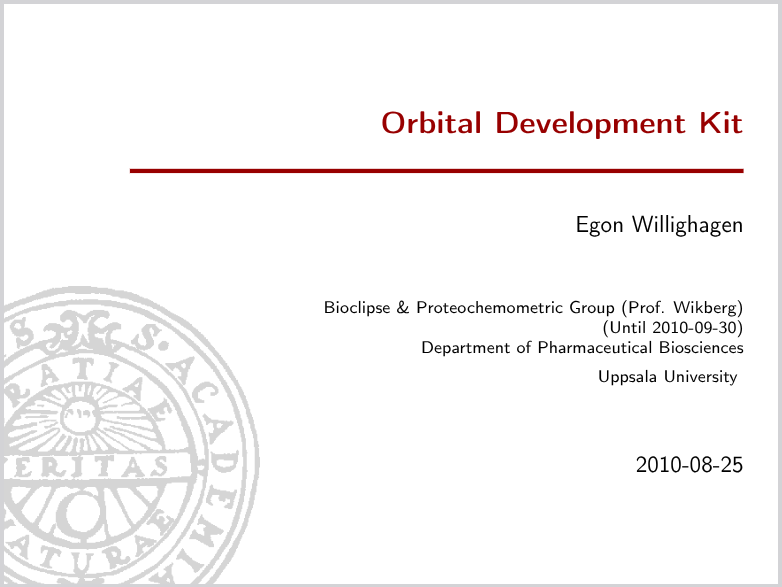
<p><a href="https://doi.org/10.5281/zenodo.3345005"><img src="/blog/assets/images/acsrdf_presentation2.png" alt="" /></a></p>]]></content><author><name>Egon Willighagen</name></author><category term="acsrdf2010" /><category term="acs" /><category term="rdf" /><category term="justdoi:10.5281/zenodo.3345005" /><summary type="html"><![CDATA[The source code is available under LGPL 2.1 at my GitHub account.]]></summary><media:thumbnail xmlns:media="http://search.yahoo.com/mrss/" url="http://egonw.github.io/blog/blog/assets/images/acsrdf_presentation2.png" /><media:content medium="image" url="http://egonw.github.io/blog/blog/assets/images/acsrdf_presentation2.png" xmlns:media="http://search.yahoo.com/mrss/" /></entry><entry><title type="html">First #acs_boston talk: Linking RDF to cheminformatics and proteochemometrics</title><link href="http://egonw.github.io/blog/2010/08/23/first-acsboston-talk-linking-rdf-to.html" rel="alternate" type="text/html" title="First #acs_boston talk: Linking RDF to cheminformatics and proteochemometrics" /><published>2010-08-23T00:00:00+00:00</published><updated>2010-08-23T00:00:00+00:00</updated><id>http://egonw.github.io/blog/2010/08/23/first-acsboston-talk-linking-rdf-to</id><content type="html" xml:base="http://egonw.github.io/blog/2010/08/23/first-acsboston-talk-linking-rdf-to.html"><![CDATA[<p>Acknowledgements to <a href="http://saml.rilspace.org/">Samuel</a> and <a href="http://annziproject.blogspot.com/">Annzi</a>, two great students!</p>

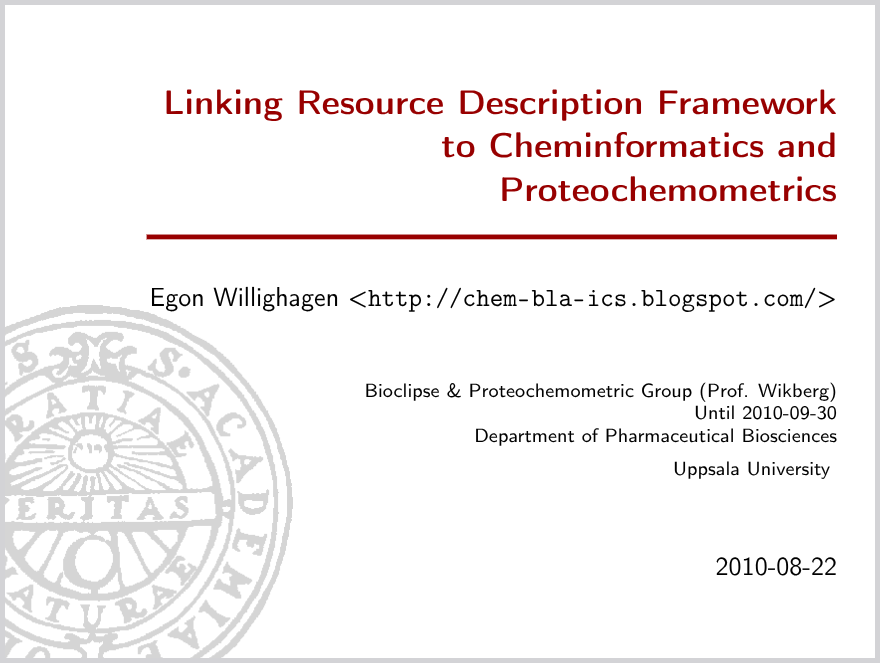
<p><a href="https://doi.org/10.5281/zenodo.3566561"><img src="/blog/assets/images/acsrdf_presentation1.png" alt="" /></a></p>]]></content><author><name>Egon Willighagen</name></author><category term="acsrdf2010" /><category term="acs" /><category term="rdf" /><category term="justdoi:10.5281/zenodo.3566561" /><summary type="html"><![CDATA[Acknowledgements to Samuel and Annzi, two great students!]]></summary><media:thumbnail xmlns:media="http://search.yahoo.com/mrss/" url="http://egonw.github.io/blog/blog/assets/images/acsrdf_presentation1.png" /><media:content medium="image" url="http://egonw.github.io/blog/blog/assets/images/acsrdf_presentation1.png" xmlns:media="http://search.yahoo.com/mrss/" /></entry><entry><title type="html">#ACS_Boston #acsrdf2010 ? It’s all about Open Standards!</title><link href="http://egonw.github.io/blog/2010/08/17/acsboston-acsrdf2010-its-all-about-open.html" rel="alternate" type="text/html" title="#ACS_Boston #acsrdf2010 ? It’s all about Open Standards!" /><published>2010-08-17T00:00:00+00:00</published><updated>2010-08-17T00:00:00+00:00</updated><id>http://egonw.github.io/blog/2010/08/17/acsboston-acsrdf2010-its-all-about-open</id><content type="html" xml:base="http://egonw.github.io/blog/2010/08/17/acsboston-acsrdf2010-its-all-about-open.html"><![CDATA[<p>Less than a week left before the <a href="http://egonw.github.com/acsrdf2010/">three ACS RDF 2010 sessions</a>!
I am both nervous and excited! We really got a great team of speakers together. As a final call for
people still not sure if they want to attend, I sent out a few emails. On Monday, we are competing with
the big <a href="http://acscinf.org/docs/publications/CIB/2010/2/items/mtgs/reports/jcim.htm">JCIM 50th anniversary</a>,
but really, that it’s 50 years of old cheminformatics, where our session is about the next 50 year.
Your call ;) I was told the meetings are in two rooms along side, so you should be able to see a bit
of both.</p>

<p>Besides the really interesting list of chemical domains covered in these talks (see below), this meeting,
though I have not advertised it as such, is really about <a href="http://en.wikipedia.org/wiki/Open_standard">Open Standards</a>
in cheminformatics. This is what I just wrote to the <a href="http://blueobelisk.sourceforge.net/wiki/Mailing_List">Blue Obelisk mailing list</a> (:</p>

<blockquote>
  <p>Dear ACS-Boston 2010 participants,</p>

  <p>with this email I would like to ask your
attention to the three Semantic Web
sessions on Sunday morning, and Monday
morning and afternoon. During these
sessions 15 presentations will be given
on how the Resource Description Framework
is changing cheminformatics.</p>

  <p>It is of special interest to the Blue
Obelisk community that the family of RDF
technologies (RDF, OWL, SPARQL) are all
successful Open Standards, building on
older and other Open Standards like HTTP,
URI, XML (or JSON or Notation3 or
Turtle), etc.</p>

  <p>Moreover, these technologies are not
restricted to one particular domain, such
as MDL/Symyx molfile, CML(XXX) are, as
this part is covered by the Web Ontology
Language (OWL)… each ontology in itself
can be (and should ofcourse) be an Open
Standard.</p>

  <p>In three sessions links to computational
chemistry, knowledge management, and
general applications are demonstrated,
with wide variety of chemical disciplines
as context, including toxicology,
chemometrics, eScience, databases, wet
lab experimentation, lipidomics, text
mining, drug discovery and health care,
gene-disease-pathway modeling, and
chemical patents.</p>

  <p>All people interested in Open
Cheminformatics should have a special
interest in these three sessions, and I
am very much looking forward to seeing
you all next Sunday and/or Monday!</p>

  <p>The full program can be found at:</p>

  <p><a href="http://egonw.github.com/acsrdf2010/">http://egonw.github.com/acsrdf2010/</a></p>

  <p>(please retweet and share with friends
otherwise)</p>

  <p>with kind regards,</p>

  <p>Egon Willighagen</p>
</blockquote>]]></content><author><name>Egon Willighagen</name></author><category term="acs" /><category term="acsrdf2010" /><category term="rdf" /><summary type="html"><![CDATA[Less than a week left before the three ACS RDF 2010 sessions! I am both nervous and excited! We really got a great team of speakers together. As a final call for people still not sure if they want to attend, I sent out a few emails. On Monday, we are competing with the big JCIM 50th anniversary, but really, that it’s 50 years of old cheminformatics, where our session is about the next 50 year. Your call ;) I was told the meetings are in two rooms along side, so you should be able to see a bit of both.]]></summary></entry><entry><title type="html">Program for the RDF symposium at the American Chemical Society fall meeting</title><link href="http://egonw.github.io/blog/2010/06/26/it-is-my-great-pleasure-to-present-full.html" rel="alternate" type="text/html" title="Program for the RDF symposium at the American Chemical Society fall meeting" /><published>2010-06-26T00:00:00+00:00</published><updated>2010-06-26T00:00:00+00:00</updated><id>http://egonw.github.io/blog/2010/06/26/it-is-my-great-pleasure-to-present-full</id><content type="html" xml:base="http://egonw.github.io/blog/2010/06/26/it-is-my-great-pleasure-to-present-full.html"><![CDATA[<p>It is my great pleasure to present the full symposium program for the RDF session at the <a href="http://www.acs.org/">American Chemical Society</a>
at the Boston meeting in August:</p>

<p><a href="https://egonw.github.com/acsrdf2010/">http://egonw.github.com/acsrdf2010/</a></p>

<p>I am excited that on Monday afternoon <a href="http://esw.w3.org/Eric_Prud'hommeaux">Eric Prud’hommeaux</a> will present the work of the
<a href="http://esw.w3.org/HCLSIG/LODD">LODD working group</a> to the chemistry community. The symposium contains three half day sessions with
topics on computing, ontologies, and applications, all chemistry oriented. The goal of the meeting is to get together people using
RDF technologies in chemistry, and the list of talks from around the world shows that this goal has been reached. The program is
diverse and exciting, and I am very much looking forward to meeting all participants to discuss challenges and cool solutions.</p>

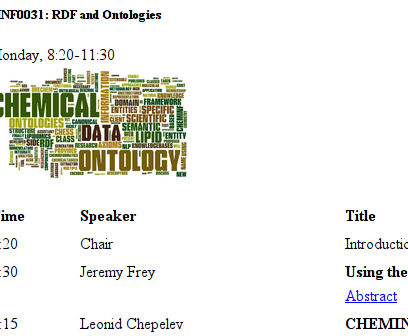
<p><img src="/blog/assets/images/acsrdf.png" alt="" /></p>

<p>People interested in joining, can sign up to the <a href="https://groups.google.com/group/acsrdf2010">meeting mailing list</a>. Besides
that the webpage is in <a href="http://www.w3.org/TR/xhtml-rdfa-primer/">XHTML+RDFa</a>, the source is also available on GitHub (well, you
really download the source code anyway), allowing people to <a href="http://egonw.github.com/acsrdf2010/#morerdfa">happily fork</a>, make
changes, and perhaps make the page as triple-dense as is possible.</p>

<p>I am also keen to have mastered some <a href="http://jquery.com/">jQuery</a> skills, and the Abstract links on the webpage use jQuery to
show and hide them.</p>]]></content><author><name>Egon Willighagen</name></author><category term="acsrdf2010" /><category term="acs" /><category term="rdf" /><category term="rdfa" /><summary type="html"><![CDATA[It is my great pleasure to present the full symposium program for the RDF session at the American Chemical Society at the Boston meeting in August:]]></summary><media:thumbnail xmlns:media="http://search.yahoo.com/mrss/" url="http://egonw.github.io/blog/blog/assets/images/acsrdf.png" /><media:content medium="image" url="http://egonw.github.io/blog/blog/assets/images/acsrdf.png" xmlns:media="http://search.yahoo.com/mrss/" /></entry><entry><title type="html">ACS Liveblogging 1st Disclosures of Drug Candidates</title><link href="http://egonw.github.io/blog/2010/04/22/acs-liveblogging-1st-disclosures-of.html" rel="alternate" type="text/html" title="ACS Liveblogging 1st Disclosures of Drug Candidates" /><published>2010-04-22T00:00:00+00:00</published><updated>2010-04-22T00:00:00+00:00</updated><id>http://egonw.github.io/blog/2010/04/22/acs-liveblogging-1st-disclosures-of</id><content type="html" xml:base="http://egonw.github.io/blog/2010/04/22/acs-liveblogging-1st-disclosures-of.html"><![CDATA[<p><a href="http://cenblog.org/the-haystack/">Carmen</a> liveblogged via <a href="http://twitter.com/carmendrahl">her twitter account</a> the disclosures
of drug candidates at the past ACS meeting, and later <a href="http://cenblog.org/the-haystack/2010/03/liveblogging-1st-disclosures-of-drug-candidates/">aggregated the tweets in her blog</a>.
While many of her tweets made it into the <a href="http://friendfeed.com/acs-san-francisco-2010">FriendFeed room</a>, the structure she
drew up and shared did not make it. And until just know, I was not aware the had tweeted those too. The first twitpic she pushed was:</p>

<p><img src="https://twitpic.com/1a3b3v" alt="" /></p>

<p>and I hope they will all end up in <a href="http://chempedia.com/substances/">ChemPedia</a>. I’ve done the above
(<a href="http://chempedia.com/substances/6-2018-7215-8416">6-2018-7215-8416</a>):</p>

<p><img src="/blog/assets/images/6-2018-7215-8416.png" alt="" /></p>

<p>Each structure I have transcribed, I will tweet with the tags <a href="http://search.twitter.com/search?q=acs_sf">#acs_sf</a>
and <a href="http://search.twitter.com/search?q=chempedia">#chempedia</a>, like in:</p>

<div class="language-plaintext highlighter-rouge"><div class="highlight"><pre class="highlight"><code>@carmendrahl http://twitpic.com/1a3b3v -&gt; http://ur1.ca/wfar #chempedia #acs_sf
</code></pre></div></div>

<p>Oh, and if you happen to know the drug candidates name (or company code), please do deposit it in ChemPedia!</p>]]></content><author><name>Egon Willighagen</name></author><category term="acs" /><category term="drugdiscovery" /><category term="chempedia" /><summary type="html"><![CDATA[Carmen liveblogged via her twitter account the disclosures of drug candidates at the past ACS meeting, and later aggregated the tweets in her blog. While many of her tweets made it into the FriendFeed room, the structure she drew up and shared did not make it. And until just know, I was not aware the had tweeted those too. The first twitpic she pushed was:]]></summary><media:thumbnail xmlns:media="http://search.yahoo.com/mrss/" url="http://egonw.github.io/blog/blog/assets/images/6-2018-7215-8416.png" /><media:content medium="image" url="http://egonw.github.io/blog/blog/assets/images/6-2018-7215-8416.png" xmlns:media="http://search.yahoo.com/mrss/" /></entry><entry><title type="html">Semantic Chemistry with the Resource Description Framework</title><link href="http://egonw.github.io/blog/2010/01/25/semantic-chemistry-with-resource.html" rel="alternate" type="text/html" title="Semantic Chemistry with the Resource Description Framework" /><published>2010-01-25T00:00:00+00:00</published><updated>2010-01-25T00:00:00+00:00</updated><id>http://egonw.github.io/blog/2010/01/25/semantic-chemistry-with-resource</id><content type="html" xml:base="http://egonw.github.io/blog/2010/01/25/semantic-chemistry-with-resource.html"><![CDATA[<p><strong>First Call for Papers</strong> <br />
Semantic Chemistry with the Resource Description Framework <br />
240th ACS National Meeting &amp; Exposition <br />
Boston, Massachusetts, August 22-26, 2010 <br />
CINF Division</p>

<p>We now invite papers for our symposium on the use of the Resource Description Framework (RDF) technologies in semantic knowledge representation
and data exchange in chemistry at the 240th National Meeting &amp; Exposition of the American Chemical Society (ACS) in Boston this fall.</p>

<p>Semantic Chemistry has been around for a while, but is seeing a revival with the adoption of the Resource Description Framework (RDF) and
matching technologies in chemistry. RDF triples provide a simple structure that allow data and knowledge alike to be presented in a single
framework. Derived technologies include the capturing of ontologies with the Web Ontology Language (OWL) and performing queries with SPARQL.
A wide variety of free and open source product make it easy to set up servers with large amounts of RDF data, while integration with HTML
is available too with RDFa.</p>

<p>The RDF symposium at the 240th ACS national meeting in Boston invites submissions of talks about the use of RDF in chemistry and cheminformatics.
Topics could include the use of OWL ontologies, OWL axioms, reasoning and interference, RDF in user interfaces, such as RDFa in web front ends,
visualization, querying systems, and applications thereof, such as linking data sets, compound classification, cloud computing, web services,
data aggregation, semantic publishing, and literature mining.</p>

<p>Abstracts may be submitted via http://abstracts.acs.org. You’ll find the RDF session as part of the CINF division symposiums. Submissions open
January 25, 2010, and the deadline is March 28, 2010. In case of questions, please email Egon Willighagen at egon.willighagen@farmbio.uu.se or
Martin Braendle at braendle@chem.ethz.ch.</p>]]></content><author><name>Egon Willighagen</name></author><category term="acs" /><category term="acsrdf2010" /><category term="rdf" /><category term="chemistry" /><category term="sparql" /><category term="rdfa" /><summary type="html"><![CDATA[First Call for Papers Semantic Chemistry with the Resource Description Framework 240th ACS National Meeting &amp; Exposition Boston, Massachusetts, August 22-26, 2010 CINF Division]]></summary></entry><entry><title type="html">re: ACS RSS feeds are messed up</title><link href="http://egonw.github.io/blog/2007/09/21/re-acs-rss-feeds-are-messed-up.html" rel="alternate" type="text/html" title="re: ACS RSS feeds are messed up" /><published>2007-09-21T00:10:00+00:00</published><updated>2007-09-21T00:10:00+00:00</updated><id>http://egonw.github.io/blog/2007/09/21/re-acs-rss-feeds-are-messed-up</id><content type="html" xml:base="http://egonw.github.io/blog/2007/09/21/re-acs-rss-feeds-are-messed-up.html"><![CDATA[<p>A couple of people now confirmed the <a href="http://chem-bla-ics.blogspot.com/2007/09/acs-rss-feeds-are-messed-up.html">problem with the ACS journal RSS feeds</a>.
Being back behind my desktop machine, I can post the obligatory screenshot:</p>

<p><img src="/blog/assets/images/acsRSSproblem.png" alt="" /></p>

<p>The feed for Chemical Biology shows 79 feed items and the first one was a <em>Environ. Sci. Technol.</em> paper. The first of the
108 papers listed in the feed for Molecular Pharmaceutics is a perp from <em>J.Phys.Chem.C.</em></p>]]></content><author><name>Egon Willighagen</name></author><category term="acs" /><category term="rss" /><summary type="html"><![CDATA[A couple of people now confirmed the problem with the ACS journal RSS feeds. Being back behind my desktop machine, I can post the obligatory screenshot:]]></summary><media:thumbnail xmlns:media="http://search.yahoo.com/mrss/" url="http://egonw.github.io/blog/blog/assets/images/acsRSSproblem.png" /><media:content medium="image" url="http://egonw.github.io/blog/blog/assets/images/acsRSSproblem.png" xmlns:media="http://search.yahoo.com/mrss/" /></entry><entry><title type="html">ACS RSS feeds are messed up</title><link href="http://egonw.github.io/blog/2007/09/16/acs-rss-feeds-are-messed-up.html" rel="alternate" type="text/html" title="ACS RSS feeds are messed up" /><published>2007-09-16T00:10:00+00:00</published><updated>2007-09-16T00:10:00+00:00</updated><id>http://egonw.github.io/blog/2007/09/16/acs-rss-feeds-are-messed-up</id><content type="html" xml:base="http://egonw.github.io/blog/2007/09/16/acs-rss-feeds-are-messed-up.html"><![CDATA[<p>All start is difficult. The ACS must know that, but <a href="http://blog.everydayscientist.com/?p=661">they still blame Google</a>.
In this blog, <a href="http://blog.everydayscientist.com/">Everyday Scientist</a> mentions that the ACS RSS journal TOC feeds are
sometimes messed up. I noted that too, but lived with it. The ACS generally is a very professional organization, but
when I read they told ES that his Google RSS client was the problem, I just had to confirm his problems, hoping that
some ACS representative can relay the message to their IT department.</p>

<p><a href="http://akregator.kde.org/">Akregator</a> is the RSS client that I use, and I noticed the exact same problem ES noted:
every now and then, twice, three times a month, the RSS feeds for one journal give the content of another journal.
For example, I get the TOC of Chemical Reviews in the RSS feed of the <a href="http://pubs.acs.org/journals/jcisd8/index.html">JCIM</a>.
Things like that.</p>

<p>Now, because Akregator has absolute nothing to do with Google, it cannot be Google who is messing up the RSS feeds.
Because ES is having the same issues I have, it cannot be Akregator either. Ergo, it is the RSS feed system of the
ACS itself that is messed up.</p>]]></content><author><name>Egon Willighagen</name></author><category term="acs" /><category term="rss" /><summary type="html"><![CDATA[All start is difficult. The ACS must know that, but they still blame Google. In this blog, Everyday Scientist mentions that the ACS RSS journal TOC feeds are sometimes messed up. I noted that too, but lived with it. The ACS generally is a very professional organization, but when I read they told ES that his Google RSS client was the problem, I just had to confirm his problems, hoping that some ACS representative can relay the message to their IT department.]]></summary></entry><entry><title type="html">ACS Chicago - Day #3</title><link href="http://egonw.github.io/blog/2007/03/29/acs-chicago-day-3.html" rel="alternate" type="text/html" title="ACS Chicago - Day #3" /><published>2007-03-29T00:20:00+00:00</published><updated>2007-03-29T00:20:00+00:00</updated><id>http://egonw.github.io/blog/2007/03/29/acs-chicago-day-3</id><content type="html" xml:base="http://egonw.github.io/blog/2007/03/29/acs-chicago-day-3.html"><![CDATA[<p>Tuesday promised to be an interesting day: an interesting ‘Scientific Communication’ CINF session in the morning and early
afternoon. And, rather important to me, the <a href="http://www.blueobelisk.org/">Blue Obelisk</a> dinner that night, just after another
CINF party, where I chatted with a few others about options of a chemistry equivalent of the <a href="http://code.google.com/soc/">Google Summer of Code</a>;
who knows what happens this summer, but start thinking about ideas on how to increase the web experience of chemistry journal web pages.</p>

<h2 id="the-gsoc">The GSoC</h2>

<p>Now that I am talking about the GSoC, you might have realized that the <a href="http://cdk.sf.net/">CDK</a> and
<a href="http://www.bioclipse.net/">Bioclipse</a> did not make it as mentoring organization. While I had not seriously expected it,
all the enthusiasm from within both projects including several interested students, I was a bit hoping for getting
accepted with at least on of them. Meanwhile, <a href="http://www.kde.org/">KDE</a>, as expected, is approved, and actually contains
two interesting chemistry project ideas too. One is about a 3D viewer/editor for which 7 students send Google a proposal,
and the other about text mining of chemical content on the desktop, using <a href="http://www.vandenoever.info/software/strigi/">Strigi</a>
(two students). Both topics have one excellent proposal, who do good in the ranking process. So, we might have some
chemistry in the GSoC after all.</p>

<h2 id="cinf">CINF</h2>

<p>OK, back to the ACS meeting. Fahrenbach had a presentation on blogging too, but don’t remember anything special about it.
The <a href="http://chem-bla-ics.blogspot.com/2007/03/acs-chicago-day-1.html">CHED</a> session was more elaborate on the whole topic,
and since you are a reader of chemical blogs, you all know about this anyway :) Loney introduced
<a href="http://biotechexchange.org/">biotechexchange.org</a> which is building a social network around biotechnology. There are other
community sites like this, and my major <em>problem</em> with these community building efforts is that they are too well defined.
I much prefer to work in a more open environment where I can get in contact just as easily with people outside some specific
topic. For the rest, the set of technologies is rather comprehensive.</p>

<p>Frenkel spoke about the imminent success of <a href="http://trc.nist.gov/ThermoML.html">ThermoML</a>, which is now being supported by
vendors and publishers, smoothing the whole dissemination of data supported by this format. It is basically what
<a href="http://www.xml-cml.org/">CML</a> is attempting to achieve in molecular structure data. Day is having a good go at this with
crystal data, and <a href="http://wwmm.ch.cam.ac.uk/wikis/wwmm/index.php/CMLCrystBase">his CrystalEye project</a> is supposed to be
launched next month.</p>

<p>Hey, at Microsoft.com, had a rather manager level presentation, with very little value for someone into the field of
‘data lifecycle and curation’. Rather disappointing on a scientific conference, or am I judging the ACS conference here?
If the Microsoft is getting interested in chemoinformatics that might be a good thing, as long as the are OK with open
source, open data and open standards. Who knows…</p>

<p>Rzepa had his presentation on the semantic wiki, which he, in similar form, <a href="http://chem-bla-ics.blogspot.com/2006/11/german-conference-on-chemoinformatics_14.html">held at the German Chemoinformatics Conference
too</a>. New, I think, were the sheets
on reasoning based on the content of the wiki. That was rather interesting. If we all would make our chemical knowledge
available as <a href="http://en.wikipedia.org/wiki/Resource_Description_Framework">RDF</a>, then this can become a big thing very
soon. I skipped the presentation of Renear on ontologies, though it was actually one that I had hand picked; but I was
simply too tired. Will watch the podcast when available. (BTW, are they making podcasts for the CINF session only, or
for the whole ACS meeting?)</p>

<p>In the afternoon, I also followed just a subset of the presentations. The last one was by Scott <a href="http://chem-bla-ics.blogspot.com/2007/03/acs-chicago-day-1.html">who spoke earlier on
Second Life</a>. I’m really interested in seeing where this
is going, though I have my reservations if this is the right medium for mining chemical knowledge. Today she spoke on the
social bookmarking and podcasting initiatives at Nature and <a href="http://network.nature.com/">Nature Network</a>. The latter is
a social site, like like BioTechExchange, but not limited to one specific topic, and more interdisciplinary (my account
at <a href="http://network.nature.com/profile/U6151BCD6">NN</a>). I blogged <a href="http://chem-bla-ics.blogspot.com/2007/02/nature-network-v2-cannot-create-new.html">about some early issues</a>
some time ago.</p>

<h2 id="jmol">Jmol</h2>

<p>Jabri showed us how <a href="http://www.jmol.org/">Jmol</a> is adding value to the <a href="http://pubs.acs.org/journals/acbcct/index.html">ACS Chemical Biology</a>
journal. Yes, that’s what she said. An opensource tool, developed by people on their free time, is making an ACS journal
more valuable. I am very happy to hear that, and it strongly supports our view that opensource chemoinformatics is very
important. Some more support from established organizations might be in order indeed!</p>

<h2 id="blue-obelisk">Blue Obelisk</h2>

<p>It has become a habit to organize <a href="http://www.blueobelisk.org/">Blue Obelisk</a> dinner to talk about opensource, opendata,
openscience, and the future. Actually, we secretly talk about talking over the world, but I can’t say that. (Neither can
I tell anything about our secret rituals. The protocol for becoming member of our society is quite simple though: be
clear about your opinion that ODOSOS is the future.) Dinner was great, and it was great talking to several older and
newer members of the movement. Cheers all! Oh, there also was some awards involved, but I hope Peter and Christoph will
blog about that and post the pictures.</p>]]></content><author><name>Egon Willighagen</name></author><category term="acs" /><summary type="html"><![CDATA[Tuesday promised to be an interesting day: an interesting ‘Scientific Communication’ CINF session in the morning and early afternoon. And, rather important to me, the Blue Obelisk dinner that night, just after another CINF party, where I chatted with a few others about options of a chemistry equivalent of the Google Summer of Code; who knows what happens this summer, but start thinking about ideas on how to increase the web experience of chemistry journal web pages.]]></summary></entry></feed>