<?xml version="1.0" encoding="utf-8"?><feed xmlns="http://www.w3.org/2005/Atom" ><generator uri="https://jekyllrb.com/" version="4.3.4">Jekyll</generator><link href="http://egonw.github.io/blog/feed/by_tag/beilstein.xml" rel="self" type="application/atom+xml" /><link href="http://egonw.github.io/blog/" rel="alternate" type="text/html" /><updated>2026-11-17T07:22:51+00:00</updated><id>http://egonw.github.io/blog/feed/by_tag/beilstein.xml</id><title type="html">chem-bla-ics</title><subtitle>Chemblaics (pronounced chem-bla-ics) is the science that uses open science and computers to solve problems in chemistry, biochemistry and related fields.</subtitle><author><name>Egon Willighagen</name></author><entry><title type="html">Status update on BJOC analysis with Oscar and ChemicalTagger #3</title><link href="http://egonw.github.io/blog/2010/12/23/status-update-on-bjoc-analysis-with_23.html" rel="alternate" type="text/html" title="Status update on BJOC analysis with Oscar and ChemicalTagger #3" /><published>2010-12-23T00:00:00+00:00</published><updated>2010-12-23T00:00:00+00:00</updated><id>http://egonw.github.io/blog/2010/12/23/status-update-on-bjoc-analysis-with_23</id><content type="html" xml:base="http://egonw.github.io/blog/2010/12/23/status-update-on-bjoc-analysis-with_23.html"><![CDATA[<p>The <a href="https://chem-bla-ics.linkedchemistry.info/2010/12/11/status-update-on-bjoc-analysis-with_11.html">two <i class="fa-solid fa-recycle fa-xs"></i></a>
<a href="https://chem-bla-ics.linkedchemistry.info/2010/12/11/status-update-on-bjoc-analysis-with.html">earlier <i class="fa-solid fa-recycle fa-xs"></i></a> posts
in this series showed screenshots of results of Oscar, but the title also promised results by Lezan’s
<a href="http://www-ucc.ch.cam.ac.uk/products/software/chemicaltagger">ChemicalTagger</a>. Sam
helped with getting the HTML pages online via the Cambridge Hudson installation. Where
Oscar find named entities (chemical compounds, processes, etc), ChemicalTagger finds
roles, like solvent, acid, base, catalyst. Roles are properties of chemical compounds
in certain situations. Ethanol is not always a solvent, sometimes it is a Xmas present.
The current output is not entirely where I want to go yet, but makes it easy which
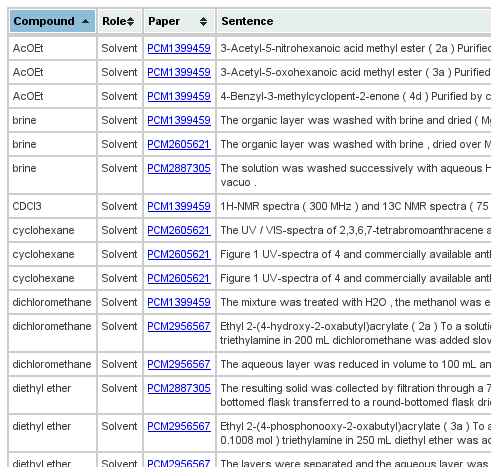
solvents are frequently found in the BJOC corpus:</p>

<p><img src="/blog/assets/images/chemtag1.png" alt="" /></p>

<p>This screenshot of an analysis of 15 BJOC papers shows that AcOEt (is that the
<a href="http://lab.chempedia.com/questions/427/are-etoac-and-acoet-the-same">same as EtOAc?</a>)
is mentioned as solvent three times in <a href="http://www.ncbi.nlm.nih.gov/sites/ppmc/articles/PMC1399459">PMC1399459</a>.
Brine, however, is mentioned as solvent in three papers.</p>

<p>As said, these <a href="https://hudson.ch.cam.ac.uk/job/oscar4-chebi/ws/target/output/bjoc.html">two</a>
<a href="https://hudson.ch.cam.ac.uk/job/oscar4-chebi/ws/target/output/roles.html">pages</a> contain
RDF and the tables are sortable. Hudson recompiles them automatically when I update the
source code to create the HTML+RDFa. So, go ahead, send me bug reports, feature requests,
and patches!</p>]]></content><author><name>Egon Willighagen</name></author><category term="oscar" /><category term="chemicaltagger" /><category term="beilstein" /><category term="justdoi:10.1186/1860-5397-1-11" /><summary type="html"><![CDATA[The two earlier posts in this series showed screenshots of results of Oscar, but the title also promised results by Lezan’s ChemicalTagger. Sam helped with getting the HTML pages online via the Cambridge Hudson installation. Where Oscar find named entities (chemical compounds, processes, etc), ChemicalTagger finds roles, like solvent, acid, base, catalyst. Roles are properties of chemical compounds in certain situations. Ethanol is not always a solvent, sometimes it is a Xmas present. The current output is not entirely where I want to go yet, but makes it easy which solvents are frequently found in the BJOC corpus:]]></summary><media:thumbnail xmlns:media="http://search.yahoo.com/mrss/" url="http://egonw.github.io/blog/blog/assets/images/chemtag1.png" /><media:content medium="image" url="http://egonw.github.io/blog/blog/assets/images/chemtag1.png" xmlns:media="http://search.yahoo.com/mrss/" /></entry><entry><title type="html">Supramolecular chemistry</title><link href="http://egonw.github.io/blog/2010/12/11/supramolecular-chemistry.html" rel="alternate" type="text/html" title="Supramolecular chemistry" /><published>2010-12-11T00:20:00+00:00</published><updated>2010-12-11T00:20:00+00:00</updated><id>http://egonw.github.io/blog/2010/12/11/supramolecular-chemistry</id><content type="html" xml:base="http://egonw.github.io/blog/2010/12/11/supramolecular-chemistry.html"><![CDATA[<p>Some smart software developer once said to not optimize your code too early. However, not caring about it at all does not help either.
Some basic knowledge of memory management can keep you going. That is, I just ran into the limits of <a href="http://oscar3-chem.sf.net/">Oscar</a>
and ChemicalTagger. As I blogged earlier today, I am <a href="https://chem-bla-ics.linkedchemistry.info/2010/12/11/status-update-on-bjoc-analysis-with.html">analyzing the BJOC literature <i class="fa-solid fa-recycle fa-xs"></i></a>,
but Lezan and I are running into a reproducible out-of-memory exception. At first I thought it was a memory leak, as it was the 95th
paper if fell over on, but after we optimized our code a bit, by reusing classes, the problem remained and turned out to be not in
recreating objects (though the code is significantly faster now), but in a single BJOC paper being too large.</p>

<p>The particular paper is not even ridiculously large, though it has an amazing 800 references! The paper, <em>Molecular recognition of
organic ammonium ions in solution using synthetic receptors</em> (doi:<a href="https://doi.org/10.3762/bjoc.6.32">10.3762/bjoc.6.32</a>), is in
fact an interesting review paper on supramolecular chemistry. The molecules I worked on (see one below) in my own supramolecular chemistry
time (doing a M.Sc. minor (6 month practical) with Peter Buijnsters in organic chemistry in the
<a href="http://www.molchem.science.ru.nl/about.php">group of Prof. Nolte</a>), are actually of the type they review, though surfactants are
not really covered in it particularly.</p>

<p><img src="/blog/assets/images/surfactant2002.png" alt="" /></p>

<p>Yeah, supramolecular chemistry has this nice level complexity; it is so supramolecular, that it is currently outside the scope
of the molecular analysis of Oscar and ChemicalTagger ;)</p>

<ul>
  <li>Buijnsters, P. J. J. A.; García-Rodríguez, C. L.; Willighagen, E. L.; Sommerdijk, N. A. J. M.; Kremer, A.; Camilleri, P.; Feiters, M. C.;
Nolte, R. J. M.; Zwanenburg, B. (2002). Cationic Gemini Surfactants Based on Tartaric Acid: Synthesis, Aggregation, Monolayer Behaviour,
and Interaction with DNA European Journal of Organic Chemistry, 2002 (8), 1397-1406 :
DOI:<a href="https://doi.org/csqhbn">10.1002/1099-0690(200204)2002:8%3C1397::AID-EJOC1397%3E3.0.CO;2-6</a></li>
</ul>]]></content><author><name>Egon Willighagen</name></author><category term="oscar" /><category term="beilstein" /><category term="chemistry" /><category term="justdoi:10.3762/bjoc.6.32" /><category term="inchikey:ZXBXTKLPJKVXBD-KKLWWLSJSA-N" /><summary type="html"><![CDATA[Some smart software developer once said to not optimize your code too early. However, not caring about it at all does not help either. Some basic knowledge of memory management can keep you going. That is, I just ran into the limits of Oscar and ChemicalTagger. As I blogged earlier today, I am analyzing the BJOC literature , but Lezan and I are running into a reproducible out-of-memory exception. At first I thought it was a memory leak, as it was the 95th paper if fell over on, but after we optimized our code a bit, by reusing classes, the problem remained and turned out to be not in recreating objects (though the code is significantly faster now), but in a single BJOC paper being too large.]]></summary><media:thumbnail xmlns:media="http://search.yahoo.com/mrss/" url="http://egonw.github.io/blog/blog/assets/images/surfactant2002.png" /><media:content medium="image" url="http://egonw.github.io/blog/blog/assets/images/surfactant2002.png" xmlns:media="http://search.yahoo.com/mrss/" /></entry><entry><title type="html">Status update on BJOC analysis with Oscar and ChemicalTagger #2</title><link href="http://egonw.github.io/blog/2010/12/11/status-update-on-bjoc-analysis-with_11.html" rel="alternate" type="text/html" title="Status update on BJOC analysis with Oscar and ChemicalTagger #2" /><published>2010-12-11T00:10:00+00:00</published><updated>2010-12-11T00:10:00+00:00</updated><id>http://egonw.github.io/blog/2010/12/11/status-update-on-bjoc-analysis-with_11</id><content type="html" xml:base="http://egonw.github.io/blog/2010/12/11/status-update-on-bjoc-analysis-with_11.html"><![CDATA[<p> </p>

<p><img src="/blog/assets/images/bjoc1.png" alt="" /></p>

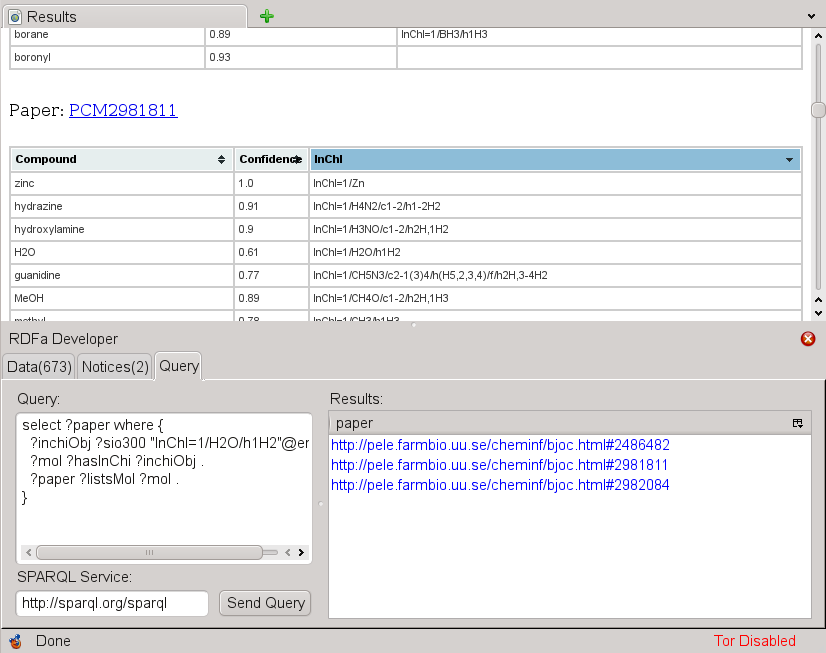
<p>A quick update on the <a href="https://chem-bla-ics.linkedchemistry.info/2010/12/11/status-update-on-bjoc-analysis-with.html">post of this morning <i class="fa-solid fa-recycle fa-xs"></i></a>. The above screenshot
shows the progress of the reporting of text mining results using <a href="http://oscar3-chem.sf.net/">Oscar</a> on the <a href="http://www.beilstein-journals.org/bjoc/">BJOC literature</a>.
I think I am almost ready to analyze the full corpus, with a blacklist put in place for <a href="https://chem-bla-ics.linkedchemistry.info/2010/12/11/supramolecular-chemistry.html">large papers <i class="fa-solid fa-recycle fa-xs"></i></a>,
What you see is the same kind of JQuery-enabled sortable list in the HTML view, and a <a href="http://en.wikipedia.org/wiki/SPARQL">SPARQL query</a>
in <a href="https://chem-bla-ics.linkedchemistry.info/2010/07/16/rdfadev-htmlrdfa-development-with.html">RDFaDev <i class="fa-solid fa-recycle fa-xs"></i></a>, to list all papers that mention
<a href="http://www.dhmo.org/facts.html">DHMO</a> (in the first 10 of all 350 BJOC papers) by its <a href="http://en.wikipedia.org/wiki/International_Chemical_Identifier">InChI</a>.</p>

<p>Importantly, IMHO, it is using the <a href="http://code.google.com/p/semanticchemistry/">CHEMINF ontology</a>.</p>]]></content><author><name>Egon Willighagen</name></author><category term="beilstein" /><category term="oscar" /><category term="inchi" /><summary type="html"><![CDATA[ ]]></summary><media:thumbnail xmlns:media="http://search.yahoo.com/mrss/" url="http://egonw.github.io/blog/blog/assets/images/bjoc1.png" /><media:content medium="image" url="http://egonw.github.io/blog/blog/assets/images/bjoc1.png" xmlns:media="http://search.yahoo.com/mrss/" /></entry><entry><title type="html">Status update on BJOC analysis with Oscar and ChemicalTagger</title><link href="http://egonw.github.io/blog/2010/12/11/status-update-on-bjoc-analysis-with.html" rel="alternate" type="text/html" title="Status update on BJOC analysis with Oscar and ChemicalTagger" /><published>2010-12-11T00:00:00+00:00</published><updated>2010-12-11T00:00:00+00:00</updated><id>http://egonw.github.io/blog/2010/12/11/status-update-on-bjoc-analysis-with</id><content type="html" xml:base="http://egonw.github.io/blog/2010/12/11/status-update-on-bjoc-analysis-with.html"><![CDATA[<p> </p>

<p><img src="/blog/assets/images/bjoc.png" alt="" /></p>

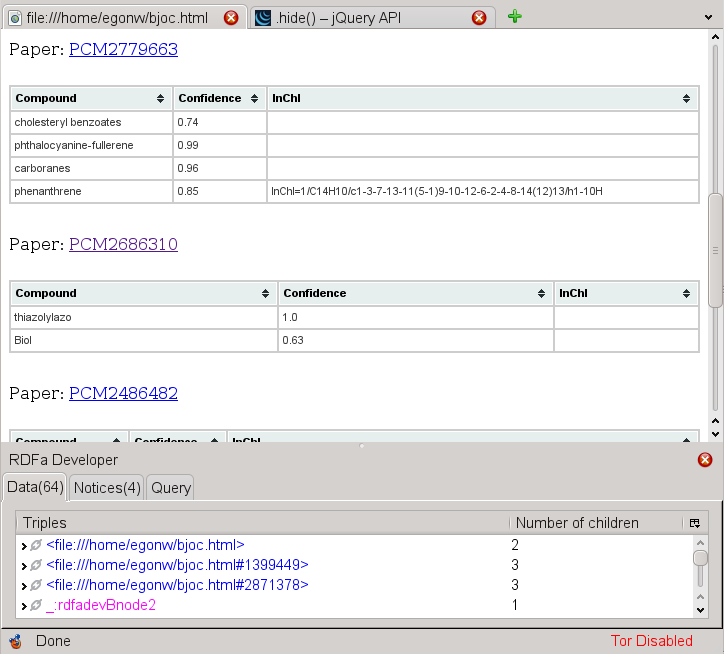
<p>This screenshot shows the current status of the <a href="http://oscar3-chem.sf.net/">Oscar</a> analysis results of the
<a href="http://www.beilstein-journals.org/bjoc/">BJOC literature</a>. The results our logged as HTML+RDFa page, as I explained before in
<a href="https://chem-bla-ics.linkedchemistry.info/2010/07/19/scripts-logs-as-htmlrdfa-mix-free-text.html">Scripts logs as HTML+RDFa: mix free text reporting with CSV <i class="fa-solid fa-recycle fa-xs"></i></a>.
The page is interactive, using <a href="http://jquery.com/">JQuery</a> goodies to allow table sorting.</p>]]></content><author><name>Egon Willighagen</name></author><category term="beilstein" /><category term="oscar" /><summary type="html"><![CDATA[ ]]></summary><media:thumbnail xmlns:media="http://search.yahoo.com/mrss/" url="http://egonw.github.io/blog/blog/assets/images/bjoc.png" /><media:content medium="image" url="http://egonw.github.io/blog/blog/assets/images/bjoc.png" xmlns:media="http://search.yahoo.com/mrss/" /></entry><entry><title type="html">How many hydrogen-bond acceptor groups does triazole have?</title><link href="http://egonw.github.io/blog/2010/12/10/how-many-hydrogen-bond-acceptor-groups.html" rel="alternate" type="text/html" title="How many hydrogen-bond acceptor groups does triazole have?" /><published>2010-12-10T00:00:00+00:00</published><updated>2010-12-10T00:00:00+00:00</updated><id>http://egonw.github.io/blog/2010/12/10/how-many-hydrogen-bond-acceptor-groups</id><content type="html" xml:base="http://egonw.github.io/blog/2010/12/10/how-many-hydrogen-bond-acceptor-groups.html"><![CDATA[<p><a href="http://en.wikipedia.org/wiki/Andrew_S.I.D._Lang">Andrew</a> asked me about the
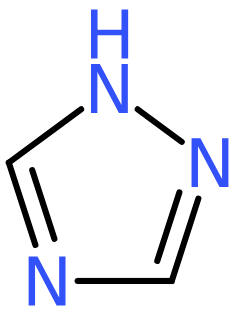
H-bond donor capabilities of <a href="http://en.wikipedia.org/wiki/1,2,4-Triazole">1,2,4-triazole</a>:</p>

<p><img src="/blog/assets/images/1,2,4-triazole.png" alt="" /></p>

<p>Apparently, the way he uses the <a href="http://cdk.sf.net">CDK</a> library, it returns
<a href="https://sourceforge.net/tracker/index.php?func=detail&amp;aid=3133610&amp;group_id=20024&amp;atid=120024">zero H-bond donor groups</a>,
as is visible in <a href="http://showme.physics.drexel.edu/onsc/models/AbrahamDescriptorsModel001.php?commonname=1,2,4-triazole">his application</a>
down the bottom of the page. When start from the PubChem entry, it correctly
detects on H-bond donor group, so it seems to have to do with implicit hydrogens
(not uncommon). Debugging will continue later, when I am done analyzing the
<a href="http://www.beilstein-journals.org/bjoc/">Beilstein Journal of Organic Chemistry</a>
literature with <a href="oscar3-chem.sf.net">Oscar</a>.</p>

<p>But, I do like to put this question out in the open: how many <em>H-bond acceptor</em>
groups does this triazole have? The CDK calculates 3 groups, while <a href="http://pubchem.ncbi.nlm.nih.gov/summary/summary.cgi?cid=9257&amp;loc=ec_rcs">PubChem
counts 2</a>.
<a href="http://www.chemspider.com/RecordView.aspx?rid=16b4a40c-0eaf-45ed-bbf3-10baed079a9b">ChemSpider thinks 3</a>
too.</p>

<p>Intuitively, I would agree with the CDK and ChemSpider: the nitrogen which acts
as the single H-bond donor still have a free electron pair. What do you think?
Is <a href="http://pubchem.ncbi.nlm.nih.gov/">PubChem</a> wrong, or is the CDK and <a href="http://chemspider.com">ChemSpider</a>
wrong? Can this special nitrogen be both a donor and acceptor at the same time?
I think so. However, I do not know how I can easily search <a href="http://wwmm.ch.cam.ac.uk/crystaleye/">CrystalEye</a>
for this. Bonus points for answering the <a href="http://blueobelisk.shapado.com/questions/how-can-i-searched-crystaleye-for-particular-packing-types">Blue Obelisk eXchange question</a>.</p>]]></content><author><name>Egon Willighagen</name></author><category term="beilstein" /><category term="cdk" /><category term="cheminf" /><category term="chemistry" /><category term="chemspider" /><category term="pubchem" /><category term="inchikey:NSPMIYGKQJPBQR-UHFFFAOYSA-N" /><summary type="html"><![CDATA[Andrew asked me about the H-bond donor capabilities of 1,2,4-triazole:]]></summary><media:thumbnail xmlns:media="http://search.yahoo.com/mrss/" url="http://egonw.github.io/blog/blog/assets/images/1,2,4-triazole.png" /><media:content medium="image" url="http://egonw.github.io/blog/blog/assets/images/1,2,4-triazole.png" xmlns:media="http://search.yahoo.com/mrss/" /></entry><entry><title type="html">Oscar4 command line utilities</title><link href="http://egonw.github.io/blog/2010/11/18/oscar4-command-line-utilities.html" rel="alternate" type="text/html" title="Oscar4 command line utilities" /><published>2010-11-18T00:00:00+00:00</published><updated>2010-11-18T00:00:00+00:00</updated><id>http://egonw.github.io/blog/2010/11/18/oscar4-command-line-utilities</id><content type="html" xml:base="http://egonw.github.io/blog/2010/11/18/oscar4-command-line-utilities.html"><![CDATA[<p>One goal of my three month project is to take Oscar4 to the community. We want to get it used more, and we need
a larger development community. Oscar4 and the related technologies do a good, sometimes excellent, job, but
have to be maintained, just like any other piece of code. To make using it easier, we are developing new APIs,
as well as two user-oriented applications: <a href="https://chem-bla-ics.linkedchemistry.info/2010/10/21/oscar-text-mining-in-taverna.html">a Taverna 2 plugin <i class="fa-solid fa-recycle fa-xs"></i></a>,
and command line utilities. The <a href="https://chem-bla-ics.linkedchemistry.info/2010/10/28/oscar4-java-api-chemical-name.html">Oscar4 Java API <i class="fa-solid fa-recycle fa-xs"></i></a>
has slightly evolved in the last three weeks, removing some complexity. In this post, I will introduce the command
line utilities.</p>

<h2 id="oscar4">Oscar4</h2>

<p>Most people will be mostly interested into the full Oscar4 program, to extract chemical entities. Oscar3 was
also capable of extracting data (like <a href="https://chem-bla-ics.linkedchemistry.info/2006/09/08/chemical-archeology-oscar3-to.html">NMR spectra <i class="fa-solid fa-recycle fa-xs"></i></a>),
but that is not yet being ported. The OscarCLI program takes input, extracts chemicals, and where possible resolves
them into connection tables (viz. InChI).</p>

<p>To extract chemicals from a line of text (e.g. <em>“This is propane.”</em>, you do:</p>

<div class="language-shell highlighter-rouge"><div class="highlight"><pre class="highlight"><code><span class="nv">$ </span>java <span class="nt">-cp</span> oscar4-cli-4.0-SNAPSHOT.jar <span class="se">\</span>
  uk.ac.cam.ch.wwmm.oscar.oscarcli.OscarCLI <span class="se">\</span>
  This is propane.
propane: <span class="nv">InChI</span><span class="o">=</span>1/C3H8/c1-3-2/h3H2,1-2H3
</code></pre></div></div>

<p>For larger chunks of texts it is easier to route it via <a href="http://en.wikipedia.org/wiki/Standard_streams">stdin</a>,
for which we can use the <code class="language-plaintext highlighter-rouge">-stdin</code> option:</p>

<div class="language-shell highlighter-rouge"><div class="highlight"><pre class="highlight"><code><span class="nv">$ </span><span class="nb">echo</span> <span class="s2">"This is propane."</span> | <span class="se">\</span>
  java <span class="nt">-cp</span> oscar4-cli-4.0-SNAPSHOT.jar <span class="se">\</span>
  uk.ac.cam.ch.wwmm.oscar.oscarcli.OscarCLI <span class="se">\</span>
  <span class="nt">-stdin</span>
propane: <span class="nv">InChI</span><span class="o">=</span>1/C3H8/c1-3-2/h3H2,1-2H3
</code></pre></div></div>

<p>That way, we can easily process large plain text files (output omitted):</p>

<div class="language-shell highlighter-rouge"><div class="highlight"><pre class="highlight"><code><span class="nv">$ </span><span class="nb">cat </span>largeFile.txt | <span class="se">\</span>
  java <span class="nt">-cp</span> oscar4-cli-4.0-SNAPSHOT.jar <span class="se">\</span>
  uk.ac.cam.ch.wwmm.oscar.oscarcli.OscarCLI <span class="se">\</span>
  <span class="nt">-stdin</span>
</code></pre></div></div>

<p>If you prefer RDF output, for further integration, use the <code class="language-plaintext highlighter-rouge">-output text/turtle</code>:</p>

<div class="language-shell highlighter-rouge"><div class="highlight"><pre class="highlight"><code><span class="nv">$ </span><span class="nb">cat </span>largeFile.txt | <span class="se">\</span>
  java <span class="nt">-cp</span> oscar4-cli-4.0-SNAPSHOT.jar <span class="se">\</span>
  uk.ac.cam.ch.wwmm.oscar.oscarcli.OscarCLI <span class="se">\</span>
  <span class="nt">-stdin</span> <span class="nt">-output</span> text/turtle
</code></pre></div></div>

<p>This returns RDF using the <a href="http://code.google.com/p/semanticchemistry/">CHEMINF</a> ontology like:</p>

<div class="language-turtle highlighter-rouge"><div class="highlight"><pre class="highlight"><code><span class="kd">@prefix</span><span class="w"> </span><span class="nn">dc:</span><span class="w">  </span><span class="p">.</span><span class="w">
</span><span class="kd">@prefix</span><span class="w"> </span><span class="nn">rdfs:</span><span class="w">  </span><span class="p">.</span><span class="w">
</span><span class="kd">@prefix</span><span class="w"> </span><span class="nn">ex:</span><span class="w">  </span><span class="p">.</span><span class="w">
</span><span class="kd">@prefix</span><span class="w"> </span><span class="nn">cheminf:</span><span class="w">  </span><span class="p">.</span><span class="w">
</span><span class="kd">@prefix</span><span class="w"> </span><span class="nn">sio:</span><span class="w"> </span><span class="p">.</span><span class="w">

</span><span class="nn">ex:</span><span class="n">entity0
</span><span class="w">  </span><span class="nn">rdfs:</span><span class="n">subClassOf</span><span class="w"> </span><span class="nn">cheminf:</span><span class="n">CHEMINF_000000</span><span class="w"> </span><span class="p">;</span><span class="w">
  </span><span class="nn">dc:</span><span class="n">label</span><span class="w"> </span><span class="s">"propane"</span><span class="w"> </span><span class="p">;</span><span class="w">
  </span><span class="nn">cheminf:</span><span class="n">CHEMINF_000200</span><span class="w"> </span><span class="p">[</span><span class="w">
    </span><span class="k">a</span><span class="w"> </span><span class="nn">cheminf:</span><span class="n">CHEMINF_000113</span><span class="w"> </span><span class="p">;</span><span class="w">
    </span><span class="nn">sio:</span><span class="n">SIO_000300</span><span class="w"> </span><span class="s">"InChI=1/C3H8/c1-3-2/h3H2,1-2H3"</span><span class="w"> </span><span class="p">.</span><span class="w">
  </span><span class="p">]</span><span class="w"> </span><span class="p">.</span><span class="w">
</span></code></pre></div></div>

<p>We can, however, also use <a href="http://jericho.htmlparser.net/docs/index.html">Jericho</a> to extract text from HTML pages, made
available with the <code class="language-plaintext highlighter-rouge">-html</code> option, and pulling in a <a href="http://www.beilstein-journals.org/bjoc/">Beilstein Journal of Organic Chemistry</a>
paper with <a href="http://en.wikipedia.org/wiki/Wget">wget</a>:</p>

<div class="language-shell highlighter-rouge"><div class="highlight"><pre class="highlight"><code><span class="nv">$ </span>wget <span class="nt">-qO-</span> https://doi.org/10.3762/bjoc.6.122 | <span class="se">\</span>
  java <span class="nt">-cp</span> oscar4-cli-4.0-SNAPSHOT.jar <span class="se">\</span>
  uk.ac.cam.ch.wwmm.oscar.oscarcli.OscarCLI <span class="se">\</span>
  <span class="nt">-stdin</span> <span class="nt">-html</span>
</code></pre></div></div>

<p>This will return 271 chemical entities recognized in the text, matching 48 unique chemical structures.</p>]]></content><author><name>Egon Willighagen</name></author><category term="oscar" /><category term="textmining" /><category term="beilstein" /><category term="inchikey:ATUOYWHBWRKTHZ-UHFFFAOYSA-N" /><summary type="html"><![CDATA[One goal of my three month project is to take Oscar4 to the community. We want to get it used more, and we need a larger development community. Oscar4 and the related technologies do a good, sometimes excellent, job, but have to be maintained, just like any other piece of code. To make using it easier, we are developing new APIs, as well as two user-oriented applications: a Taverna 2 plugin , and command line utilities. The Oscar4 Java API has slightly evolved in the last three weeks, removing some complexity. In this post, I will introduce the command line utilities.]]></summary></entry></feed>