<?xml version="1.0" encoding="utf-8"?><feed xmlns="http://www.w3.org/2005/Atom" ><generator uri="https://jekyllrb.com/" version="4.3.4">Jekyll</generator><link href="http://egonw.github.io/blog/feed/by_tag/bioclipse.xml" rel="self" type="application/atom+xml" /><link href="http://egonw.github.io/blog/" rel="alternate" type="text/html" /><updated>2026-11-22T10:22:45+00:00</updated><id>http://egonw.github.io/blog/feed/by_tag/bioclipse.xml</id><title type="html">chem-bla-ics</title><subtitle>Chemblaics (pronounced chem-bla-ics) is the science that uses open science and computers to solve problems in chemistry, biochemistry and related fields.</subtitle><author><name>Egon Willighagen</name></author><entry><title type="html">Online Seminar demoing Bioclipse-OpenTox interoperability using RDF technologies</title><link href="http://egonw.github.io/blog/2011/05/23/online-seminar-demoing-bioclipse.html" rel="alternate" type="text/html" title="Online Seminar demoing Bioclipse-OpenTox interoperability using RDF technologies" /><published>2011-05-23T00:00:00+00:00</published><updated>2011-05-23T00:00:00+00:00</updated><id>http://egonw.github.io/blog/2011/05/23/online-seminar-demoing-bioclipse</id><content type="html" xml:base="http://egonw.github.io/blog/2011/05/23/online-seminar-demoing-bioclipse.html"><![CDATA[<p><strong>Update</strong>: due to personal circumstances, it will very likely only be Ola to
give the demo :(</p>

<p>This Wednesday, Ola and I will demo our work with Nina on interoperability between
<a href="http://www.bioclipse.net">Bioclipse</a> and OpenTox:</p>

<blockquote>
  <p>OpenTox recently initiated a series of online seminars and interactive tutorials on topics related
to predictive toxicology using a virtual conferencing system supporting desktop sharing and voice.
The tutorials are part of the EU FP7 project OpenTox (<a href="http://www.opentox.org/">www.opentox.org</a>),
which aims at developing an interoperable open source predictive toxicology framework which may be
used as an enabling platform for the creation of predictive toxicology applications.</p>

  <p>The next tutorial will be held Wednesday, 25 May, at 15:00 <a href="http://en.wikipedia.org/wiki/Central_European_Summer_Time">CEST</a>,
and will describe the approach for integrating OpenTox in Bioclipse, complemented with hands-on
tutorials showing how to take advantage of OpenTox functionality from within Bioclipse via the user
interface and scripts.</p>

  <p>The intended audience is people interested in learning how to use OpenTox from within Bioclipse, and
people interested in how the integration was technically implemented. A bleeding-edge release of
Bioclipse will be made available for the participants before the tutorial.</p>

  <p>Participation in these online events involves no registration fee. To register for the seminar, visit
<a href="http://www.surveymonkey.com/s/opentoxonline">http://www.surveymonkey.com/s/opentoxonline</a>.</p>

  <p>If you have already registered for a previous OpenTox tutorial this spring you don’t need to
register again.</p>
</blockquote>]]></content><author><name>Egon Willighagen</name></author><category term="bioclipse" /><category term="opentox" /><category term="sparql" /><summary type="html"><![CDATA[Update: due to personal circumstances, it will very likely only be Ola to give the demo :(]]></summary></entry><entry><title type="html">Open Standards (Or: “the long list of things that we weren’t required to do”)</title><link href="http://egonw.github.io/blog/2011/03/15/open-standards-or-long-list-of-things.html" rel="alternate" type="text/html" title="Open Standards (Or: “the long list of things that we weren’t required to do”)" /><published>2011-03-15T00:00:00+00:00</published><updated>2011-03-15T00:00:00+00:00</updated><id>http://egonw.github.io/blog/2011/03/15/open-standards-or-long-list-of-things</id><content type="html" xml:base="http://egonw.github.io/blog/2011/03/15/open-standards-or-long-list-of-things.html"><![CDATA[<p>Hot on the heels of a presentation I give today in a ToxBank virtual meeting
on (Open) Standards (I’ll blog the points as soon as possible), I just ran into
<a href="http://weblog.clarkparsia.com/2010/05/26/another-reason-semantic-web-kicks-ass/">this great blog post</a>
by the makers of the OWL reasoner <a href="http://clarkparsia.com/pellet/">Pellet</a> (license:GPL),
which we use in <a href="http://www.bioclipse.net">Bioclipse</a>. It is spot on on what
happens if you use Open Standards: “That’s notable not only because it took
so little time, but also because of the long list of things that we weren’t
required to do in order to make it happen”. This is not a new message. For example,
the <a href="http://quixote.wikispot.org/">Quixote project</a> is doing the same thing
in computation chemistry, but important for people to understand: Open Standards
(quite like Open Source, and Open Data) are a game changer: they simply collaborating,
speeding up development, and changing the way we do things.</p>]]></content><author><name>Egon Willighagen</name></author><category term="bioclipse" /><summary type="html"><![CDATA[Hot on the heels of a presentation I give today in a ToxBank virtual meeting on (Open) Standards (I’ll blog the points as soon as possible), I just ran into this great blog post by the makers of the OWL reasoner Pellet (license:GPL), which we use in Bioclipse. It is spot on on what happens if you use Open Standards: “That’s notable not only because it took so little time, but also because of the long list of things that we weren’t required to do in order to make it happen”. This is not a new message. For example, the Quixote project is doing the same thing in computation chemistry, but important for people to understand: Open Standards (quite like Open Source, and Open Data) are a game changer: they simply collaborating, speeding up development, and changing the way we do things.]]></summary></entry><entry><title type="html">Pharmaceutical Bioinformatics</title><link href="http://egonw.github.io/blog/2011/03/11/pharmaceutical-bioinformatics.html" rel="alternate" type="text/html" title="Pharmaceutical Bioinformatics" /><published>2011-03-11T00:00:00+00:00</published><updated>2011-03-11T00:00:00+00:00</updated><id>http://egonw.github.io/blog/2011/03/11/pharmaceutical-bioinformatics</id><content type="html" xml:base="http://egonw.github.io/blog/2011/03/11/pharmaceutical-bioinformatics.html"><![CDATA[<p>The <a href="http://www.farmbio.uu.se/research/researchgroups/proteochemometrics/">Wikberg group</a>
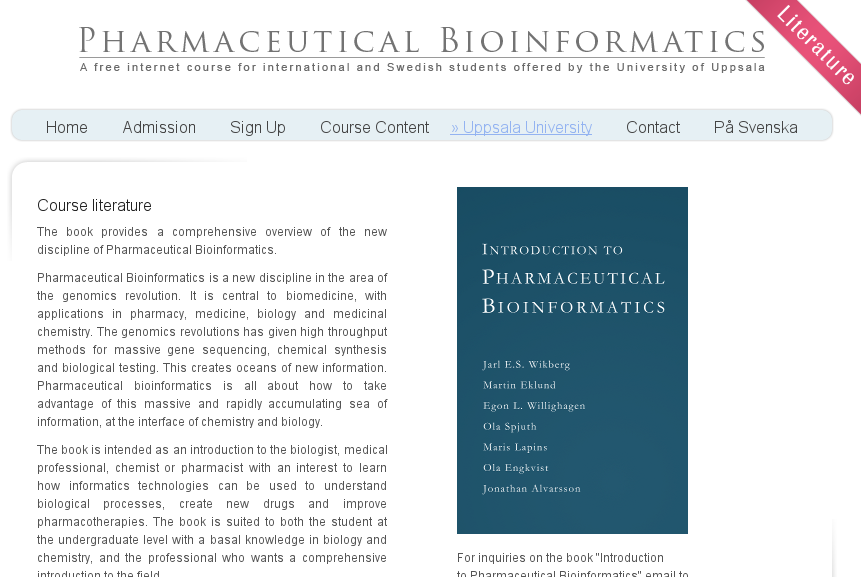
at <a href="http://www.uu.se/">Uppsala University</a> where I did my first two years of
post-docing in Sweden has a (free) course on <a href="http://www.pharmbio.org/">pharmaceutical bioinformatics</a>.
We worked hard on a course book, which after a year got printed. It ended up
with 400 pages, 15 chapters, and 3 appendices. It also includes examples on
how to do discussed topics in <a href="http://www.bioclipse.net/">Bioclipse</a>:</p>

<p><img src="/blog/assets/images/pharmbioBook.png" alt="" /></p>

<p>The chapters are:</p>

<ol>
  <li>
    <p>Introduction</p>
  </li>
  <li>
    <p>Background</p>
  </li>
  <li>
    <p>Drug discovery and development</p>
  </li>
  <li>
    <p>Bioinformatics, drugs and omics</p>
  </li>
  <li>
    <p>Representing molecules in computers</p>
  </li>
  <li>
    <p>Representation of 3D structures</p>
  </li>
  <li>
    <p>Molecular descriptors</p>
  </li>
  <li>
    <p>Sequence analysis</p>
  </li>
  <li>
    <p>Macromolecular descriptors</p>
  </li>
  <li>
    <p>Design of experiments</p>
  </li>
  <li>
    <p>Data analysis</p>
  </li>
  <li>
    <p>Databases</p>
  </li>
  <li>
    <p>QSAR</p>
  </li>
  <li>
    <p>Proteochemometrics</p>
  </li>
  <li>
    <p>Semantic web</p>
  </li>
  <li>
    <p>Answers</p>
  </li>
</ol>

<p>And three appendices:</p>

<p>A. Basic probability theory</p>

<p>B. Basic matrix algebra</p>

<p>C. Introduction to Bioclipse</p>

<p>The book is currently undergoing proof review and available to course participants
only, and should become available in a couple of months for the general public.</p>]]></content><author><name>Egon Willighagen</name></author><category term="bioclipse" /><category term="cdk" /><category term="cheminf" /><category term="chemometrics" /><category term="publishing" /><summary type="html"><![CDATA[The Wikberg group at Uppsala University where I did my first two years of post-docing in Sweden has a (free) course on pharmaceutical bioinformatics. We worked hard on a course book, which after a year got printed. It ended up with 400 pages, 15 chapters, and 3 appendices. It also includes examples on how to do discussed topics in Bioclipse:]]></summary><media:thumbnail xmlns:media="http://search.yahoo.com/mrss/" url="http://egonw.github.io/blog/blog/assets/images/pharmbioBook.png" /><media:content medium="image" url="http://egonw.github.io/blog/blog/assets/images/pharmbioBook.png" xmlns:media="http://search.yahoo.com/mrss/" /></entry><entry><title type="html">Bioclipse-CDK-ChEMBL-SPARQL-Chemometrics mashup paper published</title><link href="http://egonw.github.io/blog/2011/03/07/bioclipse-cdk-chembl-sparql.html" rel="alternate" type="text/html" title="Bioclipse-CDK-ChEMBL-SPARQL-Chemometrics mashup paper published" /><published>2011-03-07T00:00:00+00:00</published><updated>2011-03-07T00:00:00+00:00</updated><id>http://egonw.github.io/blog/2011/03/07/bioclipse-cdk-chembl-sparql</id><content type="html" xml:base="http://egonw.github.io/blog/2011/03/07/bioclipse-cdk-chembl-sparql.html"><![CDATA[<p>Our (peer-reviewed) <a href="http://www.bioclipse.net/">Bioclipse</a>-<a href="http://cdk.sf.net/">CDK</a>-SPARQL-Chemometrics
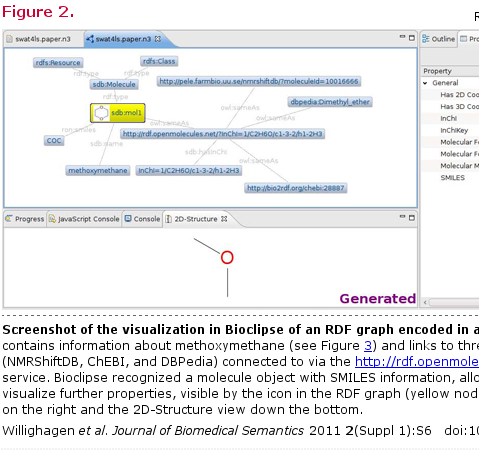
mashup paper was just published online (doi:<span class="Apple-style-span" style="font-family: Verdana, Geneva, Arial, Helvetica, sans-serif; font-size: 11px; line-height: 14px;"><a href="http://dx.doi.org/10.1186/2041-1480-2-S1-S6">10.1186/2041-1480-2-S1-S6</a></span>)
as part of the <a href="http://www.swat4ls.org/2009/">SWAT4LS 2009</a> <a href="http://www.jbiomedsem.com/supplements/2/S1">supplement</a>,
where we use the CC-SA-BY-licensed <a href="https://www.ebi.ac.uk/chembldb/">ChEMBL database</a>
as example data source, based on a <a href="http://chem-bla-ics.blogspot.com/2009/11/swat4ls-linking-open-drug-data-to.html">presentation I gave</a>
in Amsterdam back then.</p>

<p><img src="/blog/assets/images/jbiomedPaper.png" alt="" /></p>

<p>This is a Figure from our paper, but the other papers are very interesting too,
and are worth checking out!</p>]]></content><author><name>Egon Willighagen</name></author><category term="bioclipse" /><category term="cdk" /><category term="chembl" /><category term="rdf" /><category term="semweb" /><category term="sparql" /><category term="doi:10.1186/2041-1480-2-S1-S6" /><summary type="html"><![CDATA[Our (peer-reviewed) Bioclipse-CDK-SPARQL-Chemometrics mashup paper was just published online (doi:10.1186/2041-1480-2-S1-S6) as part of the SWAT4LS 2009 supplement, where we use the CC-SA-BY-licensed ChEMBL database as example data source, based on a presentation I gave in Amsterdam back then.]]></summary><media:thumbnail xmlns:media="http://search.yahoo.com/mrss/" url="http://egonw.github.io/blog/blog/assets/images/jbiomedPaper.png" /><media:content medium="image" url="http://egonw.github.io/blog/blog/assets/images/jbiomedPaper.png" xmlns:media="http://search.yahoo.com/mrss/" /></entry><entry><title type="html">OPSIN used for a Bioclipse wizard</title><link href="http://egonw.github.io/blog/2011/02/17/opsin-used-for-bioclipse-wizard.html" rel="alternate" type="text/html" title="OPSIN used for a Bioclipse wizard" /><published>2011-02-17T00:10:00+00:00</published><updated>2011-02-17T00:10:00+00:00</updated><id>http://egonw.github.io/blog/2011/02/17/opsin-used-for-bioclipse-wizard</id><content type="html" xml:base="http://egonw.github.io/blog/2011/02/17/opsin-used-for-bioclipse-wizard.html"><![CDATA[<p> </p>

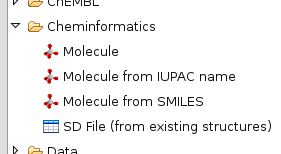
<p><img src="/blog/assets/images/bioclipseOPSIN.png" alt="" /></p>

<p>Somewhere in January I added a new <em>New Wizard</em> to <a href="http://www.bioclipse.net/">Bioclipse</a>
for <a href="https://www.ebi.ac.uk/opsin/">OPSIN <i class="fa-solid fa-recycle fa-xs"></i></a>, but forgot to blog about that earlier,
which will be available in Bioclipse 2.6 later this year (or just the <a href="http://chem-bla-ics.blogspot.com/2011/02/things-are-looking-blue-for-bioclipse.html">hudson
build service</a>).</p>]]></content><author><name>Egon Willighagen</name></author><category term="bioclipse" /><category term="iupac" /><category term="opsin" /><summary type="html"><![CDATA[ ]]></summary><media:thumbnail xmlns:media="http://search.yahoo.com/mrss/" url="http://egonw.github.io/blog/blog/assets/images/bioclipseOPSIN.png" /><media:content medium="image" url="http://egonw.github.io/blog/blog/assets/images/bioclipseOPSIN.png" xmlns:media="http://search.yahoo.com/mrss/" /></entry><entry><title type="html">Things are looking blue… (for #bioclipse)</title><link href="http://egonw.github.io/blog/2011/02/14/things-are-looking-blue-for-bioclipse.html" rel="alternate" type="text/html" title="Things are looking blue… (for #bioclipse)" /><published>2011-02-14T00:00:00+00:00</published><updated>2011-02-14T00:00:00+00:00</updated><id>http://egonw.github.io/blog/2011/02/14/things-are-looking-blue-for-bioclipse</id><content type="html" xml:base="http://egonw.github.io/blog/2011/02/14/things-are-looking-blue-for-bioclipse.html"><![CDATA[<p> </p>

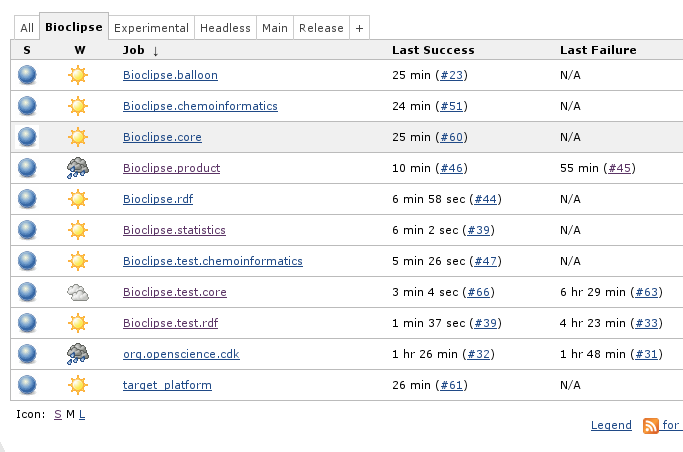
<p><img src="/blog/assets/images/hudsonBlue.png" alt="" /></p>

<p>Last Friday a virus kicked in. Don’t know whether flu or cold, but it had already
ruined my 5-6 February weekend too. I need high fever to keep bed, otherwise
I just can’t. Worse, when having an elevated temperature, I cannot think clearly
anymore, and I haven’t been able to think clear since about last Wednesday,
so I should have seen it coming. Nor can I think clear today, leading to <a href="http://biostar.stackexchange.com/questions/5552/what-is-bioinformatics">incomprehensibly
question on BioStar</a>,
and the general lack of progress in writing and other important things, like
planning.</p>

<p>Instead, I procrastinate. This is not necessarily bad, because my favorite procrastination
is open source cheminformatics. But, it’s not very efficient for getting tenure.
I wish I could procrastinate in writing review papers for <a href="http://www.nature.com/siteindex/index.html">Nature Foo</a>.</p>

<p>However, it does contribute to the <a href="http://cdk.sf.net">CDK</a> and <a href="http://bioclipse.net/">Bioclipse</a>.
And building on the seminal work by Arvid++ on setting up <a href="http://hudson.bioclipse.net/">Hudson for Bioclipse</a>
(building on := stealing his scripts and configuration files), I applied the
genetic algorithm-like approach well known in IT: change everything one by one,
and keep the best solutions. And, to my excitement, things are now looking blue
for Bioclipse :)</p>]]></content><author><name>Egon Willighagen</name></author><category term="bioclipse" /><summary type="html"><![CDATA[ ]]></summary><media:thumbnail xmlns:media="http://search.yahoo.com/mrss/" url="http://egonw.github.io/blog/blog/assets/images/hudsonBlue.png" /><media:content medium="image" url="http://egonw.github.io/blog/blog/assets/images/hudsonBlue.png" xmlns:media="http://search.yahoo.com/mrss/" /></entry><entry><title type="html">Bioclipse upgraded to CDK 1.3.8 and CDK-JChemPaint 17: builds broken</title><link href="http://egonw.github.io/blog/2011/02/13/bioclipse-upgraded-to-cdk-138-and-cdk.html" rel="alternate" type="text/html" title="Bioclipse upgraded to CDK 1.3.8 and CDK-JChemPaint 17: builds broken" /><published>2011-02-13T00:00:00+00:00</published><updated>2011-02-13T00:00:00+00:00</updated><id>http://egonw.github.io/blog/2011/02/13/bioclipse-upgraded-to-cdk-138-and-cdk</id><content type="html" xml:base="http://egonw.github.io/blog/2011/02/13/bioclipse-upgraded-to-cdk-138-and-cdk.html"><![CDATA[<p>Yesterday I did some boring plumbing: I upgraded our GC/MS machines with new
hardware. Well, the cheminformatics equivalent of it anyway. I upgraded the
<a href="http://bioclipse.net">Bioclipse</a> bundles in org.openscience.cdk for <a href="https://sourceforge.net/projects/cdk/files/cdk%20%28development%29/1.3.8/">CDK 1.3.8</a>
and <a href="https://sourceforge.net/projects/cdk/files/CDK-JChemPaint/17/">CDK-JChemPaint 17</a>.
This is typically a painful process, and now even more because a lot is changing
with how Bioclipse is build, which is with <a href="http://www.eclipse.org/buckminster/">Buckminster</a>
on <a href="http://hudson.bioclipse.net">Bioclipse’ Hudson server</a>. I am happy that
Arvid is doing the digging into Buckminster, as automatic building of Eclipse-RCP
tools is straightforward. Each part is describes by, seemingly, at least five
configurations files. For each plugin we have plugin dependencies, plugins are
wrapped into features, where you can get dependencies wrong too, and update
sites, which need to be in shape too. And on the Buckminster-side there are
.rmap and .cquery files pointing to the right git repositories, each of which
you can get wrong too.</p>

<p>Well, and I got them wrong. A few things had to happen. First of all, I had
to revert the <a href="jni-inchi.sf.net">JNI-InChI</a> library to a plugin, as I have no
experience with making <a href="http://en.wikipedia.org/wiki/OSGi">OSGi bundles</a> out
of random jars (there is this <a href="http://www.aqute.biz/Code/Bnd">bnd</a> tool which
exists for that task, but never used it before). But, the upgrade brought in
version 0.7 which should solve the InChI library loading issue, as well as bring
InChI to various more platforms. So, the JNI-InChI jar was pulled from the target
platform, and the rebuild worked out of the box.</p>

<p>The second thing I did was upgrade the <a href="https://github.com/bioclipse/org.openscience.cdk/">org.openscience.cdk</a>
bundles. This repository had three branches, <a href="https://github.com/goglepox/org.openscience.cdk">one</a>
for pure CDK, now updated to CDK 1.3.8, a <a href="https://github.com/goglepox/org.openscience.cdk/tree/cdk-jchempaint">CDK-JChemPaint branch</a>
updated to version 17, and a <a href="https://github.com/goglepox/org.openscience.cdk/tree/bioclipse2.4">bioclipse2.4</a>
branch for Bioclipse 2.x (we now and then patch things to make it work, so that
we do not have to wait for them to be applied upstream, with the CDK itself).
I thought it would be good to create a separate bioclipse2.6 branch for Bioclipse
master, but that was a mistake. This branch information is scattered over the
.rmap and .cquery files, and they are not all in one single git repository,
and those that are, are not synchronized with the versions on Hudson either.
It’s normal in prototyping, but not helping me. After a couple of hours fiddling,
I got <a href="http://pele.farmbio.uu.se/hudson/job/org.openscience.cdk/">this one compiling too</a>.</p>

<p>Right now, I’m stuck with getting <a href="http://pele.farmbio.uu.se/hudson/job/Bioclipse.chemoinformatics/">bioclipse.cheminformatics</a>
compiling again, and looking for ERRORs in an <a href="http://pele.farmbio.uu.se/hudson/job/Bioclipse.chemoinformatics/41/consoleText">enormous log file</a>.
If only ERROR messages were a bit more descriptive, something like “Hej, you
said to look for org.openscience.cdk.sinchi in file foo.bar, but I cannot find
it anywhere.”, then I’d have some clue where to look.</p>

<p>That makes me wonder if anyone actually ever wrote up best practices for error
messages…</p>

<p>BTW, I also still have another, independent dependency issue to solve: the one
for <a href="http://code.google.com/p/guava-libraries/">Google’s Guava</a>, so that everyone
can play with the <a href="http://chem-bla-ics.blogspot.com/2011/02/accessing-google-spreadsheets-from.html">Bioclipse-Google interaction</a>.</p>]]></content><author><name>Egon Willighagen</name></author><category term="bioclipse" /><category term="cdk" /><category term="jchempaint" /><summary type="html"><![CDATA[Yesterday I did some boring plumbing: I upgraded our GC/MS machines with new hardware. Well, the cheminformatics equivalent of it anyway. I upgraded the Bioclipse bundles in org.openscience.cdk for CDK 1.3.8 and CDK-JChemPaint 17. This is typically a painful process, and now even more because a lot is changing with how Bioclipse is build, which is with Buckminster on Bioclipse’ Hudson server. I am happy that Arvid is doing the digging into Buckminster, as automatic building of Eclipse-RCP tools is straightforward. Each part is describes by, seemingly, at least five configurations files. For each plugin we have plugin dependencies, plugins are wrapped into features, where you can get dependencies wrong too, and update sites, which need to be in shape too. And on the Buckminster-side there are .rmap and .cquery files pointing to the right git repositories, each of which you can get wrong too.]]></summary></entry><entry><title type="html">Accessing Google Spreadsheets from Bioclipse</title><link href="http://egonw.github.io/blog/2011/02/02/accessing-google-spreadsheets-from.html" rel="alternate" type="text/html" title="Accessing Google Spreadsheets from Bioclipse" /><published>2011-02-02T00:30:00+00:00</published><updated>2011-02-02T00:30:00+00:00</updated><id>http://egonw.github.io/blog/2011/02/02/accessing-google-spreadsheets-from</id><content type="html" xml:base="http://egonw.github.io/blog/2011/02/02/accessing-google-spreadsheets-from.html"><![CDATA[<p> </p>

<p><img src="/blog/assets/images/bcGoogle.png" alt="" /></p>

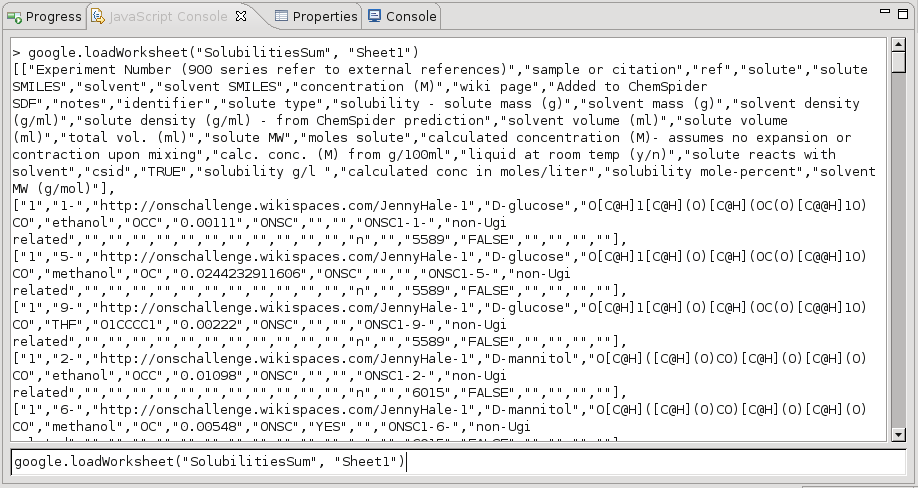
<p>I am almost done refactoring two year old code for the <a href="http://onschallenge.wikispaces.com/">Open Notebook Science
Solubility</a> project, which converted its
data from the <a href="https://spreadsheets.google.com/ccc?key=plwwufp30hfq0udnEmRD1aQ#gid=0">Google Spreadsheet</a>
<a href="http://chem-bla-ics.blogspot.com/2009/11/open-notebook-science-solubility-sparql.html">into RDF</a>,
for the Beautiful Data book chapter.</p>]]></content><author><name>Egon Willighagen</name></author><category term="bioclipse" /><category term="eclipse" /><category term="google" /><category term="javascript" /><summary type="html"><![CDATA[ ]]></summary><media:thumbnail xmlns:media="http://search.yahoo.com/mrss/" url="http://egonw.github.io/blog/blog/assets/images/bcGoogle.png" /><media:content medium="image" url="http://egonw.github.io/blog/blog/assets/images/bcGoogle.png" xmlns:media="http://search.yahoo.com/mrss/" /></entry><entry><title type="html">DIY: Running R from within Bioclipse</title><link href="http://egonw.github.io/blog/2011/02/01/diy-running-r-from-within-bioclipse.html" rel="alternate" type="text/html" title="DIY: Running R from within Bioclipse" /><published>2011-02-01T00:10:00+00:00</published><updated>2011-02-01T00:10:00+00:00</updated><id>http://egonw.github.io/blog/2011/02/01/diy-running-r-from-within-bioclipse</id><content type="html" xml:base="http://egonw.github.io/blog/2011/02/01/diy-running-r-from-within-bioclipse.html"><![CDATA[<p><strong>Important: this blog post is about a development version of Bioclipse, not
about the stable 2.4 series. See also Gilleain’s comment for this post.</strong></p>

<p>Arvid has done an excellent job in setting up <a href="http://pele.farmbio.uu.se/hudson/">Hudson for Bioclipse</a>,
which is not so trivial as for Maven projects. With the <a href="http://chem-bla-ics.blogspot.com/2011/02/running-r-from-within-bioclipse.html">R functionality</a>
I blogged about earlier today moved to the <a href="https://github.com/bioclipse/bioclipse.statistics">bioclipse.statistics repository</a>,
things are automatically build when new patches hit the repository. And Hudson
doesn’t just compile the code, it also exports binaries. The main <a href="http://www.bioclipse.net/">Bioclipse</a>
products build can be downloaded <a href="http://pele.farmbio.uu.se/hudson/job/Bioclipse.product/">here</a>
(Windows, Linux, OS/X; if you need more, please let use know). And, all the
additional features got automatically uploaded to individual update sites, very
much like Maven projects getting pushed to a Maven repository.</p>

<p>So, here’s an Bioclipse-R install guide for the adventurous (i.e. Christian,
Rajarshi and Rebecca, perhaps Juuso :). I will describe it from a <a href="http://www.debian.org/">Debian GNU/Linux</a>
perspective.</p>

<p>First, make sure you have <a href="http://www.r-project.org/">R</a> and <a href="http://cran.r-project.org/web/packages/rJava/index.html">rJava</a>
installed. I strongly recommend the versions from <a href="http://www.debian.org/releases/unstable/">sid/unstable</a>
(2.12 and 0.8-8), which are more stable here than those from <a href="http://www.debian.org/releases/testing/">testing</a>:</p>

<div class="language-shell highlighter-rouge"><div class="highlight"><pre class="highlight"><code>apt-get <span class="nb">install </span>r-base-core/sid r-cran-rjava/sid
</code></pre></div></div>

<p>Then you download the nightly build of Bioclipse 2.5.x from Hudson, e.g. for
my 32bit Linux:</p>

<div class="language-shell highlighter-rouge"><div class="highlight"><pre class="highlight"><code><span class="nb">cd</span> /tmp
wget http://pele.farmbio.uu.se/hudson/job/Bioclipse.product/lastSuccessfulBuild/artifact/tmp/bioclipse/net.bioclipse.platform_feature_2.4.0-eclipse.feature/Bioclipse.2.5.0.linux.gtk.x86.zip
unzip Bioclipse.2.5.0.linux.gtk.x86.zip
<span class="nb">cd </span>Bioclipse.2.5.0.linux.gtk.x86/&lt;/pre&gt;
</code></pre></div></div>
<p>But before we boot Bioclipse, we first need to tell it where to find the R instance,
and we need to set two variables for that: <em>R_HOME</em> and <em>java.library.path</em>.
The latter is set via the <em>bioclipse.ini</em> file, by adding this line to the end:</p>

<div class="language-shell highlighter-rouge"><div class="highlight"><pre class="highlight"><code><span class="nt">-Djava</span>.library.path<span class="o">=</span>/usr/lib/R/site-library/rJava/jri
</code></pre></div></div>

<p>The other is an environment variable and can be set with:</p>

<div class="language-shell highlighter-rouge"><div class="highlight"><pre class="highlight"><code><span class="nb">export </span><span class="nv">R_HOME</span><span class="o">=</span>//usr/lib/R
</code></pre></div></div>

<p>Then Bioclipse can be started:</p>

<div class="language-shell highlighter-rouge"><div class="highlight"><pre class="highlight"><code>./bioclipse
</code></pre></div></div>

<p>The first thing to do is install the <em>R Feature</em>. To do this open the <em>Install
New Software…</em> dialog from the <em>Help</em> menu, and add (with the <em>Add</em> button)
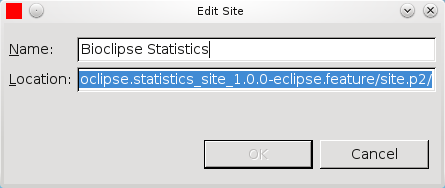
the Bioclipse Statistics update site on Hudson at <a href="http://pele.farmbio.uu.se/hudson/view/Release/job/Bioclipse.statistics/lastSuccessfulBuild/artifact/buckminster.output/net.bioclipse.statistics_site_1.0.0-eclipse.feature/site.p2/">this Location</a>
(copy/paste the Location URL into the below dialog):</p>

<p><img src="/blog/assets/images/bc26statsUpdateSite3.png" alt="" /></p>

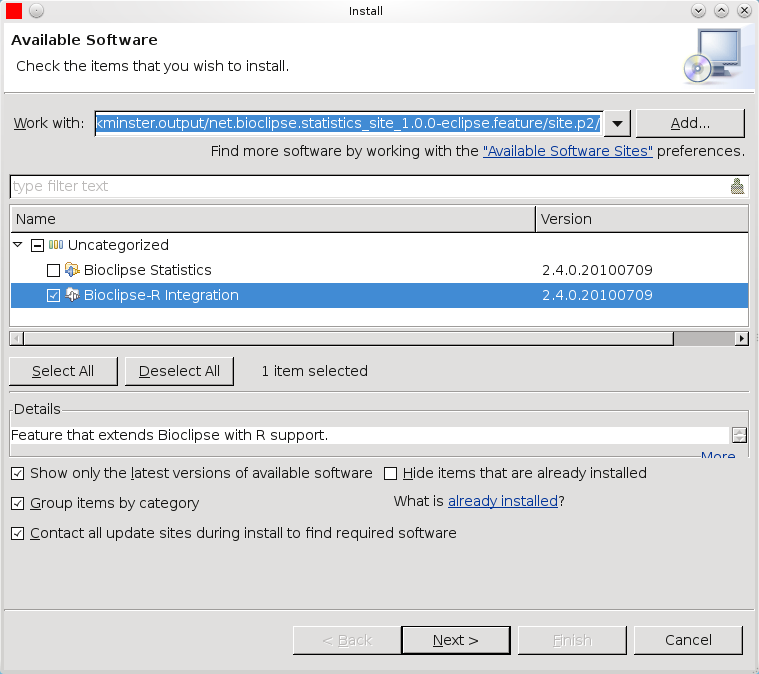
<p>When back in the Available Software dialog, select the new update site, and
mark the <em>Bioclipse-R Integration</em> feature to be installed:</p>

<p><img src="/blog/assets/images/bc26statsUpdateSite2.png" alt="" /></p>

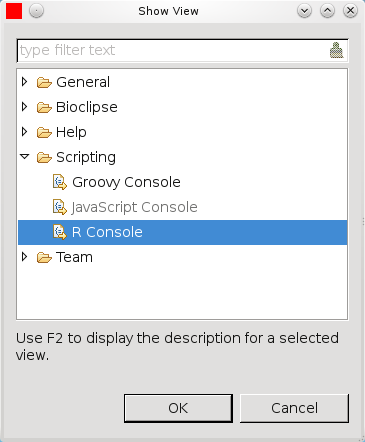
<p>After the install is completed, which will require a reboot of Bioclipse (why?!?!),
you can open the R console by opening a dialog from the Window -&gt; Show View -&gt;
Other… menu:</p>

<p><img src="/blog/assets/images/bc26statsUpdateSite4.png" alt="" /></p>

<p>The <em>R Console</em> will then show up as view, as depicted in my <a href="http://chem-bla-ics.blogspot.com/2011/02/running-r-from-within-bioclipse.html">earlier post</a>.</p>

<p>Loading of libraries, like running <em>library(“<a href="http://cran.r-project.org/web/packages/rcdk/index.html">rcdk</a>”)</em>
or <em>library(“<a href="http://cran.r-project.org/web/packages/pls/index.html">pls</a>”)</em>,
crashes the whole thing if you use R and rJava from Debian testing, and silently
fails with those from unstable. It’s on my agenda.</p>]]></content><author><name>Egon Willighagen</name></author><category term="bioclipse" /><category term="chemometrics" /><summary type="html"><![CDATA[Important: this blog post is about a development version of Bioclipse, not about the stable 2.4 series. See also Gilleain’s comment for this post.]]></summary><media:thumbnail xmlns:media="http://search.yahoo.com/mrss/" url="http://egonw.github.io/blog/blog/assets/images/bc26statsUpdateSite3.png" /><media:content medium="image" url="http://egonw.github.io/blog/blog/assets/images/bc26statsUpdateSite3.png" xmlns:media="http://search.yahoo.com/mrss/" /></entry><entry><title type="html">Running R from within Bioclipse</title><link href="http://egonw.github.io/blog/2011/02/01/running-r-from-within-bioclipse.html" rel="alternate" type="text/html" title="Running R from within Bioclipse" /><published>2011-02-01T00:00:00+00:00</published><updated>2011-02-01T00:00:00+00:00</updated><id>http://egonw.github.io/blog/2011/02/01/running-r-from-within-bioclipse</id><content type="html" xml:base="http://egonw.github.io/blog/2011/02/01/running-r-from-within-bioclipse.html"><![CDATA[<p> </p>

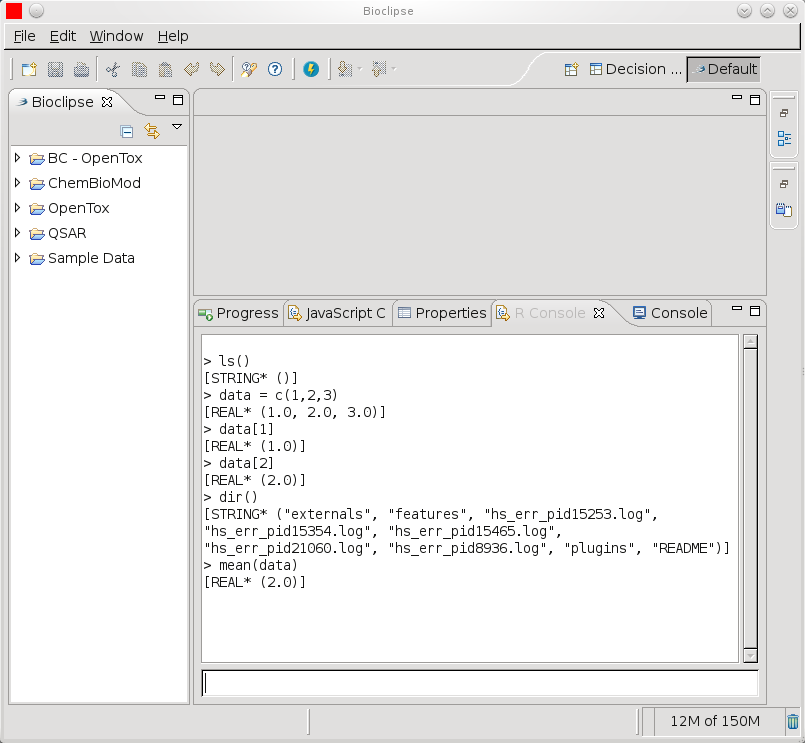
<p><img src="/blog/assets/images/bcR.png" alt="" /></p>

<p>One rarely know feature of <a href="http://www.bioclipse.net">Bioclipse</a> is that you
use it to run <a href="http://www.r-project.org/">R</a> code. This functionality has been
around for a while from <em>experimental</em>, and recently updated to use <a href="http://cran.r-project.org/web/packages/rJava/index.html">rJava</a>
by <a href="http://twitter.com/#!/carlmasak">Carl</a>. In the next months we will improve
passing around data between Bioclipse and the R session, providing a richer
chemometrics experience. And, with a bit of luck, it will be part of the upcoming 2.6
release.</p>]]></content><author><name>Egon Willighagen</name></author><category term="bioclipse" /><category term="chemometrics" /><summary type="html"><![CDATA[ ]]></summary><media:thumbnail xmlns:media="http://search.yahoo.com/mrss/" url="http://egonw.github.io/blog/blog/assets/images/bcR.png" /><media:content medium="image" url="http://egonw.github.io/blog/blog/assets/images/bcR.png" xmlns:media="http://search.yahoo.com/mrss/" /></entry></feed>