<?xml version="1.0" encoding="utf-8"?><feed xmlns="http://www.w3.org/2005/Atom" ><generator uri="https://jekyllrb.com/" version="4.3.4">Jekyll</generator><link href="http://egonw.github.io/blog/feed/by_tag/bioinfo.xml" rel="self" type="application/atom+xml" /><link href="http://egonw.github.io/blog/" rel="alternate" type="text/html" /><updated>2026-11-22T10:22:45+00:00</updated><id>http://egonw.github.io/blog/feed/by_tag/bioinfo.xml</id><title type="html">chem-bla-ics</title><subtitle>Chemblaics (pronounced chem-bla-ics) is the science that uses open science and computers to solve problems in chemistry, biochemistry and related fields.</subtitle><author><name>Egon Willighagen</name></author><entry><title type="html">Google Summer of Code 2011: some cool ideas</title><link href="http://egonw.github.io/blog/2011/03/28/google-summer-of-code-2011-some-cool.html" rel="alternate" type="text/html" title="Google Summer of Code 2011: some cool ideas" /><published>2011-03-28T00:00:00+00:00</published><updated>2011-03-28T00:00:00+00:00</updated><id>http://egonw.github.io/blog/2011/03/28/google-summer-of-code-2011-some-cool</id><content type="html" xml:base="http://egonw.github.io/blog/2011/03/28/google-summer-of-code-2011-some-cool.html"><![CDATA[<p>The <a href="http://code.google.com/soc/">Google Summer of Code</a> is a now yearly event
where university students (including PhD students) can work on open source project,
and get payed fairly well (mentors only get a T-shirt :). A few years ago I
was mentor for the <a href="http://kde.org">KDE</a> project, supervising work on <a href="http://neksa.blogspot.com/">Strigi-Chemistry</a>.
Various open source science projects participate again this year (no, no chemistry
projects, I’m afraid), but a few come close. Here are my tips of this year:</p>

<ul>
  <li>tip #1: <a href="http://debian.org">debian</a> java packaging for <a href="http://taverna.sf.net">taverna</a>
<a href="http://www.jalview.org/">jalview</a> <a href="http://jmol.org">jmol</a> <a href="http://bioclipse.net">bioclipse</a>
and <a href="http://cdk.sf.net">cdk</a>? <a href="http://goo.gl/12iU9">http://goo.gl/12iU9</a></li>
  <li>tip #2: pathway information, <a href="http://en.wikipedia.org/wiki/Web_Ontology_Language">OWL</a>,
what can you wish for more? <a href="http://code.google.com/p/semanticchemistry/">CHEMINF</a>
perhaps? <a href="http://goo.gl/qInJB">http://goo.gl/qInJB</a></li>
  <li>tip #3: Nescent has the <a href="http://jmol.org">jmol</a> protein evolution again. Great
idea, cool graphics <a href="http://goo.gl/c0r0j">http://goo.gl/c0r0j</a></li>
  <li>tip #4: how much I love the SWT-based <a href="http://www.cytoscape.org/">Cytoscape</a>
in <a href="http://bioclipse.net">Bioclipse</a>, cytoscape in HTML5 rocks <a href="http://goo.gl/jbgWY">http://goo.gl/jbgWY</a></li>
  <li>tip #5: #java <a href="http://www.biojava.org/wiki/BioJava3_project">BioJava3</a> AA
psysico-chemical prop calculations… sounds like <a href="http://pharmbio.org">http://pharmbio.org</a>
to me <a href="http://goo.gl/EG7tG">http://goo.gl/EG7tG</a></li>
  <li>tip #6: comptox in Orange with <a href="https://github.com/AZCompTox/AZOrange">AZOrange</a>
<a href="http://goo.gl/XS0vf">http://goo.gl/XS0vf</a> with perhaps room for <a href="http://cdk.sf.net">CDK</a>
and <a href="http://code.google.com/p/cinfony/">Cinfony</a></li>
</ul>]]></content><author><name>Egon Willighagen</name></author><category term="bioinfo" /><category term="cheminf" /><category term="google" /><category term="gsoc" /><summary type="html"><![CDATA[The Google Summer of Code is a now yearly event where university students (including PhD students) can work on open source project, and get payed fairly well (mentors only get a T-shirt :). A few years ago I was mentor for the KDE project, supervising work on Strigi-Chemistry. Various open source science projects participate again this year (no, no chemistry projects, I’m afraid), but a few come close. Here are my tips of this year:]]></summary></entry><entry><title type="html">Chemometrics with R</title><link href="http://egonw.github.io/blog/2011/03/15/chemometrics-with-r.html" rel="alternate" type="text/html" title="Chemometrics with R" /><published>2011-03-15T00:00:00+00:00</published><updated>2011-03-15T00:00:00+00:00</updated><id>http://egonw.github.io/blog/2011/03/15/chemometrics-with-r</id><content type="html" xml:base="http://egonw.github.io/blog/2011/03/15/chemometrics-with-r.html"><![CDATA[<p>I just heard that my supervisor’s book <a href="http://www.amazon.com/Chemometrics-Multivariate-Analysis-Natural-Sciences/dp/3642178405?ie=UTF8&amp;tag=chemblaics-20&amp;link_code=btl&amp;camp=213689&amp;creative=392969">Chemometrics with R</a><img src="http://www.assoc-amazon.com/e/ir?t=chemblaics-20&amp;l=btl&amp;camp=213689&amp;creative=392969&amp;o=1&amp;a=3642178405" alt="" />
was released, and I immediately requested our library to get a copy. Ron introduced
me to <a href="http://www.r-project.org/">R</a> at a time that most at our department were
still using Matlab. In fact, I had be maintaining Matlab scripts used in the
departments chemometrics courses, and wrote my own philogenetic tree visualization
code for Matlab, using a I-no-longer-remember line notation system for the trees.</p>

<p>This book is recommended to all bioinformaticians too: many former colleagues
from my old department are now in fact working in bioinformatics (see also <a href="http://biostar.stackexchange.com/questions/6426/from-which-disciplines-do-bioinformaticians-come-from/6458#6458">this
BioStar answer</a>).</p>]]></content><author><name>Egon Willighagen</name></author><category term="bioinfo" /><category term="chemometrics" /><category term="rstats" /><summary type="html"><![CDATA[I just heard that my supervisor’s book Chemometrics with R was released, and I immediately requested our library to get a copy. Ron introduced me to R at a time that most at our department were still using Matlab. In fact, I had be maintaining Matlab scripts used in the departments chemometrics courses, and wrote my own philogenetic tree visualization code for Matlab, using a I-no-longer-remember line notation system for the trees.]]></summary></entry><entry><title type="html">Uppsala Status Report</title><link href="http://egonw.github.io/blog/2010/11/27/uppsala-status-report.html" rel="alternate" type="text/html" title="Uppsala Status Report" /><published>2010-11-27T00:00:00+00:00</published><updated>2010-11-27T00:00:00+00:00</updated><id>http://egonw.github.io/blog/2010/11/27/uppsala-status-report</id><content type="html" xml:base="http://egonw.github.io/blog/2010/11/27/uppsala-status-report.html"><![CDATA[<p>As you know, my post-doc in <a href="http://www.farmbio.uu.se/">Uppsala</a> ended. It was
a good time, and it was great collaborating on Bioclipse with Ola, Jonathan,
Arvid, and Carl. I would have loved tighter integration with the work of Maris
and Martin, but that was limited to one joined paper (in press). I thank Professors
Jarl Wikberg and Eva Brittebo for allowing me to continue my research at their
department, and hope this is not the end of the collaboration yet.</p>

<p>Like with new year, the end of a contract is a good time to reflect on ones
accomplishments. It’s been a bit delayed, but as you know, I already in my next
<a href="http://chem-bla-ics.blogspot.com/2010/10/working-on-oscar-for-three-months.html">project in Cambridge</a>,
and will start in January with yet a longer term position in predictive toxicology
(more on that soon). This makes this a really crowded period, on top of birthdays,
<a href="http://sv.wikipedia.org/wiki/Sinterklaas">Sinterklaas</a>, x-mas, and sorts.</p>

<p><strong>My Research</strong><br />
As you might know, my research interest lies in understanding molecular properties
and their applications in larger molecular systems. This can be how small molecules
pack in crystals, finding patterns in properties (QSAR-like work), etc. Because
the underlying methods are useful in many domains, you see applications in various
too, including drug discovery, metabolomics, etc. These methods involve statistics
and cheminformatics, primarily, which is clear from my publications on method
development in chemometrics and cheminformatics. You will also have seen that
visualization is a very important tool here, as our numerical validation can
easily mislead even a trained scientist.</p>

<p><strong>How Uppsala fits in</strong><br />
About 30 months ago, I got an offer to join the <a href="http://www.bioclipse.net/">Bioclipse</a>
team to work on the cheminformatics features of the workbench. It was already
using the <a href="http://cdk.sf.net/">CDK</a>, so the project was a tight match with what
I did in the past. Additionally, there were plans to integrate <a href="http://www.r-project.org/">R</a>,
and while the latter is partially implemented, that part was unfortunately not
completed by the group yet. I believe this is a crucial aspect, and without
it the large-scale impact of Bioclipse will be severely reduced.</p>

<p>Bioclipse is positioned as a workbench to use third-party libraries, web services,
databases, etc, and has done so very successfully (doi:<a href="https://doi.org/10.1186/1471-2105-8-59">10.1186/1471-2105-8-59</a>).
It speaks many Open Standards, and already incorporates various important Open
Source libraries for life sciences research, including the aforementioned CDK
(doi:<a href="https://doi.org/10.2174/138161206777585274">10.2174/138161206777585274</a>,
doi:<a href="https://doi.org/10.1021/ci025584y">10.1021/ci025584y</a>), but also <a href="http://www.jmol.org/">Jmol</a>,
<a href="http://www.mdpi.org/molecules/html/50100093.htm">JChemPaint</a>, BioJava (doi:<a href="https://doi.org/10.1093/bioinformatics/btn397">10.1093/bioinformatics/btn397</a>),
and others. Using these libraries it has rich visualization means for life sciences
data, including molecules and protein sequences. The latter, of course, is directly
related to the proteochemometrics research done in <a href="http://www.proteochemometrics.org/index.php?option=com_content&amp;task=view&amp;id=23&amp;Itemid=14">Wikberg’s group</a>.
Recently, Bioclipse adopted scripting functionality, making it a perfect tool
to share life sciences computation, just like Taverna (doi:<a href="https://doi.org/10.1093/bioinformatics/bth361">10.1093/bioinformatics/bth361</a>)
and KNIME.</p>

<p>Where I hoped to do some research in proteochemometrics, events lead me into
different areas, which I explained in <a href="http://chem-bla-ics.blogspot.com/2010/11/why-you-have-not-heard-me-much-about.html">Why you have not heard me much about
chemometrics recently…</a>.</p>

<p>But, Bioclipse provides me with the tools I need to take molecular chemometrics
(doi:<a href="https://doi.org/10.1080/10408340600969601">10.1080/10408340600969601</a>)
forward.</p>

<p><strong>Results</strong><br />
So, what has this resulted in, besides a number of <a href="http://chem-bla-ics.blogspot.com/2010/11/more-fails-aka-no-vr-grant-awarded.html">unsuccessful</a>
grant applications? We’re still counting, but two book chapters, a book on <a href="http://www.pharmbio.org/">pharmaceutical
bioinformatics</a>, one proceedings paper, five research
papers, seven oral presentations at international meetings, and a ACS conference
on <a href="http://egonw.github.com/acsrdf2010/">RDF in chemistry</a>. Oh, and tons of
Open Source code, of course. (I’m at the edge of collapsing; I did that as student,
lost a year, but learned a lot about myself … these results I have worked
very hard for; I am not a <a href="http://en.wikipedia.org/wiki/Montgomery_Scott">miracle worker</a>.
And I have to disappoint people occasionally, as things do not work out how
I expected them to be. My apologies for that.)</p>

<p>I will not describe all in detail now, but focus on a few things around what
I made my research in Uppsala: semantic cheminformatics, which I believe to
be a key concept of where cheminformatics must be going. The first paper resulted
from a collaboration with Johannes, a medical researcher at the <a href="http://en.wikipedia.org/wiki/Ludwig_Maximilian_University_of_Munich">Ludwig-Maximilians-Universität</a>
in Germany (full reference at the end of the post). This work provides an alternative
to SOAP, which has a better solution to asynchronous computing that the polling
approaches now commonly used. A XMPP-based service just reports back when it
is done, so that you do not have to ask all the time. Makes sense to me. We
made the platform available to Bioclipse and Taverna, and demonstrated the technology
with applications in life sciences, including (QSAR) descriptor calculation,
and susceptibility for seven known HIV protease inhibitors.</p>

<p>This work stresses that if we really want to, we can significantly improve scientific
computing. It’s very much like what Peter <a href="http://wwmm.ch.cam.ac.uk/blogs/murrayrust/?p=2772">concluded this week</a>:
“None of this is rocket science - it’s purely a question of will”. This is what
I have being trying to show in the past few years. The disuse of accurate scientific
computing is a deliberate choice. Making your cheminformatics research irreproducible
is a choice, and a bad one too. There can be acceptable reasons, but the choice
would be bad nevertheless (I hope that distinction is clear: you can have valid
reasons to do something intrinsically wrong. You will be forgiven, and be encouraged
to change your behavior.) Many people on the Blue Obelisk community are laying
out the foundations and show cases, hoping to make it easier for others to change
behavior. I think we have been quite successful there.</p>

<p>Anyways… on to the second paper. As said, Bioclipse is the platform that can
bring these new cheminformatics methods to the desktop. The new and improved
Bioclipse 2 (see citation below) adds one important new feature: scripting.
My work in this paper focuses on doing making sure the cheminformatics library
was properly integrated, continued development of JChemPaint (yet unpublished,
and in collaboration with the <a href="http://www.ebi.ac.uk/steinbeck/">EBI</a>, but see
for example <a href="http://chem-bla-ics.blogspot.com/2008/06/httpchem-bla-icsblogspotcom200805develo.html">this blog post</a>),
and helping Ola and other to properly use the CDK in their applications (MetaPrint2D
(doi:<a href="https://doi.org/10.1186/1471-2105-11-362">10.1186/1471-2105-11-362</a>),
etc.). The impact of this work goes far beyond the papers on which I am author,
though not every reviewer will understand that, unfortunately. This work is
really the plumbing, it’s the development of the measuring machines to do the
job, the development of a STM device to actually get going.</p>

<p>The third paper, also listed at the end, is about defining a standard for detailed
exchange of QSAR data. It defines what information is needed to reproduce a
set of QSAR descriptors, including the input, and using a descriptor ontology
which we published about before (doi:<a href="https://doi.org/10.1021/ci050400b">10.1021/ci050400b</a>).
This project can be the seed of a public repository of QSAR data, where it will
be clear what is meant, and how the data can be used. If you are interested
in setting up such a public repository, please contact me or Ola.</p>

<p>That leaves me to the work that I have initiated in the group: the use of <a href="http://en.wikipedia.org/wiki/Resource_Description_Framework">RDF
technologies</a> (I
do hope all VR reviewers are listening). RDF provide a <a href="http://en.wikipedia.org/wiki/Lingua_franca">lingua franca</a>
for data exchange in life sciences, and the meaning of words is provided by
sharing dictionaries (ontologies). Bioclipse has been extended to speak RDF,
and we developed various applications based on it. A <a href="http://www.citeulike.org/user/egonw/article/6582022">proceedings</a>
previews the effort, while the paper is in print in the new Open Access <a href="http://www.jbiomedsem.com/">Journal
of Biomedical Semantics</a>. Of course, you can also
read much about this topic in this blog.</p>

<p>RDF is going to change bio- and cheminformatics in ways the XML has been unable
to do. Various papers are currently in preparation to provide detailed uses
case and related research. I am very excited about this technology which further
improved interoperability and reproducibility in cheminformatics. Should you
care about that? Yes, because by using these good practices, research will be
easier to interpret, conclusions judges, and as such, we can focus on the underlying
chemistry in much more details, instead of looking at noise which many current
cheminformatics literature is doing. (Ouch, that’s a bold statement indeed.
True? Well, without reproducibility it is hard to tell. Let’s all work towards
less magic, less black box, and more science in this field; we will all benefit
from that. Who knows, we might even convince the bench chemist that we are doing
something right ;)</p>

<p>So, where is the understanding of underlying patterns, you may wonder? That
is a fair question, but I have no grudge in admitting that after my PhD that
part has been underrepresented. That will change soon enough, though. Now I
can only hope it is on time go get me a Nature or Science paper, required to
get tenure (see <a href="http://friendfeed.com/mrgunn/1ea91bb9/payoffs-of-wasting-time">this discussion</a>).</p>

<p>That’s not all I did. I have not discussed the book chapters, the book, the
other publications to which I contributed in various ways (doi:<a href="https://doi.org/10.1186/1471-2105-11-159">10.1186/1471-2105-11-159</a>,
doi:<a href="https://doi.org/10.1093/bioinformatics/btq476">10.1093/bioinformatics/btq476</a>).
That will come in a more detailed report later.</p>

<p>Finally, I link to thanx <a href="http://www.uu.se">Uppsala University</a> for the <a href="http://usxs.fysik.uu.se/~kof">KoF
07 grant</a> which funded my work in Uppsala.</p>]]></content><author><name>Egon Willighagen</name></author><category term="bioclipse" /><category term="bioinfo" /><category term="cdk" /><category term="cheminf" /><category term="chemistry" /><category term="chemometrics" /><category term="postdoc" /><category term="uppsala" /><category term="doi:10.2174/138161206777585274" /><category term="doi:10.1186/1471-2105-8-59" /><category term="doi:10.1021/CI025584Y" /><category term="doi:10.3390/50100093" /><category term="justdoi:10.1093/bioinformatics/btn397" /><category term="justdoi:10.1093/bioinformatics/bth361" /><category term="doi:10.1080/10408340600969601" /><category term="justdoi:10.1186/1471-2105-11-362" /><category term="doi:10.1186/1471-2105-11-159" /><category term="doi:10.1093/BIOINFORMATICS/BTQ476" /><summary type="html"><![CDATA[As you know, my post-doc in Uppsala ended. It was a good time, and it was great collaborating on Bioclipse with Ola, Jonathan, Arvid, and Carl. I would have loved tighter integration with the work of Maris and Martin, but that was limited to one joined paper (in press). I thank Professors Jarl Wikberg and Eva Brittebo for allowing me to continue my research at their department, and hope this is not the end of the collaboration yet.]]></summary></entry><entry><title type="html">Mapping BioStar users onto the world map</title><link href="http://egonw.github.io/blog/2010/10/09/mapping-biostar-users-on-world-map.html" rel="alternate" type="text/html" title="Mapping BioStar users onto the world map" /><published>2010-10-09T00:00:00+00:00</published><updated>2010-10-09T00:00:00+00:00</updated><id>http://egonw.github.io/blog/2010/10/09/mapping-biostar-users-on-world-map</id><content type="html" xml:base="http://egonw.github.io/blog/2010/10/09/mapping-biostar-users-on-world-map.html"><![CDATA[<p><a href="http://nsaunders.wordpress.com/">Neil</a> is my new bioinformatics hero! (Sorry
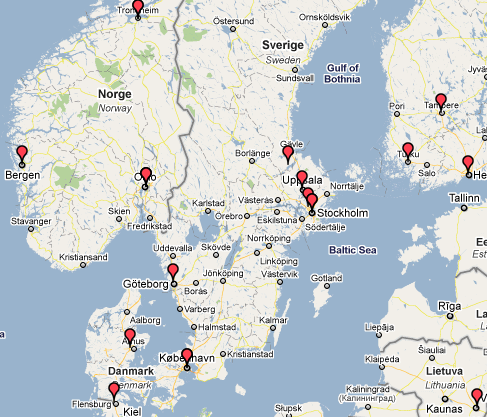
<a href="http://plindenbaum.blogspot.com/">Pierre</a> :)</p>

<p><a href="http://biostar.stackexchange.com/">BioStar</a> is a Q&amp;A website for bioinformatics,
just like the <a href="http://blueobelisk.shapado.com/">Blue Obelisk eXchange</a>. Neil
and Pierre have an ongoing struggle to gain the most karma, requiring Pierre
to put in a <a href="https://friendfeed.com/yokofakun/6f72029c/please-stop-asking-questions-on-while-i-m">formal complaint</a>
against people posting questions when he is asleep (the whole 3 hours). So,
I coined to idea of mapping all <a href="http://biostar.stackexchange.com/users">BioStar users</a>
on a Google Map. Neil picked it up, and had combined his coding skills with
the various Open API, Open Standards, and Open Source solution, to <a href="http://nsaunders.wordpress.com/2010/10/09/biostar-users-of-the-world-unite/">come up
only hours later</a>
with <a href="http://www.zeemaps.com/185997">this map</a>. Here are the BioStar users from
my region:</p>

<p><img src="/blog/assets/images/biostarUsers.png" alt="" /></p>

<p>Now, who will be my new cheminformatics hero, and make a map for the Blue Obelisk
eXchange? ;)</p>]]></content><author><name>Egon Willighagen</name></author><category term="bioinfo" /><category term="blue-obelisk" /><category term="cheminf" /><category term="rstats" /><summary type="html"><![CDATA[Neil is my new bioinformatics hero! (Sorry Pierre :)]]></summary><media:thumbnail xmlns:media="http://search.yahoo.com/mrss/" url="http://egonw.github.io/blog/blog/assets/images/biostarUsers.png" /><media:content medium="image" url="http://egonw.github.io/blog/blog/assets/images/biostarUsers.png" xmlns:media="http://search.yahoo.com/mrss/" /></entry><entry><title type="html">“LAST CALL: XEP-0244 (IO Data)”</title><link href="http://egonw.github.io/blog/2009/08/13/last-call-xep-0244-io-data.html" rel="alternate" type="text/html" title="“LAST CALL: XEP-0244 (IO Data)”" /><published>2009-08-13T00:00:00+00:00</published><updated>2009-08-13T00:00:00+00:00</updated><id>http://egonw.github.io/blog/2009/08/13/last-call-xep-0244-io-data</id><content type="html" xml:base="http://egonw.github.io/blog/2009/08/13/last-call-xep-0244-io-data.html"><![CDATA[<p>Today I received this email, which is a milestone for the <a href="http://en.wikipedia.org/wiki/Extensible_Messaging_and_Presence_Protocol">XMPP</a>
(aka Jabber) work Johannes, Ola and I have been working on as SOAP alternative using the intrinsically asynchronous XMPP as transport
protocol instead of HTTP as SOAP commonly does (see
<a href="http://chem-bla-ics.blogspot.com/2008/10/next-generation-asynchronous.html">Next generation asynchronous webservices</a>):</p>

<blockquote>
  <p>This message constitutes notice of a Last Call for comments on XEP-0244 (IO Data).</p>

  <p>Abstract: This specification defines an XMPP protocol extension for handling the input to and output from a remote entity.</p>

  <p>URL: <a href="https://www.xmpp.org/extensions/xep-0244.html">http://www.xmpp.org/extensions/xep-0244.html</a></p>

  <p>This Last Call begins today and shall end at the close of business on 2009-09-01.</p>

  <p>Please consider the following questions during this Last Call and send your feedback to the standards @ xmpp.org discussion list:</p>

  <ol>
    <li>Is this specification needed to fill gaps in the XMPP protocol stack or to clarify an existing protocol?</li>
    <li>Does the specification solve the problem stated in the introduction and requirements?</li>
    <li>Do you plan to implement this specification in your code? If not, why not?</li>
    <li>Do you have any security concerns related to this specification?</li>
    <li>Is the specification accurate and clearly written?</li>
  </ol>

  <p>Your feedback is appreciated!</p>
</blockquote>

<p>There remains quite a lot to do, and you are more than welcome to join in the project. There is a Java library and we’ve
integrated the specs into <a href="http://www.bioclipse.net/">Bioclipse</a> and <a href="http://taverna.sf.net/">Taverna</a> (see
<a href="http://chem-bla-ics.blogspot.com/2009/01/details-behind-calling-xmpp-cloud.html">Details behind the “Calling XMPP cloud services from Taverna2”</a>),
but there is no support for BioCatalogue yet, and no libraries for other programming language yet.</p>]]></content><author><name>Egon Willighagen</name></author><category term="xmpp" /><category term="bioinfo" /><category term="cheminf" /><summary type="html"><![CDATA[Today I received this email, which is a milestone for the XMPP (aka Jabber) work Johannes, Ola and I have been working on as SOAP alternative using the intrinsically asynchronous XMPP as transport protocol instead of HTTP as SOAP commonly does (see Next generation asynchronous webservices):]]></summary></entry><entry><title type="html">Open Source, Open Data at the European Bioinformatics Institute</title><link href="http://egonw.github.io/blog/2007/12/07/open-source-open-data-at-european.html" rel="alternate" type="text/html" title="Open Source, Open Data at the European Bioinformatics Institute" /><published>2007-12-07T00:00:00+00:00</published><updated>2007-12-07T00:00:00+00:00</updated><id>http://egonw.github.io/blog/2007/12/07/open-source-open-data-at-european</id><content type="html" xml:base="http://egonw.github.io/blog/2007/12/07/open-source-open-data-at-european.html"><![CDATA[<p>I was pleased to hear that <a href="http://www.steinbeck-molecular.de/steinblog/index.php/2007/12/06/steinbeck-group-moves-to-european-bioinformatics-institute-ebi-in-january-2008/">Christoph will move to the EBI</a>
early next year. Christoph has been working on Open Source and Open Data chemoinformatics since at least 1997. I first got in contact with
Christoph when I wrote code for JChemPaint (which Christoph developed) to be able to read
<a href="http://en.wikipedia.org/wiki/Chemical_Markup_Language">Chemical Markup Languages</a> (CML). This also got me into contact with
<a href="http://www.nd.edu/~gezelter/Main/index.html">Dan Gezelter</a> who is the original author of <a href="http://www.jmol.org/">Jmol</a>,
to which I also added CML support. And, of course, with Henry and <a href="http://wwmm.ch.cam.ac.uk/blogs/murrayrust/">Peter</a>,
who first developed CML. This was <strong>before</strong> XML was an official recommendation, and I have worked with CML files which you
would no longer recognize. It was in Dan’s office that the CDK was founded, where Christoph, Dan and I designed data
classes to replace the JChemPaint and Jmol data classes. Both JChemPaint and Jmol were rewritten afterwards, but for
Jmol it was later decided that more tuned classes were needed to achieve to required performance for the live rendering
of tens of thousands of atoms.</p>

<p>Well, Christoph has done many other Open Source and Open Data stuff, including the <a href="http://www.nmrshiftdb.org/">NMRShiftDB</a>,
<a href="http://www.bioclipse.net/">Bioclipse</a>, and Seneca, a tool for computer-aided structure elucidation (CASE). The scientific
impact for Christoph’s work is considerable. When I realize that much of his past work was setting out foundations, and
that these foundations have found the be solid, I am happy to hear that he can now start to apply his work to life
science problems, where current methods are failing.</p>

<p>Christoph, cheers!</p>]]></content><author><name>Egon Willighagen</name></author><category term="bioinfo" /><category term="jchempaint" /><category term="jmol" /><category term="bioclipse" /><summary type="html"><![CDATA[I was pleased to hear that Christoph will move to the EBI early next year. Christoph has been working on Open Source and Open Data chemoinformatics since at least 1997. I first got in contact with Christoph when I wrote code for JChemPaint (which Christoph developed) to be able to read Chemical Markup Languages (CML). This also got me into contact with Dan Gezelter who is the original author of Jmol, to which I also added CML support. And, of course, with Henry and Peter, who first developed CML. This was before XML was an official recommendation, and I have worked with CML files which you would no longer recognize. It was in Dan’s office that the CDK was founded, where Christoph, Dan and I designed data classes to replace the JChemPaint and Jmol data classes. Both JChemPaint and Jmol were rewritten afterwards, but for Jmol it was later decided that more tuned classes were needed to achieve to required performance for the live rendering of tens of thousands of atoms.]]></summary></entry><entry><title type="html">Excel messes up your data analysis :)</title><link href="http://egonw.github.io/blog/2007/08/01/excel-messes-up-your-data-analysis.html" rel="alternate" type="text/html" title="Excel messes up your data analysis :)" /><published>2007-08-01T00:00:00+00:00</published><updated>2007-08-01T00:00:00+00:00</updated><id>http://egonw.github.io/blog/2007/08/01/excel-messes-up-your-data-analysis</id><content type="html" xml:base="http://egonw.github.io/blog/2007/08/01/excel-messes-up-your-data-analysis.html"><![CDATA[<p>Well, no wonder: Excel is meant to be used to process money flows. Anyway, <a href="http://del.icio.us/greyarea">greyarea</a> pointed me to
<a href="http://itre.cis.upenn.edu/~myl/languagelog/archives/002912.html">this nice blog item</a> from March 2006. It discusses a 2004 article in
<a href="http://www.biomedcentral.com/bmcbioinformatics">BMC Bioinformatics</a> <em>Mistaken Identifiers: Gene name errors can be introduced
inadvertently when using Excel in bioinformatics</em> by Barry Zeeberg et al. (DOI:<a href="https://doi.org/10.1186/1471-2105-5-80">10.1186/1471-2105-5-80</a>).
Hence, the importance of semantics and proper markup languages. The quotes are illustrative:</p>

<ul><i>
When we were beta-testing [two new bioinformatics programs] on microarray data, a frustrating problem occurred repeatedly: Some
gene names kept bouncing back as "unknown." A little detective work revealed the reason: ... A default date conversion feature in
Excel ... was altering gene names that it considered to look like dates. For example, the tumor suppressor DEC1 [Deleted in
Esophageal Cancer 1] was being converted to '1-DEC.' Figure 1 lists 30 gene names that suffer an analogous fate.<br /><br />

...<br /><br />

There is another default conversion problem for RIKEN clone identifiers identifiers of the form nnnnnnnEnn, where n denotes a
digit. These identifiers are comprised of the serial number of the plate that contains the library, information on plate status,
and the address of the clone. A search ... identified more than 2,000 such identifiers out of a total set of 60,770. For example,
the RIKEN identifier "2310009E13" was converted irreversibly to the floating-point number "2.31E+13." A non-expert user might
well fail to notice that approximately 3% of the identifiers on a microarray with tens of thousands of genes had been converted
to an incorrect form, yet the potential for 2,000 identifiers to be transmogrified without notice is a considerable concern. Most
important, these conversions to an internal date representation or floating-point number format are irreversible; the original
gene name cannot be recovered.
</i></ul>

<p>Is this the article that made all bioinformaticians turn to R?</p>]]></content><author><name>Egon Willighagen</name></author><category term="bioinfo" /><category term="excel" /><category term="justdoi:10.1186/1471-2105-5-80" /><summary type="html"><![CDATA[Well, no wonder: Excel is meant to be used to process money flows. Anyway, greyarea pointed me to this nice blog item from March 2006. It discusses a 2004 article in BMC Bioinformatics Mistaken Identifiers: Gene name errors can be introduced inadvertently when using Excel in bioinformatics by Barry Zeeberg et al. (DOI:10.1186/1471-2105-5-80). Hence, the importance of semantics and proper markup languages. The quotes are illustrative:]]></summary></entry><entry><title type="html">Screencasts for life science informatics</title><link href="http://egonw.github.io/blog/2007/07/20/screencasts-for-life-science.html" rel="alternate" type="text/html" title="Screencasts for life science informatics" /><published>2007-07-20T00:00:00+00:00</published><updated>2007-07-20T00:00:00+00:00</updated><id>http://egonw.github.io/blog/2007/07/20/screencasts-for-life-science</id><content type="html" xml:base="http://egonw.github.io/blog/2007/07/20/screencasts-for-life-science.html"><![CDATA[<p><a href="http://mndoci.com/blog/">Deepak</a> blogged about <a href="http://mndoci.com/blog/2007/07/18/bioscreencastcom-02/">screencasting for bio topics</a>,
concentrated at <a href="https://web.archive.org/web/20070701050807/http://bioscreencast.com/">bioscreencast.com <i class="fa-solid fa-box-archive fa-xs"></i></a>
of which he is co-owner. I guess it is like a YouTube for
bioinformatics thingies. <a href="http://usefulchem.blogspot.com/">Jean-Claude</a> picked this up very quickly (seen on
<a href="http://cb.openmolecules.net/">Cb</a>? At least I did.), and already uploaded a screencast,
<a href="https://web.archive.org/web/*/http://bioscreencast.com/bsc_movwin.html*">demoing JSpecView <i class="fa-solid fa-link-slash fa-xs"></i></a>
written by <a href="http://wwwchem.uwimona.edu.jm:1104/chrl.html">Robert</a>. I wonder if he will upload the
<a href="http://usefulchem.blogspot.com/2006/07/cml-in-rss-feeds.html">screencasts he made for</a>
<a href="http://www.bioclipse.net/">Bioclipse</a> too? (hint, hint … :)</p>

<p>I have no idea if this site will be a success, but at least it has the right ingredients: tags, flash movies, clean UI, a
<a href="http://bioscreencast.wordpress.com/">blog to monitor technological changes and improvements</a>, and a page to
request screencasts (with voting). What I only miss is a one summary page for each screencast to which I can
easily link, for example for my <a href="http://del.icio.us/egonw">del.icio.us</a> account.</p>]]></content><author><name>Egon Willighagen</name></author><category term="bioinfo" /><summary type="html"><![CDATA[Deepak blogged about screencasting for bio topics, concentrated at bioscreencast.com of which he is co-owner. I guess it is like a YouTube for bioinformatics thingies. Jean-Claude picked this up very quickly (seen on Cb? At least I did.), and already uploaded a screencast, demoing JSpecView written by Robert. I wonder if he will upload the screencasts he made for Bioclipse too? (hint, hint … :)]]></summary></entry><entry><title type="html">Are chemogenomics and proteochemometrics the same?</title><link href="http://egonw.github.io/blog/2006/10/11/are-chemogenomics-and.html" rel="alternate" type="text/html" title="Are chemogenomics and proteochemometrics the same?" /><published>2006-10-11T00:00:00+00:00</published><updated>2006-10-11T00:00:00+00:00</updated><id>http://egonw.github.io/blog/2006/10/11/are-chemogenomics-and</id><content type="html" xml:base="http://egonw.github.io/blog/2006/10/11/are-chemogenomics-and.html"><![CDATA[<p><a href="http://www.blogger.com/profile/2366764">Joerg Wegner</a> <a href="http://miningdrugs.blogspot.com/2006/09/chemogenomics-structuring-drug.html">recently blogged</a>
about <em>Chemogenomics: structuring the drug discovery process to gene families</em> by C.J. Harris and A. P. Stevens in Drug Discov Today
(DOI: <a href="https://doi.org/10.1016/j.drudis.2006.08.013">10.1016/j.drudis.2006.08.013</a>). This review article provides a nice overview of a trend in
mathematical modelling of the interaction of small organic molecules with proteins, often referred to as <a href="http://en.wikipedia.org/wiki/QSAR">QSAR</a>.
What the article does not discuss, is the <a href="http://www.proteochemometrics.org/index.php?option=com_content&amp;task=view&amp;id=20&amp;Itemid=22">work by the group of Jarl Wikberg</a>
who coined the term proteochemometrics (see PubMed: <a href="https://pubmed.ncbi.nlm.nih.gov/11342268/">11342268</a>).</p>]]></content><author><name>Egon Willighagen</name></author><category term="cheminf" /><category term="bioinfo" /><category term="justdoi:10.1016/j.drudis.2006.08.013" /><category term="justdoi:10.1016/s0304-4165(00)00187-2" /><summary type="html"><![CDATA[Joerg Wegner recently blogged about Chemogenomics: structuring the drug discovery process to gene families by C.J. Harris and A. P. Stevens in Drug Discov Today (DOI: 10.1016/j.drudis.2006.08.013). This review article provides a nice overview of a trend in mathematical modelling of the interaction of small organic molecules with proteins, often referred to as QSAR. What the article does not discuss, is the work by the group of Jarl Wikberg who coined the term proteochemometrics (see PubMed: 11342268).]]></summary></entry><entry><title type="html">Bioinformatics: Open Source or Open Access??</title><link href="http://egonw.github.io/blog/2006/10/04/bioinformatics-open-source-or-open.html" rel="alternate" type="text/html" title="Bioinformatics: Open Source or Open Access??" /><published>2006-10-04T00:00:00+00:00</published><updated>2006-10-04T00:00:00+00:00</updated><id>http://egonw.github.io/blog/2006/10/04/bioinformatics-open-source-or-open</id><content type="html" xml:base="http://egonw.github.io/blog/2006/10/04/bioinformatics-open-source-or-open.html"><![CDATA[<p>I have heard that bioinformatics is ahead of chemoinformatics. However, I discoverd that this is not necessarily the case,
while preparing for a homology modeling course I gave this week at the <a href="http://www.cubic.uni-koeln.de/">CUBIC</a>. Open Access
is really no issue there, with open access journals and many open access databases. But it is different when it comes down
to open source software.</p>

<p>Below is a list of bioinformatics programs which are free for academic use, but not open:</p>

<ul>
  <li><a href="http://www-cryst.bioc.cam.ac.uk/~joy/">JOY</a> (free after getting license)</li>
  <li><a href="http://www.cryst.chem.uu.nl/platon/">PLATON</a> (free download)</li>
  <li><a href="http://www.biochem.ucl.ac.uk/~roman/procheck/procheck.html">PROCHECK</a> (free after getting license)</li>
  <li><a href="http://www.predictprotein.org/">ProteinPredict</a> (free download)</li>
  <li><a href="http://dunbrack.fccc.edu/SCWRL3.php">SCWRL</a> (free after getting license)</li>
  <li><a href="http://bioinf.cs.ucl.ac.uk/threader/">THREADER</a> (free after getting license)</li>
  <li><a href="http://swift.cmbi.ru.nl/gv/whatcheck/">WHAT_CHECK</a> (free download)</li>
  <li><a href="http://swift.cmbi.ru.nl/whatif/">WHAT_IF</a> (free after getting license)</li>
</ul>

<p>And this not even includes the many websites which do not offer the software behind them. And these programs cover several
steps in the whole homology modeling process. Open source homology modeling is not possible at this moment :(</p>

<p>But, on the bright side, there are already some open source programs involved too:</p>

<ul>
  <li><a href="http://www.ncbi.nlm.nih.gov/blast/">BLAST</a> (public domain)</li>
  <li><a href="http://www.gromacs.org/">GROMACS</a> (GPL)</li>
</ul>

<p>And protein structure viewers is hardly a problem at all; several open source viewers are available, among which
<a href="http://pymol.sourceforge.net/">Rasmol</a>, <a href="http://pymol.sourceforge.net/">PyMOL</a> and
<a href="http://www.jmol.org/">Jmol</a>.</p>

<p>In other words: we might not want to look at bioinformatics too much.</p>]]></content><author><name>Egon Willighagen</name></author><category term="opensource" /><category term="bioinfo" /><summary type="html"><![CDATA[I have heard that bioinformatics is ahead of chemoinformatics. However, I discoverd that this is not necessarily the case, while preparing for a homology modeling course I gave this week at the CUBIC. Open Access is really no issue there, with open access journals and many open access databases. But it is different when it comes down to open source software.]]></summary></entry></feed>