<?xml version="1.0" encoding="utf-8"?><feed xmlns="http://www.w3.org/2005/Atom" ><generator uri="https://jekyllrb.com/" version="4.3.4">Jekyll</generator><link href="http://egonw.github.io/blog/feed/by_tag/cheminf.xml" rel="self" type="application/atom+xml" /><link href="http://egonw.github.io/blog/" rel="alternate" type="text/html" /><updated>2026-11-22T10:22:45+00:00</updated><id>http://egonw.github.io/blog/feed/by_tag/cheminf.xml</id><title type="html">chem-bla-ics</title><subtitle>Chemblaics (pronounced chem-bla-ics) is the science that uses open science and computers to solve problems in chemistry, biochemistry and related fields.</subtitle><author><name>Egon Willighagen</name></author><entry><title type="html">CDK 1.3.9: the changes, the authors, and the reviewers</title><link href="http://egonw.github.io/blog/2011/05/22/cdk-139-changes-authors-and-reviewers.html" rel="alternate" type="text/html" title="CDK 1.3.9: the changes, the authors, and the reviewers" /><published>2011-05-22T00:00:00+00:00</published><updated>2011-05-22T00:00:00+00:00</updated><id>http://egonw.github.io/blog/2011/05/22/cdk-139-changes-authors-and-reviewers</id><content type="html" xml:base="http://egonw.github.io/blog/2011/05/22/cdk-139-changes-authors-and-reviewers.html"><![CDATA[<p>Hot on the heels of the <a href="http://chem-bla-ics.blogspot.com/2011/05/cdk-129-changes-authors-and-reviewers.html">stable update 1.2.9</a>,
here is a new developers release. The 1.4.0 is still waiting for the basic (molecule)
rendering of the CDK-JChemPaint patch to be submitted, but I think I will just
submit it and see what happens. If rejected, I will release 1.4.0 without it.
Mind you, I rather get that renderbasic patch up to shape (fix some regressions,
add missing docs, and unit tests where possible, etc), but there is too little
movement in this area.</p>

<p><strong>Summary</strong><br />
Like many, this release too extends atom type perception to new atom types,
making CDK algorithms applicable to more types of chemistry, but also includes
fixes for perception when certain bits of information is missing from the input.
Otherwise, it includes an improvement for the SMARTS query tool, a new AtomContainerManipulator
extractSubstructure( IAtomContainer atomContainer, int… atomIndices) helper
method, aromatic bond support for the HINReader, fixes in the PDB atom type
table and improved PDB file IO, a <a href="http://chem-bla-ics.blogspot.com/2010/07/new-cdk-default-fingerprinter.html">faster, aromaticity-independent fingerprinter</a>,
and a set of general bug fixes and performance improvements.</p>

<p><strong>The Authors</strong></p>

<pre>  34  Egon Willighagen
   8  Rajarshi Guha
   4  Gilleain Torrance
   3  Jules Kerssemakers
   2  Dmitry Katsubo
   2  Jonathan Alvarsson
   1  Julio Peironcely
   1  Onkar Shinde
   1  Stephan Beisken
   1  Mark Rijnbeek
</pre>

<p>This reflects contributions from Sweden, USA, UK, The Netherlands, and, I think,
Pakistan. In terms of institutes, this includes patches working at (not implying
the work was done as part of the day job): Karolinska Institutet, NIH, EBI (more
than one group), Radboud University Nijmegen, EPO, Uppsala University, and the
Debian project. That’s pretty impressive for one release :)</p>

<p><strong>The Reviewers</strong></p>

<pre> 20  Rajarshi Guha 
 13  Egon Willighagen 
  4  Gilleain Torrance
  1  Jonathan Alvarsson
  1  Jules Kerssemakers 
</pre>

<p>And of course kudos to all who reviewed patches!</p>

<p><strong>The Changes</strong></p>

<ul>
  <li>Fixed detection of PH3 with implicit hydrogens <a href="http://cdk.git.sourceforge.net/git/gitweb.cgi?p=cdk/cdk;a=commit;h=82197ac">82197ac</a></li>
  <li>Added a unit test for a failing sulphur AT detection + fix: 3 coordinate sulphur
without double bonds has one implicit hydrogen and is S.anyl <a href="http://cdk.git.sourceforge.net/git/gitweb.cgi?p=cdk/cdk;a=commit;h=14d41c8">14d41c8</a></li>
  <li>Fixed detection of P.ate atom types with one implicit hydrogen <a href="http://cdk.git.sourceforge.net/git/gitweb.cgi?p=cdk/cdk;a=commit;h=4ded3e4">4ded3e4</a></li>
  <li>Added unit tests for bug #3141611 <a href="http://cdk.git.sourceforge.net/git/gitweb.cgi?p=cdk/cdk;a=commit;h=359b0b0">359b0b0</a></li>
  <li>Added author tags <a href="http://cdk.git.sourceforge.net/git/gitweb.cgi?p=cdk/cdk;a=commit;h=7158552">7158552</a></li>
  <li>Make CONNECT records work with non-protein PDB files Rewrote CONNECT parsing
Do not write CONECT records for atoms that have no bonds <a href="http://cdk.git.sourceforge.net/git/gitweb.cgi?p=cdk/cdk;a=commit;h=50f79bf">50f79bf</a></li>
  <li>Use wildcards (*) in jar file references. This fixes the problem while packaging
the library for Debian as jar versions in Debian may not match with upstream.
<a href="http://cdk.git.sourceforge.net/git/gitweb.cgi?p=cdk/cdk;a=commit;h=c79bcdc">c79bcdc</a></li>
  <li>Fixed JavaDoc in accordance to current API <a href="http://cdk.git.sourceforge.net/git/gitweb.cgi?p=cdk/cdk;a=commit;h=03cfd36">03cfd36</a></li>
  <li>Added a fingerprinter which does not take into account aromaticity, but looks
at SP2 hybridization as replacement. <a href="http://cdk.git.sourceforge.net/git/gitweb.cgi?p=cdk/cdk;a=commit;h=87d562c">87d562c</a></li>
  <li>Clarified what is read from what file type <a href="http://cdk.git.sourceforge.net/git/gitweb.cgi?p=cdk/cdk;a=commit;h=b9a3cd6">b9a3cd6</a></li>
  <li>Fixed propagating of the error handler and reading mode. <a href="http://cdk.git.sourceforge.net/git/gitweb.cgi?p=cdk/cdk;a=commit;h=997908d">997908d</a></li>
  <li>catch right exception and use the logger <a href="http://cdk.git.sourceforge.net/git/gitweb.cgi?p=cdk/cdk;a=commit;h=eed4717">eed4717</a></li>
  <li>Use IAtomContainer instead of AtomContainer in AtomContainerSet <a href="http://cdk.git.sourceforge.net/git/gitweb.cgi?p=cdk/cdk;a=commit;h=74112c4">74112c4</a></li>
  <li>Escape /’s too <a href="http://cdk.git.sourceforge.net/git/gitweb.cgi?p=cdk/cdk;a=commit;h=6941321">6941321</a></li>
  <li>fixed pdb_atomtypes.xml errors mentioned in https://sourceforge.net/mailarchive/message.php?msg_id=27206678,
including the nigly vdwRadius for GLN.CD <a href="http://cdk.git.sourceforge.net/git/gitweb.cgi?p=cdk/cdk;a=commit;h=9a07280">9a07280</a></li>
  <li>whitespace-only: alignment of TYR-section <a href="http://cdk.git.sourceforge.net/git/gitweb.cgi?p=cdk/cdk;a=commit;h=81ba913">81ba913</a></li>
  <li>Typo fix -&gt; Constructs <a href="http://cdk.git.sourceforge.net/git/gitweb.cgi?p=cdk/cdk;a=commit;h=2a334d6">2a334d6</a></li>
  <li>Fixed classpath to solve those annoying error messages about unknown packages
<a href="http://cdk.git.sourceforge.net/git/gitweb.cgi?p=cdk/cdk;a=commit;h=263c7e2">263c7e2</a></li>
  <li>Added missing @Test annotation (idiot) <a href="http://cdk.git.sourceforge.net/git/gitweb.cgi?p=cdk/cdk;a=commit;h=df302b3">df302b3</a></li>
  <li>Fixed typo in PDBReader constructor <a href="http://cdk.git.sourceforge.net/git/gitweb.cgi?p=cdk/cdk;a=commit;h=92609d2">92609d2</a></li>
  <li>Added a few missing tests <a href="http://cdk.git.sourceforge.net/git/gitweb.cgi?p=cdk/cdk;a=commit;h=c143185">c143185</a></li>
  <li>Added a missing reference for Floyd’s algorithm <a href="http://cdk.git.sourceforge.net/git/gitweb.cgi?p=cdk/cdk;a=commit;h=49eb772">49eb772</a></li>
  <li>Fixed second half of patch a3e25e69419e53291e093d9365b4187843f03736 :( <a href="http://cdk.git.sourceforge.net/git/gitweb.cgi?p=cdk/cdk;a=commit;h=74bfbc9">74bfbc9</a></li>
  <li>Added missing dependencies <a href="http://cdk.git.sourceforge.net/git/gitweb.cgi?p=cdk/cdk;a=commit;h=a3e25e6">a3e25e6</a></li>
  <li>Updated the author list <a href="http://cdk.git.sourceforge.net/git/gitweb.cgi?p=cdk/cdk;a=commit;h=595cc9f">595cc9f</a></li>
  <li>Fixed a concurrency error, caused by the use of a static field which was not
supposed to be static, as the classes are instantiated just to allow customization
<a href="http://cdk.git.sourceforge.net/git/gitweb.cgi?p=cdk/cdk;a=commit;h=c0ede3f">c0ede3f</a></li>
  <li>Added two new authors <a href="http://cdk.git.sourceforge.net/git/gitweb.cgi?p=cdk/cdk;a=commit;h=833a9ac">833a9ac</a></li>
  <li>Updated to the 1.4.x API <a href="http://cdk.git.sourceforge.net/git/gitweb.cgi?p=cdk/cdk;a=commit;h=c5443a7">c5443a7</a></li>
  <li>Fixed the use of the proper Convertor <a href="http://cdk.git.sourceforge.net/git/gitweb.cgi?p=cdk/cdk;a=commit;h=2f19e98">2f19e98</a></li>
  <li>Added the Co(3+) atom type (fixes #3093644) <a href="http://cdk.git.sourceforge.net/git/gitweb.cgi?p=cdk/cdk;a=commit;h=67d5625">67d5625</a></li>
  <li>Added the unit test phosphine for bug #3190151 <a href="http://cdk.git.sourceforge.net/git/gitweb.cgi?p=cdk/cdk;a=commit;h=740e4a5">740e4a5</a></li>
  <li>Added a unit test for a phosphor without explicit or implicit hydrogens <a href="http://cdk.git.sourceforge.net/git/gitweb.cgi?p=cdk/cdk;a=commit;h=5e980dd">5e980dd</a></li>
  <li>Fixed proper syntax for ignored tests <a href="http://cdk.git.sourceforge.net/git/gitweb.cgi?p=cdk/cdk;a=commit;h=95a59f7">95a59f7</a></li>
  <li>Added unit test to see if descriptor specifications refer to existing BODO
entries <a href="http://cdk.git.sourceforge.net/git/gitweb.cgi?p=cdk/cdk;a=commit;h=7c33f88">7c33f88</a></li>
  <li>Fixed descriptor identifier <a href="http://cdk.git.sourceforge.net/git/gitweb.cgi?p=cdk/cdk;a=commit;h=0ffd85b">0ffd85b</a></li>
  <li>Added unit testing of the dict module <a href="http://cdk.git.sourceforge.net/git/gitweb.cgi?p=cdk/cdk;a=commit;h=4e47a4e">4e47a4e</a></li>
  <li>Added code testing for the dict module <a href="http://cdk.git.sourceforge.net/git/gitweb.cgi?p=cdk/cdk;a=commit;h=b2d4f85">b2d4f85</a></li>
  <li>fixed spelling error in JavaDoc <a href="http://cdk.git.sourceforge.net/git/gitweb.cgi?p=cdk/cdk;a=commit;h=3dcf2fe">3dcf2fe</a></li>
  <li>Enabled PMD and OJDC for the tautomer module <a href="http://cdk.git.sourceforge.net/git/gitweb.cgi?p=cdk/cdk;a=commit;h=b73a662">b73a662</a></li>
  <li>Create tautomers based on InChI <a href="http://cdk.git.sourceforge.net/git/gitweb.cgi?p=cdk/cdk;a=commit;h=68d21b7">68d21b7</a></li>
  <li>Updated OrderQueryBond in SMARTS &amp; isomorphism matching so that we correctly
match when faced with aromatic bonds (rather than just looking at the bond
order) <a href="http://cdk.git.sourceforge.net/git/gitweb.cgi?p=cdk/cdk;a=commit;h=cb4335e">cb4335e</a></li>
  <li>Updated HIN reader to parse aromaticring keywords and appropriately mark atoms
as aromatic. Updated test and added test case <a href="http://cdk.git.sourceforge.net/git/gitweb.cgi?p=cdk/cdk;a=commit;h=265dbba">265dbba</a></li>
  <li>Added test HIN file for aromaticrings keyword <a href="http://cdk.git.sourceforge.net/git/gitweb.cgi?p=cdk/cdk;a=commit;h=8a565e9">8a565e9</a></li>
  <li>Patch fixing isTheSame method in MolecularFormulaRange <a href="http://cdk.git.sourceforge.net/git/gitweb.cgi?p=cdk/cdk;a=commit;h=c86b52e">c86b52e</a></li>
  <li>Converted the use of HashMap to store SD (and other) properties to LinkedHashMap
so that the order of properties read in from a SD file is maintained. Performance
hit appears to be minimal <a href="http://cdk.git.sourceforge.net/git/gitweb.cgi?p=cdk/cdk;a=commit;h=b36a3e0">b36a3e0</a></li>
  <li>Removed nonexisting dependency <a href="http://cdk.git.sourceforge.net/git/gitweb.cgi?p=cdk/cdk;a=commit;h=2b3f842">2b3f842</a></li>
  <li>Removed nonexisting dependency <a href="http://cdk.git.sourceforge.net/git/gitweb.cgi?p=cdk/cdk;a=commit;h=dfe8cd9">dfe8cd9</a></li>
  <li>Added some more elements to the valence table <a href="http://cdk.git.sourceforge.net/git/gitweb.cgi?p=cdk/cdk;a=commit;h=0629d8e">0629d8e</a></li>
  <li>Fixed NPE in AtomContainerComparator when container has pseudo atoms. <a href="http://cdk.git.sourceforge.net/git/gitweb.cgi?p=cdk/cdk;a=commit;h=fe8538f">fe8538f</a></li>
  <li>Implemented simple LRU caching mechanism to avoid reparsing previously used
SMARTS queries. The cache size is set to 20 by default but can be set by the
user <a href="http://cdk.git.sourceforge.net/git/gitweb.cgi?p=cdk/cdk;a=commit;h=c3a768d">c3a768d</a></li>
  <li>Implemented simple LRU caching mechanism to avoid reparsing previously used
SMARTS queries <a href="http://cdk.git.sourceforge.net/git/gitweb.cgi?p=cdk/cdk;a=commit;h=b90c252">b90c252</a></li>
  <li>Added a not-so-unit test for reading elemental data from XML using the reader
and the underlying SAX handler <a href="http://cdk.git.sourceforge.net/git/gitweb.cgi?p=cdk/cdk;a=commit;h=0c565e4">0c565e4</a></li>
  <li>Method to extract substructures <a href="http://cdk.git.sourceforge.net/git/gitweb.cgi?p=cdk/cdk;a=commit;h=cfa5c93">cfa5c93</a></li>
  <li>StructureDiagramGenerator methods now throw CDKException instead of catch-all
java.lang.Exception. <a href="http://cdk.git.sourceforge.net/git/gitweb.cgi?p=cdk/cdk;a=commit;h=7c6a0c5">7c6a0c5</a></li>
</ul>]]></content><author><name>Egon Willighagen</name></author><category term="cdk" /><category term="cheminf" /><category term="git" /><category term="java" /><summary type="html"><![CDATA[Hot on the heels of the stable update 1.2.9, here is a new developers release. The 1.4.0 is still waiting for the basic (molecule) rendering of the CDK-JChemPaint patch to be submitted, but I think I will just submit it and see what happens. If rejected, I will release 1.4.0 without it. Mind you, I rather get that renderbasic patch up to shape (fix some regressions, add missing docs, and unit tests where possible, etc), but there is too little movement in this area.]]></summary></entry><entry><title type="html">CDK 1.2.9: the changes, the authors, and the reviewers</title><link href="http://egonw.github.io/blog/2011/05/21/cdk-129-changes-authors-and-reviewers.html" rel="alternate" type="text/html" title="CDK 1.2.9: the changes, the authors, and the reviewers" /><published>2011-05-21T00:00:00+00:00</published><updated>2011-05-21T00:00:00+00:00</updated><id>http://egonw.github.io/blog/2011/05/21/cdk-129-changes-authors-and-reviewers</id><content type="html" xml:base="http://egonw.github.io/blog/2011/05/21/cdk-129-changes-authors-and-reviewers.html"><![CDATA[<p>The CDK 1.2.9 release does not contain overly many patches, something you’d
expect from a bug fix only series, and has instead a few atom type perception
patches, and a patch by Onkar simplifying building of <a href="http://packages.debian.org/search?keywords=libcdk-java">Debian package</a>:</p>

<ul>
  <li>Added Onkar Shinde, a Debian developer who recently patched the build system
<a href="http://cdk.git.sourceforge.net/git/gitweb.cgi?p=cdk/cdk;a=commit;h=95ad780">95ad780</a></li>
  <li>Fixed detection of P.ate atom types with one implicit hydrogen <a href="http://cdk.git.sourceforge.net/git/gitweb.cgi?p=cdk/cdk;a=commit;h=d619db2">d619db2</a></li>
  <li>Added unit tests for bug #3141611 <a href="http://cdk.git.sourceforge.net/git/gitweb.cgi?p=cdk/cdk;a=commit;h=ea248f3">ea248f3</a></li>
  <li>Fixed detection of PH3 with implicit hydrogens <a href="http://cdk.git.sourceforge.net/git/gitweb.cgi?p=cdk/cdk;a=commit;h=989b151">989b151</a></li>
  <li>Added a unit test for a failing sulphur AT detection + fix: 3 coordinate sulphur
without double bonds has one implicit hydrogen and is S.anyl <a href="http://cdk.git.sourceforge.net/git/gitweb.cgi?p=cdk/cdk;a=commit;h=32f9aaa">32f9aaa</a></li>
  <li>Use wildcards (*) in jar file references. This fixes the problem while packaging
the library for Debian as jar versions in Debian may not match with upstream.
<a href="http://cdk.git.sourceforge.net/git/gitweb.cgi?p=cdk/cdk;a=commit;h=82d76f2">82d76f2</a></li>
  <li>Use IAtomContainer instead of AtomContainer in AtomContainerSet <a href="http://cdk.git.sourceforge.net/git/gitweb.cgi?p=cdk/cdk;a=commit;h=4e2e66c">4e2e66c</a></li>
</ul>

<p>(Made with <em>git log –oneline cdk-1.2.8..cdk-1.2.9 | sed ‘s/\([a-f0-9]*\)\s\(.*\).*/&lt;li&gt;\2
&lt;a href=”http:\/\/cdk.git.sourceforge.net\/git\/gitweb.cgi?p=cdk\/cdk;a=commit;h=\1”&gt;\1&lt;\/a&gt;&lt;\/li&gt;/’</em>.)</p>

<p><strong>The Authors</strong></p>

<pre>  6  Egon Willighagen
  1  Onkar Shinde
  1  Gilleain Torrance
</pre>

<p>(Made with <em>git shortlog -s -n cdk-1.2.8..cdk-1.2.9</em>.)</p>

<p><strong>The Reviewers</strong></p>

<pre>  2  Rajarshi Guha
  1  Jonathan Alvarsson
  1  Egon Willighagen
</pre>

<p>(Made with <em>git log cdk-1.2.8..cdk-1.2.9 | grep Signed-off | cut -d’:’ -f2
| cut -d’&lt;’ -f1 | sort | uniq -c</em>.)</p>]]></content><author><name>Egon Willighagen</name></author><category term="cdk" /><category term="cheminf" /><category term="java" /><summary type="html"><![CDATA[The CDK 1.2.9 release does not contain overly many patches, something you’d expect from a bug fix only series, and has instead a few atom type perception patches, and a patch by Onkar simplifying building of Debian package:]]></summary></entry><entry><title type="html">CDK 1.2.8: the changes, the authors, and the reviewers</title><link href="http://egonw.github.io/blog/2011/03/28/cdk-128-changes-authors-and-reviewers.html" rel="alternate" type="text/html" title="CDK 1.2.8: the changes, the authors, and the reviewers" /><published>2011-03-28T00:00:00+00:00</published><updated>2011-03-28T00:00:00+00:00</updated><id>http://egonw.github.io/blog/2011/03/28/cdk-128-changes-authors-and-reviewers</id><content type="html" xml:base="http://egonw.github.io/blog/2011/03/28/cdk-128-changes-authors-and-reviewers.html"><![CDATA[<p><a href="https://sourceforge.net/projects/cdk/files/cdk/1.2.8/">CDK 1.2.8</a> is one more
bug fix release in the 1.2 series.</p>

<p><strong>The changes</strong><br />
The changes include another few new atom types and fixes of recognition of earlier
defined atom types, further widening the scope of chemistry recognized by the 1.2
series. It also has a few other minor fixes, as listed below.</p>

<ul>
  <li>fixed pdb_atomtypes.xml errors mentioned in https://sourceforge.net/mailarchive/message.php?msg_id=27206678,
including the nigly vdwRadius for GLN.CD <a href="http://cdk.git.sourceforge.net/git/gitweb.cgi?p=cdk/cdk;a=commit;h=3ab7c25">3ab7c25</a></li>
  <li>whitespace-only: alignment of TYR-section <a href="http://cdk.git.sourceforge.net/git/gitweb.cgi?p=cdk/cdk;a=commit;h=5b51e15">5b51e15</a></li>
  <li>Added two new authors <a href="http://cdk.git.sourceforge.net/git/gitweb.cgi?p=cdk/cdk;a=commit;h=f72be81">f72be81</a></li>
  <li>Fixed a concurrency error, caused by the use of a static field which was not
supposed to be static, as the classes are instantiated just to allow customization
<a href="http://cdk.git.sourceforge.net/git/gitweb.cgi?p=cdk/cdk;a=commit;h=9f54afc">9f54afc</a></li>
  <li>Fixed the use of the proper Convertor <a href="http://cdk.git.sourceforge.net/git/gitweb.cgi?p=cdk/cdk;a=commit;h=3ea9180">3ea9180</a></li>
  <li>Added the Co(3+) atom type (fixes #3093644) <a href="http://cdk.git.sourceforge.net/git/gitweb.cgi?p=cdk/cdk;a=commit;h=c368c3d">c368c3d</a></li>
  <li>Added the unit test phosphine for bug #3190151 <a href="http://cdk.git.sourceforge.net/git/gitweb.cgi?p=cdk/cdk;a=commit;h=851c1a6">851c1a6</a></li>
  <li>Added a unit test for a phosphor without explicit or implicit hydrogens <a href="http://cdk.git.sourceforge.net/git/gitweb.cgi?p=cdk/cdk;a=commit;h=b35f3bf">b35f3bf</a></li>
  <li>Updated OrderQueryBond in SMARTS &amp; isomorphism matching so that we correctly
match when faced with aromatic bonds (rather than just looking at the bond
order) <a href="http://cdk.git.sourceforge.net/git/gitweb.cgi?p=cdk/cdk;a=commit;h=15f64ff">15f64ff</a></li>
</ul>

<p><strong>The authors</strong></p>

<pre>4  Egon Willighagen 
2  Jules Kerssemakers 
1  Julio Peironcely 
1  Rajarshi Guha 
</pre>

<p><strong>The reviewers</strong></p>

<pre>5  Rajarshi  Guha 
3  Egon Willighagen 
</pre>]]></content><author><name>Egon Willighagen</name></author><category term="cdk" /><category term="cheminf" /><category term="java" /><summary type="html"><![CDATA[CDK 1.2.8 is one more bug fix release in the 1.2 series.]]></summary></entry><entry><title type="html">Google Summer of Code 2011: some cool ideas</title><link href="http://egonw.github.io/blog/2011/03/28/google-summer-of-code-2011-some-cool.html" rel="alternate" type="text/html" title="Google Summer of Code 2011: some cool ideas" /><published>2011-03-28T00:00:00+00:00</published><updated>2011-03-28T00:00:00+00:00</updated><id>http://egonw.github.io/blog/2011/03/28/google-summer-of-code-2011-some-cool</id><content type="html" xml:base="http://egonw.github.io/blog/2011/03/28/google-summer-of-code-2011-some-cool.html"><![CDATA[<p>The <a href="http://code.google.com/soc/">Google Summer of Code</a> is a now yearly event
where university students (including PhD students) can work on open source project,
and get payed fairly well (mentors only get a T-shirt :). A few years ago I
was mentor for the <a href="http://kde.org">KDE</a> project, supervising work on <a href="http://neksa.blogspot.com/">Strigi-Chemistry</a>.
Various open source science projects participate again this year (no, no chemistry
projects, I’m afraid), but a few come close. Here are my tips of this year:</p>

<ul>
  <li>tip #1: <a href="http://debian.org">debian</a> java packaging for <a href="http://taverna.sf.net">taverna</a>
<a href="http://www.jalview.org/">jalview</a> <a href="http://jmol.org">jmol</a> <a href="http://bioclipse.net">bioclipse</a>
and <a href="http://cdk.sf.net">cdk</a>? <a href="http://goo.gl/12iU9">http://goo.gl/12iU9</a></li>
  <li>tip #2: pathway information, <a href="http://en.wikipedia.org/wiki/Web_Ontology_Language">OWL</a>,
what can you wish for more? <a href="http://code.google.com/p/semanticchemistry/">CHEMINF</a>
perhaps? <a href="http://goo.gl/qInJB">http://goo.gl/qInJB</a></li>
  <li>tip #3: Nescent has the <a href="http://jmol.org">jmol</a> protein evolution again. Great
idea, cool graphics <a href="http://goo.gl/c0r0j">http://goo.gl/c0r0j</a></li>
  <li>tip #4: how much I love the SWT-based <a href="http://www.cytoscape.org/">Cytoscape</a>
in <a href="http://bioclipse.net">Bioclipse</a>, cytoscape in HTML5 rocks <a href="http://goo.gl/jbgWY">http://goo.gl/jbgWY</a></li>
  <li>tip #5: #java <a href="http://www.biojava.org/wiki/BioJava3_project">BioJava3</a> AA
psysico-chemical prop calculations… sounds like <a href="http://pharmbio.org">http://pharmbio.org</a>
to me <a href="http://goo.gl/EG7tG">http://goo.gl/EG7tG</a></li>
  <li>tip #6: comptox in Orange with <a href="https://github.com/AZCompTox/AZOrange">AZOrange</a>
<a href="http://goo.gl/XS0vf">http://goo.gl/XS0vf</a> with perhaps room for <a href="http://cdk.sf.net">CDK</a>
and <a href="http://code.google.com/p/cinfony/">Cinfony</a></li>
</ul>]]></content><author><name>Egon Willighagen</name></author><category term="bioinfo" /><category term="cheminf" /><category term="google" /><category term="gsoc" /><summary type="html"><![CDATA[The Google Summer of Code is a now yearly event where university students (including PhD students) can work on open source project, and get payed fairly well (mentors only get a T-shirt :). A few years ago I was mentor for the KDE project, supervising work on Strigi-Chemistry. Various open source science projects participate again this year (no, no chemistry projects, I’m afraid), but a few come close. Here are my tips of this year:]]></summary></entry><entry><title type="html">Unfortunate (CDK) decisions</title><link href="http://egonw.github.io/blog/2011/03/13/unfortunate-cdk-decisions.html" rel="alternate" type="text/html" title="Unfortunate (CDK) decisions" /><published>2011-03-13T00:10:00+00:00</published><updated>2011-03-13T00:10:00+00:00</updated><id>http://egonw.github.io/blog/2011/03/13/unfortunate-cdk-decisions</id><content type="html" xml:base="http://egonw.github.io/blog/2011/03/13/unfortunate-cdk-decisions.html"><![CDATA[<p>Sometimes you make decisions which turn out unlucky. <a href="http://www.steinbeck-molecular.de/steinblog/">Christoph</a>,
<a href="http://www.openscience.org/blog/?author=2">Dan</a>, and I made one about 10 years
ago (see <a href="http://www.openscience.org/blog/?p=428">this photo</a> from Dan with
his whiteboard where we wrote down our thoughts). The one I am talking about
is not bad in itself, but the implementation is bad; bad in the sense that it
makes it easy for other toolkits to make a difference in size and performance
(see also <a href="http://chem-bla-ics.blogspot.com/2010/09/quo-vadis-cdk.html">Quo vadis, CDK?</a>).</p>

<p>The reason why I bring this up, is that I am answering a <a href="http://www.ccl.net/cgi-bin/ccl/message-new?2011+03+06+001">question on the CCL
mailing list</a> on
how to convert a XYZ file into an adjacency matrix, and my <a href="http://chem-bla-ics.blogspot.com/2011/02/groovy-cheminformatics.html">Groovy Cheminformatics</a>
did not have a section on graph matrices yet. And I just ran into the issue
that the CDK <a href="http://pele.farmbio.uu.se/nightly/cdk-javadoc-1.5.0.git/org/openscience/cdk/io/XYZReader.html">XYZReader</a>
only accepts an <a href="http://pele.farmbio.uu.se/nightly/cdk-javadoc-1.5.0.git/org/openscience/cdk/interfaces/IChemFile.html">IChemFile</a>.
Then I realized the book doesn’t explain yet why that is either.</p>

<p>It basically comes down that chemical files can contain a wide variety of chemistry.
MDL molfiles can contain a single Molecule, but also a set of molecules. Chemical
documents in general, think <a href="http://www.jmol.org/">Jmol</a>, can also contain trajectories
for <a href="http://en.wikipedia.org/wiki/Cyclohexane">cyclohexane</a> (see <a href="http://chemapps.stolaf.edu/jmol/docs/examples-12/jmol-flot-energy.htm?model=data/cyclohexaneFlip.jmol">this nice
animation by Bob</a>),
etc, etc. And because the CDK is a general chemistry development toolkit, it
has to support all. So, we have the IChemFile concept which corresponds to a
chemical file, containing a sequence of one or more models, which may be if
a single molecules (e.g. geometry optimizations), or multiple models (e.g. MDL
SD files). Similarly, each model can contain a variety of objects: reactions,
set of molecules, and crystals. Well, you get the point.</p>

<p>Now, at some point, it was decided that being able to convert file formats from
one into another might in fact be interesting (think <a href="http://www.openbabel.org/">OpenBabel</a>).
That’s where it went wrong (and if you start <a href="http://www.kernel.org/pub/software/scm/git/docs/git-blame.html">git blaming</a>
it would not surprise me if I am the center of all evil here). Just to keep
it simple, it made sense to have all IO classes at least support ChemFile, because
whatever the content, it could always be wrapped in an ChemFile.</p>

<p>So, the answer to the question on the CCL mailing list is a bit more involved
than I wanted:</p>

<pre>import org.openscience.cdk.*;
import org.openscience.cdk.config.*;
import org.openscience.cdk.interfaces.*;
import org.openscience.cdk.io.*;
import org.openscience.cdk.graph.matrix.*;
import org.openscience.cdk.tools.manipulator.*;
import org.openscience.cdk.graph.rebond.*;
import java.io.File;

reader = new XYZReader(
  new File("data/ethanoicacid.xyz").newReader()
);
allContent = ChemFileManipulator.getAllAtomContainers(
  reader.read(new ChemFile())
)
ethanoicAcid = allContent.get(0)

factory = AtomTypeFactory.getInstance(
  "org/openscience/cdk/config/data/jmol_atomtypes.txt", 
  ethanoicAcid.getBuilder()
);
for (IAtom atom : ethanoicAcid.atoms()) {
  factory.configure(atom);
}
RebondTool rebonder = new RebondTool(2.0, 0.5, 0.5);
rebonder.rebond(ethanoicAcid);

int[][] matrix = AdjacencyMatrix.getMatrix(ethanoicAcid)

println "The adjaceny matrix:"
for (row=0;row&lt;ethanoicAcid.getAtomCount();row++) {
  for (col=0;col&lt;ethanoicAcid.getAtomCount();col++) {
    print matrix[row][col] + " "
  }
  println ""
}
</pre>

<p>This code gives this output:</p>

<pre>The adjaceny matrix:
0 1 1 1 1 0 0 0 
1 0 0 0 0 1 1 0 
1 0 0 0 0 0 0 0 
1 0 0 0 0 0 0 0 
1 0 0 0 0 0 0 0 
0 1 0 0 0 0 0 0 
0 1 0 0 0 0 0 1 
0 0 0 0 0 0 1 0 
</pre>

<p>Note that the RebondTool didn’t pick up the bond order, but that’s not needed
for the adjacency matrix anyway.</p>

<p>Getting back on the unfortunate design decision: what would things have looked
liked if we had typed our IChemObject reading and writing classes, allowing
us to differentiate IChemObjectReader&lt;IAtomContaienr&gt; from IChemObjectReader&lt;IChemFile&gt;.
It would have greatly reduced the size of simple programs, or something like
the wished-for 50k <a href="http://jchempaint.sourceforge.net/">JChemPaint</a> applet.
Right now, pulling in a single reader, will automatically pull in all IChemObject
classes. Rather, I would just pull in IAtomContainer, which in itself is too
large too. But that’s for another blog post.</p>

<p>The key thing to remember is: <strong>don’t be afraid to add some complexity if that
allows you to make other things optional.</strong></p>]]></content><author><name>Egon Willighagen</name></author><category term="cdk" /><category term="cheminf" /><category term="opensource" /><summary type="html"><![CDATA[Sometimes you make decisions which turn out unlucky. Christoph, Dan, and I made one about 10 years ago (see this photo from Dan with his whiteboard where we wrote down our thoughts). The one I am talking about is not bad in itself, but the implementation is bad; bad in the sense that it makes it easy for other toolkits to make a difference in size and performance (see also Quo vadis, CDK?).]]></summary></entry><entry><title type="html">Pharmaceutical Bioinformatics</title><link href="http://egonw.github.io/blog/2011/03/11/pharmaceutical-bioinformatics.html" rel="alternate" type="text/html" title="Pharmaceutical Bioinformatics" /><published>2011-03-11T00:00:00+00:00</published><updated>2011-03-11T00:00:00+00:00</updated><id>http://egonw.github.io/blog/2011/03/11/pharmaceutical-bioinformatics</id><content type="html" xml:base="http://egonw.github.io/blog/2011/03/11/pharmaceutical-bioinformatics.html"><![CDATA[<p>The <a href="http://www.farmbio.uu.se/research/researchgroups/proteochemometrics/">Wikberg group</a>
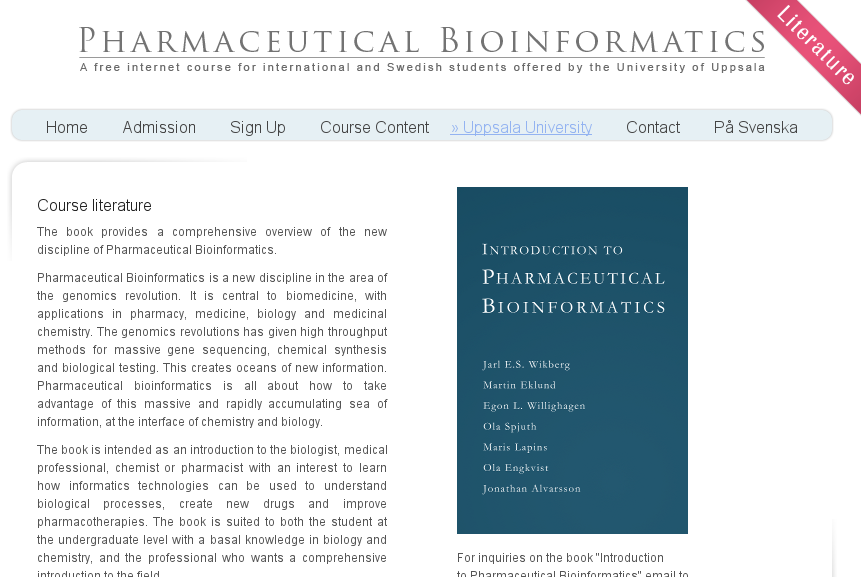
at <a href="http://www.uu.se/">Uppsala University</a> where I did my first two years of
post-docing in Sweden has a (free) course on <a href="http://www.pharmbio.org/">pharmaceutical bioinformatics</a>.
We worked hard on a course book, which after a year got printed. It ended up
with 400 pages, 15 chapters, and 3 appendices. It also includes examples on
how to do discussed topics in <a href="http://www.bioclipse.net/">Bioclipse</a>:</p>

<p><img src="/blog/assets/images/pharmbioBook.png" alt="" /></p>

<p>The chapters are:</p>

<ol>
  <li>
    <p>Introduction</p>
  </li>
  <li>
    <p>Background</p>
  </li>
  <li>
    <p>Drug discovery and development</p>
  </li>
  <li>
    <p>Bioinformatics, drugs and omics</p>
  </li>
  <li>
    <p>Representing molecules in computers</p>
  </li>
  <li>
    <p>Representation of 3D structures</p>
  </li>
  <li>
    <p>Molecular descriptors</p>
  </li>
  <li>
    <p>Sequence analysis</p>
  </li>
  <li>
    <p>Macromolecular descriptors</p>
  </li>
  <li>
    <p>Design of experiments</p>
  </li>
  <li>
    <p>Data analysis</p>
  </li>
  <li>
    <p>Databases</p>
  </li>
  <li>
    <p>QSAR</p>
  </li>
  <li>
    <p>Proteochemometrics</p>
  </li>
  <li>
    <p>Semantic web</p>
  </li>
  <li>
    <p>Answers</p>
  </li>
</ol>

<p>And three appendices:</p>

<p>A. Basic probability theory</p>

<p>B. Basic matrix algebra</p>

<p>C. Introduction to Bioclipse</p>

<p>The book is currently undergoing proof review and available to course participants
only, and should become available in a couple of months for the general public.</p>]]></content><author><name>Egon Willighagen</name></author><category term="bioclipse" /><category term="cdk" /><category term="cheminf" /><category term="chemometrics" /><category term="publishing" /><summary type="html"><![CDATA[The Wikberg group at Uppsala University where I did my first two years of post-docing in Sweden has a (free) course on pharmaceutical bioinformatics. We worked hard on a course book, which after a year got printed. It ended up with 400 pages, 15 chapters, and 3 appendices. It also includes examples on how to do discussed topics in Bioclipse:]]></summary><media:thumbnail xmlns:media="http://search.yahoo.com/mrss/" url="http://egonw.github.io/blog/blog/assets/images/pharmbioBook.png" /><media:content medium="image" url="http://egonw.github.io/blog/blog/assets/images/pharmbioBook.png" xmlns:media="http://search.yahoo.com/mrss/" /></entry><entry><title type="html">Cleaner CDK Code #9: using the LoggingTool</title><link href="http://egonw.github.io/blog/2011/02/24/cleaner-cdk-code-9-using-loggingtool.html" rel="alternate" type="text/html" title="Cleaner CDK Code #9: using the LoggingTool" /><published>2011-02-24T00:10:00+00:00</published><updated>2011-02-24T00:10:00+00:00</updated><id>http://egonw.github.io/blog/2011/02/24/cleaner-cdk-code-9-using-loggingtool</id><content type="html" xml:base="http://egonw.github.io/blog/2011/02/24/cleaner-cdk-code-9-using-loggingtool.html"><![CDATA[<p>A trick I used from Miguel Howard (of <a href="http://www.jmol.org/">Jmol</a> fame) is
to not concatenate String until really needed. String concatenation will allocate
new Strings, and thus burden the garbage collector (yeah, you lucky Fortran
users who think twice before allocating memory :). Some time ago, he suggested
this trick for the logger. I think in Jmol, but the <a href="http://cdk.sf.net/">CDK</a>
inherited that idea.</p>

<h2 id="dont-concatenate-strings-when-calling-the-loggingtool">Don’t concatenate Strings when calling the LoggingTool</h2>

<p>Logging in the CDK can be turned off, and in production use, I often do. Therefore,
we can make it speed up by concatenating debug message String only when debugging
is turned on. The CDK <a href="http://pele.farmbio.uu.se/nightly/api/org/openscience/cdk/tools/ILoggingTool.html">LoggingTool</a>
can take care of this, so you should pass the Strings are individual parameters
to the logger call. Instead of:</p>

<div class="language-java highlighter-rouge"><div class="highlight"><pre class="highlight"><code><span class="n">logger</span><span class="o">.</span><span class="na">debug</span><span class="o">(</span><span class="s">"the current atom is "</span> <span class="o">+</span> <span class="n">atom</span><span class="o">);</span>
</code></pre></div></div>

<p>you should write:</p>

<div class="language-java highlighter-rouge"><div class="highlight"><pre class="highlight"><code><span class="n">logger</span><span class="o">.</span><span class="na">debug</span><span class="o">(</span><span class="s">"the current atom is "</span><span class="o">,</span> <span class="n">atom</span><span class="o">);</span>
</code></pre></div></div>

<p>And this works for any arbitrary number of Strings and objects, because the
logging tool debug method has this signature: <code class="language-plaintext highlighter-rouge">public void debug(Object object,
Object... objects)</code>. So, you can also just do:</p>

<div class="language-java highlighter-rouge"><div class="highlight"><pre class="highlight"><code><span class="n">logger</span><span class="o">.</span><span class="na">debug</span><span class="o">(</span><span class="s">"The "</span><span class="o">,</span> <span class="n">i</span><span class="o">,</span> <span class="s">"th object is connected to the "</span><span class="o">,</span> <span class="n">j</span><span class="o">,</span> <span class="s">"th"</span><span class="o">);</span>
</code></pre></div></div>

<p>Actually, looking at the <code class="language-plaintext highlighter-rouge">debug()</code> method’s signature, I am not sure why we still
have the first Object separately… mmm.</p>]]></content><author><name>Egon Willighagen</name></author><category term="cdk" /><category term="cheminf" /><category term="java" /><summary type="html"><![CDATA[A trick I used from Miguel Howard (of Jmol fame) is to not concatenate String until really needed. String concatenation will allocate new Strings, and thus burden the garbage collector (yeah, you lucky Fortran users who think twice before allocating memory :). Some time ago, he suggested this trick for the logger. I think in Jmol, but the CDK inherited that idea.]]></summary></entry><entry><title type="html">Adding a CDK atom type</title><link href="http://egonw.github.io/blog/2011/02/24/adding-cdk-atom-type.html" rel="alternate" type="text/html" title="Adding a CDK atom type" /><published>2011-02-24T00:00:00+00:00</published><updated>2011-02-24T00:00:00+00:00</updated><id>http://egonw.github.io/blog/2011/02/24/adding-cdk-atom-type</id><content type="html" xml:base="http://egonw.github.io/blog/2011/02/24/adding-cdk-atom-type.html"><![CDATA[<p>A very quick, short post on <a href="http://cdk.sf.net/">CDK</a> atom types. These atom
types are used by the CDK to decide how many missing hydrogens an atom has,
or how many lone pairs, and if the atom can be part of an aromatic ring system.
The CDK code basically consists of three parts: the atom type ontology, the
atom type perception code, and the rest of the code that uses information from
the ontology.</p>

<p>Most of you have already developed a love/hate relation with the <a href="http://pele.farmbio.uu.se/nightly/api/org/openscience/cdk/atomtype/CDKAtomTypeMatcher.html">CDKAtomTypeMatcher</a>.
This is the class that complains about atom types not being recognized. And
let me stress this one more time. When you get such a method, it means that
the CDK cannot add hydrogen, it cannot calculate QSAR descriptors, etc, etc.
I have had the comment that CDK 1.0 never complained about that. True. It just
ignored the fact that it did not know what to do with that atom, and calculated
(wrong) properties anyway.</p>

<p>The solution to such a missing atom type warning can be two-fold. First, the
input data was wrong, for example, because formal charges were lost at some
point. A typical example is a neutral four-coordinated nitrogen. Second, the
input data is correct and the CDK is wrong. This doesn’t happen too often, but
it does.</p>

<p>This last is the topic of this post. The CDK can be ‘wrong’ in two ways. Either
it doesn’t know the atom type (CDK 1.2 and 1.4 have more atom types than CDK 1.0
ever had; so), or the perception algorithm makes a mistake. The latter is not
uncommon, particularly for some elements, like nitrogen. The cause here is the
input data, or better, the lack of input data. Missing bond orders, missing
explicit hydrogens. Now, cheminformatics can make educated guesses, and so the
perception algorithm does. But it depends on its education.</p>

<p>Doing the needed education of the CDK basically looks like <a href="https://github.com/cdk/cdk/commit/4ccb251ee0f94905071beeea2b1e56d968bda360">this commit</a>.
It adds:</p>

<ul>
  <li>a new atom type to the ontology,</li>
  <li>adds code to the CDKAtomTypeMatcher for the perception, and</li>
  <li>adds unit tests to make sure it does the right thing.</li>
</ul>

<p>Mind you, that the ontology needs to provide the following properties of an
atom type:</p>

<ol>
  <li>the element (duh),</li>
  <li>the formal charge,</li>
  <li>the number of bound neighbors,</li>
  <li>the number of double bond equivalents (<em>piBondCount</em>),</li>
  <li>the number of lone pairs, and</li>
  <li>the hybridization state (sp3, sp1, etc).</li>
</ol>

<p>The current unit tests focus on the true positives, but I got a report about
a false positive this week, which I will add shortly. Also check these posts
on <a href="http://chem-bla-ics.blogspot.com/search/label/atom%20typing">atom typing</a>
and <a href="http://chem-bla-ics.blogspot.com/search/label/atom%20types">atom types</a>.</p>]]></content><author><name>Egon Willighagen</name></author><category term="cdk" /><category term="cheminf" /><summary type="html"><![CDATA[A very quick, short post on CDK atom types. These atom types are used by the CDK to decide how many missing hydrogens an atom has, or how many lone pairs, and if the atom can be part of an aromatic ring system. The CDK code basically consists of three parts: the atom type ontology, the atom type perception code, and the rest of the code that uses information from the ontology.]]></summary></entry><entry><title type="html">Groovy Cheminformatics…</title><link href="http://egonw.github.io/blog/2011/02/06/groovy-cheminformatics.html" rel="alternate" type="text/html" title="Groovy Cheminformatics…" /><published>2011-02-06T00:00:00+00:00</published><updated>2011-02-06T00:00:00+00:00</updated><id>http://egonw.github.io/blog/2011/02/06/groovy-cheminformatics</id><content type="html" xml:base="http://egonw.github.io/blog/2011/02/06/groovy-cheminformatics.html"><![CDATA[<p><strong>Update</strong>: the <a href="https://chem-bla-ics.linkedchemistry.info/2012/01/15/groovy-cheminformatics-4th-edition.html">fourth edition <i class="fa-solid fa-recycle fa-xs"></i></a> is out.</p>

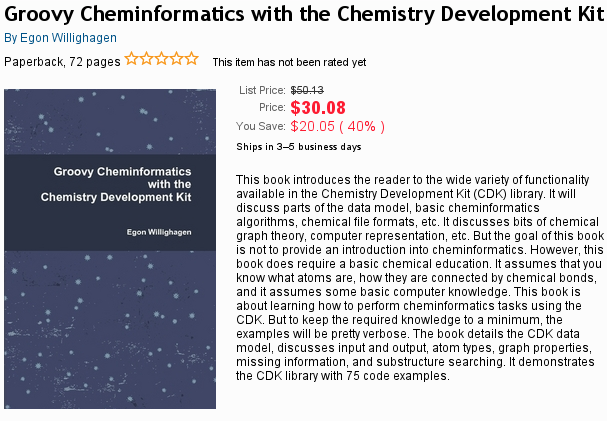
<p>Some project are never finished. Neither is this one, but it is never too late to change how things work, so, taking advantage of
publishing-on-demand, here I introduce the release-soon, release-often equivalent of cheminformatics books, my
<a href="http://www.lulu.com/product/paperback/groovy-cheminformatics-with-the-chemistry-development-kit/14745007">Groovy Cheminformatics with the Chemistry Development Kit</a>
book:</p>

<p><img src="/blog/assets/images/cdkBookLulu.png" alt="" /></p>

<p>With a serious discount for just being the first edition (1.3.8-0), but still counting at 72 pages with 75 code examples, this edition
marks a personal milestone (and probably not much more than that). There remains much to do, but I promised a release by tomorrow, so
here it is. Next releases will contain more code examples, more functionality descriptions, and more literature reviewing where such
code is used in science. The plan is to make new editions with each new <a href="http://cdk.sf.net/">CDK</a> release, as well as new editions
when I added a new chapter, section, or just paragraph. But, there will not be a Nightly build service anytime soon.</p>

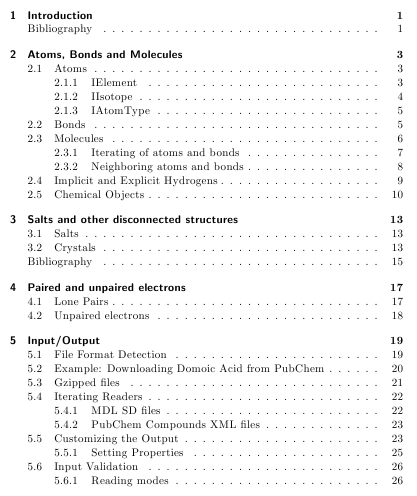
<p>The current table of content is as follows:</p>

<p><img src="/blog/assets/images/cdkBookToc1.png" alt="" /></p>

<p>Now, the book content is <strong><em>not</em></strong> open content. However, it contains nothing that is not available in other means. It’s just the
compilation that makes this book interesting, as well as that I put effort in ensuring the code examples remain working.
For that, I ask a minor financial contribution.</p>]]></content><author><name>Egon Willighagen</name></author><category term="cdk" /><category term="java" /><category term="cheminf" /><category term="cdkbook" /><summary type="html"><![CDATA[Update: the fourth edition is out.]]></summary><media:thumbnail xmlns:media="http://search.yahoo.com/mrss/" url="http://egonw.github.io/blog/blog/assets/images/cdkBookLulu.png" /><media:content medium="image" url="http://egonw.github.io/blog/blog/assets/images/cdkBookLulu.png" xmlns:media="http://search.yahoo.com/mrss/" /></entry><entry><title type="html">Karolinska Institutet</title><link href="http://egonw.github.io/blog/2011/01/12/karolinska-institutet.html" rel="alternate" type="text/html" title="Karolinska Institutet" /><published>2011-01-12T00:00:00+00:00</published><updated>2011-01-12T00:00:00+00:00</updated><id>http://egonw.github.io/blog/2011/01/12/karolinska-institutet</id><content type="html" xml:base="http://egonw.github.io/blog/2011/01/12/karolinska-institutet.html"><![CDATA[<p>Hi all, and a happy 2011! After a turbulent December (finishing up in the Oscar
project), holidays, etc, I am starting to get some sense of organization in
my new position at the <a href="http://ki.se/imm">Institutet för miljömedicin</a> at the
<a href="http://ki.se/">Karolinska Institutet</a> in <a href="http://en.wikipedia.org/wiki/Stockholm">Stockholm</a>.
I will be using cheminformatics and chemometrics methods in toxicology studies,
and work in the groups of <a href="http://ki.se/ki/jsp/polopoly.jsp?d=25010&amp;a=21910&amp;l=sv">Prof. Roland Grafström</a>
and <a href="http://ki.se/ki/jsp/polopoly.jsp?d=25010&amp;a=20446&amp;l=sv">Prof. Bengt Fadeel</a>.</p>

<p>The actual work will crystallize in the next weeks, but here are two pointers.
One is ToxBank, for which the website should go live this month, but Google
will provide some ideas about this FP7 project. The other part is into nanotoxicology
(see e.g. doi:<a href="http://dx.doi.org/10.1039/C0NR00535E">10.1039/C0NR00535E</a>).</p>

<p>So, if you are around in <a href="http://en.wikipedia.org/wiki/Solna_Municipality">Solna</a>,
give me a ping!</p>]]></content><author><name>Egon Willighagen</name></author><category term="cheminf" /><category term="chemometrics" /><category term="toxicology" /><category term="justdoi:10.1039/C0NR00535E" /><summary type="html"><![CDATA[Hi all, and a happy 2011! After a turbulent December (finishing up in the Oscar project), holidays, etc, I am starting to get some sense of organization in my new position at the Institutet för miljömedicin at the Karolinska Institutet in Stockholm. I will be using cheminformatics and chemometrics methods in toxicology studies, and work in the groups of Prof. Roland Grafström and Prof. Bengt Fadeel.]]></summary></entry></feed>