<?xml version="1.0" encoding="utf-8"?><feed xmlns="http://www.w3.org/2005/Atom" ><generator uri="https://jekyllrb.com/" version="4.3.4">Jekyll</generator><link href="http://egonw.github.io/blog/feed/by_tag/chemistry.xml" rel="self" type="application/atom+xml" /><link href="http://egonw.github.io/blog/" rel="alternate" type="text/html" /><updated>2026-11-19T06:09:00+00:00</updated><id>http://egonw.github.io/blog/feed/by_tag/chemistry.xml</id><title type="html">chem-bla-ics</title><subtitle>Chemblaics (pronounced chem-bla-ics) is the science that uses open science and computers to solve problems in chemistry, biochemistry and related fields.</subtitle><author><name>Egon Willighagen</name></author><entry><title type="html">Chemical data curation: yes, it is that bad.</title><link href="http://egonw.github.io/blog/2011/02/09/chemical-data-curation-yes-it-is-that.html" rel="alternate" type="text/html" title="Chemical data curation: yes, it is that bad." /><published>2011-02-09T00:00:00+00:00</published><updated>2011-02-09T00:00:00+00:00</updated><id>http://egonw.github.io/blog/2011/02/09/chemical-data-curation-yes-it-is-that</id><content type="html" xml:base="http://egonw.github.io/blog/2011/02/09/chemical-data-curation-yes-it-is-that.html"><![CDATA[<p>The readers of <a href="http://www.chemconnector.com/chemunicating/">Antony’s blog</a>
know enough about the problem. And many in the QSAR community know it too (and
many other do not). Chemical structure data is noisy. I haven’t recently created
a new local data set for analysis, so I have not taken time to blog about it
much, but the ambiguity in chemical databases is enormous. Just yesterday, Antony
and I had a <a href="http://www.chemconnector.com/chemunicating/different-approaches-to-storing-structures-and-inchis-on-chemspider.html">good</a>
<a href="http://blueobelisk.shapado.com/questions/where-can-i-get-inchis-with-a-fixed-hydrogen-layer">discussion</a>
about tautomers and in particular how things are linked together.</p>

<p>If we are in the field of property prediction, knowing what tautomer to calculate
descriptors for is crucial. Not that we actually have easy access to experimental
data showing what the important tautomer is for our end-point (predicted property),
but at least we can track what tautomer we modeled with. Has everyone ever asked
you to add units to experimental values? Like “<em>the temperarature was 279 degrees;
Celsius or Kelvin??</em>” Well, this is the exact same thing. If your QSAR model
training report does not include that information, you are doing it wrong. (/me
ducks)</p>

<p>So, why does it in fact matter? It matter simply because calculated properties
are different. Backing up to the ChemSpider example in my <a href="http://blueobelisk.shapado.com/questions/where-can-i-get-inchis-with-a-fixed-hydrogen-layer">question about InChIs
with the fixed-hydrogen layer</a>
I noted that (like in many other databases) the synonyms seems to include IUPAC
names for at least two tautomers. However, while the ChemSpider is, in fact,
for the tautomer-independent structure (using the InChI mobile hydrogen layer;
and keep in mind that the InChI uses only a limited amount of heuristic rules
for identifying tautomers, making it not detect all 40 tautomers of <a href="http://en.wikipedia.org/wiki/Warfarin">warfarin</a>),
the 2D diagram, the 3D model, and the calculated properties reflect only <em>one</em>
tautomer.</p>

<p>And calculated properties are exactly the input in QSAR’s statistical modeling.
It is interesting to realize that the differences in calculated molecular descriptors
can vary both minimally, or not at all, as drastically. Very drastically, in
fact. The recent paper by Porter (doi:<a href="https://doi.org/10.1007/s10822-010-9335-7">10.1007/s10822-010-9335-7</a>)
shows the 40 warfarin tautomers, and discusses a few properties, such as the
pKa. The experimental pKa of warfarin is around 5. Now, the paper reports calculated
pKa values for a variety of software products (<a href="http://ambit.sf.net">AMBIT</a>
is unfortunately missing). First of all, it shows that the various tools differ,
which is to be expected. But that variance is neglectable when compared by the
effect of picking the wrong tautomer. I was impressed by the range of predicted
values for the various tautomers. I ranged from about 5 to 12, throughout all
tools. That means warfarin is predicted to be mildly acidic (some tools predict
pKa’s down to 2.5) to very basic! No way your statistical modeling will understand
that!</p>

<p>And this is why Open Data is so important in chemistry. So, the next time Joe
(Organic) Chemist bitches about computers and cheminformatics, tell him it is
his own fault: he should have released his data out in the Open.</p>

<p>Anyway. Tautomerism was a curation issue in the first(!!!) entry I was curating.
The sixth had the more well-known problem, I think. I may be blind, but I would
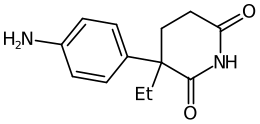
say <a href="http://www.chemspider.com/Chemical-Structure.2060.html">this drug</a> has
a stereocenter:</p>

<p><img src="/blog/assets/images/depict2060.png" alt="" /></p>

<p>But none of the databases I checked so far (including ChemSpider) defines the
stereochemistry! I thought we settled that some decades ago? Stereochemistry
of drugs matter. What is going on here? I guess I have to browse some primary
literature and access some experimental data today then. If I can afford it.</p>]]></content><author><name>Egon Willighagen</name></author><category term="chemistry" /><category term="chemspider" /><category term="inchi" /><category term="opendata" /><category term="qsar" /><category term="justdoi:10.1007/s10822-010-9335-7" /><category term="inchikey:ROBVIMPUHSLWNV-UHFFFAOYSA-N" /><summary type="html"><![CDATA[The readers of Antony’s blog know enough about the problem. And many in the QSAR community know it too (and many other do not). Chemical structure data is noisy. I haven’t recently created a new local data set for analysis, so I have not taken time to blog about it much, but the ambiguity in chemical databases is enormous. Just yesterday, Antony and I had a good discussion about tautomers and in particular how things are linked together.]]></summary><media:thumbnail xmlns:media="http://search.yahoo.com/mrss/" url="http://egonw.github.io/blog/blog/assets/images/depict2060.png" /><media:content medium="image" url="http://egonw.github.io/blog/blog/assets/images/depict2060.png" xmlns:media="http://search.yahoo.com/mrss/" /></entry><entry><title type="html">Open Chemical Data #2: Dryad</title><link href="http://egonw.github.io/blog/2011/02/02/open-chemical-data-2-dryad.html" rel="alternate" type="text/html" title="Open Chemical Data #2: Dryad" /><published>2011-02-02T00:00:00+00:00</published><updated>2011-02-02T00:00:00+00:00</updated><id>http://egonw.github.io/blog/2011/02/02/open-chemical-data-2-dryad</id><content type="html" xml:base="http://egonw.github.io/blog/2011/02/02/open-chemical-data-2-dryad.html"><![CDATA[<p><a href="http://scimantica.com/blog/">Nico</a> asked recently about the <a href="http://blueobelisk.shapado.com/questions/chemical-data-in-rdf-who-are-the-providers">availability of
chemical data as RDF</a>.
There is no so much really. Finding large amounts of Open Data in chemistry
is in general a problem. Things are slowly changing, however, though it is not
very apparent.</p>

<p>About 1.5 years ago I started a <a href="http://friendfeed.com/openchemicaldata">FriedFeed room Open Chemical Data</a>
where RSS feeds of new chemical data are aggregated. It started with the <a href="http://chem-bla-ics.blogspot.com/2009/09/open-chemical-data-1-nmrshiftdb.html">RSS
feed from the NMRShiftDB</a>,
and later ChemPedia Substances was added (which is expected to go EOL). I was
informed, however, about <a href="http://datadryad.org/">Dryad</a>. It is a website that
allows deposition of data published in journals, <em>as CC0</em>. That latter is amazing!
And when they announced <a href="http://blog.datadryad.org/2011/01/31/dryad-newsletter-january-2011/">a new twitter feed</a>,
also noted they had a RSS feed of new data sets. <a href="http://blog.datadryad.org/2011/01/31/dryad-newsletter-january-2011/#comment-371">I asked about feeds specific
for chemistry</a>,
which <a href="http://blog.datadryad.org/2011/01/31/dryad-newsletter-january-2011/#comment-375">prompted Ryan</a>
to set up <a href="http://pipes.yahoo.com/ryscher/dryadchemical">this Yahoo Pipe</a>.</p>

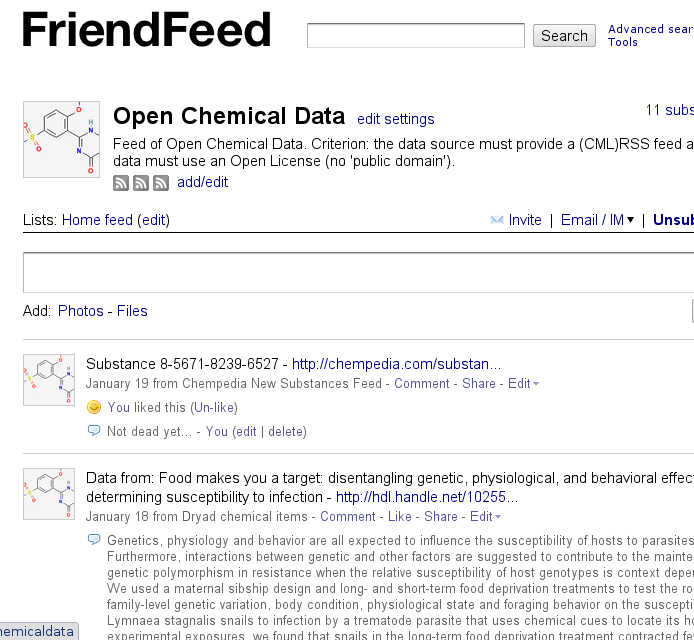
<p>So, Dryad is now part of the <a href="http://friendfeed.com/openchemicaldata">Open Chemical Data</a>
room (second item):</p>

<p><img src="/blog/assets/images/ccoChemRSS.png" alt="" /></p>]]></content><author><name>Egon Willighagen</name></author><category term="chemistry" /><category term="friendfeed" /><category term="rss" /><summary type="html"><![CDATA[Nico asked recently about the availability of chemical data as RDF. There is no so much really. Finding large amounts of Open Data in chemistry is in general a problem. Things are slowly changing, however, though it is not very apparent.]]></summary><media:thumbnail xmlns:media="http://search.yahoo.com/mrss/" url="http://egonw.github.io/blog/blog/assets/images/ccoChemRSS.png" /><media:content medium="image" url="http://egonw.github.io/blog/blog/assets/images/ccoChemRSS.png" xmlns:media="http://search.yahoo.com/mrss/" /></entry><entry><title type="html">“Atomic weights are not constant” !!!</title><link href="http://egonw.github.io/blog/2011/01/22/atomic-weights-are-not-constant.html" rel="alternate" type="text/html" title="“Atomic weights are not constant” !!!" /><published>2011-01-22T00:10:00+00:00</published><updated>2011-01-22T00:10:00+00:00</updated><id>http://egonw.github.io/blog/2011/01/22/atomic-weights-are-not-constant</id><content type="html" xml:base="http://egonw.github.io/blog/2011/01/22/atomic-weights-are-not-constant.html"><![CDATA[<p>In case you missed it, “standard atomic weights are not constants of nature”
(doi:<a href="http://dx.doi.org/10.1351/PAC-REP-10-09-14">10.1351/PAC-REP-10-09-14</a>)!
Wow, chemistry upside down. This is bigger than the new arsenic life they found!</p>

<p>Calm down, calm down. Nothing to see here, move on.</p>

<p>It was actually news a some weeks back, but a <a href="https://twitter.com/#!/MatToddChem/status/28787041277837312">tweet by @MatToddChem</a>
and a question by <a href="http://blueobelisk.shapado.com/questions/for-the-calculation-of-masses-in-open-babel-where-is-the-table-of-atomic-masses-sourced-from">Antony on the Blue Obelisk eXchange</a>,
made me write up this post.</p>

<p>Facts: 1. atomic weights have never been constant; 2. isotopic weight are constants
of nature. The difference is simple, but the public was amazed last month and
reaffirmed that science is just another religion. (In fact, the Dutch political
wizard Wilders calls religion just a politic ideology, so, science is just politics;
Q.E.D. :).</p>

<p>Atomic weights are used to calculate the weight of samples, or, the other way
around, how many molecules we have in 1 mg of some organic sample. Now, at this
macroscopic level, and looking at carbons, we have actually to do with a mix
of, mostly I guess, <sup>12</sup>C and <sup>13</sup>C, more or less 99% and
1% each. Now, these percentage reflect a mixture. Mixture composition has never
been natural constants, so the claim by the authors of the paper is weird, to
say the least. In fact, it has been know for years that the isotope ratios vary
around the world. Hence, the molecular weight of compound X is not the same
here as somewhere else. That’s all.</p>

<p>Now, the <a href="http://www.blueobelisk.org">Blue Obelisk</a> has been making this information
aggregated by IUPAC available under a permissive license. The most recent release
still has a MIT license, but the next release will be even more permissive an
have the CC0 waiver.</p>]]></content><author><name>Egon Willighagen</name></author><category term="blue-obelisk" /><category term="chemistry" /><category term="iupac" /><category term="justdoi:10.1351/PAC-REP-10-09-14" /><summary type="html"><![CDATA[In case you missed it, “standard atomic weights are not constants of nature” (doi:10.1351/PAC-REP-10-09-14)! Wow, chemistry upside down. This is bigger than the new arsenic life they found!]]></summary></entry><entry><title type="html">Converting JSON to RDF/XML with Groovy</title><link href="http://egonw.github.io/blog/2010/12/29/converting-json-to-rdfxml-with-groovy.html" rel="alternate" type="text/html" title="Converting JSON to RDF/XML with Groovy" /><published>2010-12-29T00:00:00+00:00</published><updated>2010-12-29T00:00:00+00:00</updated><id>http://egonw.github.io/blog/2010/12/29/converting-json-to-rdfxml-with-groovy</id><content type="html" xml:base="http://egonw.github.io/blog/2010/12/29/converting-json-to-rdfxml-with-groovy.html"><![CDATA[<p>Mark’s new <a href="http://www.science3point0.com/blog/2010/12/29/cc0-rdf-hosting-for-scientists/">CCO/RDF hosting functionality</a>
(see also <a href="http://chem-bla-ics.blogspot.com/2010/12/what-should-free-cc0-rdf-hosting-for.html">my post two days ago</a>)
requires <a href="http://www.w3.org/TR/REC-rdf-syntax/">RDF/XML format</a>, so I updated my code to convert the
<a href="http://chempedia.com/substances">Chempedia Substances</a> data into RDF/XML instead of N3 (I have asked
<a href="http://depth-first.com/">Rich</a> to put a new download link online). This is the
<a href="http://groovy.codehaus.org/">Groovy</a> code I used:</p>

<div class="language-groovy highlighter-rouge"><div class="highlight"><pre class="highlight"><code><span class="kn">import</span> <span class="nn">groovy.xml.MarkupBuilder</span>
<span class="kn">import</span> <span class="nn">groovy.util.IndentPrinter</span>

<span class="n">input</span> <span class="o">=</span> <span class="k">new</span> <span class="n">File</span><span class="o">(</span><span class="s2">"substances.json"</span><span class="o">)</span>
<span class="n">json</span> <span class="o">=</span> <span class="k">new</span> <span class="n">JsonSlurper</span><span class="o">().</span><span class="na">parse</span><span class="o">(</span><span class="n">input</span><span class="o">);</span>

<span class="kt">def</span> <span class="n">writer</span> <span class="o">=</span> <span class="k">new</span> <span class="n">StringWriter</span><span class="o">()</span>
<span class="kt">def</span> <span class="n">xml</span> <span class="o">=</span> <span class="k">new</span> <span class="n">MarkupBuilder</span><span class="o">(</span>
  <span class="k">new</span> <span class="nf">IndentPrinter</span><span class="o">(</span><span class="k">new</span> <span class="n">PrintWriter</span><span class="o">(</span><span class="n">writer</span><span class="o">))</span>
<span class="o">)</span>
<span class="n">xml</span><span class="o">.</span><span class="s1">'rdf:RDF'</span><span class="o">(</span>
  <span class="s1">'xmlns:rdf'</span><span class="o">:</span>
    <span class="s1">'http://www.w3.org/1999/02/22-rdf-syntax-ns#'</span><span class="o">,</span>
  <span class="s1">'xmlns:dc'</span> <span class="o">:</span>
    <span class="s1">'http://purl.org/dc/elements/1.1/'</span><span class="o">,</span>
  <span class="s1">'xmlns:iupac'</span> <span class="o">:</span>
    <span class="s1">'http://www.iupac.org/'</span><span class="o">,</span>
  <span class="s1">'xmlns:cp'</span> <span class="o">:</span>
    <span class="s1">'http://rdf.openmolecules.net/chempedia/onto#'</span><span class="o">,</span>
  <span class="s1">'xmlns:owl'</span> <span class="o">:</span>
    <span class="s1">'http://www.w3.org/2002/07/owl#'</span>
<span class="o">)</span> <span class="o">{</span>
  <span class="n">json</span><span class="o">.</span><span class="na">each</span> <span class="o">{</span> <span class="n">substance</span> <span class="o">-&gt;</span>
    <span class="n">xml</span><span class="o">.</span><span class="s1">'rdf:Description'</span><span class="o">(</span>
      <span class="s1">'rdf:about'</span><span class="o">:</span> <span class="n">substance</span><span class="o">.</span><span class="na">uri</span>
    <span class="o">)</span> <span class="o">{</span>
      <span class="n">xml</span><span class="o">.</span><span class="s1">'dc:identifier'</span><span class="o">(</span><span class="n">substance</span><span class="o">.</span><span class="na">gsid</span><span class="o">)</span>
      <span class="n">xml</span><span class="o">.</span><span class="s1">'owl:sameAs'</span><span class="o">(</span>
        <span class="s1">'rdf:resource'</span> <span class="o">:</span>
        <span class="s1">'http://rdf.openmolecules.net/?'</span> <span class="o">+</span>
        <span class="n">substance</span><span class="o">.</span><span class="na">inchi</span>
      <span class="o">)</span>
      <span class="n">xml</span><span class="o">.</span><span class="s1">'iupac:inchi'</span><span class="o">(</span>
        <span class="s1">'http://rdf.openmolecules.net/?'</span> <span class="o">+</span>
        <span class="n">substance</span><span class="o">.</span><span class="na">inchi</span>
      <span class="o">)</span>
      <span class="k">for</span> <span class="o">(</span><span class="kt">int</span> <span class="n">i</span> <span class="o">=</span> <span class="mi">0</span><span class="o">;</span> <span class="n">i</span><span class="o">&lt;</span><span class="n">substance</span><span class="o">.</span><span class="na">namings</span><span class="o">.</span><span class="na">size</span><span class="o">();</span> <span class="n">i</span><span class="o">++)</span>
      <span class="o">{</span>
        <span class="n">naming</span> <span class="o">=</span> <span class="n">substance</span><span class="o">.</span><span class="na">namings</span><span class="o">.</span><span class="na">get</span><span class="o">(</span><span class="n">i</span><span class="o">);</span>
        <span class="n">namingURI</span> <span class="o">=</span> <span class="n">substance</span><span class="o">.</span><span class="na">uri</span> <span class="o">+</span> <span class="s2">"/naming"</span> <span class="o">+</span> <span class="n">i</span><span class="o">;</span>
        <span class="n">xml</span><span class="o">.</span><span class="s1">'cp:hasNaming'</span> <span class="o">{</span>
          <span class="n">xml</span><span class="o">.</span><span class="s1">'rdf:Description'</span> <span class="o">{</span>
            <span class="n">xml</span><span class="o">.</span><span class="s1">'cp:hasName'</span><span class="o">(</span><span class="n">naming</span><span class="o">.</span><span class="na">name</span><span class="o">)</span>
            <span class="n">xml</span><span class="o">.</span><span class="s1">'cp:hasStatus'</span><span class="o">(</span><span class="n">naming</span><span class="o">.</span><span class="na">status</span><span class="o">)</span>
            <span class="n">xml</span><span class="o">.</span><span class="s1">'cp:hasScore'</span><span class="o">(</span><span class="n">naming</span><span class="o">.</span><span class="na">score</span><span class="o">)</span>
          <span class="o">}</span>
        <span class="o">}</span>
      <span class="o">}</span>
    <span class="o">}</span>
  <span class="o">}</span>
<span class="o">}</span>
<span class="n">println</span> <span class="n">writer</span><span class="o">.</span><span class="na">toString</span><span class="o">();</span>
</code></pre></div></div>]]></content><author><name>Egon Willighagen</name></author><category term="groovy" /><category term="chemistry" /><category term="rdf" /><category term="json" /><summary type="html"><![CDATA[Mark’s new CCO/RDF hosting functionality (see also my post two days ago) requires RDF/XML format, so I updated my code to convert the Chempedia Substances data into RDF/XML instead of N3 (I have asked Rich to put a new download link online). This is the Groovy code I used:]]></summary></entry><entry><title type="html">Supramolecular chemistry</title><link href="http://egonw.github.io/blog/2010/12/11/supramolecular-chemistry.html" rel="alternate" type="text/html" title="Supramolecular chemistry" /><published>2010-12-11T00:20:00+00:00</published><updated>2010-12-11T00:20:00+00:00</updated><id>http://egonw.github.io/blog/2010/12/11/supramolecular-chemistry</id><content type="html" xml:base="http://egonw.github.io/blog/2010/12/11/supramolecular-chemistry.html"><![CDATA[<p>Some smart software developer once said to not optimize your code too early. However, not caring about it at all does not help either.
Some basic knowledge of memory management can keep you going. That is, I just ran into the limits of <a href="http://oscar3-chem.sf.net/">Oscar</a>
and ChemicalTagger. As I blogged earlier today, I am <a href="https://chem-bla-ics.linkedchemistry.info/2010/12/11/status-update-on-bjoc-analysis-with.html">analyzing the BJOC literature <i class="fa-solid fa-recycle fa-xs"></i></a>,
but Lezan and I are running into a reproducible out-of-memory exception. At first I thought it was a memory leak, as it was the 95th
paper if fell over on, but after we optimized our code a bit, by reusing classes, the problem remained and turned out to be not in
recreating objects (though the code is significantly faster now), but in a single BJOC paper being too large.</p>

<p>The particular paper is not even ridiculously large, though it has an amazing 800 references! The paper, <em>Molecular recognition of
organic ammonium ions in solution using synthetic receptors</em> (doi:<a href="https://doi.org/10.3762/bjoc.6.32">10.3762/bjoc.6.32</a>), is in
fact an interesting review paper on supramolecular chemistry. The molecules I worked on (see one below) in my own supramolecular chemistry
time (doing a M.Sc. minor (6 month practical) with Peter Buijnsters in organic chemistry in the
<a href="http://www.molchem.science.ru.nl/about.php">group of Prof. Nolte</a>), are actually of the type they review, though surfactants are
not really covered in it particularly.</p>

<p><img src="/blog/assets/images/surfactant2002.png" alt="" /></p>

<p>Yeah, supramolecular chemistry has this nice level complexity; it is so supramolecular, that it is currently outside the scope
of the molecular analysis of Oscar and ChemicalTagger ;)</p>

<ul>
  <li>Buijnsters, P. J. J. A.; García-Rodríguez, C. L.; Willighagen, E. L.; Sommerdijk, N. A. J. M.; Kremer, A.; Camilleri, P.; Feiters, M. C.;
Nolte, R. J. M.; Zwanenburg, B. (2002). Cationic Gemini Surfactants Based on Tartaric Acid: Synthesis, Aggregation, Monolayer Behaviour,
and Interaction with DNA European Journal of Organic Chemistry, 2002 (8), 1397-1406 :
DOI:<a href="https://doi.org/csqhbn">10.1002/1099-0690(200204)2002:8%3C1397::AID-EJOC1397%3E3.0.CO;2-6</a></li>
</ul>]]></content><author><name>Egon Willighagen</name></author><category term="oscar" /><category term="beilstein" /><category term="chemistry" /><category term="justdoi:10.3762/bjoc.6.32" /><category term="inchikey:ZXBXTKLPJKVXBD-KKLWWLSJSA-N" /><summary type="html"><![CDATA[Some smart software developer once said to not optimize your code too early. However, not caring about it at all does not help either. Some basic knowledge of memory management can keep you going. That is, I just ran into the limits of Oscar and ChemicalTagger. As I blogged earlier today, I am analyzing the BJOC literature , but Lezan and I are running into a reproducible out-of-memory exception. At first I thought it was a memory leak, as it was the 95th paper if fell over on, but after we optimized our code a bit, by reusing classes, the problem remained and turned out to be not in recreating objects (though the code is significantly faster now), but in a single BJOC paper being too large.]]></summary><media:thumbnail xmlns:media="http://search.yahoo.com/mrss/" url="http://egonw.github.io/blog/blog/assets/images/surfactant2002.png" /><media:content medium="image" url="http://egonw.github.io/blog/blog/assets/images/surfactant2002.png" xmlns:media="http://search.yahoo.com/mrss/" /></entry><entry><title type="html">How many hydrogen-bond acceptor groups does triazole have?</title><link href="http://egonw.github.io/blog/2010/12/10/how-many-hydrogen-bond-acceptor-groups.html" rel="alternate" type="text/html" title="How many hydrogen-bond acceptor groups does triazole have?" /><published>2010-12-10T00:00:00+00:00</published><updated>2010-12-10T00:00:00+00:00</updated><id>http://egonw.github.io/blog/2010/12/10/how-many-hydrogen-bond-acceptor-groups</id><content type="html" xml:base="http://egonw.github.io/blog/2010/12/10/how-many-hydrogen-bond-acceptor-groups.html"><![CDATA[<p><a href="http://en.wikipedia.org/wiki/Andrew_S.I.D._Lang">Andrew</a> asked me about the
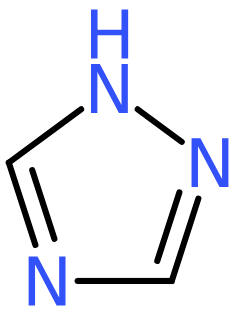
H-bond donor capabilities of <a href="http://en.wikipedia.org/wiki/1,2,4-Triazole">1,2,4-triazole</a>:</p>

<p><img src="/blog/assets/images/1,2,4-triazole.png" alt="" /></p>

<p>Apparently, the way he uses the <a href="http://cdk.sf.net">CDK</a> library, it returns
<a href="https://sourceforge.net/tracker/index.php?func=detail&amp;aid=3133610&amp;group_id=20024&amp;atid=120024">zero H-bond donor groups</a>,
as is visible in <a href="http://showme.physics.drexel.edu/onsc/models/AbrahamDescriptorsModel001.php?commonname=1,2,4-triazole">his application</a>
down the bottom of the page. When start from the PubChem entry, it correctly
detects on H-bond donor group, so it seems to have to do with implicit hydrogens
(not uncommon). Debugging will continue later, when I am done analyzing the
<a href="http://www.beilstein-journals.org/bjoc/">Beilstein Journal of Organic Chemistry</a>
literature with <a href="oscar3-chem.sf.net">Oscar</a>.</p>

<p>But, I do like to put this question out in the open: how many <em>H-bond acceptor</em>
groups does this triazole have? The CDK calculates 3 groups, while <a href="http://pubchem.ncbi.nlm.nih.gov/summary/summary.cgi?cid=9257&amp;loc=ec_rcs">PubChem
counts 2</a>.
<a href="http://www.chemspider.com/RecordView.aspx?rid=16b4a40c-0eaf-45ed-bbf3-10baed079a9b">ChemSpider thinks 3</a>
too.</p>

<p>Intuitively, I would agree with the CDK and ChemSpider: the nitrogen which acts
as the single H-bond donor still have a free electron pair. What do you think?
Is <a href="http://pubchem.ncbi.nlm.nih.gov/">PubChem</a> wrong, or is the CDK and <a href="http://chemspider.com">ChemSpider</a>
wrong? Can this special nitrogen be both a donor and acceptor at the same time?
I think so. However, I do not know how I can easily search <a href="http://wwmm.ch.cam.ac.uk/crystaleye/">CrystalEye</a>
for this. Bonus points for answering the <a href="http://blueobelisk.shapado.com/questions/how-can-i-searched-crystaleye-for-particular-packing-types">Blue Obelisk eXchange question</a>.</p>]]></content><author><name>Egon Willighagen</name></author><category term="beilstein" /><category term="cdk" /><category term="cheminf" /><category term="chemistry" /><category term="chemspider" /><category term="pubchem" /><category term="inchikey:NSPMIYGKQJPBQR-UHFFFAOYSA-N" /><summary type="html"><![CDATA[Andrew asked me about the H-bond donor capabilities of 1,2,4-triazole:]]></summary><media:thumbnail xmlns:media="http://search.yahoo.com/mrss/" url="http://egonw.github.io/blog/blog/assets/images/1,2,4-triazole.png" /><media:content medium="image" url="http://egonw.github.io/blog/blog/assets/images/1,2,4-triazole.png" xmlns:media="http://search.yahoo.com/mrss/" /></entry><entry><title type="html">Trust has no place in science #2</title><link href="http://egonw.github.io/blog/2010/12/10/trust-has-no-place-in-science-2.html" rel="alternate" type="text/html" title="Trust has no place in science #2" /><published>2010-12-10T00:00:00+00:00</published><updated>2010-12-10T00:00:00+00:00</updated><id>http://egonw.github.io/blog/2010/12/10/trust-has-no-place-in-science-2</id><content type="html" xml:base="http://egonw.github.io/blog/2010/12/10/trust-has-no-place-in-science-2.html"><![CDATA[<p>Thanks to all who replied and shared their views. Particular thanx to <a href="http://scientopia.org/blogs/christinaslisrant/">Christina</a>
who replied in <a href="http://scientopia.org/blogs/christinaslisrant/2010/12/06/the-role-of-trust-in-science/">her blog</a>.
With <a href="http://chem-bla-ics.blogspot.com/2010/12/trust-has-no-place-in-science.html?showComment=1291834410259#c629729480067400710">Saml</a>,
and <a href="http://friendfeed.com/cpikas/ed2c2155/new-post-role-of-trust-in-science">Cameron and Bill</a>
they think this is about semantics. Linguistic tricks. I hope not; this is too
serious to get away with such. “Reliable, trustworthy, assumptions”: it’s all
working around the real issue. Similarly, splitting up ‘trust’ into ‘blind trust’
and ‘smart trust’ is just working around the real problem.</p>

<p>Indeed, my point is different. The key of science is to replace trust by facts.
Or, when talking about database, software, research papers in Nature, it is
replacing trust with <em>traceability</em>. Actually, we seem to have lost a long-standing
tradition of citing previous work when we write down the arguments we base our
argumentation on. Facts are backed up with references, providing the required
traceability.</p>

<p>Now, compare that to current electronic sciences. We ‘trust’ our database to
have done something sane. Well, don’t. They made an attempt, but made errors.
As they say with software, having zero bugs just means you have not found them
yet.</p>

<p>The real point with ‘trust’ is, is that it is completely irrelevant. It adds
zero to the scholarly discussion. Whether you trust the highly curated <a href="https://www.ebi.ac.uk/chembl/">ChEMBL
database</a> or not, it has errors. (<a href="http://baoilleach.blogspot.com/">Noel</a>
pointed out <a href="http://baoilleach.blogspot.com/2010/12/name-that-stereochemistry-when-mol.html">one source of ambiguity in the ChEMBL database</a>
this week). What does matter, instead, is if those errors are significant. Do
they affect the conclusions I draw when I use this data. That is what actually
matter. <strong>Trust has no place in science</strong>. Error has.</p>

<p>Sadly, this is basically the hypothesis of the VR grant I wrote up but <a href="http://chem-bla-ics.blogspot.com/2010/11/more-fails-aka-no-vr-grant-awarded.html">did
not get awarded</a>.
But I trust I do better next time.</p>

<p>Why this matters? Well, this is what <a href="http://www.acronymattic.com/ODOSOS.html">ODOSOS</a>
is about: bring back the traceability into science, and get rid of <em>trust</em>.</p>]]></content><author><name>Egon Willighagen</name></author><category term="chemistry" /><category term="odosos" /><category term="science" /><summary type="html"><![CDATA[Thanks to all who replied and shared their views. Particular thanx to Christina who replied in her blog. With Saml, and Cameron and Bill they think this is about semantics. Linguistic tricks. I hope not; this is too serious to get away with such. “Reliable, trustworthy, assumptions”: it’s all working around the real issue. Similarly, splitting up ‘trust’ into ‘blind trust’ and ‘smart trust’ is just working around the real problem.]]></summary></entry><entry><title type="html">Trust has no place in science</title><link href="http://egonw.github.io/blog/2010/12/06/trust-has-no-place-in-science.html" rel="alternate" type="text/html" title="Trust has no place in science" /><published>2010-12-06T00:10:00+00:00</published><updated>2010-12-06T00:10:00+00:00</updated><id>http://egonw.github.io/blog/2010/12/06/trust-has-no-place-in-science</id><content type="html" xml:base="http://egonw.github.io/blog/2010/12/06/trust-has-no-place-in-science.html"><![CDATA[<p>One discussion I had often had in the past year, is about trust in science.
I, for one, believe (hahahaha; you see the irony? ;) that <em>trust</em> has nothing
to do with science. Likewise, any scholar should be, IMHO, <a href="http://chem-bla-ics.blogspot.com/2010/12/what-is-hes.html">hes</a>
is suspicious when someone talks about trust. A scholarly scientist will never
trust any result: hes will accept it as true or false, but will take responsibility
for that decision; hes will not hide behind ‘but I trusted him’ or ‘but it was
published in Nature’.</p>

<p>Antony <a href="http://friendfeed.com/chemconnector/665d673f/please-participate-in-poll-about-public">asked</a>
last week the community to answer a questionnaire, which turned out the be about
our trust in online chemical database. He presented the <a href="http://www.slideshare.net/AntonyWilliams/chemspider-connecting-and-curating-online-chemistry-resources?from=ss_embed">results at the EBI</a>.
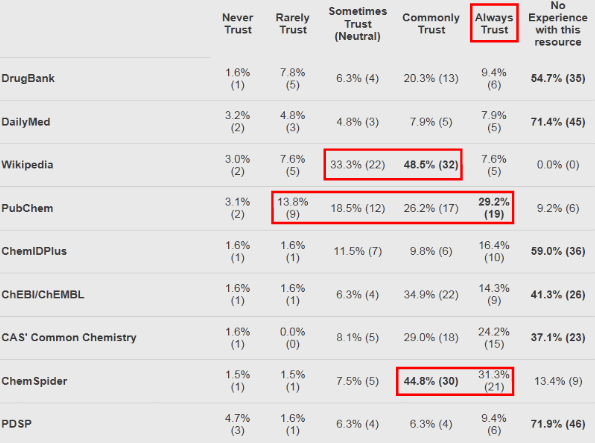
This is the slide that summarizes the results from that questionnaire:</p>

<p><img src="/blog/assets/images/trust.png" alt="" /></p>

<p>We see that trust clearly has a very significant place in science. How disappointing.
You can spot me in these results easily: I am the one that consequently answered
‘Never Trust’ for all databases. It’s not that I do not value those databases,
but there is no need for them to trust them. I verify. This is actually a point
visible in Tony’s presentation: we can compare databases.</p>

<p>This is the point that I and others have been making for more than a decade
now: if we do things properly, we can do this verification. Anyone can. With
Open Data, Open Source, and Open Standards we can. I can only stress once more
how important this is. We trust people, we trust government, but repeatedly
this trust is taken advantage of. Without transparency, people can hide. By
being able to hide, human loose there ability to decide what is right. With
transparency, we see things return to normal, as we saw this week with <a href="http://translate.google.com/translate?hl=en&amp;sl=nl&amp;tl=en&amp;u=http://www.volkskrant.nl/vk/nl/2668/Buitenland/article/detail/1068247/2010/12/04/Declaraties-Britse-politici-fors-lager.dhtml">UK politicians</a>.</p>

<p>Further reading in my blog:</p>

<ul>
  <li><a href="http://chem-bla-ics.blogspot.com/2010/11/why-you-have-not-heard-me-much-about.html">Why you have not heard me much about chemometrics recently…</a></li>
  <li><a href="http://chem-bla-ics.blogspot.com/2010/08/molecular-chemometrics-principles-3.html">The Molecular Chemometrics Principles #3: stand on shoulders</a></li>
  <li><a href="http://chem-bla-ics.blogspot.com/2010/08/molecular-chemometrics-principles-2-be.html">The Molecular Chemometrics Principles #2: be clear in what you mean</a></li>
  <li><a href="http://chem-bla-ics.blogspot.com/2010/08/molecular-chemometrics-principles-1.html">The Molecular Chemometrics Principles #1: access to data</a></li>
</ul>

<p><strong>Update</strong>: if you liked this post, you will also like blogs posts <a href="http://bjoern.brembs.net/news.php?item.684.11">like this</a>
one from Björn.</p>]]></content><author><name>Egon Willighagen</name></author><category term="chemistry" /><category term="science" /><summary type="html"><![CDATA[One discussion I had often had in the past year, is about trust in science. I, for one, believe (hahahaha; you see the irony? ;) that trust has nothing to do with science. Likewise, any scholar should be, IMHO, hes is suspicious when someone talks about trust. A scholarly scientist will never trust any result: hes will accept it as true or false, but will take responsibility for that decision; hes will not hide behind ‘but I trusted him’ or ‘but it was published in Nature’.]]></summary><media:thumbnail xmlns:media="http://search.yahoo.com/mrss/" url="http://egonw.github.io/blog/blog/assets/images/trust.png" /><media:content medium="image" url="http://egonw.github.io/blog/blog/assets/images/trust.png" xmlns:media="http://search.yahoo.com/mrss/" /></entry><entry><title type="html">Uppsala Status Report</title><link href="http://egonw.github.io/blog/2010/11/27/uppsala-status-report.html" rel="alternate" type="text/html" title="Uppsala Status Report" /><published>2010-11-27T00:00:00+00:00</published><updated>2010-11-27T00:00:00+00:00</updated><id>http://egonw.github.io/blog/2010/11/27/uppsala-status-report</id><content type="html" xml:base="http://egonw.github.io/blog/2010/11/27/uppsala-status-report.html"><![CDATA[<p>As you know, my post-doc in <a href="http://www.farmbio.uu.se/">Uppsala</a> ended. It was
a good time, and it was great collaborating on Bioclipse with Ola, Jonathan,
Arvid, and Carl. I would have loved tighter integration with the work of Maris
and Martin, but that was limited to one joined paper (in press). I thank Professors
Jarl Wikberg and Eva Brittebo for allowing me to continue my research at their
department, and hope this is not the end of the collaboration yet.</p>

<p>Like with new year, the end of a contract is a good time to reflect on ones
accomplishments. It’s been a bit delayed, but as you know, I already in my next
<a href="http://chem-bla-ics.blogspot.com/2010/10/working-on-oscar-for-three-months.html">project in Cambridge</a>,
and will start in January with yet a longer term position in predictive toxicology
(more on that soon). This makes this a really crowded period, on top of birthdays,
<a href="http://sv.wikipedia.org/wiki/Sinterklaas">Sinterklaas</a>, x-mas, and sorts.</p>

<p><strong>My Research</strong><br />
As you might know, my research interest lies in understanding molecular properties
and their applications in larger molecular systems. This can be how small molecules
pack in crystals, finding patterns in properties (QSAR-like work), etc. Because
the underlying methods are useful in many domains, you see applications in various
too, including drug discovery, metabolomics, etc. These methods involve statistics
and cheminformatics, primarily, which is clear from my publications on method
development in chemometrics and cheminformatics. You will also have seen that
visualization is a very important tool here, as our numerical validation can
easily mislead even a trained scientist.</p>

<p><strong>How Uppsala fits in</strong><br />
About 30 months ago, I got an offer to join the <a href="http://www.bioclipse.net/">Bioclipse</a>
team to work on the cheminformatics features of the workbench. It was already
using the <a href="http://cdk.sf.net/">CDK</a>, so the project was a tight match with what
I did in the past. Additionally, there were plans to integrate <a href="http://www.r-project.org/">R</a>,
and while the latter is partially implemented, that part was unfortunately not
completed by the group yet. I believe this is a crucial aspect, and without
it the large-scale impact of Bioclipse will be severely reduced.</p>

<p>Bioclipse is positioned as a workbench to use third-party libraries, web services,
databases, etc, and has done so very successfully (doi:<a href="https://doi.org/10.1186/1471-2105-8-59">10.1186/1471-2105-8-59</a>).
It speaks many Open Standards, and already incorporates various important Open
Source libraries for life sciences research, including the aforementioned CDK
(doi:<a href="https://doi.org/10.2174/138161206777585274">10.2174/138161206777585274</a>,
doi:<a href="https://doi.org/10.1021/ci025584y">10.1021/ci025584y</a>), but also <a href="http://www.jmol.org/">Jmol</a>,
<a href="http://www.mdpi.org/molecules/html/50100093.htm">JChemPaint</a>, BioJava (doi:<a href="https://doi.org/10.1093/bioinformatics/btn397">10.1093/bioinformatics/btn397</a>),
and others. Using these libraries it has rich visualization means for life sciences
data, including molecules and protein sequences. The latter, of course, is directly
related to the proteochemometrics research done in <a href="http://www.proteochemometrics.org/index.php?option=com_content&amp;task=view&amp;id=23&amp;Itemid=14">Wikberg’s group</a>.
Recently, Bioclipse adopted scripting functionality, making it a perfect tool
to share life sciences computation, just like Taverna (doi:<a href="https://doi.org/10.1093/bioinformatics/bth361">10.1093/bioinformatics/bth361</a>)
and KNIME.</p>

<p>Where I hoped to do some research in proteochemometrics, events lead me into
different areas, which I explained in <a href="http://chem-bla-ics.blogspot.com/2010/11/why-you-have-not-heard-me-much-about.html">Why you have not heard me much about
chemometrics recently…</a>.</p>

<p>But, Bioclipse provides me with the tools I need to take molecular chemometrics
(doi:<a href="https://doi.org/10.1080/10408340600969601">10.1080/10408340600969601</a>)
forward.</p>

<p><strong>Results</strong><br />
So, what has this resulted in, besides a number of <a href="http://chem-bla-ics.blogspot.com/2010/11/more-fails-aka-no-vr-grant-awarded.html">unsuccessful</a>
grant applications? We’re still counting, but two book chapters, a book on <a href="http://www.pharmbio.org/">pharmaceutical
bioinformatics</a>, one proceedings paper, five research
papers, seven oral presentations at international meetings, and a ACS conference
on <a href="http://egonw.github.com/acsrdf2010/">RDF in chemistry</a>. Oh, and tons of
Open Source code, of course. (I’m at the edge of collapsing; I did that as student,
lost a year, but learned a lot about myself … these results I have worked
very hard for; I am not a <a href="http://en.wikipedia.org/wiki/Montgomery_Scott">miracle worker</a>.
And I have to disappoint people occasionally, as things do not work out how
I expected them to be. My apologies for that.)</p>

<p>I will not describe all in detail now, but focus on a few things around what
I made my research in Uppsala: semantic cheminformatics, which I believe to
be a key concept of where cheminformatics must be going. The first paper resulted
from a collaboration with Johannes, a medical researcher at the <a href="http://en.wikipedia.org/wiki/Ludwig_Maximilian_University_of_Munich">Ludwig-Maximilians-Universität</a>
in Germany (full reference at the end of the post). This work provides an alternative
to SOAP, which has a better solution to asynchronous computing that the polling
approaches now commonly used. A XMPP-based service just reports back when it
is done, so that you do not have to ask all the time. Makes sense to me. We
made the platform available to Bioclipse and Taverna, and demonstrated the technology
with applications in life sciences, including (QSAR) descriptor calculation,
and susceptibility for seven known HIV protease inhibitors.</p>

<p>This work stresses that if we really want to, we can significantly improve scientific
computing. It’s very much like what Peter <a href="http://wwmm.ch.cam.ac.uk/blogs/murrayrust/?p=2772">concluded this week</a>:
“None of this is rocket science - it’s purely a question of will”. This is what
I have being trying to show in the past few years. The disuse of accurate scientific
computing is a deliberate choice. Making your cheminformatics research irreproducible
is a choice, and a bad one too. There can be acceptable reasons, but the choice
would be bad nevertheless (I hope that distinction is clear: you can have valid
reasons to do something intrinsically wrong. You will be forgiven, and be encouraged
to change your behavior.) Many people on the Blue Obelisk community are laying
out the foundations and show cases, hoping to make it easier for others to change
behavior. I think we have been quite successful there.</p>

<p>Anyways… on to the second paper. As said, Bioclipse is the platform that can
bring these new cheminformatics methods to the desktop. The new and improved
Bioclipse 2 (see citation below) adds one important new feature: scripting.
My work in this paper focuses on doing making sure the cheminformatics library
was properly integrated, continued development of JChemPaint (yet unpublished,
and in collaboration with the <a href="http://www.ebi.ac.uk/steinbeck/">EBI</a>, but see
for example <a href="http://chem-bla-ics.blogspot.com/2008/06/httpchem-bla-icsblogspotcom200805develo.html">this blog post</a>),
and helping Ola and other to properly use the CDK in their applications (MetaPrint2D
(doi:<a href="https://doi.org/10.1186/1471-2105-11-362">10.1186/1471-2105-11-362</a>),
etc.). The impact of this work goes far beyond the papers on which I am author,
though not every reviewer will understand that, unfortunately. This work is
really the plumbing, it’s the development of the measuring machines to do the
job, the development of a STM device to actually get going.</p>

<p>The third paper, also listed at the end, is about defining a standard for detailed
exchange of QSAR data. It defines what information is needed to reproduce a
set of QSAR descriptors, including the input, and using a descriptor ontology
which we published about before (doi:<a href="https://doi.org/10.1021/ci050400b">10.1021/ci050400b</a>).
This project can be the seed of a public repository of QSAR data, where it will
be clear what is meant, and how the data can be used. If you are interested
in setting up such a public repository, please contact me or Ola.</p>

<p>That leaves me to the work that I have initiated in the group: the use of <a href="http://en.wikipedia.org/wiki/Resource_Description_Framework">RDF
technologies</a> (I
do hope all VR reviewers are listening). RDF provide a <a href="http://en.wikipedia.org/wiki/Lingua_franca">lingua franca</a>
for data exchange in life sciences, and the meaning of words is provided by
sharing dictionaries (ontologies). Bioclipse has been extended to speak RDF,
and we developed various applications based on it. A <a href="http://www.citeulike.org/user/egonw/article/6582022">proceedings</a>
previews the effort, while the paper is in print in the new Open Access <a href="http://www.jbiomedsem.com/">Journal
of Biomedical Semantics</a>. Of course, you can also
read much about this topic in this blog.</p>

<p>RDF is going to change bio- and cheminformatics in ways the XML has been unable
to do. Various papers are currently in preparation to provide detailed uses
case and related research. I am very excited about this technology which further
improved interoperability and reproducibility in cheminformatics. Should you
care about that? Yes, because by using these good practices, research will be
easier to interpret, conclusions judges, and as such, we can focus on the underlying
chemistry in much more details, instead of looking at noise which many current
cheminformatics literature is doing. (Ouch, that’s a bold statement indeed.
True? Well, without reproducibility it is hard to tell. Let’s all work towards
less magic, less black box, and more science in this field; we will all benefit
from that. Who knows, we might even convince the bench chemist that we are doing
something right ;)</p>

<p>So, where is the understanding of underlying patterns, you may wonder? That
is a fair question, but I have no grudge in admitting that after my PhD that
part has been underrepresented. That will change soon enough, though. Now I
can only hope it is on time go get me a Nature or Science paper, required to
get tenure (see <a href="http://friendfeed.com/mrgunn/1ea91bb9/payoffs-of-wasting-time">this discussion</a>).</p>

<p>That’s not all I did. I have not discussed the book chapters, the book, the
other publications to which I contributed in various ways (doi:<a href="https://doi.org/10.1186/1471-2105-11-159">10.1186/1471-2105-11-159</a>,
doi:<a href="https://doi.org/10.1093/bioinformatics/btq476">10.1093/bioinformatics/btq476</a>).
That will come in a more detailed report later.</p>

<p>Finally, I link to thanx <a href="http://www.uu.se">Uppsala University</a> for the <a href="http://usxs.fysik.uu.se/~kof">KoF
07 grant</a> which funded my work in Uppsala.</p>]]></content><author><name>Egon Willighagen</name></author><category term="bioclipse" /><category term="bioinfo" /><category term="cdk" /><category term="cheminf" /><category term="chemistry" /><category term="chemometrics" /><category term="postdoc" /><category term="uppsala" /><category term="doi:10.2174/138161206777585274" /><category term="doi:10.1186/1471-2105-8-59" /><category term="doi:10.1021/CI025584Y" /><category term="doi:10.3390/50100093" /><category term="justdoi:10.1093/bioinformatics/btn397" /><category term="justdoi:10.1093/bioinformatics/bth361" /><category term="doi:10.1080/10408340600969601" /><category term="justdoi:10.1186/1471-2105-11-362" /><category term="doi:10.1186/1471-2105-11-159" /><category term="doi:10.1093/BIOINFORMATICS/BTQ476" /><summary type="html"><![CDATA[As you know, my post-doc in Uppsala ended. It was a good time, and it was great collaborating on Bioclipse with Ola, Jonathan, Arvid, and Carl. I would have loved tighter integration with the work of Maris and Martin, but that was limited to one joined paper (in press). I thank Professors Jarl Wikberg and Eva Brittebo for allowing me to continue my research at their department, and hope this is not the end of the collaboration yet.]]></summary></entry><entry><title type="html">Algorithm or Model: OpenTox API quiz</title><link href="http://egonw.github.io/blog/2010/10/30/algorithm-or-model-opentox-api-quiz.html" rel="alternate" type="text/html" title="Algorithm or Model: OpenTox API quiz" /><published>2010-10-30T00:00:00+00:00</published><updated>2010-10-30T00:00:00+00:00</updated><id>http://egonw.github.io/blog/2010/10/30/algorithm-or-model-opentox-api-quiz</id><content type="html" xml:base="http://egonw.github.io/blog/2010/10/30/algorithm-or-model-opentox-api-quiz.html"><![CDATA[<p><a href="http://bg.linkedin.com/in/ninajeliazkova">Nina</a> (who still does not seem to blog) wrote up this
interesting question, triggered by the <a href="http://www.opentox.org/dev/apis/api-1.1/">OpenTox API ontology</a>:</p>

<blockquote>
  <p>Given: A publication, describing specific method of property prediction (not a generic machine
learning algorithm). An implementation of this publication.</p>

  <p>Example: <a href="http://pubs.acs.org/doi/abs/10.1021/ci8001815">pKa</a>. This is a decision tree with
SMARTS in the nodes. There is a training set, which could be used in validation.</p>

  <ul>
    <li>Should it be exposed by OpenTox services as ot:Algorithm or ot:Model ?</li>
    <li>What is the right way to use / extend Blue Obelisk descriptors dictionary to describe
this implementation?</li>
    <li>Would you classify this method as a descriptor calculation or as a predictive model?</li>
  </ul>
</blockquote>

<p>I would say, a ot:Model is a ot:Algorithm, just a comlex one.</p>

<p>The question shows one of the virtues of ontologies: they require us to carefully
think about what we say. It is almost as like they put the scholar back into
science.</p>

<p>On a different note, can we please start making an <a href="http://pantonprinciples.org/">Open Data</a>
pKa database?!?</p>]]></content><author><name>Egon Willighagen</name></author><category term="chemistry" /><category term="ontologies" /><category term="justdoi:10.1021/ci8001815" /><summary type="html"><![CDATA[Nina (who still does not seem to blog) wrote up this interesting question, triggered by the OpenTox API ontology:]]></summary></entry></feed>