<?xml version="1.0" encoding="utf-8"?><feed xmlns="http://www.w3.org/2005/Atom" ><generator uri="https://jekyllrb.com/" version="4.3.4">Jekyll</generator><link href="http://egonw.github.io/blog/feed/by_tag/chemometrics.xml" rel="self" type="application/atom+xml" /><link href="http://egonw.github.io/blog/" rel="alternate" type="text/html" /><updated>2026-11-22T10:22:45+00:00</updated><id>http://egonw.github.io/blog/feed/by_tag/chemometrics.xml</id><title type="html">chem-bla-ics</title><subtitle>Chemblaics (pronounced chem-bla-ics) is the science that uses open science and computers to solve problems in chemistry, biochemistry and related fields.</subtitle><author><name>Egon Willighagen</name></author><entry><title type="html">Chemometrics with R</title><link href="http://egonw.github.io/blog/2011/03/15/chemometrics-with-r.html" rel="alternate" type="text/html" title="Chemometrics with R" /><published>2011-03-15T00:00:00+00:00</published><updated>2011-03-15T00:00:00+00:00</updated><id>http://egonw.github.io/blog/2011/03/15/chemometrics-with-r</id><content type="html" xml:base="http://egonw.github.io/blog/2011/03/15/chemometrics-with-r.html"><![CDATA[<p>I just heard that my supervisor’s book <a href="http://www.amazon.com/Chemometrics-Multivariate-Analysis-Natural-Sciences/dp/3642178405?ie=UTF8&amp;tag=chemblaics-20&amp;link_code=btl&amp;camp=213689&amp;creative=392969">Chemometrics with R</a><img src="http://www.assoc-amazon.com/e/ir?t=chemblaics-20&amp;l=btl&amp;camp=213689&amp;creative=392969&amp;o=1&amp;a=3642178405" alt="" />
was released, and I immediately requested our library to get a copy. Ron introduced
me to <a href="http://www.r-project.org/">R</a> at a time that most at our department were
still using Matlab. In fact, I had be maintaining Matlab scripts used in the
departments chemometrics courses, and wrote my own philogenetic tree visualization
code for Matlab, using a I-no-longer-remember line notation system for the trees.</p>

<p>This book is recommended to all bioinformaticians too: many former colleagues
from my old department are now in fact working in bioinformatics (see also <a href="http://biostar.stackexchange.com/questions/6426/from-which-disciplines-do-bioinformaticians-come-from/6458#6458">this
BioStar answer</a>).</p>]]></content><author><name>Egon Willighagen</name></author><category term="bioinfo" /><category term="chemometrics" /><category term="rstats" /><summary type="html"><![CDATA[I just heard that my supervisor’s book Chemometrics with R was released, and I immediately requested our library to get a copy. Ron introduced me to R at a time that most at our department were still using Matlab. In fact, I had be maintaining Matlab scripts used in the departments chemometrics courses, and wrote my own philogenetic tree visualization code for Matlab, using a I-no-longer-remember line notation system for the trees.]]></summary></entry><entry><title type="html">Pharmaceutical Bioinformatics</title><link href="http://egonw.github.io/blog/2011/03/11/pharmaceutical-bioinformatics.html" rel="alternate" type="text/html" title="Pharmaceutical Bioinformatics" /><published>2011-03-11T00:00:00+00:00</published><updated>2011-03-11T00:00:00+00:00</updated><id>http://egonw.github.io/blog/2011/03/11/pharmaceutical-bioinformatics</id><content type="html" xml:base="http://egonw.github.io/blog/2011/03/11/pharmaceutical-bioinformatics.html"><![CDATA[<p>The <a href="http://www.farmbio.uu.se/research/researchgroups/proteochemometrics/">Wikberg group</a>
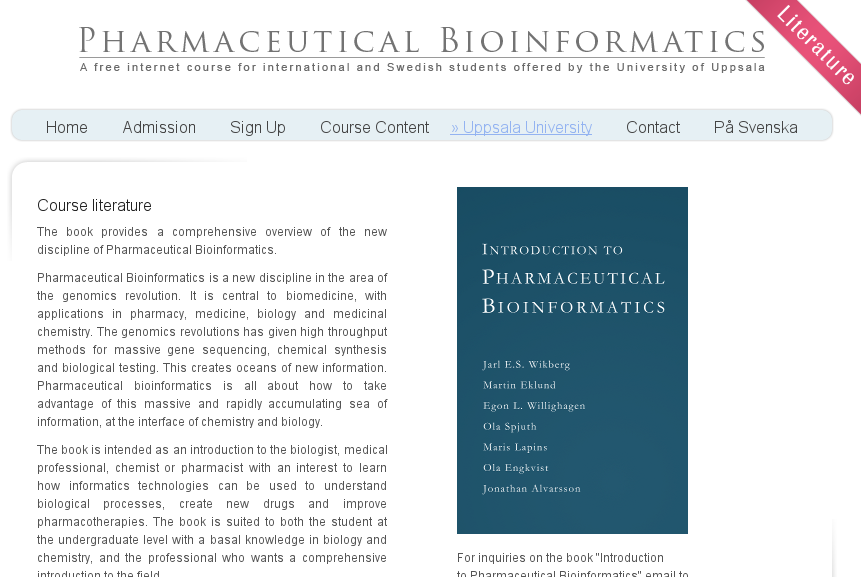
at <a href="http://www.uu.se/">Uppsala University</a> where I did my first two years of
post-docing in Sweden has a (free) course on <a href="http://www.pharmbio.org/">pharmaceutical bioinformatics</a>.
We worked hard on a course book, which after a year got printed. It ended up
with 400 pages, 15 chapters, and 3 appendices. It also includes examples on
how to do discussed topics in <a href="http://www.bioclipse.net/">Bioclipse</a>:</p>

<p><img src="/blog/assets/images/pharmbioBook.png" alt="" /></p>

<p>The chapters are:</p>

<ol>
  <li>
    <p>Introduction</p>
  </li>
  <li>
    <p>Background</p>
  </li>
  <li>
    <p>Drug discovery and development</p>
  </li>
  <li>
    <p>Bioinformatics, drugs and omics</p>
  </li>
  <li>
    <p>Representing molecules in computers</p>
  </li>
  <li>
    <p>Representation of 3D structures</p>
  </li>
  <li>
    <p>Molecular descriptors</p>
  </li>
  <li>
    <p>Sequence analysis</p>
  </li>
  <li>
    <p>Macromolecular descriptors</p>
  </li>
  <li>
    <p>Design of experiments</p>
  </li>
  <li>
    <p>Data analysis</p>
  </li>
  <li>
    <p>Databases</p>
  </li>
  <li>
    <p>QSAR</p>
  </li>
  <li>
    <p>Proteochemometrics</p>
  </li>
  <li>
    <p>Semantic web</p>
  </li>
  <li>
    <p>Answers</p>
  </li>
</ol>

<p>And three appendices:</p>

<p>A. Basic probability theory</p>

<p>B. Basic matrix algebra</p>

<p>C. Introduction to Bioclipse</p>

<p>The book is currently undergoing proof review and available to course participants
only, and should become available in a couple of months for the general public.</p>]]></content><author><name>Egon Willighagen</name></author><category term="bioclipse" /><category term="cdk" /><category term="cheminf" /><category term="chemometrics" /><category term="publishing" /><summary type="html"><![CDATA[The Wikberg group at Uppsala University where I did my first two years of post-docing in Sweden has a (free) course on pharmaceutical bioinformatics. We worked hard on a course book, which after a year got printed. It ended up with 400 pages, 15 chapters, and 3 appendices. It also includes examples on how to do discussed topics in Bioclipse:]]></summary><media:thumbnail xmlns:media="http://search.yahoo.com/mrss/" url="http://egonw.github.io/blog/blog/assets/images/pharmbioBook.png" /><media:content medium="image" url="http://egonw.github.io/blog/blog/assets/images/pharmbioBook.png" xmlns:media="http://search.yahoo.com/mrss/" /></entry><entry><title type="html">DIY: Running R from within Bioclipse</title><link href="http://egonw.github.io/blog/2011/02/01/diy-running-r-from-within-bioclipse.html" rel="alternate" type="text/html" title="DIY: Running R from within Bioclipse" /><published>2011-02-01T00:10:00+00:00</published><updated>2011-02-01T00:10:00+00:00</updated><id>http://egonw.github.io/blog/2011/02/01/diy-running-r-from-within-bioclipse</id><content type="html" xml:base="http://egonw.github.io/blog/2011/02/01/diy-running-r-from-within-bioclipse.html"><![CDATA[<p><strong>Important: this blog post is about a development version of Bioclipse, not
about the stable 2.4 series. See also Gilleain’s comment for this post.</strong></p>

<p>Arvid has done an excellent job in setting up <a href="http://pele.farmbio.uu.se/hudson/">Hudson for Bioclipse</a>,
which is not so trivial as for Maven projects. With the <a href="http://chem-bla-ics.blogspot.com/2011/02/running-r-from-within-bioclipse.html">R functionality</a>
I blogged about earlier today moved to the <a href="https://github.com/bioclipse/bioclipse.statistics">bioclipse.statistics repository</a>,
things are automatically build when new patches hit the repository. And Hudson
doesn’t just compile the code, it also exports binaries. The main <a href="http://www.bioclipse.net/">Bioclipse</a>
products build can be downloaded <a href="http://pele.farmbio.uu.se/hudson/job/Bioclipse.product/">here</a>
(Windows, Linux, OS/X; if you need more, please let use know). And, all the
additional features got automatically uploaded to individual update sites, very
much like Maven projects getting pushed to a Maven repository.</p>

<p>So, here’s an Bioclipse-R install guide for the adventurous (i.e. Christian,
Rajarshi and Rebecca, perhaps Juuso :). I will describe it from a <a href="http://www.debian.org/">Debian GNU/Linux</a>
perspective.</p>

<p>First, make sure you have <a href="http://www.r-project.org/">R</a> and <a href="http://cran.r-project.org/web/packages/rJava/index.html">rJava</a>
installed. I strongly recommend the versions from <a href="http://www.debian.org/releases/unstable/">sid/unstable</a>
(2.12 and 0.8-8), which are more stable here than those from <a href="http://www.debian.org/releases/testing/">testing</a>:</p>

<div class="language-shell highlighter-rouge"><div class="highlight"><pre class="highlight"><code>apt-get <span class="nb">install </span>r-base-core/sid r-cran-rjava/sid
</code></pre></div></div>

<p>Then you download the nightly build of Bioclipse 2.5.x from Hudson, e.g. for
my 32bit Linux:</p>

<div class="language-shell highlighter-rouge"><div class="highlight"><pre class="highlight"><code><span class="nb">cd</span> /tmp
wget http://pele.farmbio.uu.se/hudson/job/Bioclipse.product/lastSuccessfulBuild/artifact/tmp/bioclipse/net.bioclipse.platform_feature_2.4.0-eclipse.feature/Bioclipse.2.5.0.linux.gtk.x86.zip
unzip Bioclipse.2.5.0.linux.gtk.x86.zip
<span class="nb">cd </span>Bioclipse.2.5.0.linux.gtk.x86/&lt;/pre&gt;
</code></pre></div></div>
<p>But before we boot Bioclipse, we first need to tell it where to find the R instance,
and we need to set two variables for that: <em>R_HOME</em> and <em>java.library.path</em>.
The latter is set via the <em>bioclipse.ini</em> file, by adding this line to the end:</p>

<div class="language-shell highlighter-rouge"><div class="highlight"><pre class="highlight"><code><span class="nt">-Djava</span>.library.path<span class="o">=</span>/usr/lib/R/site-library/rJava/jri
</code></pre></div></div>

<p>The other is an environment variable and can be set with:</p>

<div class="language-shell highlighter-rouge"><div class="highlight"><pre class="highlight"><code><span class="nb">export </span><span class="nv">R_HOME</span><span class="o">=</span>//usr/lib/R
</code></pre></div></div>

<p>Then Bioclipse can be started:</p>

<div class="language-shell highlighter-rouge"><div class="highlight"><pre class="highlight"><code>./bioclipse
</code></pre></div></div>

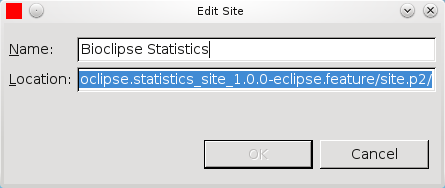
<p>The first thing to do is install the <em>R Feature</em>. To do this open the <em>Install
New Software…</em> dialog from the <em>Help</em> menu, and add (with the <em>Add</em> button)
the Bioclipse Statistics update site on Hudson at <a href="http://pele.farmbio.uu.se/hudson/view/Release/job/Bioclipse.statistics/lastSuccessfulBuild/artifact/buckminster.output/net.bioclipse.statistics_site_1.0.0-eclipse.feature/site.p2/">this Location</a>
(copy/paste the Location URL into the below dialog):</p>

<p><img src="/blog/assets/images/bc26statsUpdateSite3.png" alt="" /></p>

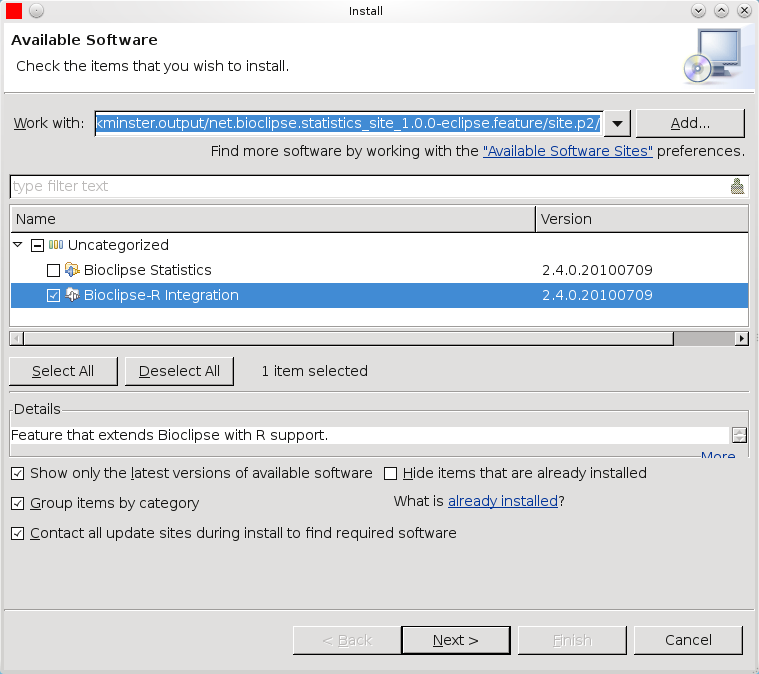
<p>When back in the Available Software dialog, select the new update site, and
mark the <em>Bioclipse-R Integration</em> feature to be installed:</p>

<p><img src="/blog/assets/images/bc26statsUpdateSite2.png" alt="" /></p>

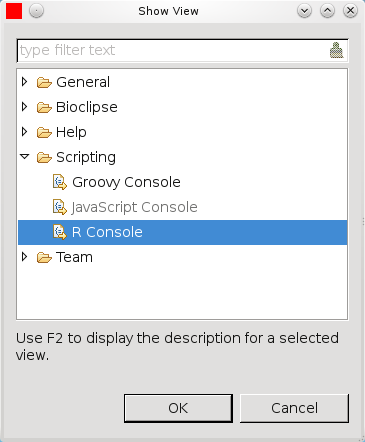
<p>After the install is completed, which will require a reboot of Bioclipse (why?!?!),
you can open the R console by opening a dialog from the Window -&gt; Show View -&gt;
Other… menu:</p>

<p><img src="/blog/assets/images/bc26statsUpdateSite4.png" alt="" /></p>

<p>The <em>R Console</em> will then show up as view, as depicted in my <a href="http://chem-bla-ics.blogspot.com/2011/02/running-r-from-within-bioclipse.html">earlier post</a>.</p>

<p>Loading of libraries, like running <em>library(“<a href="http://cran.r-project.org/web/packages/rcdk/index.html">rcdk</a>”)</em>
or <em>library(“<a href="http://cran.r-project.org/web/packages/pls/index.html">pls</a>”)</em>,
crashes the whole thing if you use R and rJava from Debian testing, and silently
fails with those from unstable. It’s on my agenda.</p>]]></content><author><name>Egon Willighagen</name></author><category term="bioclipse" /><category term="chemometrics" /><summary type="html"><![CDATA[Important: this blog post is about a development version of Bioclipse, not about the stable 2.4 series. See also Gilleain’s comment for this post.]]></summary><media:thumbnail xmlns:media="http://search.yahoo.com/mrss/" url="http://egonw.github.io/blog/blog/assets/images/bc26statsUpdateSite3.png" /><media:content medium="image" url="http://egonw.github.io/blog/blog/assets/images/bc26statsUpdateSite3.png" xmlns:media="http://search.yahoo.com/mrss/" /></entry><entry><title type="html">Running R from within Bioclipse</title><link href="http://egonw.github.io/blog/2011/02/01/running-r-from-within-bioclipse.html" rel="alternate" type="text/html" title="Running R from within Bioclipse" /><published>2011-02-01T00:00:00+00:00</published><updated>2011-02-01T00:00:00+00:00</updated><id>http://egonw.github.io/blog/2011/02/01/running-r-from-within-bioclipse</id><content type="html" xml:base="http://egonw.github.io/blog/2011/02/01/running-r-from-within-bioclipse.html"><![CDATA[<p> </p>

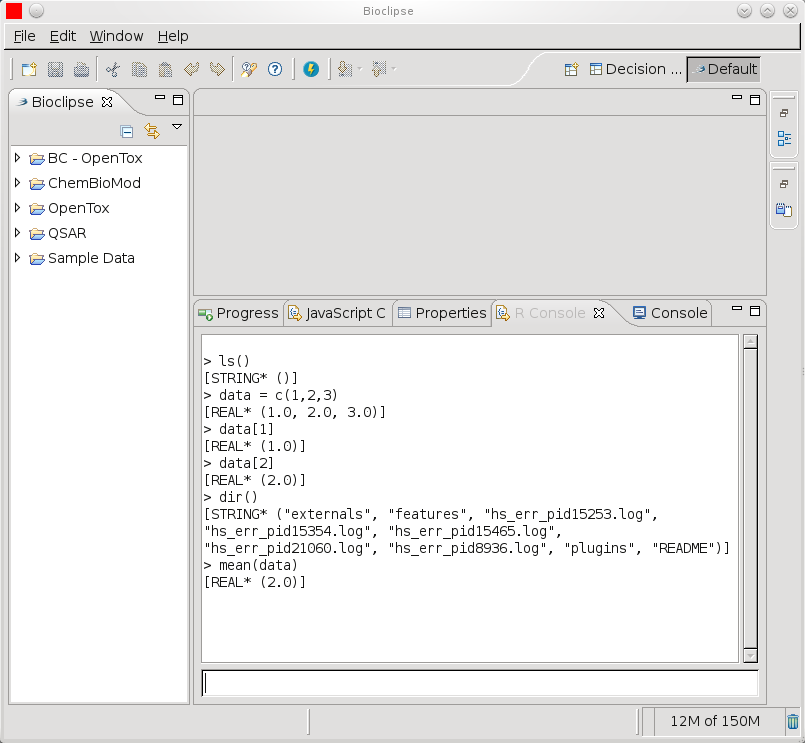
<p><img src="/blog/assets/images/bcR.png" alt="" /></p>

<p>One rarely know feature of <a href="http://www.bioclipse.net">Bioclipse</a> is that you
use it to run <a href="http://www.r-project.org/">R</a> code. This functionality has been
around for a while from <em>experimental</em>, and recently updated to use <a href="http://cran.r-project.org/web/packages/rJava/index.html">rJava</a>
by <a href="http://twitter.com/#!/carlmasak">Carl</a>. In the next months we will improve
passing around data between Bioclipse and the R session, providing a richer
chemometrics experience. And, with a bit of luck, it will be part of the upcoming 2.6
release.</p>]]></content><author><name>Egon Willighagen</name></author><category term="bioclipse" /><category term="chemometrics" /><summary type="html"><![CDATA[ ]]></summary><media:thumbnail xmlns:media="http://search.yahoo.com/mrss/" url="http://egonw.github.io/blog/blog/assets/images/bcR.png" /><media:content medium="image" url="http://egonw.github.io/blog/blog/assets/images/bcR.png" xmlns:media="http://search.yahoo.com/mrss/" /></entry><entry><title type="html">Karolinska Institutet</title><link href="http://egonw.github.io/blog/2011/01/12/karolinska-institutet.html" rel="alternate" type="text/html" title="Karolinska Institutet" /><published>2011-01-12T00:00:00+00:00</published><updated>2011-01-12T00:00:00+00:00</updated><id>http://egonw.github.io/blog/2011/01/12/karolinska-institutet</id><content type="html" xml:base="http://egonw.github.io/blog/2011/01/12/karolinska-institutet.html"><![CDATA[<p>Hi all, and a happy 2011! After a turbulent December (finishing up in the Oscar
project), holidays, etc, I am starting to get some sense of organization in
my new position at the <a href="http://ki.se/imm">Institutet för miljömedicin</a> at the
<a href="http://ki.se/">Karolinska Institutet</a> in <a href="http://en.wikipedia.org/wiki/Stockholm">Stockholm</a>.
I will be using cheminformatics and chemometrics methods in toxicology studies,
and work in the groups of <a href="http://ki.se/ki/jsp/polopoly.jsp?d=25010&amp;a=21910&amp;l=sv">Prof. Roland Grafström</a>
and <a href="http://ki.se/ki/jsp/polopoly.jsp?d=25010&amp;a=20446&amp;l=sv">Prof. Bengt Fadeel</a>.</p>

<p>The actual work will crystallize in the next weeks, but here are two pointers.
One is ToxBank, for which the website should go live this month, but Google
will provide some ideas about this FP7 project. The other part is into nanotoxicology
(see e.g. doi:<a href="http://dx.doi.org/10.1039/C0NR00535E">10.1039/C0NR00535E</a>).</p>

<p>So, if you are around in <a href="http://en.wikipedia.org/wiki/Solna_Municipality">Solna</a>,
give me a ping!</p>]]></content><author><name>Egon Willighagen</name></author><category term="cheminf" /><category term="chemometrics" /><category term="toxicology" /><category term="justdoi:10.1039/C0NR00535E" /><summary type="html"><![CDATA[Hi all, and a happy 2011! After a turbulent December (finishing up in the Oscar project), holidays, etc, I am starting to get some sense of organization in my new position at the Institutet för miljömedicin at the Karolinska Institutet in Stockholm. I will be using cheminformatics and chemometrics methods in toxicology studies, and work in the groups of Prof. Roland Grafström and Prof. Bengt Fadeel.]]></summary></entry><entry><title type="html">My talk at Imperial College</title><link href="http://egonw.github.io/blog/2010/12/14/my-talk-at-imperial-college.html" rel="alternate" type="text/html" title="My talk at Imperial College" /><published>2010-12-14T00:00:00+00:00</published><updated>2010-12-14T00:00:00+00:00</updated><id>http://egonw.github.io/blog/2010/12/14/my-talk-at-imperial-college</id><content type="html" xml:base="http://egonw.github.io/blog/2010/12/14/my-talk-at-imperial-college.html"><![CDATA[<p>Yesterday I was guest with <a href="http://www1.imperial.ac.uk/medicine/people/j.fonville07/">Judy</a>
at the <a href="http://www1.imperial.ac.uk/surgeryandcancer/">Department of Surgery &amp; Cancer</a>
at <a href="http://www1.imperial.ac.uk/">Imperial College</a>, where I presented the what
I am working on. As I met up in a pub with Ron (my former PhD supervisor, who
now works on metabolomics at the <a href="http://www.iasma.it/">Istituto Agrario San Michele all’Adige</a>
in Italy) the night before, the presentation does share many slides from previous
talks, but also adds a few new ones.</p>

<p><a href="https://doi.org/10.5281/zenodo.3597909"><img src="/blog/assets/images/odosos_imperial2010.png" alt="" /></a></p>

<p>It was great talking to Judy about her PhD research on NMR in metabolomics,
and <a href="http://www1.imperial.ac.uk/medicine/people/t.ebbels/">Tim</a> about further
work in this research. I was interesting to learn that here too they have problems
in metabolite identification quick like those when analyzing *C/MS data, and
was really happy to hear he is in contact with <a href="http://www.steinbeck-molecular.de/steinblog/">Christoph</a>
about an Open repository for metabolomics data.</p>

<p>Another ‘new’ slide was one advertising the yesterday launched <a href="http://www.openresearchcomputation.com/">Open Research
Computation</a> which I’ll blog about
in more detail later today.</p>]]></content><author><name>Egon Willighagen</name></author><category term="chemometrics" /><category term="drugdiscovery" /><category term="metabolomics" /><category term="odosos" /><category term="toxicology" /><category term="doi:10.5281/ZENODO.3597909" /><summary type="html"><![CDATA[Yesterday I was guest with Judy at the Department of Surgery &amp; Cancer at Imperial College, where I presented the what I am working on. As I met up in a pub with Ron (my former PhD supervisor, who now works on metabolomics at the Istituto Agrario San Michele all’Adige in Italy) the night before, the presentation does share many slides from previous talks, but also adds a few new ones.]]></summary><media:thumbnail xmlns:media="http://search.yahoo.com/mrss/" url="http://egonw.github.io/blog/blog/assets/images/odosos_imperial2010.png" /><media:content medium="image" url="http://egonw.github.io/blog/blog/assets/images/odosos_imperial2010.png" xmlns:media="http://search.yahoo.com/mrss/" /></entry><entry><title type="html">Uppsala Status Report</title><link href="http://egonw.github.io/blog/2010/11/27/uppsala-status-report.html" rel="alternate" type="text/html" title="Uppsala Status Report" /><published>2010-11-27T00:00:00+00:00</published><updated>2010-11-27T00:00:00+00:00</updated><id>http://egonw.github.io/blog/2010/11/27/uppsala-status-report</id><content type="html" xml:base="http://egonw.github.io/blog/2010/11/27/uppsala-status-report.html"><![CDATA[<p>As you know, my post-doc in <a href="http://www.farmbio.uu.se/">Uppsala</a> ended. It was
a good time, and it was great collaborating on Bioclipse with Ola, Jonathan,
Arvid, and Carl. I would have loved tighter integration with the work of Maris
and Martin, but that was limited to one joined paper (in press). I thank Professors
Jarl Wikberg and Eva Brittebo for allowing me to continue my research at their
department, and hope this is not the end of the collaboration yet.</p>

<p>Like with new year, the end of a contract is a good time to reflect on ones
accomplishments. It’s been a bit delayed, but as you know, I already in my next
<a href="http://chem-bla-ics.blogspot.com/2010/10/working-on-oscar-for-three-months.html">project in Cambridge</a>,
and will start in January with yet a longer term position in predictive toxicology
(more on that soon). This makes this a really crowded period, on top of birthdays,
<a href="http://sv.wikipedia.org/wiki/Sinterklaas">Sinterklaas</a>, x-mas, and sorts.</p>

<p><strong>My Research</strong><br />
As you might know, my research interest lies in understanding molecular properties
and their applications in larger molecular systems. This can be how small molecules
pack in crystals, finding patterns in properties (QSAR-like work), etc. Because
the underlying methods are useful in many domains, you see applications in various
too, including drug discovery, metabolomics, etc. These methods involve statistics
and cheminformatics, primarily, which is clear from my publications on method
development in chemometrics and cheminformatics. You will also have seen that
visualization is a very important tool here, as our numerical validation can
easily mislead even a trained scientist.</p>

<p><strong>How Uppsala fits in</strong><br />
About 30 months ago, I got an offer to join the <a href="http://www.bioclipse.net/">Bioclipse</a>
team to work on the cheminformatics features of the workbench. It was already
using the <a href="http://cdk.sf.net/">CDK</a>, so the project was a tight match with what
I did in the past. Additionally, there were plans to integrate <a href="http://www.r-project.org/">R</a>,
and while the latter is partially implemented, that part was unfortunately not
completed by the group yet. I believe this is a crucial aspect, and without
it the large-scale impact of Bioclipse will be severely reduced.</p>

<p>Bioclipse is positioned as a workbench to use third-party libraries, web services,
databases, etc, and has done so very successfully (doi:<a href="https://doi.org/10.1186/1471-2105-8-59">10.1186/1471-2105-8-59</a>).
It speaks many Open Standards, and already incorporates various important Open
Source libraries for life sciences research, including the aforementioned CDK
(doi:<a href="https://doi.org/10.2174/138161206777585274">10.2174/138161206777585274</a>,
doi:<a href="https://doi.org/10.1021/ci025584y">10.1021/ci025584y</a>), but also <a href="http://www.jmol.org/">Jmol</a>,
<a href="http://www.mdpi.org/molecules/html/50100093.htm">JChemPaint</a>, BioJava (doi:<a href="https://doi.org/10.1093/bioinformatics/btn397">10.1093/bioinformatics/btn397</a>),
and others. Using these libraries it has rich visualization means for life sciences
data, including molecules and protein sequences. The latter, of course, is directly
related to the proteochemometrics research done in <a href="http://www.proteochemometrics.org/index.php?option=com_content&amp;task=view&amp;id=23&amp;Itemid=14">Wikberg’s group</a>.
Recently, Bioclipse adopted scripting functionality, making it a perfect tool
to share life sciences computation, just like Taverna (doi:<a href="https://doi.org/10.1093/bioinformatics/bth361">10.1093/bioinformatics/bth361</a>)
and KNIME.</p>

<p>Where I hoped to do some research in proteochemometrics, events lead me into
different areas, which I explained in <a href="http://chem-bla-ics.blogspot.com/2010/11/why-you-have-not-heard-me-much-about.html">Why you have not heard me much about
chemometrics recently…</a>.</p>

<p>But, Bioclipse provides me with the tools I need to take molecular chemometrics
(doi:<a href="https://doi.org/10.1080/10408340600969601">10.1080/10408340600969601</a>)
forward.</p>

<p><strong>Results</strong><br />
So, what has this resulted in, besides a number of <a href="http://chem-bla-ics.blogspot.com/2010/11/more-fails-aka-no-vr-grant-awarded.html">unsuccessful</a>
grant applications? We’re still counting, but two book chapters, a book on <a href="http://www.pharmbio.org/">pharmaceutical
bioinformatics</a>, one proceedings paper, five research
papers, seven oral presentations at international meetings, and a ACS conference
on <a href="http://egonw.github.com/acsrdf2010/">RDF in chemistry</a>. Oh, and tons of
Open Source code, of course. (I’m at the edge of collapsing; I did that as student,
lost a year, but learned a lot about myself … these results I have worked
very hard for; I am not a <a href="http://en.wikipedia.org/wiki/Montgomery_Scott">miracle worker</a>.
And I have to disappoint people occasionally, as things do not work out how
I expected them to be. My apologies for that.)</p>

<p>I will not describe all in detail now, but focus on a few things around what
I made my research in Uppsala: semantic cheminformatics, which I believe to
be a key concept of where cheminformatics must be going. The first paper resulted
from a collaboration with Johannes, a medical researcher at the <a href="http://en.wikipedia.org/wiki/Ludwig_Maximilian_University_of_Munich">Ludwig-Maximilians-Universität</a>
in Germany (full reference at the end of the post). This work provides an alternative
to SOAP, which has a better solution to asynchronous computing that the polling
approaches now commonly used. A XMPP-based service just reports back when it
is done, so that you do not have to ask all the time. Makes sense to me. We
made the platform available to Bioclipse and Taverna, and demonstrated the technology
with applications in life sciences, including (QSAR) descriptor calculation,
and susceptibility for seven known HIV protease inhibitors.</p>

<p>This work stresses that if we really want to, we can significantly improve scientific
computing. It’s very much like what Peter <a href="http://wwmm.ch.cam.ac.uk/blogs/murrayrust/?p=2772">concluded this week</a>:
“None of this is rocket science - it’s purely a question of will”. This is what
I have being trying to show in the past few years. The disuse of accurate scientific
computing is a deliberate choice. Making your cheminformatics research irreproducible
is a choice, and a bad one too. There can be acceptable reasons, but the choice
would be bad nevertheless (I hope that distinction is clear: you can have valid
reasons to do something intrinsically wrong. You will be forgiven, and be encouraged
to change your behavior.) Many people on the Blue Obelisk community are laying
out the foundations and show cases, hoping to make it easier for others to change
behavior. I think we have been quite successful there.</p>

<p>Anyways… on to the second paper. As said, Bioclipse is the platform that can
bring these new cheminformatics methods to the desktop. The new and improved
Bioclipse 2 (see citation below) adds one important new feature: scripting.
My work in this paper focuses on doing making sure the cheminformatics library
was properly integrated, continued development of JChemPaint (yet unpublished,
and in collaboration with the <a href="http://www.ebi.ac.uk/steinbeck/">EBI</a>, but see
for example <a href="http://chem-bla-ics.blogspot.com/2008/06/httpchem-bla-icsblogspotcom200805develo.html">this blog post</a>),
and helping Ola and other to properly use the CDK in their applications (MetaPrint2D
(doi:<a href="https://doi.org/10.1186/1471-2105-11-362">10.1186/1471-2105-11-362</a>),
etc.). The impact of this work goes far beyond the papers on which I am author,
though not every reviewer will understand that, unfortunately. This work is
really the plumbing, it’s the development of the measuring machines to do the
job, the development of a STM device to actually get going.</p>

<p>The third paper, also listed at the end, is about defining a standard for detailed
exchange of QSAR data. It defines what information is needed to reproduce a
set of QSAR descriptors, including the input, and using a descriptor ontology
which we published about before (doi:<a href="https://doi.org/10.1021/ci050400b">10.1021/ci050400b</a>).
This project can be the seed of a public repository of QSAR data, where it will
be clear what is meant, and how the data can be used. If you are interested
in setting up such a public repository, please contact me or Ola.</p>

<p>That leaves me to the work that I have initiated in the group: the use of <a href="http://en.wikipedia.org/wiki/Resource_Description_Framework">RDF
technologies</a> (I
do hope all VR reviewers are listening). RDF provide a <a href="http://en.wikipedia.org/wiki/Lingua_franca">lingua franca</a>
for data exchange in life sciences, and the meaning of words is provided by
sharing dictionaries (ontologies). Bioclipse has been extended to speak RDF,
and we developed various applications based on it. A <a href="http://www.citeulike.org/user/egonw/article/6582022">proceedings</a>
previews the effort, while the paper is in print in the new Open Access <a href="http://www.jbiomedsem.com/">Journal
of Biomedical Semantics</a>. Of course, you can also
read much about this topic in this blog.</p>

<p>RDF is going to change bio- and cheminformatics in ways the XML has been unable
to do. Various papers are currently in preparation to provide detailed uses
case and related research. I am very excited about this technology which further
improved interoperability and reproducibility in cheminformatics. Should you
care about that? Yes, because by using these good practices, research will be
easier to interpret, conclusions judges, and as such, we can focus on the underlying
chemistry in much more details, instead of looking at noise which many current
cheminformatics literature is doing. (Ouch, that’s a bold statement indeed.
True? Well, without reproducibility it is hard to tell. Let’s all work towards
less magic, less black box, and more science in this field; we will all benefit
from that. Who knows, we might even convince the bench chemist that we are doing
something right ;)</p>

<p>So, where is the understanding of underlying patterns, you may wonder? That
is a fair question, but I have no grudge in admitting that after my PhD that
part has been underrepresented. That will change soon enough, though. Now I
can only hope it is on time go get me a Nature or Science paper, required to
get tenure (see <a href="http://friendfeed.com/mrgunn/1ea91bb9/payoffs-of-wasting-time">this discussion</a>).</p>

<p>That’s not all I did. I have not discussed the book chapters, the book, the
other publications to which I contributed in various ways (doi:<a href="https://doi.org/10.1186/1471-2105-11-159">10.1186/1471-2105-11-159</a>,
doi:<a href="https://doi.org/10.1093/bioinformatics/btq476">10.1093/bioinformatics/btq476</a>).
That will come in a more detailed report later.</p>

<p>Finally, I link to thanx <a href="http://www.uu.se">Uppsala University</a> for the <a href="http://usxs.fysik.uu.se/~kof">KoF
07 grant</a> which funded my work in Uppsala.</p>]]></content><author><name>Egon Willighagen</name></author><category term="bioclipse" /><category term="bioinfo" /><category term="cdk" /><category term="cheminf" /><category term="chemistry" /><category term="chemometrics" /><category term="postdoc" /><category term="uppsala" /><category term="doi:10.2174/138161206777585274" /><category term="doi:10.1186/1471-2105-8-59" /><category term="doi:10.1021/CI025584Y" /><category term="doi:10.3390/50100093" /><category term="justdoi:10.1093/bioinformatics/btn397" /><category term="justdoi:10.1093/bioinformatics/bth361" /><category term="doi:10.1080/10408340600969601" /><category term="justdoi:10.1186/1471-2105-11-362" /><category term="doi:10.1186/1471-2105-11-159" /><category term="doi:10.1093/BIOINFORMATICS/BTQ476" /><summary type="html"><![CDATA[As you know, my post-doc in Uppsala ended. It was a good time, and it was great collaborating on Bioclipse with Ola, Jonathan, Arvid, and Carl. I would have loved tighter integration with the work of Maris and Martin, but that was limited to one joined paper (in press). I thank Professors Jarl Wikberg and Eva Brittebo for allowing me to continue my research at their department, and hope this is not the end of the collaboration yet.]]></summary></entry><entry><title type="html">Why you have not heard me much about chemometrics recently…</title><link href="http://egonw.github.io/blog/2010/11/20/why-you-have-not-heard-me-much-about.html" rel="alternate" type="text/html" title="Why you have not heard me much about chemometrics recently…" /><published>2010-11-20T00:00:00+00:00</published><updated>2010-11-20T00:00:00+00:00</updated><id>http://egonw.github.io/blog/2010/11/20/why-you-have-not-heard-me-much-about</id><content type="html" xml:base="http://egonw.github.io/blog/2010/11/20/why-you-have-not-heard-me-much-about.html"><![CDATA[<p>A casual reader my not know the background of the title of my blog. A bit over
five years ago, when I started this blog, <a href="http://chem-bla-ics.blogspot.com/2005/10/chem-bla-ics.html">I defined chemblaics</a>:</p>

<blockquote>
  <p>Chemblaics (pronounced chem-bla-ics) is the science that uses computers to address and possibly
solve problems in the area of chemistry, biochemistry and related fields. The general denomiter
seems to be molecules, but I might be wrong there. The big difference between chemblaics and
areas as cheminformatics, chemoinformatics, chemometrics, proteochemometrics, etc, is that
chemblaic only uses open source software, making experimental results reproducable and validatable.
And this is a big difference with how research in these areas is now often done.</p>
</blockquote>

<p>Later, I also identified <em>molecular chemometrics</em> (doi:<a href="http://dx.doi.org/10.1080/10408340600969601">10.1080/10408340600969601</a>)
when I reviewed important innovation in the field, which has, IMHO, a strong
overlap with chemblaics. Any reader of my blog will understand that I see semantic
technologies play a very important role here, as Open Standard for communication
Open Data between the bench chemist and the data analyst using Open Source allowing
others to reproduce, validate, and extend that work. Some have identified the
possibilities the internet brings over 10 years ago, while the use of semantic
computing goes back even further.</p>

<p>And what have the big publishers done? Nothing much yet. Not the old, not the
new. There are project ongoing, and there is a tendency (BioMed Central starts
delivering Open Data, Beilstein Institute spits RDF for a few years now, Royal
Society of Chemistry has Project Prospect), but most publishers are too late,
and not investing enough with respect to their yearly turn over. This is particularly
clear if you realize that <em>citizen and hobby scientists</em> can innovate publishing
more effectively than those projects (really!). Anyway, I do not want to talk
about publishing now, but it is just so relevant: I am not a publisher, but
publications are the primary source of knowledge (not implying at all that I
think that is the best way; it is not).</p>

<p>Instead, I am a data analyst, a chemometrician, a statistician, a cheminformatics
dude, or a (pharmaceutical) bioinformatician, depending on your field of expertise.
Really, I am a chemblaics guy: I apply and develop informatics and statistics
methods to understand chemistry (and biology) better.</p>

<p>During my PhD it became painfully clear that current science is horribly failing,
in many ways:</p>

<ul>
  <li>Firstly, we are hiring the wrong people because we care more about a co-authored
pipetting paper in Nature, than ground-breaking work in the J. Chem. Inf.
Mod. (what journal?! Exactly my point!).</li>
  <li>Secondly, we have our most bright scientists (the full time professors, assuming
that some have been hired for the right reasons) spend most of their time
on administrative work (like proposal writing, administrating big national/EU
projects).</li>
  <li>Thirdly, we spent million (in whatever currency) on large projects which end
in useless political discussions instead of getting science done.</li>
  <li>Finally, all knowledge from laborious, hard work is placed in PDF hamburgers
and lost to society (unless you spend multibucks to extract it again).</li>
</ul>

<p>There are likely several more, but these three are the most important to me
right now.</p>

<p>So, in the past years after finishing my PhD research which was on data mining
and modeling molecular data, I have spend much of my time on improving methods
in chem- and bioinformatics to handle. Hardly anyone else was doing it (several
Blue Obelisk community un-members as prominent exceptions), but someone has.</p>

<p>Why I have been doing this? Well, without good, curated data sources it is impossible
to decide why my (or others) predictive models are not working (as good as we
want them to be). Is this relevant? I would say so, yes! The field is riddled
with irreproducible studies of which one has no clue how useful they are. Trust
the authors who wrote the paper? No, thank you, but I rather verify: I am a
scientist and not a cleric. Weirdly, one would have expected this to be the
default in cheminformatics, where most stuff is electronic and reproducing results
should be cheap. Well, another fail for science, I guess.</p>

<p>So, that explains why I have not recently done so much in chemometrics. Will
I return? Surely! Right about now. There is already a paper <em>in press</em> where
we link the semantic web to (proteo)chemometrics, and more is to follow soon.</p>

<p>One example, interestingly, is pKa prediction, which has seen quite a few publications
recently, yet experimental pKa data is not available as Open Data. Why?? Let
me know if you have any clue. Yet, pKa prediction seems to be important to drug
discovery, as it gets an awful lot of attention (400+ papers in the past 10
year, of which 50+ in 2010!). But this is about to change. Samuel and I are
finishing a project that greatly simplifies knowledge aggregation and curation,
as input to statistical modeling. We now have the tools ready to do this fast
and efficiently. Right now, I am entering curated data at a speed of about 3
chemical structures a minute. That means, given I need a break now and then,
that I enter create a data set of reasonable size in a few days. Crowd-sourcing
this, the a small community can liberate data from literature in a few days.</p>

<p>This will have a huge impact on the cheminformatics and QSAR communities. They
will no longer have any excuse for making their data not available. There is
no argument anymore that curation is expensive. This will also have a huge impact
on cheminformatics and chemical data vendors. Where Open Source only had moderate
impact so far (several software vendors have already joined the Open Source
cheminformatics community), this will force them to rethink their business model.
Where they could hide behind curation where it came to text mining initiatives
(like Oscar, on which I am currently working), with cheap, expert curation knowledge
building at hand, they will be forced to rethink their added value.</p>

<p>The impact on the CDK should be clear too. We no longer depend on published
models for ALogP, XLogP, pKa, etc, predictions. Within a year, you can expect
the CDK project to release the tools to train your own models, and make choices
suitable for your user base. For example, you can make more precise models around
the structures your lab works on, or more generic models with large screening
projects. Importantly, the community will provide an Open Data knowledge base
to start from. Using our Open Standards, you can plug in your own confidential
data and make mixed, targeted models.</p>

<p>Is this possible with the cheminformatics of the past 30 years? No, and that’s
the reason why I have been away from chemometrics for a while.</p>]]></content><author><name>Egon Willighagen</name></author><category term="cheminf" /><category term="chemometrics" /><category term="odosos" /><category term="opendata" /><category term="qsar" /><category term="doi:10.1080/10408340600969601" /><summary type="html"><![CDATA[A casual reader my not know the background of the title of my blog. A bit over five years ago, when I started this blog, I defined chemblaics:]]></summary></entry><entry><title type="html">The Molecular Chemometrics Principles #2: be clear in what you mean</title><link href="http://egonw.github.io/blog/2010/08/12/molecular-chemometrics-principles-2-be.html" rel="alternate" type="text/html" title="The Molecular Chemometrics Principles #2: be clear in what you mean" /><published>2010-08-12T00:00:00+00:00</published><updated>2010-08-12T00:00:00+00:00</updated><id>http://egonw.github.io/blog/2010/08/12/molecular-chemometrics-principles-2-be</id><content type="html" xml:base="http://egonw.github.io/blog/2010/08/12/molecular-chemometrics-principles-2-be.html"><![CDATA[<p>I noted <a href="https://chem-bla-ics.linkedchemistry.info/2010/08/09/molecular-chemometrics-principles-1.html">earlier this week</a>
that <em>[d]uring the week [in <a href="/2010/08/06/oxford-2.html">Oxford <i class="fa-solid fa-recycle fa-xs"></i></a>], someone (name and address is know at the
editorial office) commented on the fact that my blog posts are somewhat difficult to follow; that is, it’s
often not clear why I am posting what I am posting</em>. This triggered the start of a series of principles in
the field I coined <a href="https://doi.org/10.1080/10408340600969601">Molecular Chemometrics</a>, and the promise
that I will try to indicate in each blog post to which of these principles it relates. Just to put things in a bit more
perspective; to make a bit more clear why I am blogging about that bit; just to be clear in what I mean.</p>

<p>Now, the first principle was about the need for access to data (<a href="https://chem-bla-ics.linkedchemistry.info/2010/08/09/molecular-chemometrics-principles-1.html">McPrinciple #1</a>).
This principle goes without saying, one would think, but is not widely accepted yet. This is why Open Data promotion is still needed. For example, data in papers
still is not freely redistributable, as <a href="https://chem-bla-ics.linkedchemistry.info/2010/08/09/molecular-chemometrics-principles-1.html">Peter points out once again</a>.</p>

<p>Anyway, this post is not about McPrinciple #1, but about the second principle.</p>

<p><strong>Molecular Chemometrics Principles #2</strong>: In order to reproduce cheminformatics studies you need to be able to understand the input data.</p>

<p>Readers of my blog will surely recognize this theme. Clearly this theme explains my past fetish for the
<a href="http://chem-bla-ics.blogspot.com/search?q=CML">Chemical Markup Language</a>, and my more recent work on the
<a href="http://chem-bla-ics.blogspot.com/search?q=RDF">Resource Description Framework</a>.</p>

<p>And it is so easy to jump to conclusions. Easy to make mistakes. And this is not just at the received side; the sending
person may have accidentally made a mistake, or left something accidentally unclear, causing incorrect assumptions, and
therefore errors in the cheminformatics computation. Now, if the data was semantically (clearly) annotated, and the
meaning was clear, it was also trivial to see when a mistake had sneaked in. Think of it as a check bit.</p>

<p>“Well, isn’t this a bit exaggerated,” you might say. Perhaps, perhaps not. An simple, recent example. We all know
<a href="http://www.opensmiles.org/">SMILES</a>, right? And we all know that lower case element symbols indicate aromaticity, right?
That is, c1ccccc1 is aromatic, right? So, what’s the problem then?</p>

<p>Now, consider the SMILES string c1ccc1. Lower case carbon element symbols, so aromatic, right? Oh, wait…</p>

<p>Therefore, be clear in what you mean. It saves us from a lot of trouble.</p>

<p>Further reading:</p>

<ul>
  <li><a href="https://chem-bla-ics.linkedchemistry.info/2010/08/09/molecular-chemometrics-principles-1.html">The Molecular Chemometrics Principles #1: access to data</a></li>
  <li>Molecular Chemometrics, 2006 (doi:<a href="https://doi.org/10.1080/10408340600969601">10.1080/10408340600969601</a>)</li>
</ul>]]></content><author><name>Egon Willighagen</name></author><category term="mcprinciples" /><category term="chemometrics" /><category term="rdf" /><category term="cml" /><category term="semweb" /><category term="doi:10.1080/10408340600969601" /><summary type="html"><![CDATA[I noted earlier this week that [d]uring the week [in Oxford ], someone (name and address is know at the editorial office) commented on the fact that my blog posts are somewhat difficult to follow; that is, it’s often not clear why I am posting what I am posting. This triggered the start of a series of principles in the field I coined Molecular Chemometrics, and the promise that I will try to indicate in each blog post to which of these principles it relates. Just to put things in a bit more perspective; to make a bit more clear why I am blogging about that bit; just to be clear in what I mean.]]></summary></entry><entry><title type="html">The Molecular Chemometrics Principles #1: access to data</title><link href="http://egonw.github.io/blog/2010/08/09/molecular-chemometrics-principles-1.html" rel="alternate" type="text/html" title="The Molecular Chemometrics Principles #1: access to data" /><published>2010-08-09T00:00:00+00:00</published><updated>2010-08-09T00:00:00+00:00</updated><id>http://egonw.github.io/blog/2010/08/09/molecular-chemometrics-principles-1</id><content type="html" xml:base="http://egonw.github.io/blog/2010/08/09/molecular-chemometrics-principles-1.html"><![CDATA[<p>The meetings in and around Oxford were great! I already wrote that the Predictive Toxicology workshop was brilliant
(see <a href="/2010/08/01/oxford.html">Oxford… #1 <i class="fa-solid fa-recycle fa-xs"></i></a>) and
<a href="/2010/08/06/oxford-2.html">Oxford… #2 <i class="fa-solid fa-recycle fa-xs"></i></a>), but I also very, very much enjoyed meeting up
with <a href="http://www.danhagon.me.uk/blog/">Dan</a> and <a href="http://semanticscience.wordpress.com/">Nico</a>! During the week, someone
(name and address is know at the editorial office) commented on the fact that my blog posts are somewhat difficult
to follow; that is, it’s often not clear why I am posting what I am posting.</p>

<p>Indeed, I am not particularly one of those bloggers who spends trees after trees, in great detail explaining what is going on.
I do make a lot of use of <a href="http://en.wikipedia.org/wiki/Hyperlink">hyperlinking</a>; much more than the average blogger. I
actually assume that readers follow links, to read about the perspective of a blog post. But we all know that scientists
do not read the cited papers in a paper they are reading, so who am I to assume blog readers would start doing that with blogs :)</p>

<p>Well, since <a href="/2010/02/19/open-data-panton-principles.html">principles seems popular <i class="fa-solid fa-recycle fa-xs"></i></a>, it might be
a good start of my grand scheme that is behind this blog: the Molecular Chemometrics Principles. Hence, this first post about
the why. The why is simply to provide a reference frame to what I am blogging about. In the next few posts on these
McPrinciples (is that a catchy name, or what?) that will appear over the next two weeks, I will outline the code of
chem-bla-ics. And, moreover, from now on, I will tag all my posts with the reaons why I make that post. I am sure that will
not be too helpful for the occasional reader, but for anyone who is serious about chem-bla-ics, this will be a genuine gold
mine of data for pattern recognition and data mining otherwise.</p>

<p>So, here goes.</p>

<p><strong>Molecular Chemometrics Principles #1</strong>: In order to reproduce cheminformatics studies you need access to the input data.</p>

<p>The reason for this is that statistical modeling very much depends on the data on which modeling was done, patterns
were recognized, etc. Therefore, without the input data, it is practically impossible to accurately reproduce results.
Fortunately, the acceptance of the importance of access to data (e.g. as Open Data) is slowly getting momentum in
science.</p>

<p>Further reading: Molecular Chemometrics, 2006 (doi:<a href="https://doi.org/10.1080/10408340600969601">10.1080/10408340600969601</a>)</p>]]></content><author><name>Egon Willighagen</name></author><category term="chemometrics" /><category term="mcprinciples" /><category term="doi:10.1080/10408340600969601" /><summary type="html"><![CDATA[The meetings in and around Oxford were great! I already wrote that the Predictive Toxicology workshop was brilliant (see Oxford… #1 ) and Oxford… #2 ), but I also very, very much enjoyed meeting up with Dan and Nico! During the week, someone (name and address is know at the editorial office) commented on the fact that my blog posts are somewhat difficult to follow; that is, it’s often not clear why I am posting what I am posting.]]></summary></entry></feed>