<?xml version="1.0" encoding="utf-8"?><feed xmlns="http://www.w3.org/2005/Atom" ><generator uri="https://jekyllrb.com/" version="4.3.4">Jekyll</generator><link href="http://egonw.github.io/blog/feed/by_tag/cito.xml" rel="self" type="application/atom+xml" /><link href="http://egonw.github.io/blog/" rel="alternate" type="text/html" /><updated>2026-11-19T06:09:00+00:00</updated><id>http://egonw.github.io/blog/feed/by_tag/cito.xml</id><title type="html">chem-bla-ics</title><subtitle>Chemblaics (pronounced chem-bla-ics) is the science that uses open science and computers to solve problems in chemistry, biochemistry and related fields.</subtitle><author><name>Egon Willighagen</name></author><entry><title type="html">CiteULike CiTO Use Case #1: Wordles</title><link href="http://egonw.github.io/blog/2010/10/31/citeulike-cito-use-case-1-wordles.html" rel="alternate" type="text/html" title="CiteULike CiTO Use Case #1: Wordles" /><published>2010-10-31T00:00:00+00:00</published><updated>2010-10-31T00:00:00+00:00</updated><id>http://egonw.github.io/blog/2010/10/31/citeulike-cito-use-case-1-wordles</id><content type="html" xml:base="http://egonw.github.io/blog/2010/10/31/citeulike-cito-use-case-1-wordles.html"><![CDATA[<p>Last month I reported a <a href="https://chem-bla-ics.linkedchemistry.info/2010/09/17/list-of-things-i-miss-in-citeulike.html">few things I missed <i class="fa-solid fa-recycle fa-xs"></i></a>
in <a href="http://www.citeulike.org/">CiteULike</a>. One of them was support for CiTO (see
doi:<a href="https://doi.org/10.1186/2041-1480-1-S1-S6">10.1186/2041-1480-1-S1-S6</a>), a great Citation Typing Ontology.</p>

<p>I promised the CiTO author, <a href="http://www.zoo.ox.ac.uk/staff/academics/shotton_dm.htm">David</a>, my use cases, but have been horribly
busy in the past few weeks with my new position, wrapping up my past position, and thinking on my position after Cambridge. But finally, here it is. Based on source code I
<a href="http://github.com/egonw/groovy-citeulike">wrote and released earlier</a>, the first use case I represent is the
<a href="http://www.wordle.net/">Wordle</a> one, which I <a href="https://chem-bla-ics.linkedchemistry.info/2010/02/21/wordle-of-titles-of-20-most-recent.html">showed with manual work in February <i class="fa-solid fa-recycle fa-xs"></i></a>.</p>

<p>Now that all the data is semantically marked up in CiteULike, I can easily extract all paper titles (or whatever is available in CiteULike) for all papers that cite the first
<a href="http://cdk.sf.net/">CDK</a> paper (doi:<a href="http://dx.doi.org/10.1021/ci025584y">10.1021/ci025584y</a>). Using the JSON interface, I have
<a href="http://github.com/egonw/groovy-citeulike/blob/master/cul2wordleInput.groovy">this Groovy script</a> to extract all titles:</p>

<div class="language-groovy highlighter-rouge"><div class="highlight"><pre class="highlight"><code><span class="kn">import</span> <span class="nn">groovyx.net.http.HTTPBuilder</span>
<span class="kn">import</span> <span class="nn">groovyx.net.http.Method</span>
<span class="kn">import</span> <span class="nn">static</span> <span class="n">groovyx</span><span class="o">.</span><span class="na">net</span><span class="o">.</span><span class="na">http</span><span class="o">.</span><span class="na">ContentType</span><span class="o">.</span><span class="na">JSON</span>

<span class="n">culUrl</span> <span class="o">=</span> <span class="s2">"http://www.citeulike.org/"</span><span class="o">;</span>

<span class="n">citotags</span> <span class="o">=</span> <span class="o">[</span>
  <span class="s2">"cito--cites"</span><span class="o">,</span>
  <span class="s2">"cito--usesMethodIn"</span><span class="o">,</span>
  <span class="s2">"cito--discusses"</span><span class="o">,</span>
  <span class="s2">"cito--extends"</span>
<span class="c1">// there are more, but these are all</span>
<span class="c1">// I use right now</span>
<span class="o">]</span>

<span class="n">papers</span> <span class="o">=</span> <span class="o">[</span>
  <span class="s2">"1073448"</span><span class="o">,</span>
  <span class="s2">"423382"</span>
<span class="o">]</span>

<span class="n">http</span> <span class="o">=</span> <span class="k">new</span> <span class="n">HTTPBuilder</span><span class="o">(</span><span class="n">culUrl</span><span class="o">)</span>

<span class="n">papers</span><span class="o">.</span><span class="na">each</span> <span class="o">{</span> <span class="n">paper</span> <span class="o">-&gt;</span>
  <span class="n">println</span> <span class="s2">"# Processing $paper..."</span>
  <span class="n">citotags</span><span class="o">.</span><span class="na">each</span> <span class="o">{</span> <span class="n">tag</span> <span class="o">-&gt;</span>
    <span class="n">citation</span> <span class="o">=</span> <span class="s2">"$tag--$paper"</span><span class="o">.</span><span class="na">toLowerCase</span><span class="o">()</span>
    <span class="n">http</span><span class="o">.</span><span class="na">request</span><span class="o">(</span><span class="n">Method</span><span class="o">.</span><span class="na">valueOf</span><span class="o">(</span><span class="s2">"GET"</span><span class="o">),</span> <span class="n">JSON</span><span class="o">)</span> <span class="o">{</span>
      <span class="n">uri</span><span class="o">.</span><span class="na">path</span> <span class="o">=</span> <span class="s2">"/json/user/egonw/tag/$citation"</span>

      <span class="n">response</span><span class="o">.</span><span class="na">success</span> <span class="o">=</span> <span class="o">{</span> <span class="n">resp</span><span class="o">,</span><span class="n">json</span> <span class="o">-&gt;</span>
        <span class="n">json</span><span class="o">.</span><span class="na">each</span> <span class="o">{</span> <span class="n">article</span> <span class="o">-&gt;</span>
          <span class="n">tripleCount</span> <span class="o">=</span> <span class="mi">0</span><span class="o">;</span>
          <span class="n">article</span><span class="o">.</span><span class="na">tags</span><span class="o">.</span><span class="na">each</span> <span class="o">{</span> <span class="n">artTag</span> <span class="o">-&gt;</span>
            <span class="k">if</span> <span class="o">(</span><span class="n">artTag</span><span class="o">.</span><span class="na">startsWith</span><span class="o">(</span><span class="n">tag</span><span class="o">))</span> <span class="n">tripleCount</span><span class="o">++</span>
          <span class="o">}</span>
          <span class="k">if</span> <span class="o">(</span><span class="n">tripleCount</span> <span class="o">&gt;</span> <span class="mi">0</span><span class="o">)</span> <span class="o">{</span>
            <span class="n">title</span> <span class="o">=</span> <span class="n">article</span><span class="o">.</span><span class="na">title</span>
            <span class="n">title</span> <span class="o">=</span> <span class="n">title</span><span class="o">.</span><span class="na">replaceAll</span><span class="o">(</span><span class="s2">"\\{"</span><span class="o">,</span><span class="s2">""</span><span class="o">)</span>
            <span class="n">title</span> <span class="o">=</span> <span class="n">title</span><span class="o">.</span><span class="na">replaceAll</span><span class="o">(</span><span class="s2">"\\}"</span><span class="o">,</span><span class="s2">""</span><span class="o">)</span>
            <span class="n">println</span> <span class="s2">"$title"</span>
          <span class="o">}</span>
        <span class="o">}</span>
      <span class="o">}</span>
    <span class="o">}</span>
  <span class="o">}</span>
<span class="o">}</span>
</code></pre></div></div>

<p>The output is two blocks which I can easily copy/paste into Wordle. Now, I think I heard one can actually download the java code, so I am tempted to integrate it later,
but for now copy/paste will do fine, after the data handling is mostly automated: with a few lines extra I can make such visualizations for any paper
I annotated in CiteULike with CiTO.</p>

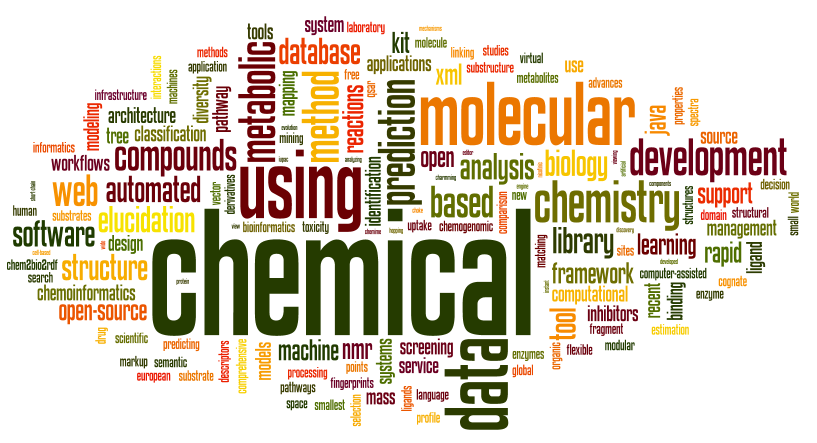
<p><strong>The CDK I paper</strong></p>

<p><img src="/blog/assets/images/wordleCDK1.png" alt="" /></p>

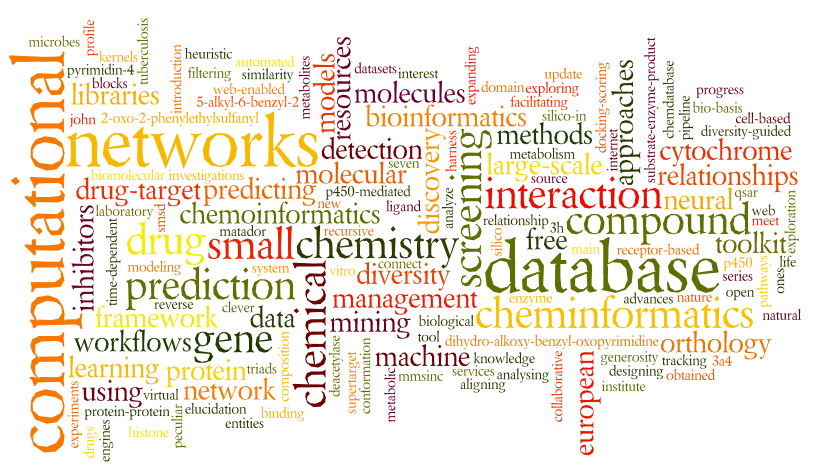
<p><strong>The CDK II paper</strong></p>

<p><img src="/blog/assets/images/wordleCDK2.png" alt="" /></p>

<p>Interesting differences… more statistics will soon follow. See <a href="https://chem-bla-ics.linkedchemistry.info/2010/02/22/further-statistics-on-papers-citing-cdk.html">Further statistics on the papers citing the CDK <i class="fa-solid fa-recycle fa-xs"></i></a>
for the kind of analyses I have in mind.</p>]]></content><author><name>Egon Willighagen</name></author><category term="justdoi:10.1186/2041-1480-1-S1-S6" /><category term="cito" /><category term="citeulike" /><category term="cdk" /><category term="wordle" /><category term="doi:10.1021/CI025584Y" /><summary type="html"><![CDATA[Last month I reported a few things I missed in CiteULike. One of them was support for CiTO (see doi:10.1186/2041-1480-1-S1-S6), a great Citation Typing Ontology.]]></summary><media:thumbnail xmlns:media="http://search.yahoo.com/mrss/" url="http://egonw.github.io/blog/blog/assets/images/wordleCDK1.png" /><media:content medium="image" url="http://egonw.github.io/blog/blog/assets/images/wordleCDK1.png" xmlns:media="http://search.yahoo.com/mrss/" /></entry><entry><title type="html">A list of things I miss in CiteULike</title><link href="http://egonw.github.io/blog/2010/09/17/list-of-things-i-miss-in-citeulike.html" rel="alternate" type="text/html" title="A list of things I miss in CiteULike" /><published>2010-09-17T00:00:00+00:00</published><updated>2010-09-17T00:00:00+00:00</updated><id>http://egonw.github.io/blog/2010/09/17/list-of-things-i-miss-in-citeulike</id><content type="html" xml:base="http://egonw.github.io/blog/2010/09/17/list-of-things-i-miss-in-citeulike.html"><![CDATA[<p>AJCann posted a blog today about what <a href="http://scienceoftheinvisible.blogspot.com/2010/09/long-list-of-things-i-dont-like-about.html">he doesn’t like about Mendeley</a>.
Abhishek replied that he does not like people complain about one tool, instead of pointing out a good alternative.
<a href="http://www.mendeley.com/">Mendeley</a> has two alternatives, <a href="http://www.zotero.org/">Zotero</a> and <a href="http://www.citeulike.org/">CiteULike</a> (there is also
<a href="http://connotea.org/">Connotea</a>, but got behind in evolution).</p>

<p>Agreeing with <a href="http://twitter.com/citeulike">@citeulike</a> and <a href="http://twitter.com/abhishektiwari">@abhishektiwari</a>, as a service provider
any bad news is good news too: they provide opportunities to improve. So, as encouraged to do so, I reported my long list of things I miss in CiteULike:</p>

<ul>
  <li>@citeulike ok, one more. wish #18: get readermeter.org to also support citeulike</li>
  <li>@citeulike wish #17: allow people linking between papers in their libs using CiTO to annotate how they cite papers, see http://ur.ly/lBUO</li>
  <li>@citeulike wish #16: I think I saw images from some papers, right? how about doing that for #biomedcentral journals too?</li>
  <li>@citeulike wish #15: at the same http://ur.ly/lIGn page, the tag cloud should reflect tag use with font sizing</li>
  <li>@citeulike wish #14: upon ‘post url’, the first page with extraced information should allow marking as ‘I am author’ (cannot find that)</li>
  <li>@citeulike (new) wish #12: clicking an account name should get me to a public portal, rather than just his paper list</li>
  <li>@citeulike good point, wish #13: be more strong on requiring people to tag papers… and use article keywords as default tags</li>
  <li>@citeulike wish #11: remove ‘no-tag’ from tag clouds</li>
  <li>@citeulike wish #10: support #RDF export with BIBO and/or PRISM</li>
  <li>@citeulike wish #9: use #foaf for the RDFa for account pages, and to mark up friends</li>
  <li>@citeulike wish #8: and more generally, make #citeulike part of the #linkeddata network (provide an #rdf API)</li>
  <li>@citeulike wish #7: start using RDFa, e.g. with the PRISM ontology</li>
  <li>@citeulike wish #6: on an article page (like http://ur.ly/lvWk) summarize the network that bookmarked that article, not just the acc names</li>
  <li>@citeulike wish #5: don’t show the ‘copy’ button for papers that are already in my archive (really a bug)</li>
  <li>@citeulike indeed, but don’t or do it right… wish #4: allow people to have that link automatically point to an external blog</li>
  <li>@citeulike wish #3: provide summaries of lists, like article count per journal and article count per year</li>
  <li>@citeulike well, I’ll use the blog functoinality to summarize… wish #2: do not try to be a blogging platform</li>
  <li>@citeulike (new) wish #1: put automatically focus on text field after clicking search and select all text for easy deletion</li>
</ul>

<p>The reports are now also available in the <a href="http://www.citeulike.org/groupfunc/3124/forums">fora of CiteULike</a>.</p>]]></content><author><name>Egon Willighagen</name></author><category term="cito" /><category term="citeulike" /><summary type="html"><![CDATA[AJCann posted a blog today about what he doesn’t like about Mendeley. Abhishek replied that he does not like people complain about one tool, instead of pointing out a good alternative. Mendeley has two alternatives, Zotero and CiteULike (there is also Connotea, but got behind in evolution).]]></summary></entry><entry><title type="html">Citing the Chemistry Development Kit</title><link href="http://egonw.github.io/blog/2010/02/18/citing-chemistry-development-kit.html" rel="alternate" type="text/html" title="Citing the Chemistry Development Kit" /><published>2010-02-18T00:00:00+00:00</published><updated>2010-02-18T00:00:00+00:00</updated><id>http://egonw.github.io/blog/2010/02/18/citing-chemistry-development-kit</id><content type="html" xml:base="http://egonw.github.io/blog/2010/02/18/citing-chemistry-development-kit.html"><![CDATA[<p>Two weeks ago, a paper by Peter Ertl was published about <a href="http://www.jcheminf.com/content/2/1/1">Molecular structure input on the web</a>
(doi:<a href="https://doi.org/10.1186/1758-2946-2-1">10.1186/1758-2946-2-1</a>). In this paper, he discusses the state of things and describes his
contribution to this field, the <a href="http://www.molinspiration.com/jme/">JME Molecule Editor</a>. The article also cites the CDK, but only
the website and not one of the two papers (doi:<a href="https://doi.org/10.1021/ci025584y">10.1021/ci025584y</a>, or
doi:<a href="10.2174/138161206777585274">10.2174/138161206777585274</a>). This is not an isolated case, but a common pattern. In principle, the
proper work is cited, and nothing is wrong. Practically it means, that a citation to the <a href="http://cdk.sf.net/">CDK website</a>
does not show up in the citation network. This is <strong><em>not</em></strong> a problem caused by these papers, but merely by the nature current citation
databases work: they only count citations between journal articles, and only sometimes extend to books or conference abstracts.</p>

<p>Now, addressing the limitations of the current citation databases is technically simple, and purely blocked by social and commercial
aspects. The Citation Typing Ontology by <a href="http://www.zoo.ox.ac.uk/staff/academics/shotton_dm.htm">David Shotton</a> defines the framework
to define citation types, independent from any existing database. The semantic web technologies will take it from there, and allow
aggregation etc.</p>

<p>There are some things to think about on how to use such citation networks, though. If we calculate the impact of the CDK project,
we should combine citation counts to the website(s), papers, etc, after removal of duplicates, etc. The
<a href="http://imageweb.zoo.ox.ac.uk/pub/2009/citobase/cito-20090311/cito-content/owldoc/objectproperties/cites.html">cito:cites</a> does
link to resources, and the CDK paper resources is not the same as the CDK website resource. But, we could define a Project Class,
where both are foo:partOf. Then, we could define that <em>the triple chain the:citingWork cito:cites the:CDKArticle foo:partOf the:CDKProject</em>
would imply <em>the triple the:citingWork cito:cites the:CDKProject</em>.</p>

<h2 id="typed-citations">Typed Citations</h2>

<p>Now, while writing up this blog, I realize that my fork of this morning, <a href="http://github.com/egonw/bibo-cto">A BIBO Citation Typing Ontology</a>,
might actually be counter-productive in the long run, as I was only working out a solution to a simpler, but different problem, which the
CiTO also addresses: a citation is not typed. When a paper does cite the CDK paper, we still do not know if it <em>uses</em> the CDK, or
merely mentioned it as <em>related-but-unused</em>, or even <em>refuted</em> work.</p>

<p>Now, as I am leaning towards the Biobliography Ontology as RDF-based system for my references, and been using this already in the
<a href="http://rdf.farmbio.uu.se/chembl/snorql/">RDF store hosting the ChEMBL data</a>,
I forked the CiTO to define rdfs:domain and rdfs:range on <a href="http://bibotools.googlecode.com/svn/bibo-ontology/trunk/doc/classes/Document___-538479979.html">bibo:Document</a>.
The CiTO 1.5 actually defines a large set of document types too, and I rather see BIBO reused.</p>

<p>This indeed has the downside that the bibocto:cites cannot be used for the above chaining, and this might bite me seriously later.
Well, nothing wrong with a failing experiment, right? For now, it will serve my purpose: setting up a citation database for the CDK
project papers.</p>

<h2 id="the-cdk-citation-database">The CDK citation database</h2>

<p>So, here goes (it’s <a href="http://www.w3.org/TR/xhtml-rdfa-primer/">RDFa-enabled</a>; check this
<a href="http://www.w3.org/2007/08/pyRdfa/extract?uri=http://chem-bla-ics.blogspot.com/2010/02/citing-chemistry-development-kit.html">RDF pulled out</a>):</p>

<pre xmlns:bibo="http://purl.org/ontology/bibo/" xmlns:bibocto="http://github.com/egonw/bibo-cto/" about="urn:doi:10.1021/ci025584y" rel="bibocto:cites" typeof="bibo:Article">@prefix bibo: &lt;http://purl.org/ontology/bibo/&gt;.
@prefix bibocto: &lt;http://github.com/egonw/bibo-cto/&gt;.

&lt;urn:doi:10.1186/1758-2946-2-1&gt; a bibo:Article ;
  bibocto:cites <span about="urn:doi:10.1021/ci025584y">&lt;urn:doi:10.1021/ci025584y&gt;</span> .
</pre>

<p>I am not entirely happy about the error-prone XHTML+RDFa of the above example, and
<a href="http://www.semanticoverflow.com/questions/573/how-to-create-rdfa-powered-n3-in-the-html-output">filed a question of better solution</a> on
<a href="http://www.semanticoverflow.com/">SemanticOverflow</a>.</p>

<p>While the above example merely defines the citation of Peter Ertl’s article to the CDK (whether that is valid or not… would
he have cited the other paper perhaps?), the citation typing allows me to state how the CDK paper is cited. Now, Peter states:</p>

<blockquote>
  <p>It is also gratifying to see the advent of open source movement in cheminformatics on the Internet, as advocated for example
by the Blue Obelisk Group (<a href="http://blueobelisk.sourceforge.net/wiki/Main_Page">40</a>) and witnessed by collaborative projects
like Chemistry Development Kit CDK (<a href="http://sourceforge.net/apps/mediawiki/cdk/index.php?title=Main_Page">41</a>),
Jmol (<a href="http://jmol.sourceforge.net/">42</a>), Bioclipse (<a href="http://www.bioclipse.net/">43</a>) and several others.</p>
</blockquote>

<p>So, I think it is fair to state that:</p>

<pre xmlns:bibo="http://purl.org/ontology/bibo/" xmlns:bibocto="http://github.com/egonw/bibo-cto/" about="urn:doi:10.1021/ci025584y" rel="bibocto:credits">&lt;urn:doi:10.1186/1758-2946-2-1&gt; bibocto:credits <span about="urn:doi:10.1021/ci025584y">&lt;urn:doi:10.1021/ci025584y&gt;</span> .
</pre>

<p>which is very much appreciated!</p>]]></content><author><name>Egon Willighagen</name></author><category term="cdk" /><category term="cito" /><category term="bioclipse" /><category term="jchempaint" /><category term="jmol" /><category term="rdf" /><category term="owl" /><category term="justdoi:10.1186/1758-2946-2-1" /><category term="doi:10.1021/CI025584Y" /><category term="doi:10.1021/CI025584Y" /><category term="rdfa" /><summary type="html"><![CDATA[Two weeks ago, a paper by Peter Ertl was published about Molecular structure input on the web (doi:10.1186/1758-2946-2-1). In this paper, he discusses the state of things and describes his contribution to this field, the JME Molecule Editor. The article also cites the CDK, but only the website and not one of the two papers (doi:10.1021/ci025584y, or doi:10.2174/138161206777585274). This is not an isolated case, but a common pattern. In principle, the proper work is cited, and nothing is wrong. Practically it means, that a citation to the CDK website does not show up in the citation network. This is not a problem caused by these papers, but merely by the nature current citation databases work: they only count citations between journal articles, and only sometimes extend to books or conference abstracts.]]></summary></entry></feed>