<?xml version="1.0" encoding="utf-8"?><feed xmlns="http://www.w3.org/2005/Atom" ><generator uri="https://jekyllrb.com/" version="4.3.4">Jekyll</generator><link href="http://egonw.github.io/blog/feed/by_tag/conference.xml" rel="self" type="application/atom+xml" /><link href="http://egonw.github.io/blog/" rel="alternate" type="text/html" /><updated>2026-11-22T10:22:45+00:00</updated><id>http://egonw.github.io/blog/feed/by_tag/conference.xml</id><title type="html">chem-bla-ics</title><subtitle>Chemblaics (pronounced chem-bla-ics) is the science that uses open science and computers to solve problems in chemistry, biochemistry and related fields.</subtitle><author><name>Egon Willighagen</name></author><entry><title type="html">Oxford… #2</title><link href="http://egonw.github.io/blog/2010/08/06/oxford-2.html" rel="alternate" type="text/html" title="Oxford… #2" /><published>2010-08-06T00:00:00+00:00</published><updated>2010-08-06T00:00:00+00:00</updated><id>http://egonw.github.io/blog/2010/08/06/oxford-2</id><content type="html" xml:base="http://egonw.github.io/blog/2010/08/06/oxford-2.html"><![CDATA[<p>The <a href="/2010/08/01/oxford.html">Predictive Toxicology <i class="fa-solid fa-recycle fa-xs"></i></a> meeting is over. It was a great meeting, by any standard.
Very much recommended, and many thanx to Barry for the organization! The meeting was a true workshop, with a mix of presentations and getting
work done. I participated in a group that looked at mutagenicity of potential anti-malaria drugs from the datasets of GSK and Novartis recently
release as Open Data. We used various tools to predict properties, and plan to make all our results freely available soon. Otherwise, it was
also great to meet Nina again (with whom I <a href="https://chem-bla-ics.blogspot.com/2010/08/using-bioclipse-to-upload-data-to.html">talked about OpenTox</a>),
and to meet other CDK users, including Patrik (<a href="https://web.archive.org/web/20100918124243/https://www.farma.ku.dk/smartcyp/">SMARTCyp <i class="fa-solid fa-box-archive fa-xs"></i></a>,
doi:<a href="https://doi.org/10.1021/ml100016x">10.1021/ml100016x</a>) and David (<a href="http://inkspotscience.com/">Inkspot</a>).</p>

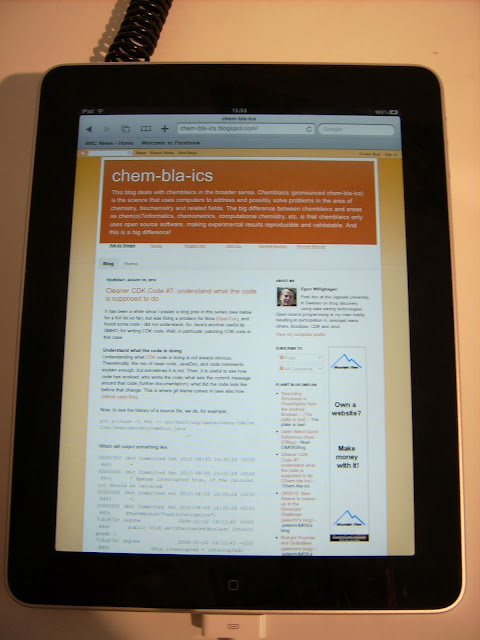
<p>In the afternoon I walked around a bit more in Oxford, did some more shopping… and visited the Apple shop and played with an iPad. It’s
indeed a great piece of hardware. Looking forward to the first Android versions :)</p>

<p><img src="/blog/assets/images/DSCI0107.JPG" alt="" /></p>]]></content><author><name>Egon Willighagen</name></author><category term="cdk" /><category term="oxford" /><category term="oxfordadmet2010" /><category term="justdoi:10.1021/ml100016x" /><category term="conference" /><summary type="html"><![CDATA[The Predictive Toxicology meeting is over. It was a great meeting, by any standard. Very much recommended, and many thanx to Barry for the organization! The meeting was a true workshop, with a mix of presentations and getting work done. I participated in a group that looked at mutagenicity of potential anti-malaria drugs from the datasets of GSK and Novartis recently release as Open Data. We used various tools to predict properties, and plan to make all our results freely available soon. Otherwise, it was also great to meet Nina again (with whom I talked about OpenTox), and to meet other CDK users, including Patrik (SMARTCyp , doi:10.1021/ml100016x) and David (Inkspot).]]></summary></entry><entry><title type="html">German Conference on Chemoinformatics 2006: Day 3</title><link href="http://egonw.github.io/blog/2006/11/14/german-conference-on-chemoinformatics_14.html" rel="alternate" type="text/html" title="German Conference on Chemoinformatics 2006: Day 3" /><published>2006-11-14T00:00:00+00:00</published><updated>2006-11-14T00:00:00+00:00</updated><id>http://egonw.github.io/blog/2006/11/14/german-conference-on-chemoinformatics_14</id><content type="html" xml:base="http://egonw.github.io/blog/2006/11/14/german-conference-on-chemoinformatics_14.html"><![CDATA[<p>Just some short quites note about the third day (see <a href="https://chem-bla-ics.linkedchemistry.info/2006/11/13/german-conference-on-chemoinformatics.html">day 1 and 2 <i class="fa-solid fa-recycle fa-xs"></i></a>).
Today’s program of the <a href="http://scholle.oc.uni-kiel.de/users/cic/tagungen/workshop06/index.html">German Conference on Chemoinformatics</a>
started with a presentation by Rzepa about his work on a semantic wiki (DOI:<a href="https://doi.org/10.1021/ci060139e">10.1021/ci060139e</a>),
which might be <a href="http://www.ch.ic.ac.uk/wiki/">online here</a>. (He recorded a podcast, but I have not seen it online yet.) I wish I could
see the sources of those wiki pages, to see how that system integrates RDF, but at least <a href="http://www.jmol.org/">Jmol</a> is running fine.
The presentation by Couch showed the status of the <a href="http://www.materialsgrid.org/">Materials Grid project</a>, and how a guy called AgentX
does all the hard work. Ihlenfeldt updated us about the status of <a href="http://pubchem.ncbi.nlm.nih.gov/">PubChem</a>, and mostly on what they
had to do to keep the system from dying from its own success, for example using something called minimol. Googling does not seem to
help, as that points to a number of things, but not any PubChem webpage. I am still waiting for a European organization to set up a mirror.</p>

<p>After the coffee break, Kuhn showed a coarse grained force field, approximating molecules by hacking them up in fragment of 3-10 heavy atoms.
I guess, a bit like some small molecules force fields do for methyls. Fragments within a molecule are tied together by springs, and intra-
and intermolecular force field parameters by running MD runs on fragment pairs. Varnek argued that QSPR for melting point prediction has
reached a fundamental limited, with an RMSE of around 30 to 40 degrees Celsius, which makes it quite unreasonable to decide whether a
compound with a predicted melting point of 40 degrees is solid or fluid at room temperature.</p>

<p>You have to forgive me for not reporting on the afternoon session; I was tied up talking with people at our booth, talking about the CDK,
Taverna, Bioclipse, Jmol, other opensource chemoinformatics tools, and chemoinformatics in general. Very nice, but exhausting. I might
advise the organization to set up a blog aggregator next year, though I am not sure whether there are others blogging about this conference.</p>]]></content><author><name>Egon Willighagen</name></author><category term="cheminf" /><category term="conference" /><category term="justdoi:10.1021/ci060139e" /><category term="semweb" /><summary type="html"><![CDATA[Just some short quites note about the third day (see day 1 and 2 ). Today’s program of the German Conference on Chemoinformatics started with a presentation by Rzepa about his work on a semantic wiki (DOI:10.1021/ci060139e), which might be online here. (He recorded a podcast, but I have not seen it online yet.) I wish I could see the sources of those wiki pages, to see how that system integrates RDF, but at least Jmol is running fine. The presentation by Couch showed the status of the Materials Grid project, and how a guy called AgentX does all the hard work. Ihlenfeldt updated us about the status of PubChem, and mostly on what they had to do to keep the system from dying from its own success, for example using something called minimol. Googling does not seem to help, as that points to a number of things, but not any PubChem webpage. I am still waiting for a European organization to set up a mirror.]]></summary></entry><entry><title type="html">German Conference on Chemoinformatics 2006: Day 1 and 2</title><link href="http://egonw.github.io/blog/2006/11/13/german-conference-on-chemoinformatics.html" rel="alternate" type="text/html" title="German Conference on Chemoinformatics 2006: Day 1 and 2" /><published>2006-11-13T00:00:00+00:00</published><updated>2006-11-13T00:00:00+00:00</updated><id>http://egonw.github.io/blog/2006/11/13/german-conference-on-chemoinformatics</id><content type="html" xml:base="http://egonw.github.io/blog/2006/11/13/german-conference-on-chemoinformatics.html"><![CDATA[<p>The <a href="http://scholle.oc.uni-kiel.de/users/cic/tagungen/workshop06/index.html">2nd German Conference on Chemoinformatics</a>
started yesterday, with two chemoinformatics tutorials: one on industrial chemoinformatics (I saw this presentation
before… not sure when), with a good overview on integrating different information sources; the second one was about
opensource chemoinformatics by <a href="http://wiki.cubic.uni-koeln.de/blog/index.php">Christoph Steinbeck</a> (being involved
in opensource chemoinformatics for almost 10 years now!), which included a <a href="http://www.bioclipse.net/">Bioclipse</a>
demo (by me) and a demo by Thomas Kuhn on the <a href="http://cdk.sf.net/">CDK</a> based chemoinformatics plugin to
<a href="http://taverna.sf.net/">Taverna</a>. Other opensource projects of the <a href="http://www.blueobelisk.org/">Blue Obelisk</a>
movement were mentioned and a few outside it too.</p>

<p>The conference is in honor of the life work by <a href="http://www2.chemie.uni-erlangen.de/">Prof. Gasteiger</a>, who gave an
overview of chemoinformatics in his group, Germany and Europe. He stressed the need of education in chemoinformatics,
like in <a href="http://wiki.cubic.uni-koeln.de/blog/pivot/entry.php?id=12">Obernai</a>. He also highlighted that we, today,
are still solving the same problem as 30 years ago. Which is true, which is why this channel is called
<a href="https://chem-bla-ics.linkedchemistry.info/">Chem-bla-ics <i class="fa-solid fa-recycle fa-xs"></i></a>, trying to solve that problem. When asked if opensource chemoinformatics
form the start would have addressed this, he replied that he requires people to cooperatively do research with his
group; opensource clearly cannot enforce that.</p>

<h1 id="day-2">Day 2</h1>

<p>Todays program had a number of interesting presentations (I, unfortunately, missed the first presentation, so
have to visit that group soon now, to make up for that.) <a href="http://www.dq.fct.unl.pt/staff/jas/introduction.htm">Prof. Aires-de-Sousa</a>
showed his work on MOLMAP for mapping metabolic networks (<a href="http://www.genome.jp/kegg/">KEGG</a> really, see my
<a href="https://chem-bla-ics.linkedchemistry.info/2006/04/04/mining-kegg-pathway-database-with-self.html">earlier blog <i class="fa-solid fa-recycle fa-xs"></i></a>), and showed,
just as proof of principle, classification of organisms based on this.</p>

<p>J. Weisser talked about docking, still an obligatory topic. This work really showed two new approaches: the use
of QM partial charges (the example showed an improvement in RMSD of a factor 10, not very statistical, but
promising indeed); the second was the fact that water does not like to be in tight spots, because of reduced
possibilities for hydrogen bonding. A concept common in understand supramolecular phenomenon, but I have not
seen this applied to docking before. But I am no expert in that field. M. Wagner showed work on using KEGG
data to estimate likely metabolites, and the use in reducing effects of metabolic degradation. T. Schroeter
introduced me to <a href="http://www.gaussianprocess.org/">gaussian processes</a>, a new data modeling method. Quite
embarrassing to get introduced to such, as being specialized in modeling methods for chemical problems.</p>

<p>The poster session was, as normally, really exhausting, talking to a lot of people. Having a booth at the exhibition
on opensource chemoinformatics added a nice twist to this. I therefore skipped the FIZ-award winner lectures, so I
hope someone else will blog about those.</p>

<p>One last note: <a href="http://www.sun.com/software/opensource/java/">Sun started releasing their Java platform under the GPL license</a>.
<a href="http://wwmm.ch.cam.ac.uk/blogs/downing/">Jim</a>, seems that they <a href="https://chem-bla-ics.linkedchemistry.info/2006/10/25/being-good-opensource-user.html">proved me wrong <i class="fa-solid fa-recycle fa-xs"></i></a>.
The class library is still not GPL, but is expected to become licensed such somewhere in the first half of next year.</p>]]></content><author><name>Egon Willighagen</name></author><category term="cheminf" /><category term="conference" /><category term="openscience" /><category term="bioclipse" /><category term="cdk" /><category term="taverna" /><category term="java" /><summary type="html"><![CDATA[The 2nd German Conference on Chemoinformatics started yesterday, with two chemoinformatics tutorials: one on industrial chemoinformatics (I saw this presentation before… not sure when), with a good overview on integrating different information sources; the second one was about opensource chemoinformatics by Christoph Steinbeck (being involved in opensource chemoinformatics for almost 10 years now!), which included a Bioclipse demo (by me) and a demo by Thomas Kuhn on the CDK based chemoinformatics plugin to Taverna. Other opensource projects of the Blue Obelisk movement were mentioned and a few outside it too.]]></summary></entry><entry><title type="html">Free online ChemConf 2006 conference</title><link href="http://egonw.github.io/blog/2006/04/02/free-online-chemconf-2006-conference.html" rel="alternate" type="text/html" title="Free online ChemConf 2006 conference" /><published>2006-04-02T00:00:00+00:00</published><updated>2006-04-02T00:00:00+00:00</updated><id>http://egonw.github.io/blog/2006/04/02/free-online-chemconf-2006-conference</id><content type="html" xml:base="http://egonw.github.io/blog/2006/04/02/free-online-chemconf-2006-conference.html"><![CDATA[<p>Internet has the nice feature of bringing together people. This has helped many open source projects in the past. But it is also a
convenient and cheap way to have conferences. Next month, the
<a href="http://web.archive.org/web/20060213124001/http://www.ched-ccce.org/confchem/">ChemConf 2006 <i class="fa-solid fa-box-archive fa-xs"></i></a>
conference will be held, and interested people only need to subscribe to a mailing list to participate.</p>

<p>The topic of this years ChemConf is Web-Based Applications for Chemical Education. At least three posters will show the use of
Java applets in chemistry education, using <a href="https://jmol.org/">Jmol</a>, <a href="http://jchempaint.sourceforge.net/">JChemPaint</a> and
<a href="http://jspecview.sourceforge.net/">JSpecView</a>. I am (co-)author of two of them.</p>

<p>Again, participation is free. So join in!</p>]]></content><author><name>Egon Willighagen</name></author><category term="conference" /><category term="jmol" /><category term="jchempaint" /><category term="education" /><summary type="html"><![CDATA[Internet has the nice feature of bringing together people. This has helped many open source projects in the past. But it is also a convenient and cheap way to have conferences. Next month, the ChemConf 2006 conference will be held, and interested people only need to subscribe to a mailing list to participate.]]></summary></entry></feed>