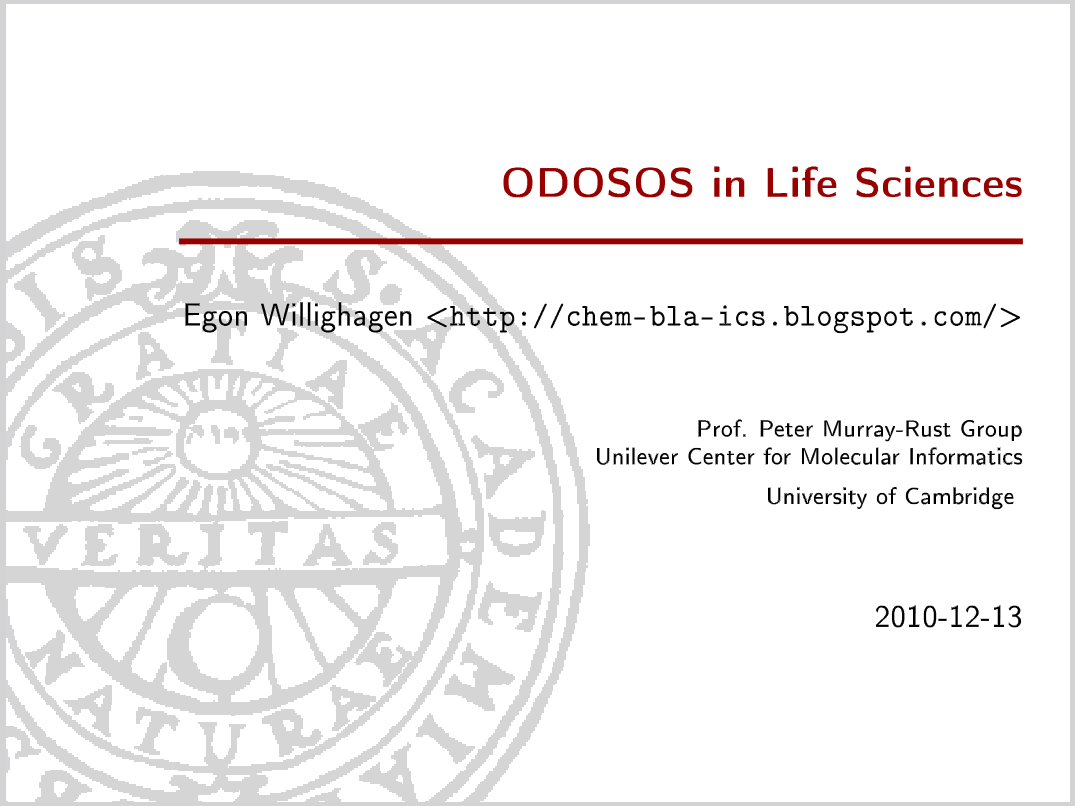
<?xml version="1.0" encoding="utf-8"?><feed xmlns="http://www.w3.org/2005/Atom" ><generator uri="https://jekyllrb.com/" version="4.3.4">Jekyll</generator><link href="http://egonw.github.io/blog/feed/by_tag/drugdiscovery.xml" rel="self" type="application/atom+xml" /><link href="http://egonw.github.io/blog/" rel="alternate" type="text/html" /><updated>2026-11-19T06:09:00+00:00</updated><id>http://egonw.github.io/blog/feed/by_tag/drugdiscovery.xml</id><title type="html">chem-bla-ics</title><subtitle>Chemblaics (pronounced chem-bla-ics) is the science that uses open science and computers to solve problems in chemistry, biochemistry and related fields.</subtitle><author><name>Egon Willighagen</name></author><entry><title type="html">My talk at Imperial College</title><link href="http://egonw.github.io/blog/2010/12/14/my-talk-at-imperial-college.html" rel="alternate" type="text/html" title="My talk at Imperial College" /><published>2010-12-14T00:00:00+00:00</published><updated>2010-12-14T00:00:00+00:00</updated><id>http://egonw.github.io/blog/2010/12/14/my-talk-at-imperial-college</id><content type="html" xml:base="http://egonw.github.io/blog/2010/12/14/my-talk-at-imperial-college.html"><![CDATA[<p>Yesterday I was guest with <a href="http://www1.imperial.ac.uk/medicine/people/j.fonville07/">Judy</a>
at the <a href="http://www1.imperial.ac.uk/surgeryandcancer/">Department of Surgery &amp; Cancer</a>
at <a href="http://www1.imperial.ac.uk/">Imperial College</a>, where I presented the what
I am working on. As I met up in a pub with Ron (my former PhD supervisor, who
now works on metabolomics at the <a href="http://www.iasma.it/">Istituto Agrario San Michele all’Adige</a>
in Italy) the night before, the presentation does share many slides from previous
talks, but also adds a few new ones.</p>

<p><a href="https://doi.org/10.5281/zenodo.3597909"><img src="/blog/assets/images/odosos_imperial2010.png" alt="" /></a></p>

<p>It was great talking to Judy about her PhD research on NMR in metabolomics,
and <a href="http://www1.imperial.ac.uk/medicine/people/t.ebbels/">Tim</a> about further
work in this research. I was interesting to learn that here too they have problems
in metabolite identification quick like those when analyzing *C/MS data, and
was really happy to hear he is in contact with <a href="http://www.steinbeck-molecular.de/steinblog/">Christoph</a>
about an Open repository for metabolomics data.</p>

<p>Another ‘new’ slide was one advertising the yesterday launched <a href="http://www.openresearchcomputation.com/">Open Research
Computation</a> which I’ll blog about
in more detail later today.</p>]]></content><author><name>Egon Willighagen</name></author><category term="chemometrics" /><category term="drugdiscovery" /><category term="metabolomics" /><category term="odosos" /><category term="toxicology" /><category term="doi:10.5281/ZENODO.3597909" /><summary type="html"><![CDATA[Yesterday I was guest with Judy at the Department of Surgery &amp; Cancer at Imperial College, where I presented the what I am working on. As I met up in a pub with Ron (my former PhD supervisor, who now works on metabolomics at the Istituto Agrario San Michele all’Adige in Italy) the night before, the presentation does share many slides from previous talks, but also adds a few new ones.]]></summary><media:thumbnail xmlns:media="http://search.yahoo.com/mrss/" url="http://egonw.github.io/blog/blog/assets/images/odosos_imperial2010.png" /><media:content medium="image" url="http://egonw.github.io/blog/blog/assets/images/odosos_imperial2010.png" xmlns:media="http://search.yahoo.com/mrss/" /></entry><entry><title type="html">ACS Liveblogging 1st Disclosures of Drug Candidates</title><link href="http://egonw.github.io/blog/2010/04/22/acs-liveblogging-1st-disclosures-of.html" rel="alternate" type="text/html" title="ACS Liveblogging 1st Disclosures of Drug Candidates" /><published>2010-04-22T00:00:00+00:00</published><updated>2010-04-22T00:00:00+00:00</updated><id>http://egonw.github.io/blog/2010/04/22/acs-liveblogging-1st-disclosures-of</id><content type="html" xml:base="http://egonw.github.io/blog/2010/04/22/acs-liveblogging-1st-disclosures-of.html"><![CDATA[<p><a href="http://cenblog.org/the-haystack/">Carmen</a> liveblogged via <a href="http://twitter.com/carmendrahl">her twitter account</a> the disclosures
of drug candidates at the past ACS meeting, and later <a href="http://cenblog.org/the-haystack/2010/03/liveblogging-1st-disclosures-of-drug-candidates/">aggregated the tweets in her blog</a>.
While many of her tweets made it into the <a href="http://friendfeed.com/acs-san-francisco-2010">FriendFeed room</a>, the structure she
drew up and shared did not make it. And until just know, I was not aware the had tweeted those too. The first twitpic she pushed was:</p>

<p><img src="https://twitpic.com/1a3b3v" alt="" /></p>

<p>and I hope they will all end up in <a href="http://chempedia.com/substances/">ChemPedia</a>. I’ve done the above
(<a href="http://chempedia.com/substances/6-2018-7215-8416">6-2018-7215-8416</a>):</p>

<p><img src="/blog/assets/images/6-2018-7215-8416.png" alt="" /></p>

<p>Each structure I have transcribed, I will tweet with the tags <a href="http://search.twitter.com/search?q=acs_sf">#acs_sf</a>
and <a href="http://search.twitter.com/search?q=chempedia">#chempedia</a>, like in:</p>

<div class="language-plaintext highlighter-rouge"><div class="highlight"><pre class="highlight"><code>@carmendrahl http://twitpic.com/1a3b3v -&gt; http://ur1.ca/wfar #chempedia #acs_sf
</code></pre></div></div>

<p>Oh, and if you happen to know the drug candidates name (or company code), please do deposit it in ChemPedia!</p>]]></content><author><name>Egon Willighagen</name></author><category term="acs" /><category term="drugdiscovery" /><category term="chempedia" /><summary type="html"><![CDATA[Carmen liveblogged via her twitter account the disclosures of drug candidates at the past ACS meeting, and later aggregated the tweets in her blog. While many of her tweets made it into the FriendFeed room, the structure she drew up and shared did not make it. And until just know, I was not aware the had tweeted those too. The first twitpic she pushed was:]]></summary><media:thumbnail xmlns:media="http://search.yahoo.com/mrss/" url="http://egonw.github.io/blog/blog/assets/images/6-2018-7215-8416.png" /><media:content medium="image" url="http://egonw.github.io/blog/blog/assets/images/6-2018-7215-8416.png" xmlns:media="http://search.yahoo.com/mrss/" /></entry><entry><title type="html">Sugammadex: the molecular condom</title><link href="http://egonw.github.io/blog/2008/03/11/sugammadex-molecular-condom.html" rel="alternate" type="text/html" title="Sugammadex: the molecular condom" /><published>2008-03-11T00:00:00+00:00</published><updated>2008-03-11T00:00:00+00:00</updated><id>http://egonw.github.io/blog/2008/03/11/sugammadex-molecular-condom</id><content type="html" xml:base="http://egonw.github.io/blog/2008/03/11/sugammadex-molecular-condom.html"><![CDATA[<p>Two things I like blogging: 1. the turn-over of information; 2. the informal nature. There are <a href="http://chem-bla-ics.blogspot.com/2007/01/why-do-i-blog.html">more</a>.
The turn-over is optimized by commonly: 1. short blog items; 2. easily allows scanning tons of headlines; 3. often full of links if you want to know the details.</p>

<p>Today, my eye was caught by <a href="http://gaussling.wordpress.com/2008/03/10/sugammadex-buzz-for-organon/">Sugammadex Buzz for Organon</a> over at
<a href="http://gaussling.wordpress.com/">Lamentations on Chemistry</a>. The reason was <a href="http://www.organon.nl/">Organon</a>, which is just around the corner here.
They had <a href="http://www.organon.com/Media/Press_Releases/2008_01_02_Schering_Plough_announces_new_drug_application_for_sugammadex_assigned_priority_review_status_by_U_S_FDA.asp?ComponentID=197129&amp;SourcePageID=8237#1">news</a>
about a new drug.</p>

<p>Getting to the second reason, I like the informal nature. Just to make sure I checked the press release, but it was really Gaussling that called
<a href="http://en.wikipedia.org/wiki/Sugammadex">Sugammadex</a> a <em>molecular condom</em>. This is funny for (at least) two reasons. First, it points
(intentionally?) to the birth control drugs of Organon; second, it is right on with how the drug works.</p>]]></content><author><name>Egon Willighagen</name></author><category term="sugammadex" /><category term="drugdiscovery" /><category term="blog" /><summary type="html"><![CDATA[Two things I like blogging: 1. the turn-over of information; 2. the informal nature. There are more. The turn-over is optimized by commonly: 1. short blog items; 2. easily allows scanning tons of headlines; 3. often full of links if you want to know the details.]]></summary></entry><entry><title type="html">“Jmol and the CDK add powerful chemical capabilities”, says Munos in Nature Reviews Drug Discovery</title><link href="http://egonw.github.io/blog/2006/09/13/jmol-and-cdk-add-powerful-chemical.html" rel="alternate" type="text/html" title="“Jmol and the CDK add powerful chemical capabilities”, says Munos in Nature Reviews Drug Discovery" /><published>2006-09-13T00:00:00+00:00</published><updated>2006-09-13T00:00:00+00:00</updated><id>http://egonw.github.io/blog/2006/09/13/jmol-and-cdk-add-powerful-chemical</id><content type="html" xml:base="http://egonw.github.io/blog/2006/09/13/jmol-and-cdk-add-powerful-chemical.html"><![CDATA[<p><a href="http://www.nature.com/nrd/journal/vaop/ncurrent/authors/nrd2131.html">Bernard Munos</a> at <a href="http://www.lilly.com/">Eli Lilly &amp; Co.</a>
wrote up a lengthy analysis on open source in drug discovery in <a href="http://www.nature.com/nrd/index.html">Nature Reviews Drug Discovery</a>:
Can open-source R&amp;D reinvigorate drug research? (DOI:<a href="https://doi.org/10.1038/nrd2131">10.1038/nrd2131</a>). When scanning the article
I saw this quote:</p>

<p><em>Other tools such as eMolecules, Jmol or the Chemistry Development Kit are adding powerful chemical search and visualization
capabilities to the open-source scientist’s toolbox.</em></p>

<p>Unfortunately, the paper does not point to the correct <a href="http://cdk.sf.net/">CDK website</a>, but to the CUBIC backend at
<a href="http://almost.cubic.uni-koeln.de/cdk">http://almost.cubic.uni-koeln.de/cdk</a>. Moreover, I don’t think the quote does full justice to
what the CDK has achieved in the past six years; I’m sure we have achieved more than a fingerprinter and some 2D and 3D rendering!</p>]]></content><author><name>Egon Willighagen</name></author><category term="drugdiscovery" /><category term="jmol" /><category term="cdk" /><category term="opensource" /><category term="justdoi:10.1038/nrd2131" /><summary type="html"><![CDATA[Bernard Munos at Eli Lilly &amp; Co. wrote up a lengthy analysis on open source in drug discovery in Nature Reviews Drug Discovery: Can open-source R&amp;D reinvigorate drug research? (DOI:10.1038/nrd2131). When scanning the article I saw this quote:]]></summary></entry><entry><title type="html">Open source in drug discovery</title><link href="http://egonw.github.io/blog/2006/03/12/open-source-in-drug-discovery.html" rel="alternate" type="text/html" title="Open source in drug discovery" /><published>2006-03-12T00:00:00+00:00</published><updated>2006-03-12T00:00:00+00:00</updated><id>http://egonw.github.io/blog/2006/03/12/open-source-in-drug-discovery</id><content type="html" xml:base="http://egonw.github.io/blog/2006/03/12/open-source-in-drug-discovery.html"><![CDATA[<p>Geldenhuys et al. published an article in <a href="http://www.sciencedirect.com/science/journal/13596446">Drug Discovery Today</a> titled
<em>Optimizing the use of open-source software applications in drug discovery</em> (DOI:<a href="https://doi.org/10.1016/S1359-6446(05)03692-5">10.1016/S1359-6446(05)03692-5</a>),
and approached the review from a bench chemist point of view. Unfortunately, he discusses free, but closed source, program in one go.</p>

<p>He discusses the advantages and problems with opensource, and mentions the often lacking user-friendly GUI (true),
and the the lack of literature to validate the program. It was unclear to me wether the last argument applied to the free tools,
or to the open source programs; I thought the open-source projects like the <a href="http://cdk.sf.net/">CDK</a>,
<a href="http://joelib.sf.net/">JOELib</a>, <a href="http://www.jmol.org/">Jmol</a> and <a href="http://pymol.sf.net/">PyMol</a> were quite strong in this area,
at least compared to the commercial software I have seen.</p>]]></content><author><name>Egon Willighagen</name></author><category term="drugdiscovery" /><category term="justdoi:10.1016/S1359-6446(05)03692-5" /><category term="openscience" /><summary type="html"><![CDATA[Geldenhuys et al. published an article in Drug Discovery Today titled Optimizing the use of open-source software applications in drug discovery (DOI:10.1016/S1359-6446(05)03692-5), and approached the review from a bench chemist point of view. Unfortunately, he discusses free, but closed source, program in one go.]]></summary></entry></feed>