<?xml version="1.0" encoding="utf-8"?><feed xmlns="http://www.w3.org/2005/Atom" ><generator uri="https://jekyllrb.com/" version="4.3.4">Jekyll</generator><link href="http://egonw.github.io/blog/feed/by_tag/excel.xml" rel="self" type="application/atom+xml" /><link href="http://egonw.github.io/blog/" rel="alternate" type="text/html" /><updated>2026-11-22T10:22:45+00:00</updated><id>http://egonw.github.io/blog/feed/by_tag/excel.xml</id><title type="html">chem-bla-ics</title><subtitle>Chemblaics (pronounced chem-bla-ics) is the science that uses open science and computers to solve problems in chemistry, biochemistry and related fields.</subtitle><author><name>Egon Willighagen</name></author><entry><title type="html">Supplementary files, publishing, and standards #2</title><link href="http://egonw.github.io/blog/2011/03/24/supplementary-files-publishing-and_24.html" rel="alternate" type="text/html" title="Supplementary files, publishing, and standards #2" /><published>2011-03-24T00:00:00+00:00</published><updated>2011-03-24T00:00:00+00:00</updated><id>http://egonw.github.io/blog/2011/03/24/supplementary-files-publishing-and_24</id><content type="html" xml:base="http://egonw.github.io/blog/2011/03/24/supplementary-files-publishing-and_24.html"><![CDATA[<p>You must read <a href="http://chem-bla-ics.blogspot.com/2011/03/supplementary-files-publishing-and.html">this previous post</a>
first.</p>

<p>Now, it is important to realize there are standards at many levels. Open specifications
allow people to implement the specification without having to pay fees, run
into patents, etc. To me, an Open Specification is something you can take, modify,
and propose to the community as new Standard.</p>

<p>Standards themselves are basically something orthogonal (IMHO, not uncriticized):
if something is a standard is just the result of the community picking up and
using the specification. Something doesn’t have to be Open to be a standard,
nor does it have to undergone year-long debates (like HTML5). A standard doesn’t
even have to be fixed to a version (they can be backwards compatible). There
are therefore many kinds of standards, including <em>de facto</em> standards.</p>

<p>These distinctions are crucial. Another is that standards rarely cover everything.
For example, it is ridicule to talk about Excel as a <em>de facto</em> standard in
data exchange in science. Now, the Microsoft formats are ‘Open Standards’ (they
sneaked in, when the world was complaining). But, they are standards at the
wrong level for scientific computation: they define a standard container, and
not any semantics. That’s up to the user: “Hey, why should I waste a column
on units… everyone knows we put in temperatures as Kelvin, ummm, Fahrenheit,
ummm… Kelcius, or what is it again the eurotrash uses?”</p>

<p>This problem holds for very many fields, and you see it in many different formulation.
Or the whole discussion about ScHTML and PDF, on what is more semantic. Or this
one: “Oh, let’s use a database so that our statisticians can do there work.”
Been there, done that.</p>

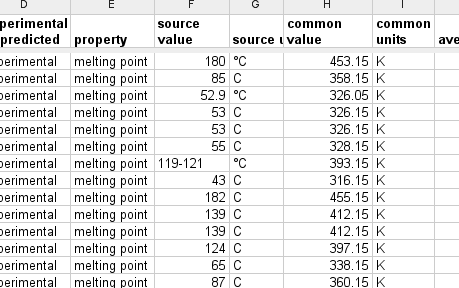
<p>Now, just to end a bit more positively, here’s a <a href="http://usefulchem.blogspot.com/2011/03/open-modeling-of-melting-point-data.html">group of bright, visionary
people</a>
using the standards at the right levels in <a href="https://spreadsheets.google.com/ccc?key=0Ak1R8T6wt4YQdDdNd0wzRVBQdWRMSWpxZjd3X2QtVUE&amp;hl=en#gid=0">this spreadsheet</a>:</p>

<p><img src="/blog/assets/images/excel.png" alt="" /></p>]]></content><author><name>Egon Willighagen</name></author><category term="excel" /><category term="publishing" /><summary type="html"><![CDATA[You must read this previous post first.]]></summary><media:thumbnail xmlns:media="http://search.yahoo.com/mrss/" url="http://egonw.github.io/blog/blog/assets/images/excel.png" /><media:content medium="image" url="http://egonw.github.io/blog/blog/assets/images/excel.png" xmlns:media="http://search.yahoo.com/mrss/" /></entry><entry><title type="html">Excel messes up your data analysis :)</title><link href="http://egonw.github.io/blog/2007/08/01/excel-messes-up-your-data-analysis.html" rel="alternate" type="text/html" title="Excel messes up your data analysis :)" /><published>2007-08-01T00:00:00+00:00</published><updated>2007-08-01T00:00:00+00:00</updated><id>http://egonw.github.io/blog/2007/08/01/excel-messes-up-your-data-analysis</id><content type="html" xml:base="http://egonw.github.io/blog/2007/08/01/excel-messes-up-your-data-analysis.html"><![CDATA[<p>Well, no wonder: Excel is meant to be used to process money flows. Anyway, <a href="http://del.icio.us/greyarea">greyarea</a> pointed me to
<a href="http://itre.cis.upenn.edu/~myl/languagelog/archives/002912.html">this nice blog item</a> from March 2006. It discusses a 2004 article in
<a href="http://www.biomedcentral.com/bmcbioinformatics">BMC Bioinformatics</a> <em>Mistaken Identifiers: Gene name errors can be introduced
inadvertently when using Excel in bioinformatics</em> by Barry Zeeberg et al. (DOI:<a href="https://doi.org/10.1186/1471-2105-5-80">10.1186/1471-2105-5-80</a>).
Hence, the importance of semantics and proper markup languages. The quotes are illustrative:</p>

<ul><i>
When we were beta-testing [two new bioinformatics programs] on microarray data, a frustrating problem occurred repeatedly: Some
gene names kept bouncing back as "unknown." A little detective work revealed the reason: ... A default date conversion feature in
Excel ... was altering gene names that it considered to look like dates. For example, the tumor suppressor DEC1 [Deleted in
Esophageal Cancer 1] was being converted to '1-DEC.' Figure 1 lists 30 gene names that suffer an analogous fate.<br /><br />

...<br /><br />

There is another default conversion problem for RIKEN clone identifiers identifiers of the form nnnnnnnEnn, where n denotes a
digit. These identifiers are comprised of the serial number of the plate that contains the library, information on plate status,
and the address of the clone. A search ... identified more than 2,000 such identifiers out of a total set of 60,770. For example,
the RIKEN identifier "2310009E13" was converted irreversibly to the floating-point number "2.31E+13." A non-expert user might
well fail to notice that approximately 3% of the identifiers on a microarray with tens of thousands of genes had been converted
to an incorrect form, yet the potential for 2,000 identifiers to be transmogrified without notice is a considerable concern. Most
important, these conversions to an internal date representation or floating-point number format are irreversible; the original
gene name cannot be recovered.
</i></ul>

<p>Is this the article that made all bioinformaticians turn to R?</p>]]></content><author><name>Egon Willighagen</name></author><category term="bioinfo" /><category term="excel" /><category term="justdoi:10.1186/1471-2105-5-80" /><summary type="html"><![CDATA[Well, no wonder: Excel is meant to be used to process money flows. Anyway, greyarea pointed me to this nice blog item from March 2006. It discusses a 2004 article in BMC Bioinformatics Mistaken Identifiers: Gene name errors can be introduced inadvertently when using Excel in bioinformatics by Barry Zeeberg et al. (DOI:10.1186/1471-2105-5-80). Hence, the importance of semantics and proper markup languages. The quotes are illustrative:]]></summary></entry></feed>