<?xml version="1.0" encoding="utf-8"?><feed xmlns="http://www.w3.org/2005/Atom" ><generator uri="https://jekyllrb.com/" version="4.3.4">Jekyll</generator><link href="http://egonw.github.io/blog/feed/by_tag/linux.xml" rel="self" type="application/atom+xml" /><link href="http://egonw.github.io/blog/" rel="alternate" type="text/html" /><updated>2026-11-19T06:09:00+00:00</updated><id>http://egonw.github.io/blog/feed/by_tag/linux.xml</id><title type="html">chem-bla-ics</title><subtitle>Chemblaics (pronounced chem-bla-ics) is the science that uses open science and computers to solve problems in chemistry, biochemistry and related fields.</subtitle><author><name>Egon Willighagen</name></author><entry><title type="html">An Ubuntu Blue Obelisk meta package</title><link href="http://egonw.github.io/blog/2010/07/24/ubuntu-blue-obelisk-meta-package.html" rel="alternate" type="text/html" title="An Ubuntu Blue Obelisk meta package" /><published>2010-07-24T00:00:00+00:00</published><updated>2010-07-24T00:00:00+00:00</updated><id>http://egonw.github.io/blog/2010/07/24/ubuntu-blue-obelisk-meta-package</id><content type="html" xml:base="http://egonw.github.io/blog/2010/07/24/ubuntu-blue-obelisk-meta-package.html"><![CDATA[<p>There was some talk recently about <a href="http://www.blueobelisk.org/">Blue Obelisk</a> software available as <a href="http://www.ubuntu.com/">Ubuntu</a> /
<a href="http://www.debian.org/">Debian</a> packages. This morning I had trouble waking up, so hacked up a <a href="https://launchpad.net/~egonw/+archive/ppa">metapackage</a>,
so that you can now do:</p>

<div class="language-shell highlighter-rouge"><div class="highlight"><pre class="highlight"><code><span class="nb">sudo </span>add-apt-repository ppa:egonw
<span class="nb">sudo </span>aptitude <span class="nb">install </span>blueobelisk
</code></pre></div></div>

<p>Currently, it installs BODR, Kalzium, Gnome Chemistry Utils, Chemical-MIME, <a href="http://www.openbabel.org/">OpenBabel</a>, and the
<a href="http://cdk.sf.net/">CDK</a>. Ideas, feature requests, patches, etc, welcome via <a href="http://github.com/egonw/blueobelisk.debian">GitHub</a>.</p>]]></content><author><name>Egon Willighagen</name></author><category term="blue-obelisk" /><category term="linux" /><summary type="html"><![CDATA[There was some talk recently about Blue Obelisk software available as Ubuntu / Debian packages. This morning I had trouble waking up, so hacked up a metapackage, so that you can now do:]]></summary></entry><entry><title type="html">OOChemistry 0.1 released: call for participation</title><link href="http://egonw.github.io/blog/2010/03/06/oochemistry-01-released-call-for.html" rel="alternate" type="text/html" title="OOChemistry 0.1 released: call for participation" /><published>2010-03-06T00:00:00+00:00</published><updated>2010-03-06T00:00:00+00:00</updated><id>http://egonw.github.io/blog/2010/03/06/oochemistry-01-released-call-for</id><content type="html" xml:base="http://egonw.github.io/blog/2010/03/06/oochemistry-01-released-call-for.html"><![CDATA[<p><a href="http://sourceforge.net/users/annulen">Konstantin</a> released <a href="http://sourceforge.net/projects/oochemistry/files/oochemistry/oochemistry-0.1.0/">OOChemistry 0.1</a>
and sent <a href="http://sourceforge.net/mailarchive/forum.php?thread_name=64911267871776@webmail108.yandex.ru&amp;forum_name=cdk-jchempaint">this email</a> to the
<a href="http://sourceforge.net/mailarchive/forum.php?forum_name=cdk-jchempaint">cdk-jchempaint mailing list</a> (I added a few links and an extra newline):</p>

<blockquote>
  <p>Hello, colleagues!</p>

  <p>I’d like to announce first alpha version of <a href="http://sourceforge.net/projects/oochemistry/">OOChemistry</a>. It is an extension for
<a href="http://openoffice.org/">OpenOffice.org</a> which provides cross-platform OLE-like integration of OOo with <a href="http://jchempaint.sf.net/">JChemPaint</a>
chemical diagram editor. With OOChemistry you can draw structure, embed into document (text or presentation) and than double click and edit
whenever you want on any platform having OpenOffice.org and Java Runtime (Windows, Linux, Mac OS X, other Unix flavours). Remember that it’s
only alpha and is not recommended for production use (e.g., compatibility with futher versions is not guaranteed).</p>

  <p>Known bugs: <a href="http://sourceforge.net/tracker/?group_id=273144&amp;atid=1161036">http://sourceforge.net/tracker/?group_id=273144&amp;atid=1161036</a>, (please, submit if you found other issues!)
More about project, contact info, how to contribute: http://oochemistry.sourceforge.net
Direct link to download: http://sourceforge.net/projects/oochemistry/files/latest</p>

  <p>OOChemistry needs your help! Experience in Java, in development of projects dealing with JChemPaint/CDK, or in development of OpenOffice.org
extensions will be highly appreciated. Of course, you can help not only in coding, but also in translation of interface and writing docs.</p>

  <p>–
Regards,
Konstantin</p>
</blockquote>

<p>Your feedback as well as coding contributions are very much appreciated! I am excited about seeing chemical editing facilities in OpenOffice.org,
and while the integration is not as good as <a href="http://wwmm.ch.cam.ac.uk/blogs/murrayrust/?p=1797">Chem4Word</a>, it is something I can run on
my Linux system.</p>]]></content><author><name>Egon Willighagen</name></author><category term="cdk" /><category term="jchempaint" /><category term="linux" /><summary type="html"><![CDATA[Konstantin released OOChemistry 0.1 and sent this email to the cdk-jchempaint mailing list (I added a few links and an extra newline):]]></summary></entry><entry><title type="html">11 Years of Debian</title><link href="http://egonw.github.io/blog/2008/12/30/11-years-of-debian.html" rel="alternate" type="text/html" title="11 Years of Debian" /><published>2008-12-30T00:00:00+00:00</published><updated>2008-12-30T00:00:00+00:00</updated><id>http://egonw.github.io/blog/2008/12/30/11-years-of-debian</id><content type="html" xml:base="http://egonw.github.io/blog/2008/12/30/11-years-of-debian.html"><![CDATA[<p>11 years ago, a day more or less, I bought an the special issue of <a href="http://www.chip.de/">CHIP</a> which <a href="http://lists.debian.org/debian-user/1998/01/msg00359.html">shipped Debian 1.3.1</a>.
I think I’ve tried <a href="http://www.opensuse.org/">SuSe</a> and <a href="http://www.redhat.com/">RedHat</a> earlier that year, but this <a href="http://www.debian.org/">Debian</a> release made me switch away
from proprietary products 98% (taxes I still had to do with Windows98). Right now, I am mostly running <a href="http://www.ubuntu.com/">Ubuntu</a>, which leans heavily on the work of the Debian project.</p>

<p>I celebrated by installing a prerelease of Lenny, Debian’s next stable release, but still testing now, in a virtual box with <a href="http://www.virtualbox.org/">VirtualBox</a>.
Works like a charm, and will allow me in 2009 to finally pick up some packaging work for Debian, and maybe, finally, get Jmol available in Debian main.</p>]]></content><author><name>Egon Willighagen</name></author><category term="linux" /><category term="debian" /><summary type="html"><![CDATA[11 years ago, a day more or less, I bought an the special issue of CHIP which shipped Debian 1.3.1. I think I’ve tried SuSe and RedHat earlier that year, but this Debian release made me switch away from proprietary products 98% (taxes I still had to do with Windows98). Right now, I am mostly running Ubuntu, which leans heavily on the work of the Debian project.]]></summary></entry><entry><title type="html">Scintilla and Postgenomic.com on Linux 2.6.17+</title><link href="http://egonw.github.io/blog/2007/11/12/scintilla-and-postgenomiccom-on-linux.html" rel="alternate" type="text/html" title="Scintilla and Postgenomic.com on Linux 2.6.17+" /><published>2007-11-12T00:00:00+00:00</published><updated>2007-11-12T00:00:00+00:00</updated><id>http://egonw.github.io/blog/2007/11/12/scintilla-and-postgenomiccom-on-linux</id><content type="html" xml:base="http://egonw.github.io/blog/2007/11/12/scintilla-and-postgenomiccom-on-linux.html"><![CDATA[<p>That’s why blogging works! I reported last Friday on <a href="http://chem-bla-ics.blogspot.com/2007/11/using-nintendo-wii-for-serious-science.html">using my Wii for reading</a>
<a href="http://scintilla.nature.com/">Scintilla</a> and <a href="http://www.postgenomic.com/">Postgenomic.com</a>.
<a href="http://chem-bla-ics.blogspot.com/2007/11/using-nintendo-wii-for-serious-science.html#c9163469498026561308">Alf replied</a>:</p>

<blockquote>
  <p>It is the Linux kernel, yes: TCP window scaling was switched on by default in kernels since about a year ago
(and in Vista too, I think), and one of our routers or firewalls doesn’t like it. We’re trying to get them
upgraded, but it takes a while…</p>
</blockquote>

<p>Ah, the trick word: TCP windows scaling. A quick google turned up a <a href="http://inodes.org/blog/2006/09/06/tcp-window-scaling-and-kernel-2617/">workaround in John’s Tidbits blog</a>:</p>

<blockquote>
  <p>There are 2 quick fixes. First you can simply turn off windows scaling all together by doing</p>

  <p>echo 0 &gt; /proc/sys/net/ipv4/tcp_window_scaling</p>

  <p>but that limits your window to 64k. Or you can limit the size of your TCP buffers back to pre 2.6.17 kernel values which means a wscale value of about 2 is used which is acceptable to most broken routers.</p>

  <p>echo “4096 16384 131072” &gt; /proc/sys/net/ipv4/tcp_wmem
echo “4096 87380 174760” &gt; /proc/sys/net/ipv4/tcp_rmem</p>

  <p>The original values would have had 4MB in the last column above which is what was allowing these massive windows.</p>

  <p>In a thread somewhere which I can’t find anymore Dave Miller had a great quote along the lines of</p>

  <p>“I refuse to workaround it, window scaling has been part of the protocol since 1999, deal with it.”</p>
</blockquote>

<p>That worked for me. I think Dave Miller is right, but can’t resist reading Scintilla and Postgenomic.com on my desktop too ;)</p>]]></content><author><name>Egon Willighagen</name></author><category term="linux" /><category term="postgenomic" /><summary type="html"><![CDATA[That’s why blogging works! I reported last Friday on using my Wii for reading Scintilla and Postgenomic.com. Alf replied:]]></summary></entry><entry><title type="html">Using the Nintendo Wii for serious science…</title><link href="http://egonw.github.io/blog/2007/11/09/using-nintendo-wii-for-serious-science.html" rel="alternate" type="text/html" title="Using the Nintendo Wii for serious science…" /><published>2007-11-09T00:00:00+00:00</published><updated>2007-11-09T00:00:00+00:00</updated><id>http://egonw.github.io/blog/2007/11/09/using-nintendo-wii-for-serious-science</id><content type="html" xml:base="http://egonw.github.io/blog/2007/11/09/using-nintendo-wii-for-serious-science.html"><![CDATA[<p>On my desktop, the <a href="http://scintilla.nature.com/">Scintilla</a> and <a href="http://postgenomic.com/">Postgenomic.com</a> websites
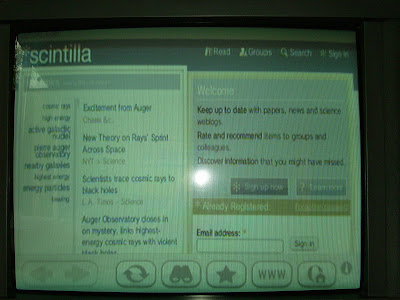
do not work. It is not a browser problem, but has something to do with TCP/IP packages not reaching its destination:
the browser. Euan told me they are aware of the problem, but apparently have not found a solution yet.</p>

<p>However, my <a href="http://wii.nintendo.com/">Wii</a> does not have the problem, which makes me wonder if it is a disagreement
between the <a href="http://www.nature.com/">Nature</a> server and my <a href="http://packages.ubuntu.com/gutsy/metapackages/linux">Linux kernel</a>…
Anyway, this is what the two website look like (first Scintilla, then Postgenomic.com):</p>

<p><img src="/blog/assets/images/dsci0190.jpg" alt="" /></p>

<p><img src="/blog/assets/images/dsci0191.jpg" alt="" /></p>

<p>(BTW, that was one <a href="http://depth-first.com/articles/2007/10/29/compiling-the-inchi-toolkit-to-pure-java-bytecode-with-nestedvm">very nice piece of work by Rich</a>!
Make sure to also read the <a href="http://depth-first.com/articles/2007/10/31/jinchi-run-inchi-anywhere-java-runs">follow up</a>.)</p>

<p>The only real disadvantage is that it does not integrate well with the things I do daily. If I see some interesting
post, and would like to tag it on <a href="http://del.icio.us/egonw">my del.icio.us account</a>, I have to google for it on
my desktop :(</p>

<p>(You thought I was going to talk about <a href="http://folding.stanford.edu/">F@H</a> or so, didn’t you? :)</p>]]></content><author><name>Egon Willighagen</name></author><category term="nintendo" /><category term="linux" /><category term="postgenomic" /><summary type="html"><![CDATA[On my desktop, the Scintilla and Postgenomic.com websites do not work. It is not a browser problem, but has something to do with TCP/IP packages not reaching its destination: the browser. Euan told me they are aware of the problem, but apparently have not found a solution yet.]]></summary><media:thumbnail xmlns:media="http://search.yahoo.com/mrss/" url="http://egonw.github.io/blog/blog/assets/images/dsci0190.jpg" /><media:content medium="image" url="http://egonw.github.io/blog/blog/assets/images/dsci0190.jpg" xmlns:media="http://search.yahoo.com/mrss/" /></entry><entry><title type="html">NXClient on Ubuntu Gutsy</title><link href="http://egonw.github.io/blog/2007/08/28/nxclient-on-ubuntu-gutsy.html" rel="alternate" type="text/html" title="NXClient on Ubuntu Gutsy" /><published>2007-08-28T00:00:00+00:00</published><updated>2007-08-28T00:00:00+00:00</updated><id>http://egonw.github.io/blog/2007/08/28/nxclient-on-ubuntu-gutsy</id><content type="html" xml:base="http://egonw.github.io/blog/2007/08/28/nxclient-on-ubuntu-gutsy.html"><![CDATA[<p>If you, like me, already upgrade to <a href="http://www.ubuntu.com/">Ubuntu</a> <a href="https://wiki.ubuntu.com/GutsyGibbon">Gutsy</a>,
and use <a href="http://www.nomachine.com/download.php">nxclient</a> for remote login (highly recommended, though proprietary code),
you might run into the problem that the login no longer works, returning the message “Cannot find KDE environment.”. Ubuntu’s
<a href="http://www.launchpad.net/">Lauchpad</a> (generally an excellent service) was rather uncooperative and disregarded a bug report
about the problem, I found the solution with <code class="language-plaintext highlighter-rouge">grep -ri kde /usr/NX</code>:</p>

<div class="language-plaintext highlighter-rouge"><div class="highlight"><pre class="highlight"><code>/usr/NX/etc/node.cfg:CommandStartKDE="/usr/bin/dbus-launch --exit-with-session startkde"
</code></pre></div></div>

<p>The solution was to:</p>

<div class="language-shell highlighter-rouge"><div class="highlight"><pre class="highlight"><code><span class="nb">sudo </span>aptitude <span class="nb">install </span>dbus-x11
</code></pre></div></div>

<p>which contains the <code class="language-plaintext highlighter-rouge">dbus-launch</code> executable, formerly found in the <em>dbus</em> package itself. I assume it works for
“Cannot find GNOME environment” too.</p>]]></content><author><name>Egon Willighagen</name></author><category term="linux" /><category term="kde" /><summary type="html"><![CDATA[If you, like me, already upgrade to Ubuntu Gutsy, and use nxclient for remote login (highly recommended, though proprietary code), you might run into the problem that the login no longer works, returning the message “Cannot find KDE environment.”. Ubuntu’s Lauchpad (generally an excellent service) was rather uncooperative and disregarded a bug report about the problem, I found the solution with grep -ri kde /usr/NX:]]></summary></entry><entry><title type="html">XCMS on Ubuntu Feisty</title><link href="http://egonw.github.io/blog/2007/08/27/xcms-on-ubuntu-feisty.html" rel="alternate" type="text/html" title="XCMS on Ubuntu Feisty" /><published>2007-08-27T00:00:00+00:00</published><updated>2007-08-27T00:00:00+00:00</updated><id>http://egonw.github.io/blog/2007/08/27/xcms-on-ubuntu-feisty</id><content type="html" xml:base="http://egonw.github.io/blog/2007/08/27/xcms-on-ubuntu-feisty.html"><![CDATA[<p>I just installed <a href="http://metlin.scripps.edu/download/packages/xcms_1.9.2.tar.gz">XCMS 1.9.2</a> on my Ubuntu system.
<a href="http://metlin.scripps.edu/download/">XCMS</a> is a GPL-ed <a href="http://www.r-project.org/">R</a> package for metabolomics data analysis.
Just for the record, you need to install the <a href="http://ubuntuguide.org/wiki/Ubuntu:Feisty">Feisty</a> packages for
<a href="http://packages.ubuntu.com/feisty/source/netcdf">NetCDF</a>:</p>

<div class="language-shell highlighter-rouge"><div class="highlight"><pre class="highlight"><code><span class="nb">sudo </span>aptitude <span class="nb">install </span>netcdfg-dev libnetcdf3
R CMD INSTALL <span class="nt">--library</span><span class="o">=</span>/usr/local/lib/R/site-library xcms_1.9.2.tar.gz
</code></pre></div></div>]]></content><author><name>Egon Willighagen</name></author><category term="linux" /><category term="metabolomics" /><summary type="html"><![CDATA[I just installed XCMS 1.9.2 on my Ubuntu system. XCMS is a GPL-ed R package for metabolomics data analysis. Just for the record, you need to install the Feisty packages for NetCDF:]]></summary></entry><entry><title type="html">KDE desktop search: Kat, Strigi and Tenor</title><link href="http://egonw.github.io/blog/2006/06/17/kde-desktop-search-kat-strigi-and.html" rel="alternate" type="text/html" title="KDE desktop search: Kat, Strigi and Tenor" /><published>2006-06-17T00:00:00+00:00</published><updated>2006-06-17T00:00:00+00:00</updated><id>http://egonw.github.io/blog/2006/06/17/kde-desktop-search-kat-strigi-and</id><content type="html" xml:base="http://egonw.github.io/blog/2006/06/17/kde-desktop-search-kat-strigi-and.html"><![CDATA[<p>Desktop searching has become a hot topic (some <a href="http://chem-bla-ics.blogspot.com/2006/05/molecular-indexing-on-kde-and-osx.html">earlier</a>
<a href="http://chem-bla-ics.blogspot.com/2005/11/ubuntu-dapper-will-include-chemistry.html">blogs</a>), now that years of data accumulated on ones
hard disk: PDFs, OpenOffice.org documents, Latex manuscripts, old Java source code, digitized music, and a lot of chemical files. Well,
on my hard disk that is. Unlike piles of paper, a computer could search this data, but due to the size an index is required. What’s KDE4
going to offer?</p>

<p>For the <a href="http://www.kde.org/">KDE</a> desktop <a href="http://kat.mandriva.com/">Kat</a> has for more than a year offered this, and latter
<a href="http://www.kde-apps.org/content/show.php?content=36832">Kerry</a> came along as frontend to [Beagle(http://beaglewiki.org/Main_Page)],
though this does not have the nice integration with KDE <a href="http://developer.kde.org/documentation/tutorials/kfile-plugin/t1.html">kfile plugins</a>.
Since then, Kat developed has come to a stop (unfortunately), and attempts to reach the main author
(<a href="mailto:roberto.cappuccio@gmail.com">Roberto</a>) have been unsuccesfull. Last thing happening was a rewrite of the database backend.</p>

<p>Additionally, <a href="http://dot.kde.org/1109163846/">Scott Wheeler proposed Tenor</a> on <a href="http://www.fosdem.org/">FOSDEM</a> 2005:
<em>“KDE 4: Beyond Hierarchical Data, The Desktop as a Searchable Web of Context”</em>. A semantic desktop; potentially cool, but I have heard
<a href="http://www.kdedevelopers.org/blog/72?from=10">little from it lately</a>, except for some rumours that
<a href="http://mail.kde.org/pipermail/klink/2006-April/000133.html">Scott has some actual code at home</a>.</p>

<p>Now, <a href="http://www.vandenoever.info/software/strigi/">Strigi</a> (<a href="http://www.kde-look.org/content/show.php?content=40889">download</a>) has come along,
with a fast indexing engine, just the thing where the Kat developed seemed to have stopped. The design is different from that of Kat, but it
does not seem unlikely that Kat code can be ported. No support for PDF or OpenOffice.org documents yet, but that’s really the easy part, and
kfile is on its way.</p>

<p>Getting back to Tenor, one might wonder how Strigi could implement Tenor concepts. A simple approach is at least to allow users to tag files,
just like we have become used to with blogs (e.g. <a href="http://www.technorati.com/">Technorati.com</a>) and websites (e.g.
<a href="http://www.connotea.org/">Connotea</a>). This could be easily implemented using <a href="http://wiki.linuxquestions.org/wiki/Extended_attributes">extended attributes</a>
(xattr), <a href="http://chem-bla-ics.blogspot.com/2006/05/molecular-indexing-on-kde-and-osx.html">already used by Beagle</a>:</p>

<div class="language-plaintext highlighter-rouge"><div class="highlight"><pre class="highlight"><code># file: home/egonw/1CRN.jpg
user.Tenor.Keywords="crambin"
user.Tenor.Comment="Used in my ontologies presentation."
</code></pre></div></div>

<p>Obviously, this example shows not just these tags, but a user comment too. The idea, here, is that Strigi mines these attributes in
addition to the file itself, so that search on tags can be done too. BTW, my argument to use this, instead of putting these things
in the Strigi database itself, is persistence: data and metadata are kept together. KDE’s file properties dialog would be extended
with an extra tab that allows editing these fields.</p>

<p>Strigi itself can be embedded in KDE applications to search specific information (e.g. search molecular data within
<a href="http://cniehaus.livejournal.com/23010.html">Kalzium</a> using the <a href="http://www.iupac.org/inchi/">InChI</a>), and even in the FileOpen dialog.
We need patches for KDE4 that allows this, soon.</p>]]></content><author><name>Egon Willighagen</name></author><category term="kde" /><category term="strigi" /><category term="kalzium" /><category term="linux" /><category term="technorati" /><category term="connotea" /><summary type="html"><![CDATA[Desktop searching has become a hot topic (some earlier blogs), now that years of data accumulated on ones hard disk: PDFs, OpenOffice.org documents, Latex manuscripts, old Java source code, digitized music, and a lot of chemical files. Well, on my hard disk that is. Unlike piles of paper, a computer could search this data, but due to the size an index is required. What’s KDE4 going to offer?]]></summary></entry><entry><title type="html">A live life-sciences CD</title><link href="http://egonw.github.io/blog/2006/05/22/live-life-sciences-cd.html" rel="alternate" type="text/html" title="A live life-sciences CD" /><published>2006-05-22T00:00:00+00:00</published><updated>2006-05-22T00:00:00+00:00</updated><id>http://egonw.github.io/blog/2006/05/22/live-life-sciences-cd</id><content type="html" xml:base="http://egonw.github.io/blog/2006/05/22/live-life-sciences-cd.html"><![CDATA[<p>November last year, I <a href="http://chem-bla-ics.blogspot.com/2005/11/goal-live-chemblaics-cd.html">reported my plans</a> to develop
a live CD with all our favorite chemo- and bioinformatics software. <a href="http://www.bioclipse.net/">Bioclipse</a> requires Java5
and sort of still depends on the Sun JVM (I will experiment with classpath-generics later), but is now distributable with
operating systems. So, I made a <a href="http://www.kubuntu.org/">Kubuntu</a> derived operating system with
<a href="http://openbabel.sourceforge.net/">OpenBabel</a>, <a href="http://www.jmol.org/">Jmol</a>, <a href="http://pymol.sourceforge.net/">PyMOL</a>,
Bioclipse, and, on systems level, the chemical MIMEs and <a href="http://www.kde-apps.org/content/show.php?content=28995">kfile_chemical</a>,
wich extends the desktop with chemistry awareness. In addition, I added the
<a href="http://www.blueobelisk.org/">Blue Obelisk Data Repository</a>, all <a href="http://almost.cubic.uni-koeln.de/cdk/cdk_top/cdk_news/">CDK News</a>
issues, and the full <a href="http://www.nmrshiftdb.org/">NMRShiftDB</a> data in CML format.</p>

<p>The <a href="http://wiki.cubic.uni-koeln.de/iso/cdname.iso">iso image</a> can be downloaded, and is really a first set up. Bioclipse does not
work, but much of the rest does. Please download it (about 625MB) and experiment with it, and leave your comments with this blog item.</p>]]></content><author><name>Egon Willighagen</name></author><category term="linux" /><category term="jmol" /><category term="bioclipse" /><summary type="html"><![CDATA[November last year, I reported my plans to develop a live CD with all our favorite chemo- and bioinformatics software. Bioclipse requires Java5 and sort of still depends on the Sun JVM (I will experiment with classpath-generics later), but is now distributable with operating systems. So, I made a Kubuntu derived operating system with OpenBabel, Jmol, PyMOL, Bioclipse, and, on systems level, the chemical MIMEs and kfile_chemical, wich extends the desktop with chemistry awareness. In addition, I added the Blue Obelisk Data Repository, all CDK News issues, and the full NMRShiftDB data in CML format.]]></summary></entry><entry><title type="html">An test suite for free, open source JVMs</title><link href="http://egonw.github.io/blog/2006/02/06/test-suite-for-free-open-source-jvms.html" rel="alternate" type="text/html" title="An test suite for free, open source JVMs" /><published>2006-02-06T00:00:00+00:00</published><updated>2006-02-06T00:00:00+00:00</updated><id>http://egonw.github.io/blog/2006/02/06/test-suite-for-free-open-source-jvms</id><content type="html" xml:base="http://egonw.github.io/blog/2006/02/06/test-suite-for-free-open-source-jvms.html"><![CDATA[<p>This weekend I continued my work on getting the <a href="http://cdk.sf.net/">CDK</a> and <a href="http://www.jmol.org/">Jmol</a> run with free, open source JVMs.
Really, a lot works fine, as reported earlier in this blog: JChemPaint works and Jmol almost works (see the
<a href="http://developer.classpath.org/mediation/FreeSwingTestApps">Classpath’s FreeSwingTestApps wiki page</a>), and well over 95% of the CDK JUnit
tests run without trouble too. So it comes down to identifying what does not run properly, and file bugs for this. For example,
<a href="http://gcc.gnu.org/bugzilla/show_bug.cgi?id=26101">26101</a> and <a href="http://gcc.gnu.org/bugzilla/show_bug.cgi?id=26108">26108</a>.</p>

<p>To make this finding bugs in Classpath and the free virtual machines easier, I have setup a CDK based test suite: the CDK
<a href="http://sourceforge.net/project/showfiles.php?group_id=20024">OpenSource JVM Test Suite</a>. The idea is it can be used for regression testing,
and identification of bugs in the virtual machines. It can also be used to do timing benchmarks, and I will report on both of these soon.</p>

<p>But I first need to write some scripts to make nice XHTML pages. And, I have tweaked the CDK tests to skip known bugs, so that all reported
bugs are actually caused by the virtual machine and the Java library that it uses, and not by a bug in the CDK itself.</p>]]></content><author><name>Egon Willighagen</name></author><category term="linux" /><category term="java" /><category term="cdk" /><category term="jmol" /><summary type="html"><![CDATA[This weekend I continued my work on getting the CDK and Jmol run with free, open source JVMs. Really, a lot works fine, as reported earlier in this blog: JChemPaint works and Jmol almost works (see the Classpath’s FreeSwingTestApps wiki page), and well over 95% of the CDK JUnit tests run without trouble too. So it comes down to identifying what does not run properly, and file bugs for this. For example, 26101 and 26108.]]></summary></entry></feed>