<?xml version="1.0" encoding="utf-8"?><feed xmlns="http://www.w3.org/2005/Atom" ><generator uri="https://jekyllrb.com/" version="4.3.4">Jekyll</generator><link href="http://egonw.github.io/blog/feed/by_tag/myexperiment.xml" rel="self" type="application/atom+xml" /><link href="http://egonw.github.io/blog/" rel="alternate" type="text/html" /><updated>2026-11-19T06:09:00+00:00</updated><id>http://egonw.github.io/blog/feed/by_tag/myexperiment.xml</id><title type="html">chem-bla-ics</title><subtitle>Chemblaics (pronounced chem-bla-ics) is the science that uses open science and computers to solve problems in chemistry, biochemistry and related fields.</subtitle><author><name>Egon Willighagen</name></author><entry><title type="html">Second #acs_boston talk: teaching scientific communication</title><link href="http://egonw.github.io/blog/2010/09/08/second-acsboston-talk-teaching.html" rel="alternate" type="text/html" title="Second #acs_boston talk: teaching scientific communication" /><published>2010-09-08T00:00:00+00:00</published><updated>2010-09-08T00:00:00+00:00</updated><id>http://egonw.github.io/blog/2010/09/08/second-acsboston-talk-teaching</id><content type="html" xml:base="http://egonw.github.io/blog/2010/09/08/second-acsboston-talk-teaching.html"><![CDATA[<p>Below are the slides of my ACS CHED talk in Boston:</p>

<p><a href="https://doi.org/10.5281/zenodo.3563519"><img src="/blog/assets/images/acs2010_teaching_talk.png" alt="" /></a></p>]]></content><author><name>Egon Willighagen</name></author><category term="acs" /><category term="education" /><category term="github" /><category term="myexperiment" /><category term="cito:citesAsEvidence:10.5281/ZENODO.3563519" /><summary type="html"><![CDATA[Below are the slides of my ACS CHED talk in Boston:]]></summary><media:thumbnail xmlns:media="http://search.yahoo.com/mrss/" url="http://egonw.github.io/blog/blog/assets/images/acs2010_teaching_talk.png" /><media:content medium="image" url="http://egonw.github.io/blog/blog/assets/images/acs2010_teaching_talk.png" xmlns:media="http://search.yahoo.com/mrss/" /></entry><entry><title type="html">Using Bioclipse to upload data to an OpenTox server</title><link href="http://egonw.github.io/blog/2010/08/04/using-bioclipse-to-upload-data-to.html" rel="alternate" type="text/html" title="Using Bioclipse to upload data to an OpenTox server" /><published>2010-08-04T00:10:00+00:00</published><updated>2010-08-04T00:10:00+00:00</updated><id>http://egonw.github.io/blog/2010/08/04/using-bioclipse-to-upload-data-to</id><content type="html" xml:base="http://egonw.github.io/blog/2010/08/04/using-bioclipse-to-upload-data-to.html"><![CDATA[<p>As part of a continuing mashup of <a href="http://www.bioclipse.net/">Bioclipse</a> and <a href="http://www.opentox.org/">OpenTox</a>, I sat down with Nina in
<a href="http://chem-bla-ics.blogspot.com/2010/08/oxford.html">Oxford</a> to implement uploading molecules from within Bioclipse with JavaScript to
OpenTox servers. This opens the route to calculate QSAR descriptors using the
<a href="http://opentox.org/dev/apis/api-1.1/">OpenTox API</a>.</p>

<p>As, a result, you can (with the code at my laptop) now do (see this <a href="http://www.myexperiment.org/workflows/1468">BSL script at MyExperiment</a>):</p>

<div class="language-javascript highlighter-rouge"><div class="highlight"><pre class="highlight"><code><span class="c1">// requires an unspecified Bioclipse development version</span>

<span class="nx">ds</span> <span class="o">=</span> <span class="nx">opentox</span><span class="p">.</span><span class="nf">createDataset</span><span class="p">(</span><span class="dl">"</span><span class="s2">http://apps.ideaconsult.net:8080/ambit2/</span><span class="dl">"</span><span class="p">);</span>

<span class="nx">opentox</span><span class="p">.</span><span class="nf">addMolecule</span><span class="p">(</span><span class="nx">ds</span><span class="p">,</span> <span class="nx">cdk</span><span class="p">.</span><span class="nf">fromSMILES</span><span class="p">(</span><span class="dl">"</span><span class="s2">CCCCC[N+](C)(C)C</span><span class="dl">"</span><span class="p">))</span>
<span class="nx">opentox</span><span class="p">.</span><span class="nf">addMolecule</span><span class="p">(</span><span class="nx">ds</span><span class="p">,</span> <span class="nx">cdk</span><span class="p">.</span><span class="nf">fromSMILES</span><span class="p">(</span><span class="dl">"</span><span class="s2">ClC(I)Br</span><span class="dl">"</span><span class="p">))</span>

<span class="nx">opentox</span><span class="p">.</span><span class="nf">deletaDataset</span><span class="p">(</span><span class="nx">ds</span><span class="p">);</span>
</code></pre></div></div>

<p>Make sure to check out the other stuff <a href="http://chem-bla-ics.blogspot.com/search?q=opentox">I have been doing with respect to OpenTox</a>.</p>]]></content><author><name>Egon Willighagen</name></author><category term="bioclipse" /><category term="opentox" /><category term="cheminf" /><category term="myexperiment" /><summary type="html"><![CDATA[As part of a continuing mashup of Bioclipse and OpenTox, I sat down with Nina in Oxford to implement uploading molecules from within Bioclipse with JavaScript to OpenTox servers. This opens the route to calculate QSAR descriptors using the OpenTox API.]]></summary></entry><entry><title type="html">Bioclipse Manager for MyExperiment.org</title><link href="http://egonw.github.io/blog/2009/11/04/bioclipse-manager-for-myexperimentorg.html" rel="alternate" type="text/html" title="Bioclipse Manager for MyExperiment.org" /><published>2009-11-04T00:00:00+00:00</published><updated>2009-11-04T00:00:00+00:00</updated><id>http://egonw.github.io/blog/2009/11/04/bioclipse-manager-for-myexperimentorg</id><content type="html" xml:base="http://egonw.github.io/blog/2009/11/04/bioclipse-manager-for-myexperimentorg.html"><![CDATA[<p>Some time ago I wrote about using <a href="http://chem-bla-ics.blogspot.com/2009/08/bioclipse-and-sparql-end-points-2.html">Bioclipse to query to MyExperiment.org SPARQL end point</a>.
I think I had not mentioned that I have also written a manager to download <a href="http://www.myexperiment.org/">MyExperiment</a>
<a href="http://wiki.bioclipse.net/index.php?title=A_Meta_Language_for_Bioclipse (BSL)">Bioclipse Scripting Language</a> scripts (though
there are no GUI elements yet):</p>

<div class="language-javascript highlighter-rouge"><div class="highlight"><pre class="highlight"><code><span class="o">&gt;</span> <span class="nx">myexperiment</span><span class="p">.</span><span class="nf">search</span><span class="p">(</span><span class="dl">"</span><span class="s2">RDF</span><span class="dl">"</span><span class="p">)</span>
<span class="p">[</span><span class="mi">921</span><span class="p">,</span> <span class="mi">928</span><span class="p">,</span> <span class="mi">889</span><span class="p">]</span>

<span class="o">&gt;</span> <span class="nx">myexperiment</span><span class="p">.</span><span class="nf">search</span><span class="p">(</span><span class="dl">"</span><span class="s2">Kabsch</span><span class="dl">"</span><span class="p">)</span>
<span class="p">[</span><span class="mi">937</span><span class="p">]</span>
</code></pre></div></div>

<p>The returned lists give the workflow numbers for matching BSL scripts, which you can then simply download with:</p>

<div class="language-javascript highlighter-rouge"><div class="highlight"><pre class="highlight"><code><span class="o">&gt;</span> <span class="kd">var</span> <span class="nx">file</span> <span class="o">=</span> <span class="nx">myexperiment</span><span class="p">.</span><span class="nf">downloadWorkflow</span><span class="p">(</span><span class="mi">937</span><span class="p">)</span>
<span class="nx">ui</span><span class="p">.</span><span class="nf">open</span><span class="p">(</span><span class="nx">file</span><span class="p">)</span>
</code></pre></div></div>]]></content><author><name>Egon Willighagen</name></author><category term="bioclipse" /><category term="rdf" /><category term="sparql" /><category term="myexperiment" /><summary type="html"><![CDATA[Some time ago I wrote about using Bioclipse to query to MyExperiment.org SPARQL end point. I think I had not mentioned that I have also written a manager to download MyExperiment Bioclipse Scripting Language scripts (though there are no GUI elements yet):]]></summary></entry><entry><title type="html">Bioclipse and SPARQL end points #2: MyExperiment</title><link href="http://egonw.github.io/blog/2009/08/21/bioclipse-and-sparql-end-points-2.html" rel="alternate" type="text/html" title="Bioclipse and SPARQL end points #2: MyExperiment" /><published>2009-08-21T00:00:00+00:00</published><updated>2009-08-21T00:00:00+00:00</updated><id>http://egonw.github.io/blog/2009/08/21/bioclipse-and-sparql-end-points-2</id><content type="html" xml:base="http://egonw.github.io/blog/2009/08/21/bioclipse-and-sparql-end-points-2.html"><![CDATA[<p><a href="http://en.wikipedia.org/wiki/Resource_Description_Framework">RDF</a> and <a href="http://en.wikipedia.org/wiki/SPARQL">SPARQL</a>
are two really useful Open Standards. <a href="http://github.com/egonw/bioclipse.rdf/tree/master">Bioclipse-RDF</a> is a
plugin for <a href="http://www.bioclipse.net/">Bioclipse</a> that provide RDF functionality, among which using remote SPARQL end points.</p>

<p>The <a href="http://www.myexperiment.org/">MyExperiment</a> team has set up an excellent <a href="http://rdf.myexperiment.org/">RDF front end</a>.
For example, this is <a href="http://rdf.myexperiment.org/User/286">my MyExperiment account in RDF</a>. The storage gets updated
once every day (at this moment), but I’m sure that will become more often in the future. The SPARQL end point
allows us to make any query against the database that <a href="http://rdf.myexperiment.org/ontologies/">their ontologies</a>
support. The above query showed up 132 workflows when I ran it today.</p>

<h2 id="gists">Gists</h2>

<p>Now, so far I have been using <a href="http://gist.github.com/">Gist</a> to share Bioclipse scripts and I wrote
some <a href="https://chem-bla-ics.linkedchemistry.info/2009/01/16/bioclipse-and-gist-integration.html">Bioclipse GUI elements for downloading such gists <i class="fa-solid fa-recycle fa-xs"></i></a>.
To annotate these gists, <a href="http://delicious.com/">Delicious</a> has been used, and a listing of Bioclipse scripts can be found under the
tags <a href="http://delicious.com/tag/bioclipse+gist">bioclipse and gist</a>.</p>

<p>MyExperiment also allows to share workflows, but originally only for <a href="http://taverna.sf.net/">Taverna</a>.
A recent change, however, made it possible to share other <em>types</em> of workflows too. And, MyExperiment
itself also allows all the annotation which we may want to do.</p>

<p>Now, using the Bioclipse-RDF functionality, I can query the MyExperiment database and use that information
do to stuff. If this stuff is a Bioclipse script, then I can just download it, as the download link of a
workflow is part of the RDF too, as we will see.</p>

<h2 id="querying-a-sparql-end-point">Querying a SPARQL end point</h2>

<p>As we have seen in the <a href="https://chem-bla-ics.linkedchemistry.info/2009/08/16/bioclipse-and-sparql-end-points.html">first article of this series <i class="fa-solid fa-recycle fa-xs"></i></a>,
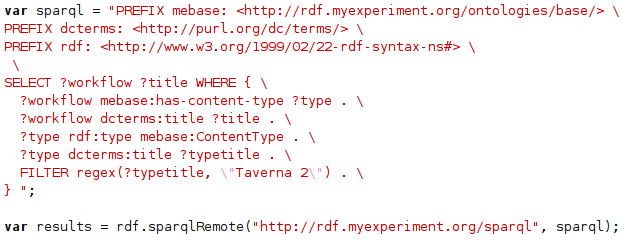
the RDF manager his a method to query a remote SPARQL end point. The complexity is mostly in formulating the SPARQL (and this one
happens to be available as <a href="http://www.myexperiment.org/workflows/890">workflow on MyExperiment too</a>:</p>

<p><img src="/blog/assets/images/myExp890.png" alt="" /></p>

<p>This is worsened by the fact that JavaScript does not have a type of multiline Strings, so the backslashes at
the end of the lines are JavaScript syntax and not part of the SPARQL. To simplify the SPARQL, I will show
below the SPARQL only, and not the Bioclipse script wrapping as is done in the above code snippet.</p>

<h2 id="list-all-taverna-2-workflows">List all Taverna 2 workflows</h2>

<p>Listing all Taverna 2 workflows, as shown in that earlier snippet, is done with the SPARQL:</p>

<script src="https://gist.github.com/egonw/172138.js"></script>

<p>This query asks for a <code class="language-plaintext highlighter-rouge">?workflow</code> and its <code class="language-plaintext highlighter-rouge">?title</code>, and the workflow <code class="language-plaintext highlighter-rouge">?type</code> must be of Class <code class="language-plaintext highlighter-rouge">ContentType</code> as defined in the
<code class="language-plaintext highlighter-rouge">mebase</code> namespace, and we want to know the <code class="language-plaintext highlighter-rouge">?typetitle</code> of that content type, because we are filtering that using a
<a href="http://en.wikipedia.org/wiki/Regular_expression">regular expression</a> to contain “Taverna 2”. Well, if you cannot
follow this, just <a href="http://www.bing.com/search?q=sparql+tutorial&amp;go=&amp;form=QBLH&amp;filt=all">google for SPARQL</a>,
and run one of those tutorials which are abundantly present on the web.</p>

<h2 id="finding-tags-used-to-annotate-workflows">Finding tags used to annotate workflows</h2>

<p>To list all tags which have likely to do with metabolomics, I can do:</p>

<script src="https://gist.github.com/egonw/172277.js"></script>

<p>And I can also list all workflows that are tagged like this. Because I could not get string matching to work, I used the tag’s URI instead:</p>

<script src="https://gist.github.com/egonw/172685.js"></script>

<h2 id="all-myexperiments-users-in-sweden">All MyExperiments Users in Sweden</h2>

<p>I was also interested in all MyExperiment Users in Sweden, and again, a simple SPARQL tells me where they live:</p>

<script src="https://gist.github.com/egonw/172129.js"></script>

<h2 id="finding-duncan-and-pierre">Finding Duncan and Pierre</h2>

<p>Very easy to find users, such as <a href="http://duncan.hull.name/">Duncan</a>:</p>

<script src="https://gist.github.com/egonw/172686.js"></script>

<p>Or <a href="http://plindenbaum.blogspot.com/">Pierre</a>, who has not listed where he lives:</p>

<script src="https://gist.github.com/egonw/172687.js"></script>

<h2 id="my-workflows">My workflows</h2>

<p>Given a user, it is also easy to get the workflows he <em>owns</em>. Again, I am using my URI instead of combining with a search
for my account, because the MyExperiment SPARQL end point is not particularly fast:</p>

<script src="https://gist.github.com/egonw/172691.js"></script>

<p>Earlier in this series:</p>

<ol>
  <li><a href="https://chem-bla-ics.linkedchemistry.info/2009/08/16/bioclipse-and-sparql-end-points.html">Bioclipse and SPARQL end points #1: DBPedia <i class="fa-solid fa-recycle fa-xs"></i></a></li>
</ol>]]></content><author><name>Egon Willighagen</name></author><category term="bioclipse" /><category term="rdf" /><category term="foaf" /><category term="myexperiment" /><category term="rdf" /><category term="sparql" /><summary type="html"><![CDATA[RDF and SPARQL are two really useful Open Standards. Bioclipse-RDF is a plugin for Bioclipse that provide RDF functionality, among which using remote SPARQL end points.]]></summary><media:thumbnail xmlns:media="http://search.yahoo.com/mrss/" url="http://egonw.github.io/blog/blog/assets/images/myExp890.png" /><media:content medium="image" url="http://egonw.github.io/blog/blog/assets/images/myExp890.png" xmlns:media="http://search.yahoo.com/mrss/" /></entry><entry><title type="html">Taverna Workshop, Day 1 Update</title><link href="http://egonw.github.io/blog/2007/10/08/taverna-workshop-day-1-update.html" rel="alternate" type="text/html" title="Taverna Workshop, Day 1 Update" /><published>2007-10-08T00:10:00+00:00</published><updated>2007-10-08T00:10:00+00:00</updated><id>http://egonw.github.io/blog/2007/10/08/taverna-workshop-day-1-update</id><content type="html" xml:base="http://egonw.github.io/blog/2007/10/08/taverna-workshop-day-1-update.html"><![CDATA[<p>The second part of the morning session featured a presentation by Sirisha Gollapudi which spoke about mining
biological graphs, such as protein-protein interaction networks and metabolic pathways. Patterns detection
for nodes with only one edge, and cycles etc, using Taverna. An example data she worked on is the Palsson human
metabolism (doi:<a href="https://doi.org/10.1073/pnas.0610772104">10.1073/pnas.0610772104</a>); she mentioned that this
metabolite data set contains <a href="http://en.wikipedia.org/wiki/Cocaine">cocaine</a> :) Neil Chue Hong finished with
an introduction on the <a href="http://www.omii.ac.uk/">OMII-UK</a> which is co-host of this meeting.</p>

<p>After lunch Mark Wilkinson introduced <a href="http://biomoby.org/">BioMoby</a>, which we actually use in Wageningen already.
I have tried to use <a href="http://biomoby.open-bio.org/CVS_CONTENT/moby-live/Java/docs/">jMoby</a> to set up services
based on the <a href="http://cdk.sf.net/">CDK</a>, but failed sofar. Will talk with Mark on that. Next was my presentation,
and I spoke about <a href="http://www.cdk-taverna.de/">CDK-Taverna</a>, <a href="http://www.bioclipse.net/">Bioclipse</a> and some
peculiarities with chemoinformatics workflow, like the importance with intermediate interaction, the need to
visualize the data and complex, information rich data. Bioclipse is seeing
<a href="http://wiki.bioclipse.net/index.php?title=Bioclipse2">an integration of BioMoby and of Taverna</a>.</p>

<p>After the coffee brake Marco Roos spoke about <a href="http://myexperiment.org/">myExperiment</a> and his work on text
mining. I unfortunately missed this presentation, as I was meeting with people from the EBI who work on the
<a href="http://www.ebi.ac.uk/thornton-srv/databases/MACiE/">MACiE database</a> (see
<a href="http://chem-bla-ics.blogspot.com/2006/02/chemical-reactions-in-cml.html">this blog item</a>).</p>

<p>A discussion session afterwards introduced a few more Taverna uses, and encountered technical problems.
Taverna2 is actually going to be quite interesting, with a data caching system between work processors, and a
powerful scheme of annotation of processors, which will allow rating, finding local services, etc. More on
that tomorrow. Dinner time now :)</p>]]></content><author><name>Egon Willighagen</name></author><category term="taverna" /><category term="ebi" /><category term="cdk" /><category term="bioclipse" /><category term="myexperiment" /><category term="justdoi:10.1073/pnas.0610772104" /><category term="inchikey:ZPUCINDJVBIVPJ-LJISPDSOSA-N" /><summary type="html"><![CDATA[The second part of the morning session featured a presentation by Sirisha Gollapudi which spoke about mining biological graphs, such as protein-protein interaction networks and metabolic pathways. Patterns detection for nodes with only one edge, and cycles etc, using Taverna. An example data she worked on is the Palsson human metabolism (doi:10.1073/pnas.0610772104); she mentioned that this metabolite data set contains cocaine :) Neil Chue Hong finished with an introduction on the OMII-UK which is co-host of this meeting.]]></summary></entry></feed>