<?xml version="1.0" encoding="utf-8"?><feed xmlns="http://www.w3.org/2005/Atom" ><generator uri="https://jekyllrb.com/" version="4.3.4">Jekyll</generator><link href="http://egonw.github.io/blog/feed/by_tag/nmr.xml" rel="self" type="application/atom+xml" /><link href="http://egonw.github.io/blog/" rel="alternate" type="text/html" /><updated>2026-11-17T07:22:51+00:00</updated><id>http://egonw.github.io/blog/feed/by_tag/nmr.xml</id><title type="html">chem-bla-ics</title><subtitle>Chemblaics (pronounced chem-bla-ics) is the science that uses open science and computers to solve problems in chemistry, biochemistry and related fields.</subtitle><author><name>Egon Willighagen</name></author><entry><title type="html">ToxBank: a data warehouse for (computational) toxicology</title><link href="http://egonw.github.io/blog/2011/03/08/toxbank-data-warehouse-for.html" rel="alternate" type="text/html" title="ToxBank: a data warehouse for (computational) toxicology" /><published>2011-03-08T00:00:00+00:00</published><updated>2011-03-08T00:00:00+00:00</updated><id>http://egonw.github.io/blog/2011/03/08/toxbank-data-warehouse-for</id><content type="html" xml:base="http://egonw.github.io/blog/2011/03/08/toxbank-data-warehouse-for.html"><![CDATA[<p>Last week I was in sunny <a href="http://en.wikipedia.org/wiki/Cascais">Cascais</a>, and
in three days experienced -23<sup>o</sup>C and +18<sup>o</sup>C. The reason
I was there was the kick-off meeting of the EU FP7 cluster SEURAT, which includes
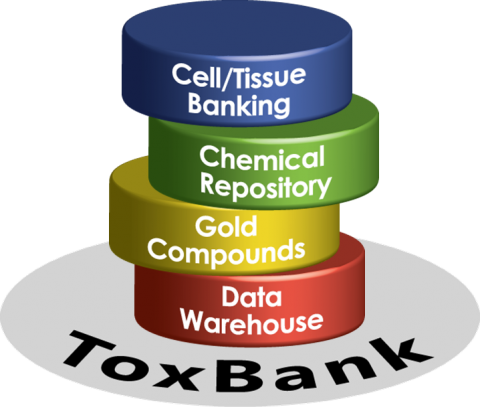
‘our’ <a href="http://toxbank.net/">ToxBank</a> project.</p>

<p><img src="/blog/assets/images/ToxBankComponents.png" alt="" /></p>

<p>Data types we will host include many different types, including my favorite
metabolomics. Don’t ask me what this will practically mean, but some keywords
we already know include RDF, <a href="http://opentox.org/">OpenTox</a>, and <a href="http://www.leadscope.com/toxml.php">ToxML</a>.
With metabolomics, I hope to squeeze in metabolomics.</p>

<p>And that data warehousing for metabolomics is important was only recently shown
be the retraction (via <a href="http://retractionwatch.wordpress.com/">RetractionWatch</a>)
of <a href="http://www.nature.com/nature/journal/v434/n7030/full/nature03356.html">this Nature paper</a>
(doi:<a href="http://dx.doi.org/10.1038/nature03356">10.1038/nature03356</a>). The reason
was that it critically depended on conclusions from another <a href="http://pubs.acs.org/doi/abs/10.1021/jf902670b">retracted</a>
<a href="http://pubs.acs.org/doi/abs/10.1021/jf021166h">paper</a> (doi:<a href="http://dx.doi.org/10.1021/jf021166h">10.1021/jf021166h</a>),
from J. Agric. Food Chem. in 2009.</p>

<p>In this paper, they identified ten chemicals from arabidopsis: <a href="http://en.wikipedia.org/wiki/Butanoic_acid">butanoic acid</a>;
<a href="http://en.wikipedia.org/wiki/Trans-cinnamic_acid">trans-cinnamic acid</a>; o-<a href="http://en.wikipedia.org/wiki/Coumaric_acid">coumaric
acid</a>; p-coumaric acid; <a href="http://en.wikipedia.org/wiki/Ferulic_acid">ferulic
acid</a>; p-hydroxybenzamide; <a href="http://en.wikipedia.org/wiki/Methyl_p-hydroxybenzoate">methyl
p-hydroxybenzoate</a>; 3-indolepropanoic
acid; <a href="http://en.wikipedia.org/wiki/Syringic_acid">syringic acid</a>; and, <a href="http://en.wikipedia.org/wiki/Vanillic_acid">vanillic
acid</a>. I hope I have the links to
Wikipedia correct, as this was based on names only, as the paper does not seem
to list InChIs or even SMILESes. The ten chemical were identified with HPLC
and NMR. No experimental data seems to be given. What NMR data did they base
the identification on? I have seen pretty interesting assignments of chemical
identity in GC/MS and LC/MS, so was quite disappointed to not see the gory details
here.</p>

<p>But fortunately, I could look at the raw data. Yeah, sure! Dream on.</p>

<p>In fact, it seems the characterizations of the 10 chemicals was challenged,
causing the authors to look again at their data. Unfortunately, they could not
find experimental data anymore. The authors write in the <a href="http://pubs.acs.org/doi/full/10.1021/jf902670b">retraction</a>:</p>

<blockquote>
  <p>We have been unable to find experimental data that document the actual isolation of butanoic acid,
trans-cinnamic acid, …</p>
</blockquote>

<p>Now, readers of my blog I care about raw data (see <a href="http://chem-bla-ics.blogspot.com/2010/08/molecular-chemometrics-principles-1.html">McPrinciple #1</a>).
For example, it was a key feature of our <a href="http://chem-bla-ics.blogspot.com/search?q=MetWare">MetWare</a>
project. It is not entirely clear to me that they could no longer find the raw
data, or whether they were no longer able to correlate their extracted characteristics
with the know NMR for those ten compounds. This only strengthens the importance
of NMR databases in metabolite identification, something <a href="http://www.steinbeck-molecular.de/steinblog/">Christoph</a>
would only agree with.</p>

<p>I am not sure we will see the bottom of this, and see if the authors could have
prevented this retraction. However, I do believe the paper was flawed in the
first place: it did not give experimental detail allowing the referees to judge
the metabolite identification. The referees failed, as the apparently did not
find this aspect important enough to have this data in the paper. And, the journal
failed clearly, by not having a good editorial requirement in place around availability
of data. This is not specific to this retracted paper, nor of this journal.
It’s pretty much the community standard, despite many calling for years for
better standards, e.g. via minimal reporting standards.</p>

<p>Well, maybe journal editors will soon wake up, and make availability of experimental
data in papers of this kind (and any type, IMHO) a community standard, and strong
standard, such strong that referees can reject papers of papers do not provide
this minimal information.</p>

<p>Why? It would have saved a lot of people from doing the wrong thing. The original
paper was cited 54 times (according to WoS) and the Nature paper 52 times (up
one since the RetractionWatch post). We’re bound to see a few more retractions
as a result of this, I guess.</p>

<p>So, where I failed to get MetWare going within the <a href="http://www.metabolomicscentre.nl/">Netherlands Metabolomics
Center</a>, let’s hope ToxBank does better.
But given the list of ToxBank partners, I have no doubt about that.</p>]]></content><author><name>Egon Willighagen</name></author><category term="metabolomics" /><category term="metware" /><category term="nature" /><category term="nmr" /><category term="opendata" /><category term="publishing" /><category term="justdoi:10.1038/nature03356" /><category term="justdoi:10.1021/jf902670b" /><category term="justdoi:10.1021/jf021166h" /><summary type="html"><![CDATA[Last week I was in sunny Cascais, and in three days experienced -23oC and +18oC. The reason I was there was the kick-off meeting of the EU FP7 cluster SEURAT, which includes ‘our’ ToxBank project.]]></summary><media:thumbnail xmlns:media="http://search.yahoo.com/mrss/" url="http://egonw.github.io/blog/blog/assets/images/ToxBankComponents.png" /><media:content medium="image" url="http://egonw.github.io/blog/blog/assets/images/ToxBankComponents.png" xmlns:media="http://search.yahoo.com/mrss/" /></entry><entry><title type="html">Open NMR data: raw curves and annotated peak lists</title><link href="http://egonw.github.io/blog/2009/03/04/open-nmr-data-raw-curves-and-annotated.html" rel="alternate" type="text/html" title="Open NMR data: raw curves and annotated peak lists" /><published>2009-03-04T00:00:00+00:00</published><updated>2009-03-04T00:00:00+00:00</updated><id>http://egonw.github.io/blog/2009/03/04/open-nmr-data-raw-curves-and-annotated</id><content type="html" xml:base="http://egonw.github.io/blog/2009/03/04/open-nmr-data-raw-curves-and-annotated.html"><![CDATA[<p>Games are known to trigger technical innovation. But recently it also triggered innovation on open chemical databases. Jean-Claude
<a href="http://usefulchem.blogspot.com/2009/03/spectral-game-update.html">reported</a>:</p>

<blockquote>
  <p>We are very excited by what we have put together so far. There are currently 457 H NMR, 389 C NMR, 11 IR and 29 NIR spectra. This
is only possible because of people who submitted their spectra to ChemSpider as Open Data - please keep uploading!</p>
</blockquote>

<p>Now, the <a href="http://nmrshiftdb.org/">NMRShiftDB</a> also hosts quite a number of NMR spectra, and I have a hobby to submit spectra,
particularly for rare nuclei. In particular, I think it is fun to to have as many as possible structures which have spectra for
all the nuclei in that structure. <a href="http://en.wikipedia.org/wiki/Benzene">Benzene</a> is a simple example for which NMR spectra are
available for all nuclei (see <a href="http://nmrshiftdb.chemie.uni-mainz.de/portal/js_pane/P-Results/nmrshiftdbaction/showDetailsFromHome/molNumber/7901">this entry</a>).</p>

<p>Now, the main difference between the NMRShiftDB and <a href="http://www.chemspider.com/">ChemSpider</a> spectral data is the the first are annotated
peak lists (each shift is assigned to an atom), and the latter are full, but unannotated, spectral curves. So, there are quite a few
things you could do here. For example, see which structures which NMR curves are not yet annotated in NMRShiftDB.
<a href="http://www.chemspider.com/blog/">Antony</a> pointed me to <a href="http://www.chemspider.com/spectra.aspx">this page</a> which is an overview
of all spectral data in ChemSpider, but that page is difficult to machine process. Partly, because it is a mix of Open and
Proprietary data, and partly because it uses JavaScript to navigate the table. (BTW, RDF interfaces to both resources would
be much more helpful, and simply allow me to query all molecules which have a spectrum which is Open, and which is not found
in the NMRShiftDB. I am working on a RDF interface to NMRShiftDB.)</p>

<p>Antony also <a href="http://usefulchem.blogspot.com/2009/03/spectral-game-update.html#c6864087472599346745">asked</a> me to advertise the
option to upload Open spectral curves to ChemSpider. So, hereby. However, I really do hope ChemSpider will make it easier for
others to reuse all the Open Data, as having to machine browsing the linked HTML interface is a waste of ChemSpider computing
resources.</p>

<p><strong>Update</strong>: the game is now available from <a href="http://spectralgame.com/">spectralgame.com</a>.</p>]]></content><author><name>Egon Willighagen</name></author><category term="opendata" /><category term="chemspider" /><category term="nmr" /><summary type="html"><![CDATA[Games are known to trigger technical innovation. But recently it also triggered innovation on open chemical databases. Jean-Claude reported:]]></summary></entry><entry><title type="html">Inter- and Extrapolation: the NMR shift prediction debate</title><link href="http://egonw.github.io/blog/2007/07/13/inter-and-extrapolation-nmr-shift.html" rel="alternate" type="text/html" title="Inter- and Extrapolation: the NMR shift prediction debate" /><published>2007-07-13T00:00:00+00:00</published><updated>2007-07-13T00:00:00+00:00</updated><id>http://egonw.github.io/blog/2007/07/13/inter-and-extrapolation-nmr-shift</id><content type="html" xml:base="http://egonw.github.io/blog/2007/07/13/inter-and-extrapolation-nmr-shift.html"><![CDATA[<p>Chemical blogspace has seen a lengthy discussion on <a href="http://chem-bla-ics.blogspot.com/2007/06/quality-of-chemical-database.html">the quality of a few NMR shift prediction programs</a>,
and Ryan wanted to make <a href="http://acdlabs.typepad.com/my_weblog/2007/07/final-note-on-t.html">a final statement</a>. Down his blog item
he had this quote from Jeff, discussing the use of the <a href="http://www.nmrshiftdb.org/">NMRShiftDB</a> as external test set:</p>

<ul><i>
“Of course customers are really interested in how accurately a prediction program can predict THEIR molecules - not a collection of external data such as NMRShiftDB.”
</i></ul>

<p>I’m sure none of us knows what weird chemistry people are doing; we will never know what the overlap of the NMRShiftDB test
set with the customer data set is. The quote suggests it is low, but we simply do not know.</p>

<h2 id="interpolation-and-extrapolation">Interpolation and Extrapolation</h2>

<p>The accuracy of prediction models is very difficult to grasp, and one can only estimate it; using a test set.
If few data is available, one may opt for using the training set as test set too, and gives an estimate if the
modeling method is able to predict at all. However, the outcome of this exercise is the worst possible estimate
you can make. So, when possible you use an independent test set, which does not contain any molecules that were
present in the training set. (Actually, one could even suggest that this must happen on a shift level, but that
gives problems with HOSE-code based prediction.)</p>

<p>Now, what Ryan stresses in his <a href="http://acdlabs.typepad.com/my_weblog/2007/07/final-note-on-t.html">latest blog item</a>
is that prediction test results for the various available methods does not explicitly state the amount of overlap
between the training and test set, one cannot draw any conclusions. Agreed. I would, however, like to tune this
even a bit further, after reading the stupid quote (of course, taking out of context). What Jeff probably aimed
at, is that the prediction accuracy is only meaningful to a customer if there is considerable between the customers
data set and the test set, which is what the model makers do not know.</p>

<p>And the overlap actually goes beyond the overlap in terms of molecular identity. It is really the overlap in terms
of molecular substructures that matters: a database with alkanes but no phenyl rings will more accurately predict
other alkanes not present in the training set (interpolation), but will not accurately predict compounds with
phenyl rings (extrapolation). What the customer needs is that his personal data set does not require extrapolation.
That is what matters.</p>

<p>It is interesting to realize, however, that the NMRShiftDB allows you to upload your molecules, or alternatively,
you download the software (it’s open source) and the data (it’s open data) if you don’t want to send your molecules
over the internet, and the NMRShiftDB software will automatically take into account your own data set.</p>

<p>Thus, if you are working on a series of related molecules, you can extend the NMRShiftDB data set with already
elucidated structures, reducing the prediction error for your yet related unknowns derivatives. It is that easy
to include prior/expert knowledge in the NMRShiftDB. I believe the ACD/Labs software allows this too, so the
quote is really meaningless. Not correct, not wrong, simply says nothing.</p>

<h2 id="open-data-open-source-open-standards">Open Data, Open Source, Open Standards</h2>

<p>Now, the various releases of the ACD/Labs software show a simple, understandable trend that increasing the number
of data you use for the training set, reduces the prediction error. That’s because of various reasons I will not
go into in this item. The ACD/Labs NMR databases are expensive, because they have to manually extract and validate
the data from literature (see <a href="http://acdlabs.typepad.com/my_weblog/2007/06/the_purgatory_d.html">The Purgatory Database</a>);
so, during my PhD I only bought the CNMR and HNMR prediction packages. (Off topic: two weeks after I received my
copies of the software, ACD/Labs released a new version, which they kindly sent me a copy of too. Common in
opensource, but much appreciated at that time. Cheers, <a href="http://www.acdlabs.com/">ACD/Labs</a>!)</p>

<p>The ACD/Labs databases are likely expensive because of various reasons. And this is where the ODOSOS concept of the
<a href="http://www.blueobelisk.org/">Blue Obelisk</a> comes in. <strong>Open Data</strong>: if publishers would not copyright their data,
NMR databases would be much cheaper to set up (see <a href="http://wwmm.ch.cam.ac.uk/blogs/murrayrust/?p=405">this thread in Peter’s blog</a>);
assuming ACD/Labs has to pay publishers for actually setting up their database. <strong>Open Source</strong>: the various Blue
Obelisk projects provide the <a href="http://chem-bla-ics.blogspot.com/2006/09/chemical-archeology-oscar3-to.html">tools to automatically create a purgatory NMR database</a>;
no humans needed for that any more. <strong>Open Standards</strong>: the data from the NMRShiftDB can be downloaded in various
formats, among which CMLSpect. Being able to easily read the data, made it possible that we actually have this
discussion. Sure, the open data part of the NMRShiftDB is crucial too! But the database could have used an obscure,
binary, undocumented, with many software tweaks and special cases, <code class="language-plaintext highlighter-rouge">.doc</code>-like format, which no one could support.</p>

<p>Clearly, ODOSOS gives all, even proprietary, NMR prediction tools a boost, and I am very happy to see that happen.
It is the point that we, the Blue Obelisk Movement, are trying to make for some time now.</p>]]></content><author><name>Egon Willighagen</name></author><category term="nmr" /><summary type="html"><![CDATA[Chemical blogspace has seen a lengthy discussion on the quality of a few NMR shift prediction programs, and Ryan wanted to make a final statement. Down his blog item he had this quote from Jeff, discussing the use of the NMRShiftDB as external test set:]]></summary></entry><entry><title type="html">Archiving spectra: use InChI and CML</title><link href="http://egonw.github.io/blog/2007/06/22/archiving-spectra-use-inchi-and-cml.html" rel="alternate" type="text/html" title="Archiving spectra: use InChI and CML" /><published>2007-06-22T00:00:00+00:00</published><updated>2007-06-22T00:00:00+00:00</updated><id>http://egonw.github.io/blog/2007/06/22/archiving-spectra-use-inchi-and-cml</id><content type="html" xml:base="http://egonw.github.io/blog/2007/06/22/archiving-spectra-use-inchi-and-cml.html"><![CDATA[<p><a href="http://acdlabs.typepad.com/my_weblog/">Ryan</a> blogged in <a href="http://acdlabs.typepad.com/my_weblog/2007/06/archive_this.html">Archive This</a>
about some advices from ACD on how to store spectra in your electronic lab notebook.</p>

<h2 id="use-inchi">Use InChI</h2>

<p>This reminded me of a <a href="http://chem-bla-ics.blogspot.com/2007/02/rsc-first-publisher-to-go-semantic.html">discussion I had with with Colin</a>
when he was at the CUBIC, which was about experimental sections. I proposed that the <a href="http://www.iupac.org/inchi/">InChI</a> should have a
prominent place in the experimental section. An important argument for this is that it allows well-defined atom numbering to be used when
writing down the NMR bits in that section: the InChI gives a unique numbering, so that the numbering used in the experimental section
becomes author neutral. Because the InChI puts the carbons up front, the <sup>13</sup>C NMR details get numbers from 1-13, or whatever
the carbon count is. For proton NMR it is not difficult either, they are simply numbered according to the heavy atom to which they are
attached. For situations where two hydrogens attached to the same heavy atom have different shifts, then a and b can still be used.
The numbers are easily added to 2D diagrams anyway.</p>

<p>If software vendors (e.g. <a href="http://www.acdlabs.com/">ACD</a> and <a href="http://bioclipse.net/">Bioclipse</a>) and publishers (e.g. ACS,
<a href="http://www.rsc.org/Publishing/Journals/ProjectProspect/">RSC</a>, <a href="http://www.chemistrycentral.com/">Chemistry Central</a>) could adopt this
proposal, then experimental sections immediately are better machine parsable and ready for automatic processing, such as discussed in
my blog item <a href="http://chem-bla-ics.blogspot.com/2006/09/chemical-archeology-oscar3-to.html">Chemical Archeology: OSCAR3 to NMRShiftDB.org</a>
and by <a href="http://www.acscinf.org/dbx/mtgs/232nm/232cinfprogram.asp">Christoph at the ACS meeting</a>, available as
<a href="http://acscinf.org/docs/meetings/232nm/presentations/232nm101.pdf">PDF</a> and this 18MB
<a href="http://acscinf.org/docs/meetings/232nm/presentations/232nm101.mp3">MP3</a>.</p>

<h2 id="use-cml">Use CML</h2>

<p>Even better is to use <a href="http://en.wikipedia.org/wiki/Chemical_Markup_Language">CML</a> for this, or CMLSpect to be precise (paper is accepted,
and should appear soon). This XML-based language allows the full semantic markup of all the experimental details and all the interesting
assignments you want to archive. I would like to <strong>challenge ACD</strong> to follow Bioclipse’s lead and provide export as CMLSpect for spectral
assignments and markup of experimental details, in addition to the PDF in whatever format they prefer. Cheers for the work by Tobias
and Stefan on spectrum support in Bioclipse!</p>]]></content><author><name>Egon Willighagen</name></author><category term="cml" /><category term="inchi" /><category term="nmr" /><summary type="html"><![CDATA[Ryan blogged in Archive This about some advices from ACD on how to store spectra in your electronic lab notebook.]]></summary></entry><entry><title type="html">Janocchio: Jmol and CDK based 1H coupling constant prediction</title><link href="http://egonw.github.io/blog/2007/06/10/janocchio-jmol-and-cdk-based-1h.html" rel="alternate" type="text/html" title="Janocchio: Jmol and CDK based 1H coupling constant prediction" /><published>2007-06-10T00:00:00+00:00</published><updated>2007-06-10T00:00:00+00:00</updated><id>http://egonw.github.io/blog/2007/06/10/janocchio-jmol-and-cdk-based-1h</id><content type="html" xml:base="http://egonw.github.io/blog/2007/06/10/janocchio-jmol-and-cdk-based-1h.html"><![CDATA[<p>While looking up a reference for <a href="http://firstglance.jmol.org/">FirstGlance in Jmol</a>, I found <a href="https://sourceforge.net/projects/janocchio/">Janocchio</a>,
a <a href="http://cdk.sf.net/">CDK</a> and <a href="http://www.jmol.org/">Jmol</a> based tool for prediction of coupling constants,
<a href="https://doi.org/10.1002/mrc.2016">recently published</a> in <a href="http://www3.interscience.wiley.com/cgi-bin/jhome/3767">Magnetic Resonance in Chemistry</a>.
It’s written by Evans, Bodkin, Baker and Sharman (from <a href="http://lilly.com/">Eli Lilly</a>) and licensed LGPL. It is one of those rare contributions of
pharmaceutical industry, and I can only deeply appreciate this contribution.</p>

<p>A quote from the article:</p>

<ul><i>
It was therefore decided to create a Java application and applet,
‘JAva NOe and Coupling Calculator with Handy Interactive Operation’
(Janocchio), using the open source libraries of the molecular viewer Jmol
and the Chemical Development Kit (CDK). It aims to provide a simple and
intuitive way to calculate both the NOEs and couplings.
</i></ul>

<p>Release 1.0.1 of last May uses an old Jmol, and the CDK release from 26 August 2005. A bit outdated, and I am wondering if it would
be a lot of work to integrate this into Bioclipse. <a href="http://wiki.bioclipse.net/index.php?title=SummerOfCode">Maybe a summer job</a>?</p>]]></content><author><name>Egon Willighagen</name></author><category term="jmol" /><category term="cdk" /><category term="nmr" /><category term="justdoi:10.1002/mrc.2016" /><summary type="html"><![CDATA[While looking up a reference for FirstGlance in Jmol, I found Janocchio, a CDK and Jmol based tool for prediction of coupling constants, recently published in Magnetic Resonance in Chemistry. It’s written by Evans, Bodkin, Baker and Sharman (from Eli Lilly) and licensed LGPL. It is one of those rare contributions of pharmaceutical industry, and I can only deeply appreciate this contribution.]]></summary></entry></feed>