<?xml version="1.0" encoding="utf-8"?><feed xmlns="http://www.w3.org/2005/Atom" ><generator uri="https://jekyllrb.com/" version="4.3.4">Jekyll</generator><link href="http://egonw.github.io/blog/feed/by_tag/openscience.xml" rel="self" type="application/atom+xml" /><link href="http://egonw.github.io/blog/" rel="alternate" type="text/html" /><updated>2026-11-19T06:09:00+00:00</updated><id>http://egonw.github.io/blog/feed/by_tag/openscience.xml</id><title type="html">chem-bla-ics</title><subtitle>Chemblaics (pronounced chem-bla-ics) is the science that uses open science and computers to solve problems in chemistry, biochemistry and related fields.</subtitle><author><name>Egon Willighagen</name></author><entry><title type="html">Oxford…</title><link href="http://egonw.github.io/blog/2010/08/01/oxford.html" rel="alternate" type="text/html" title="Oxford…" /><published>2010-08-01T00:00:00+00:00</published><updated>2010-08-01T00:00:00+00:00</updated><id>http://egonw.github.io/blog/2010/08/01/oxford</id><content type="html" xml:base="http://egonw.github.io/blog/2010/08/01/oxford.html"><![CDATA[<p>Yesterday, I arrived in <a href="http://en.wikipedia.org/wiki/Oxford">Oxford</a>, after a 3.5 hour bus transfer from <a href="http://en.wikipedia.org/wiki/London_Stansted_Airport">London Stansted</a>.
Long, boring ride (though I might have seen a few <a href="http://www.rspb.org.uk/wildlife/birdguide/name/r/redkite/index.aspx">red kites</a>, but seeing that they were near extinct, I
am wondering what other large bird of prey has strong split tail like a swallow). Showed once more that the UK infrastructure has hardly changed since the 19th century.
Enjoying an undergraduate room at one of the colleges. Pretty basic, but makes me feel more like a human than a tourist. Yes!, undergraduate students are human too! One of
the advantages is you get an excellent internet connection :)</p>

<p>Anyways, going to the <a href="http://echeminfo.com/comty_oxfordadmet10">Predictive Toxicology</a> workshop, thanx to the bursary award I received from echeminfo (see
<a href="http://echeminfo.com/">Oxford, August 2010: eCheminfo Predictive ADME &amp; Toxicology 2010 Workshop</a>).</p>

<p>This afternoon I walked around a bit, watching all the old buildings. But I guess being here without anyone to share it with, and that it just looks
<a href="http://en.wikipedia.org/wiki/Cambridge">Cambridge</a>, makes me not-so-much impressed. Moreover, it’s too busy with tourists and people randomly wearing Oxford University
sweatshirts. Small and nice was the <a href="http://www.mhs.ox.ac.uk/">Museum of the History of Science</a>, with some nice chemical pieces, like this one:</p>

<p><img src="/blog/assets/images/DSCI0089.JPG" alt="" /></p>

<p>Buildings like the <a href="http://en.wikipedia.org/wiki/Radcliffe_Camera">Radcliffe Camera</a> are nice on the outside, but closed. Seems I have to become a fellow first. This is
what it looked like today:</p>

<p><img src="/blog/assets/images/DSCI0094.JPG" alt="" /></p>

<p>Quite interesting too was the Oxford University Press shop. I’m a sucker for books. Apparently, you can just write a book and publish it. For example, an extensive list of
<a href="http://ukcatalogue.oup.com/category/academic/series/general/opr.do">dictionaries on about anything</a>… and since I have been writing several book chapters right now,
perhaps this is actually an interesting route…</p>

<p>But the question is, of course, how long will we keep reading books… they’re the <a href="http://wwmm.ch.cam.ac.uk/blogs/murrayrust/?p=1064">hamburgers</a> of educational material…
Kindle and alikes will soon drop in price, and cost some €30 euro. But e-book prices will have to drop too, and I still do not get why an e-book is more expensive than a
paperback… (see <a href="http://chem-bla-ics.blogspot.com/2010/07/amazon-kindle-edition-is-more-expensive.html">Amazon, the Kindle edition is more expensive than the paperback??</a>).
But then again… they are rich, and I am not.</p>

<p>There was some recent talk about the fact that no one can be Open to the full. You either do Open Data or Open Source, and make a living from the rest. That’s where
I nicely show I know bullocks of economics. I do <a href="http://bodr.sf.net/">BODR</a>, <a href="http://cdk.sf.net/">CDK</a>, … all Open, all for free.</p>

<p>OK. That’s a plus for Oxford… it makes you think about things. Perhaps there is something to <a href="http://en.wikipedia.org/wiki/Morphic_field#Morphogenetic_field">morphogenetic</a>
fields…</p>]]></content><author><name>Egon Willighagen</name></author><category term="toxicology" /><category term="openscience" /><summary type="html"><![CDATA[Yesterday, I arrived in Oxford, after a 3.5 hour bus transfer from London Stansted. Long, boring ride (though I might have seen a few red kites, but seeing that they were near extinct, I am wondering what other large bird of prey has strong split tail like a swallow). Showed once more that the UK infrastructure has hardly changed since the 19th century. Enjoying an undergraduate room at one of the colleges. Pretty basic, but makes me feel more like a human than a tourist. Yes!, undergraduate students are human too! One of the advantages is you get an excellent internet connection :)]]></summary><media:thumbnail xmlns:media="http://search.yahoo.com/mrss/" url="http://egonw.github.io/blog/blog/assets/images/DSCI0089.JPG" /><media:content medium="image" url="http://egonw.github.io/blog/blog/assets/images/DSCI0089.JPG" xmlns:media="http://search.yahoo.com/mrss/" /></entry><entry><title type="html">Critical mass for Open Notebook Science wikis by prepopulation with RDF data</title><link href="http://egonw.github.io/blog/2010/06/26/critical-mass-for-open-notebook-science.html" rel="alternate" type="text/html" title="Critical mass for Open Notebook Science wikis by prepopulation with RDF data" /><published>2010-06-26T00:00:00+00:00</published><updated>2010-06-26T00:00:00+00:00</updated><id>http://egonw.github.io/blog/2010/06/26/critical-mass-for-open-notebook-science</id><content type="html" xml:base="http://egonw.github.io/blog/2010/06/26/critical-mass-for-open-notebook-science.html"><![CDATA[<p>One of the problems with Open Data, - Source, and Standards (<a href="http://chem-bla-ics.blogspot.com/2007/10/why-odosos-is-important.html">ODOSOS</a>) is
to get critical mass: for the project to move forward, you need both a good user community and an active developers community. The first is the
crucial reward for the latter: people using your work is the incentive. Sometimes, a project does not succeed in doing that; Rich was
<a href="http://depth-first.com/">questioning</a> if his <a href="http://chempedia.com/">ChemPedia</a> project <a href="http://depth-first.com/articles/2010/06/22/what-about-chempedia">built up enough mass</a>.</p>

<p>This also applies to wikis. <a href="http://wikipedia.org/">WikiPedia</a> clearly has enough critical mass, but is struggling with scaling, which is another
problem you can encounter. Building a dedicated, domain specific wiki allows you to do things the way you like. For example, the can be used to
build up the knowledge base around a specific problem. For example, HIV drugs (see <a href="http://hivdb.stanford.edu/">HIVdb</a> as an example knowledge base).
The wiki could contain information you need for your data analysis. The developers team will likely be small, but the data will be highly curated.
You are basically both the developer and the user community. Hopefully, in good <a href="http://en.wikipedia.org/wiki/Open_Notebook_Science">Open Notebook Science</a>
manner, things will grow, and others will join in on building the knowledge base.</p>

<p><a href="http://semantic-mediawiki.org/wiki/Semantic_MediaWiki">Semantic MediaWiki</a> bridges the human readable wiki content, with machine readable RDF
content. This wiki does require some additional annotation, but at the same time makes important facts machine readable. The
<a href="http://wiki.bioclipse.net/">Bioclipse Wiki</a> is using it, though we are not yet taking advantage of the RDF exposure.</p>

<p>Now, returning to the critical mass aspect we started with. Samuel, who did a project with me on reasoning with
<a href="http://saml.rilspace.org/content/3rd-project-update-integrating-swi-prolog-for-semantic-reasoning-in-bioclipse">Prolog in Bioclipse</a>, is now
doing a <a href="http://en.wikipedia.org/wiki/Google_Summer_of_Code">Google Summer of Code</a> <a href="http://saml.rilspace.org/tags/gsoc2010">project</a>
(is there any significance in the fact that three <a href="http://www.bioclipse.net/">Bioclipse</a> developers are student or have been mentor in the GSoC? :)
within the Semantic MediaWiki project. In particular, one of the things he was just working on, is the
<a href="http://saml.rilspace.org/populating-smw-from-rdfxml-first-test">import of RDF into a wiki</a>.</p>

<p>Oh goodies! That is pretty cool, don’t you think? Just pull together RDF from your field of interest, drop it on the wiki, and you have your
initial wiki the experts can continue to curate, add facts, etc. He already told me about his plans to add a
<a href="http://en.wikipedia.org/wiki/SPARQL">SPARQL</a> end point for the Semantic MediaWiki software.</p>]]></content><author><name>Egon Willighagen</name></author><category term="openscience" /><category term="opendata" /><category term="sparql" /><category term="wiki" /><category term="gsoc" /><summary type="html"><![CDATA[One of the problems with Open Data, - Source, and Standards (ODOSOS) is to get critical mass: for the project to move forward, you need both a good user community and an active developers community. The first is the crucial reward for the latter: people using your work is the incentive. Sometimes, a project does not succeed in doing that; Rich was questioning if his ChemPedia project built up enough mass.]]></summary></entry><entry><title type="html">Really free chemistry books</title><link href="http://egonw.github.io/blog/2009/09/17/really-free-chemistry-books.html" rel="alternate" type="text/html" title="Really free chemistry books" /><published>2009-09-17T00:00:00+00:00</published><updated>2009-09-17T00:00:00+00:00</updated><id>http://egonw.github.io/blog/2009/09/17/really-free-chemistry-books</id><content type="html" xml:base="http://egonw.github.io/blog/2009/09/17/really-free-chemistry-books.html"><![CDATA[<p>With pleasure I read <a href="http://opendotdotdot.blogspot.com/2009/09/analogue-or-digital-both-please.html">Analogue or Digital? - Both, Please</a>.
Funnily, I just created MP3 (or, preferably <a href="http://en.wikipedia.org/wiki/Vorbis">Ogg Vorbis</a>, superior but hardly
any support by commercial companies, who rather seem to pay license fees) directly from the CD.</p>

<p>Anyway… the blog wanders of to Google introducing searchable books, with many out-of-copyright. I was wondering
how many chemistry books the pre-1923 book set included, and that actually sums up to about
<a href="http://books.google.com/books?lr=&amp;as_brr=0&amp;q=chemistry&amp;btnG=Search+Books&amp;as_drrb_is=b&amp;as_minm_is=0&amp;as_miny_is=&amp;as_maxm_is=0&amp;as_maxy_is=1922">41 thousand books</a>,
just for the <em>chemistry</em> search term.</p>

<p>There is quite cool stuff there, like the <a href="http://books.google.com/books?id=HC_kQAAACAAJ&amp;dq=inauthor:lavoisier&amp;lr=&amp;as_drrb_is=b&amp;as_minm_is=0&amp;as_miny_is=&amp;as_maxm_is=0&amp;as_maxy_is=1922&amp;as_brr=0">English translation of the works</a>
of <a href="http://en.wikipedia.org/wiki/Antoine_Lavoisier">Lavoisier</a>.</p>

<p>This is really cool! I can just <a href="http://books.google.com/books/download/Elements_of_chemistry.pdf?id=adYKAAAAIAAJ&amp;output=pdf&amp;sig=ACfU3U1wSuUXDwx3MVNlSSWj7BFAjdjApw&amp;source=gbs_v2_summary_r&amp;cad=0">download this</a>
onto my eReader (which I don’t have yet anyway, but my Dell laptop will do fine; if only the PDF was broken), but
this actually allows me to read all the stuff I read about when doing History of Chemistry in the last year it
was given in <a href="http://ru.nl/">Nijmegen</a>, back in 1993. Which was funny in itself, as the course was for second year
students, but one of my introduction tutors suggested me to take it, which I did. It was a great course, by a great
teacher, btw! It is a shame that the course was lost from the curriculum, much like I hated to see electrochemistry
and cheminformatics lost in Nijmegen. Severe and very regrettable loss of diversity in the education there.</p>

<p>Anyways, I’m going to need hours to browse all the goodies there. Did you spot the
<a href="http://books.google.com/books?id=lndOAAAAMAAJ&amp;q=chemistry&amp;dq=chemistry&amp;lr=&amp;as_drrb_is=b&amp;as_minm_is=0&amp;as_miny_is=&amp;as_maxm_is=0&amp;as_maxy_is=1922&amp;as_brr=0">1913 copy of the CRC Handbook of Chemistry and Physics</a>
yet?</p>

<p>I am looking forward to seeing people starting text mining on these books… anyway?</p>]]></content><author><name>Egon Willighagen</name></author><category term="openscience" /><category term="publishing" /><summary type="html"><![CDATA[With pleasure I read Analogue or Digital? - Both, Please. Funnily, I just created MP3 (or, preferably Ogg Vorbis, superior but hardly any support by commercial companies, who rather seem to pay license fees) directly from the CD.]]></summary></entry><entry><title type="html">VRMS meme: how much non-free software are you running?</title><link href="http://egonw.github.io/blog/2009/09/13/vrms-meme-how-much-non-free-software.html" rel="alternate" type="text/html" title="VRMS meme: how much non-free software are you running?" /><published>2009-09-13T00:00:00+00:00</published><updated>2009-09-13T00:00:00+00:00</updated><id>http://egonw.github.io/blog/2009/09/13/vrms-meme-how-much-non-free-software</id><content type="html" xml:base="http://egonw.github.io/blog/2009/09/13/vrms-meme-how-much-non-free-software.html"><![CDATA[<p>Over at <a href="http://planet.ubuntu.com/">Planet Ubuntu</a> there is a meme running around VRMS
(<a href="http://en.wikipedia.org/wiki/Vrms">Virtual Richard M. Stallman</a>, brilliant name!) which finds non-free software on
your desktop. I uninstalled Sun’s Java6, for which there is the
<a href="http://www.outflux.net/blog/archives/2009/09/12/uninstall-sun-java6/">OpenJDK6 alternative</a>.</p>

<p>These are my current results:</p>

<div class="language-plaintext highlighter-rouge"><div class="highlight"><pre class="highlight"><code>Non-free packages installed on egonw-laptop

fglrx-modaliases          Identifiers supported by the ATI graphics driver
linux-generic             Complete Generic Linux kernel
linux-restricted-modules- Non-free Linux 2.6.28 modules helper script
linux-restricted-modules- Restricted Linux modules for generic kernels
skype                     Skype - Take a deep breath
sun-java5-bin             Sun Java(TM) Runtime Environment (JRE) 5.0 (architectu
sun-java5-demo            Sun Java(TM) Development Kit (JDK) 5.0 demos and examp
sun-java5-jdk             Sun Java(TM) Development Kit (JDK) 5.0
sun-java5-jre             Sun Java(TM) Runtime Environment (JRE) 5.0 (architectu

            Contrib packages installed on egonw-laptop

flashplugin-installer     Adobe Flash Player plugin installer
flashplugin-nonfree       Adobe Flash Player plugin installer (transitional pack
msttcorefonts             transitional dummy package
ttf-mscorefonts-installer Installer for Microsoft TrueType core fonts

  9 non-free packages, 0.4% of 2050 installed packages.
  4 contrib packages, 0.2% of 2050 installed packages.
</code></pre></div></div>]]></content><author><name>Egon Willighagen</name></author><category term="java" /><category term="ubuntu" /><category term="openscience" /><summary type="html"><![CDATA[Over at Planet Ubuntu there is a meme running around VRMS (Virtual Richard M. Stallman, brilliant name!) which finds non-free software on your desktop. I uninstalled Sun’s Java6, for which there is the OpenJDK6 alternative.]]></summary></entry><entry><title type="html">Reminder: my talk in Frankfurt on Monday; Want to meet up?</title><link href="http://egonw.github.io/blog/2009/08/29/reminder-my-talk-in-frankfurt-on-monday.html" rel="alternate" type="text/html" title="Reminder: my talk in Frankfurt on Monday; Want to meet up?" /><published>2009-08-29T00:00:00+00:00</published><updated>2009-08-29T00:00:00+00:00</updated><id>http://egonw.github.io/blog/2009/08/29/reminder-my-talk-in-frankfurt-on-monday</id><content type="html" xml:base="http://egonw.github.io/blog/2009/08/29/reminder-my-talk-in-frankfurt-on-monday.html"><![CDATA[<p>Quick and short reminder about my <a href="http://chem-bla-ics.blogspot.com/2009/04/open-knowledge-reproducibility-in.html">Open Knowledge: Reproducibility in Cheminformatics with Open Data, Open Source and Open Standards</a>
talk on Monday. The session is great anyway, with other talks from <a href="http://blog.openwetware.org/scienceintheopen/">Cameron</a>, <a href="http://chembl.blogspot.com/">John</a> and
someone from Berlin on a Open Access HTS system (which reminds me to talk about the <em>Open Access</em> and that the term is tainted).</p>

<p>I still have a free program, other than I want to see <a href="http://chem-bla-ics.blogspot.com/2009/08/social-web-does-not-wait-for-bioclipse.html">Google Wave</a>
in action (and while I have receive my invitation, I have not received a login account yet). There is a potentially interesting talk about
<em>Second Generation Small Molecule Therapeutics</em> by 15:00. But no plans otherwise for the afternoon and/or evening.</p>

<p>If you like to talk about <a href="http://cdk.sf.net/">CDK</a>, <a href="http://www.bioclipse.net/">Bioclipse</a> and/or the <a href="http://blueobelisk.sourceforge.net/wiki/Main_Page">Blue Obelisk movement</a>.
Or about my talk on Open Data, Open Standards and Open Source (ODOSOS) in chemoinformatics.</p>

<p>If you happen to be around the Frankfurt Westend campus. In building 4, I think, the Hörsaalzentrum, where the conference is. Please
let me know if you like to meet up. I hope to be online :), but no promise on that… should work at a Uni location, not?
Let’s see… This is how to ping me, and don’t worry about redundancy.</p>

<p><strong>Email</strong>: egon.willighagen at gmail dot com <br />
<strong>IRC</strong>: #cdk at irc.freenode.net <br />
<strong>Twitter</strong>: <a href="http://twitter.com/egonwillighagen">egonwillighagen</a> <br />
<strong>Identica</strong>: <a href="http://identi.ca/chemblaics">chemblaics</a> <br />
<strong>Blog</strong>: just leave a reply to this message <br /></p>]]></content><author><name>Egon Willighagen</name></author><category term="openscience" /><category term="openaccess" /><category term="blue-obelisk" /><summary type="html"><![CDATA[Quick and short reminder about my Open Knowledge: Reproducibility in Cheminformatics with Open Data, Open Source and Open Standards talk on Monday. The session is great anyway, with other talks from Cameron, John and someone from Berlin on a Open Access HTS system (which reminds me to talk about the Open Access and that the term is tainted).]]></summary></entry><entry><title type="html">The Dr Who’s of Life Sciences</title><link href="http://egonw.github.io/blog/2009/06/21/dr-whos-of-life-sciences.html" rel="alternate" type="text/html" title="The Dr Who’s of Life Sciences" /><published>2009-06-21T00:00:00+00:00</published><updated>2009-06-21T00:00:00+00:00</updated><id>http://egonw.github.io/blog/2009/06/21/dr-whos-of-life-sciences</id><content type="html" xml:base="http://egonw.github.io/blog/2009/06/21/dr-whos-of-life-sciences.html"><![CDATA[<p>Peter recently wrote up a model of how several <a href="http://en.wikipedia.org/wiki/Blue_Obelisk">Blue Obelisk</a> (please contribute to the page!)
projects changed in history: <a href="http://wwmm.ch.cam.ac.uk/blogs/murrayrust/?p=2059">The Doctor Who Model of Open Source</a>. This was later
picked up by <a href="http://opendotdotdot.blogspot.com/2009/06/doctor-who-model-of-open-source.html">Glyn</a> and then by
<a href="http://tech.slashdot.org/story/09/06/19/1326254/The-Doctor-Who-Model-of-Open-Source?from=rss">Slashdot</a> (second time Peter got that
fame; that’s one of the advantages of working at a well-known institute, instead of something like Uppsala University. Beside
<a href="http://www.bioclipse.net/">Bioclipse</a>, <a href="http://www.gromacs.org/">GROMACS</a> and the <a href="http://cdk.sf.net/">CDK</a>,
<a href="http://en.wikipedia.org/wiki/MySQL_AB">MySQL AB</a> actually has a headquarters here.) Thanx to
<a href="http://www.steinbeck-molecular.de/steinblog/index.php/2009/06/19/geek-knighthood-blue-obelisk-on-slashdot/comment-page-1/#comment-8809">Chris who pointed me</a>
to the Slashdot coverage.</p>

<p>Now, the several blogs and the Slashdot item contain interesting discussions on whether the ‘Dr Who’ model is the best model of how
open source projects can evolve. Fact is, at least, that the model does not describe a new phenomenon; Peter merely describes a how
the Blue Obelisk deals with the limited resources we have in cheminformatics, and that the succession of project leaders ensures both
the scientists interest (who are generally not payed for development or, $Foo forbid, maintenance of scientific data analysis methods)
as well as the project itself. This makes life science open source different from most pure-IT projects: open source academic software
is always something on the side.</p>

<p>So, when Miguel Howard turned to <a href="http://www.jmol.org/">Jmol</a>, he had seemingly unlimited resources to work on Jmol and he had great
ideas and made them work: Miguel is the father of the now so popular Jmol applet with scripting functionality. It did mean that the
integration with the CDK I worked on, as planned by the original Jmol author <a href="http://www.openscience.org/blog/">Dan Gezelter</a>,
<a href="http://www.steinbeck-molecular.de/steinblog/">Christoph</a> and me in 2000: the CDK data model was too slow (it is amazing how fast
Jmol is, without using accelerated graphics! See this Nature Preceedings paper:
DOI:<a href="http://dx.doi.org/10.1038/npre.2007.50.1">10.1038/npre.2007.50.1</a>). My attention was better spend on the CDK.</p>

<p>Now, if the need arises, and the current Jmol head Bob looses interest or time, I’ll be available to take over again. That is
less likely to happen for an older Dr. Who actor. Several Slashdot commenters also pointed out that the model also matches the
‘drummer-in-a-band’ model. I guess, or lead-singer… This moved the discussion of what the model exactly models. Peter writes:</p>

<blockquote>
  <p>“Instead the Blue Obelisk community seems to have evolved a “Doctor Who” model. You’ll recall that every few years something
fatal happens to the Doctor and you think he is going to die and there will never be another series. Then he regenerates.
The new Doctor has a different personality, a different philosophy (though always on the side of good). It is never clear
how long any Doctor will remain unregenerated or who will come after him. And this is a common theme in the Blue Obelisk.”</p>
</blockquote>

<p>This brings me back to the earlier observation I wrote down: science is different, and Peter is right when he says
<em>you think he is going to die and there will never be another series</em>. This thought is justified for many open source science
projects; in Glyn’s blog there is the remark of lack of data, but I think if someone would count of the number of dead open
source science projects, I think the outcome will be that the fear is highly justified.</p>

<p>This is likely also the power of the <a href="http://en.wikipedia.org/wiki/Blue_Obelisk">Blue Obelisk</a>: it creates a lively and
rewarding community with equally minded people, forming an eco-system where the individual projects can flourish. Maybe
someone can come of with a good metaphore for the Blue Obelisk, matching the Dr Who model? BBC comes to mind: is the BBC
an eco-system where small TV series can survive?</p>

<p>Anyways, my father used to watch Dr Who, and being compared to Dr Who is much more rewarding than being compared to a
drummer in some band.</p>]]></content><author><name>Egon Willighagen</name></author><category term="openscience" /><category term="blue-obelisk" /><category term="cdk" /><category term="jmol" /><category term="doi:10.1038/NPRE.2007.50.1" /><summary type="html"><![CDATA[Peter recently wrote up a model of how several Blue Obelisk (please contribute to the page!) projects changed in history: The Doctor Who Model of Open Source. This was later picked up by Glyn and then by Slashdot (second time Peter got that fame; that’s one of the advantages of working at a well-known institute, instead of something like Uppsala University. Beside Bioclipse, GROMACS and the CDK, MySQL AB actually has a headquarters here.) Thanx to Chris who pointed me to the Slashdot coverage.]]></summary></entry><entry><title type="html">StARlite talks in Uppsala; Helena’s Open Chemogenomics thesis</title><link href="http://egonw.github.io/blog/2009/03/30/starlite-talks-in-uppsala-helenas-open.html" rel="alternate" type="text/html" title="StARlite talks in Uppsala; Helena’s Open Chemogenomics thesis" /><published>2009-03-30T00:00:00+00:00</published><updated>2009-03-30T00:00:00+00:00</updated><id>http://egonw.github.io/blog/2009/03/30/starlite-talks-in-uppsala-helenas-open</id><content type="html" xml:base="http://egonw.github.io/blog/2009/03/30/starlite-talks-in-uppsala-helenas-open.html"><![CDATA[<p><a href="http://chembl.blogspot.com/">John</a> was in <a href="http://chembl.blogspot.com/2009/03/hit-sack-pt-viii-first-hotel-linne.html">Uppsala last Friday</a>, and our group
had the pleasure of talking to/with him before he was opponent to Helena defending her thesis on <em>Chemogenomics: Models of Protein-Ligand Interaction Space</em>
(ISBN:<a href="http://urn.kb.se/resolve?urn=urn:nbn:se:uu:diva-89299">978-91-554-7430-0</a>). Since we believe we can do tons of really interesting science on John’s
<a href="http://www.ebi.ac.uk/chembl/">StARlite data</a>, I was excited to talk to him in person. He gave three talks that day, and managed to keep the overlap minimal (yes, not quite an absolute measure, but you get the point). We showed him the efforts of Arvid, Carl, Jonathan and me on converting the StARlite data to RDF, on which I will write shortly.</p>

<p>BTW, Helena’s thesis is partly Open (see Peter’s <a href="http://wwmm.ch.cam.ac.uk/blogs/murrayrust/?p=1481">“should theses be Open?”</a>). Partly, because it has the
thesis parts which have not been published in journals before. I find this an interesting intermediate solution. Of course, all the really interesting bits
are missing (the peer-reviewed papers), but at least puts the wrapping material in the Open (introduction, discussion, conclusion). I think I will do the
same with my thesis (unless someone funds my papers to become Open Choice).</p>]]></content><author><name>Egon Willighagen</name></author><category term="openscience" /><category term="chembl" /><summary type="html"><![CDATA[John was in Uppsala last Friday, and our group had the pleasure of talking to/with him before he was opponent to Helena defending her thesis on Chemogenomics: Models of Protein-Ligand Interaction Space (ISBN:978-91-554-7430-0). Since we believe we can do tons of really interesting science on John’s StARlite data, I was excited to talk to him in person. He gave three talks that day, and managed to keep the overlap minimal (yes, not quite an absolute measure, but you get the point). We showed him the efforts of Arvid, Carl, Jonathan and me on converting the StARlite data to RDF, on which I will write shortly.]]></summary></entry><entry><title type="html">Open Data versus Capatalism?</title><link href="http://egonw.github.io/blog/2009/03/03/open-data-versus-capatalism.html" rel="alternate" type="text/html" title="Open Data versus Capatalism?" /><published>2009-03-03T00:00:00+00:00</published><updated>2009-03-03T00:00:00+00:00</updated><id>http://egonw.github.io/blog/2009/03/03/open-data-versus-capatalism</id><content type="html" xml:base="http://egonw.github.io/blog/2009/03/03/open-data-versus-capatalism.html"><![CDATA[<p><a href="http://iandavis.com/blog/">Ian Davis</a> was recently <a href="http://mndoci.tumblr.com/post/82535784/open-data-is-more-important-than-open-source">quoted</a> saying
<em>open data is more important than open source</em>, which was pulled (out of context) from <a href="http://www.slideshare.net/iandavis/code4lib2009-keynote-1073812">this presentation</a>.
The context was (a slide earlier): <em>Data outlasts code</em>.</p>

<p>As far as I can see, this is <strong>utter nonsense</strong>, even within context of the slide (see also this
<a href="http://friendfeed.com/e/4a8c5012-ee18-2b72-390a-ca3298b3a57c/open-data-is-more-important-than-open/">discussion on FriendFeed</a>). Obviously, within the context of
<em>Ian</em> it does makes sense, and I hope he will respond in his blog and explain why he thinks Open Data is more special.</p>

<p>Without code, you have no way of accessing the data. Ask anyone to recover from a hard disk failure. In
<a href="http://blueobelisk.sourceforge.net/wiki/ODOSOS">ODOSOS</a> (Open Standards, Open Data, Open Source) they are all equal. You need them all for progress.
You cannot single out one as being more important than another. Why would you anyway? Politics is all I can think of… All three combine and ensure
our science is more efficient.</p>

<p><a href="http://www.abhishek-tiwari.com/">Fishy Perspective</a> (what’s in a name) comments on this in <a href="http://www.abhishek-tiwari.com/2009/03/data-vendetta.html">Data Vendetta</a>,
and I will take one quote out of context:</p>

<blockquote>
  <p>Organizations are spending lot of money do generate proprietary data to safeguard its competitive edge, why you are convinced that
they need to disclose that, no one is here for charity. Most the companies have their proprietary data policies, and they release
the data in public only when there is sufficient overlap from publicly available databases.</p>
</blockquote>

<h2 id="open-data-versus-capitalism">Open Data versus Capitalism?</h2>

<p>Companies are about money making, and there is nothing wrong with that. Others to work to make the world a better place.</p>

<p>If Rosalind had not shared her data (following <em>Data Vendetta</em>, and not going into whether she did willingly or knowingly), all current
pharmaceutical research would have been delayed by half a year(?), more(?)… who knows. Even that half year would have meant quite a lot
of death people. A lot of medicine would have not been discovered or hit the market at the same time. Capitalism is one thing, not good,
not bad, orthogonal really. <strong>Capitalism as ideology does not contradict Open Data</strong>. But sharing knowledge as Open Data always has a positive
effect on mankind.</p>

<p>If you want to make money, please do, as much as you can. But please pick carefully what you want to make money on. Be creative!
Do some innovation! Be bold! Go where no one has gone before!</p>]]></content><author><name>Egon Willighagen</name></author><category term="opendata" /><category term="openscience" /><category term="odosos" /><summary type="html"><![CDATA[Ian Davis was recently quoted saying open data is more important than open source, which was pulled (out of context) from this presentation. The context was (a slide earlier): Data outlasts code.]]></summary></entry><entry><title type="html">Peer reviewed Cheminformatics #2: Code review for the Chemistry Development Kit</title><link href="http://egonw.github.io/blog/2008/12/08/peer-reviewed-cheminformatics-2-code.html" rel="alternate" type="text/html" title="Peer reviewed Cheminformatics #2: Code review for the Chemistry Development Kit" /><published>2008-12-08T00:00:00+00:00</published><updated>2008-12-08T00:00:00+00:00</updated><id>http://egonw.github.io/blog/2008/12/08/peer-reviewed-cheminformatics-2-code</id><content type="html" xml:base="http://egonw.github.io/blog/2008/12/08/peer-reviewed-cheminformatics-2-code.html"><![CDATA[<p>Peer review is an important component of open source development, and recently there was the discussion the other way around, if open source is
required for peer review. Depends on your definition of peer review: No, if you restrict peer review to what it is in publishing (see
<a href="http://chem-bla-ics.blogspot.com/2008/11/re-open-source-peer-review.html">Re: Open Source != peer review</a>); Yes, if we really want to speed up
cheminformatics evolution and assume unrestricted, open peer review where reviewers can openly publish there review report with all the greasy
details (see <a href="http://chem-bla-ics.blogspot.com/2008/07/peer-reviewed-chemoinformatics-why.html">Peer reviewed Chemoinformatics: Why OpenSource Chemoinformatics should be the default</a>).</p>

<p>The <a href="http://www.chemistry-development-kit.org/">CDK</a> has a strong history of peer review. Patches have been available from
<a href="http://cdk.svn.sf.net/">SVN</a> from the start, and later we instantiated a mailing list so that people could easily monitor code changes, and
I have actually being doing this since the start, scanning the code patches, knowing that a lot of code is backed up by unit tests to detect
regressions. Anyone can review CDK code in this manner, just by subscribing to the <a href="https://sourceforge.net/mailarchive/forum.php?forum_name=cdk-commits">cdk-commits</a>
mailing list. If one has questions or comments on a patch, a reply to <a href="https://sourceforge.net/mailarchive/forum.php?forum_name=cdk-devel">cdk-devel</a>
is all that is needed to get things going.</p>

<p>About a year ago, CDK development had become so extensive that code review in this manner was no longer the way forward (though still possible,
and still used). However, it turned out that it was all too easy to overlook a patch or just click it away in busy times. This was experienced
by some developers who previously monitored the cdk-commit messages sketched above. So, we moved to a more formal patching system where any
non-trivial patching is done in a SVN branch. Once the primary developer is happy about the branch, (s)he requests a review by other developers.
These can leave comments in the source code, reply to the mailing list, or leave comments in the <a href="https://sourceforge.net/tracker2/?group_id=20024&amp;atid=320024">CDK patch tracker</a>.
This more formal work habit got into action about half a year ago already.</p>

<p>A <a href="https://sourceforge.net/mailarchive/forum.php?thread_name=200812041823.25546.stefan.kuhn%40ebi.ac.uk&amp;forum_name=cdk-devel">recent message</a>
from Stefan makes clear that this tracker has some room for improvements. For example, there is no automatic email to cdk-devel when a patch
has not been tended to for a longer period of time. And, I do not see a simple way of doing this with the SourceForge bug track system.</p>

<p>But, what I can do, is define a number of groups to represent the state of the patch. So, I defined:</p>

<ul>
  <li><a href="https://sourceforge.net/tracker2/?func=browse&amp;group_id=20024&amp;atid=320024&amp;status=1&amp;artgroup=896890">Needs Review</a>: this patch has not been reviewed (sufficiently) yet</li>
  <li><a href="https://sourceforge.net/tracker2/?func=browse&amp;group_id=20024&amp;atid=320024&amp;status=1&amp;artgroup=896891">Accepted</a>: but not yet applied to SVN yet. When applied, the patch report is simply closed</li>
  <li><a href="https://sourceforge.net/tracker2/?func=browse&amp;group_id=20024&amp;atid=320024&amp;status=1&amp;artgroup=896892">Needs Revision</a>: the reviewers like to see changes made to the patch</li>
</ul>

<p><img src="/blog/assets/images/cdkPatching.png" alt="" /></p>

<p>Not perfect, but a step forward in tracking the state of patches.</p>]]></content><author><name>Egon Willighagen</name></author><category term="cdk" /><category term="openscience" /><summary type="html"><![CDATA[Peer review is an important component of open source development, and recently there was the discussion the other way around, if open source is required for peer review. Depends on your definition of peer review: No, if you restrict peer review to what it is in publishing (see Re: Open Source != peer review); Yes, if we really want to speed up cheminformatics evolution and assume unrestricted, open peer review where reviewers can openly publish there review report with all the greasy details (see Peer reviewed Chemoinformatics: Why OpenSource Chemoinformatics should be the default).]]></summary><media:thumbnail xmlns:media="http://search.yahoo.com/mrss/" url="http://egonw.github.io/blog/blog/assets/images/cdkPatching.png" /><media:content medium="image" url="http://egonw.github.io/blog/blog/assets/images/cdkPatching.png" xmlns:media="http://search.yahoo.com/mrss/" /></entry><entry><title type="html">EMBRACE workshop in Uppsala</title><link href="http://egonw.github.io/blog/2008/11/03/embrace-workshop-in-uppsala.html" rel="alternate" type="text/html" title="EMBRACE workshop in Uppsala" /><published>2008-11-03T00:00:00+00:00</published><updated>2008-11-03T00:00:00+00:00</updated><id>http://egonw.github.io/blog/2008/11/03/embrace-workshop-in-uppsala</id><content type="html" xml:base="http://egonw.github.io/blog/2008/11/03/embrace-workshop-in-uppsala.html"><![CDATA[<p>This Monday and Tuesday I will attend the EMBRACE workshop <a href="http://teacher.bmc.uu.se/webservicesworkshop/Welcome.html">Understanding, creating and deploying EMBRACE compliant WebServices</a>.
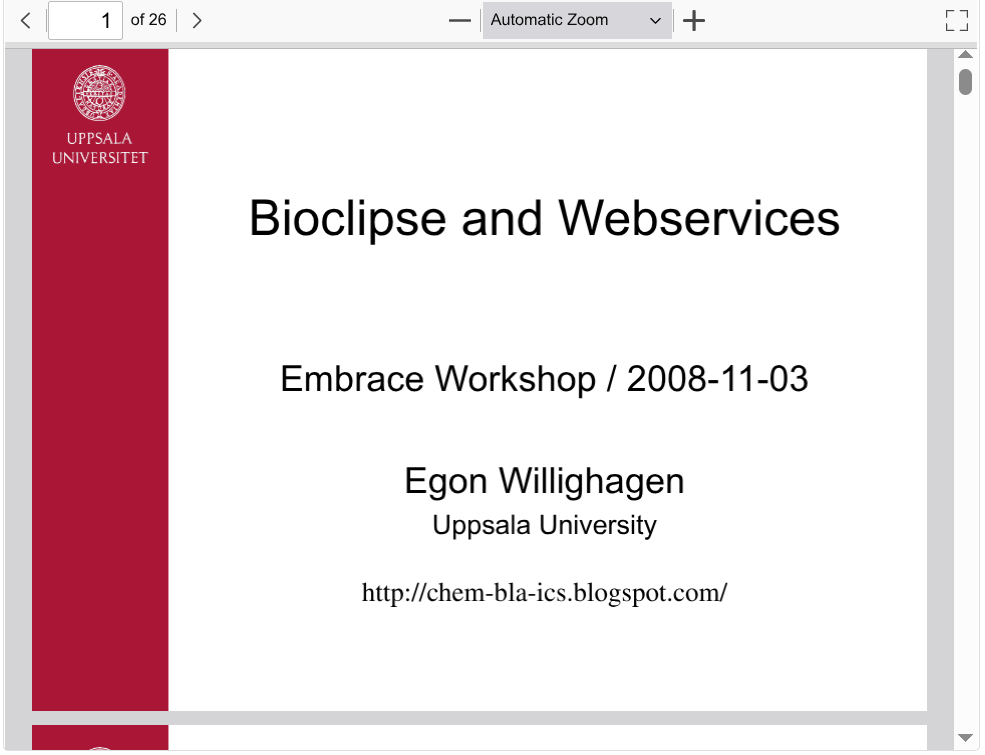
I will present there the ongoing work in Bioclipse to support services and web services in particular. The sheets of the presentation will look like:</p>

<p><a href="https://doi.org/10.5281/zenodo.2647677"><img src="/blog/assets/images/bioclipseWebserviceEmbrace.png" alt="" /></a></p>]]></content><author><name>Egon Willighagen</name></author><category term="bioclipse" /><category term="openscience" /><category term="justdoi:10.5281/zenodo.2647677" /><category term="web" /><summary type="html"><![CDATA[This Monday and Tuesday I will attend the EMBRACE workshop Understanding, creating and deploying EMBRACE compliant WebServices. I will present there the ongoing work in Bioclipse to support services and web services in particular. The sheets of the presentation will look like:]]></summary><media:thumbnail xmlns:media="http://search.yahoo.com/mrss/" url="http://egonw.github.io/blog/blog/assets/images/bioclipseWebserviceEmbrace.png" /><media:content medium="image" url="http://egonw.github.io/blog/blog/assets/images/bioclipseWebserviceEmbrace.png" xmlns:media="http://search.yahoo.com/mrss/" /></entry></feed>