<?xml version="1.0" encoding="utf-8"?><feed xmlns="http://www.w3.org/2005/Atom" ><generator uri="https://jekyllrb.com/" version="4.3.4">Jekyll</generator><link href="http://egonw.github.io/blog/feed/by_tag/opensource.xml" rel="self" type="application/atom+xml" /><link href="http://egonw.github.io/blog/" rel="alternate" type="text/html" /><updated>2026-11-19T06:09:00+00:00</updated><id>http://egonw.github.io/blog/feed/by_tag/opensource.xml</id><title type="html">chem-bla-ics</title><subtitle>Chemblaics (pronounced chem-bla-ics) is the science that uses open science and computers to solve problems in chemistry, biochemistry and related fields.</subtitle><author><name>Egon Willighagen</name></author><entry><title type="html">Some Source Code Hosting Providers are More Equal than Others</title><link href="http://egonw.github.io/blog/2011/05/01/some-source-code-hosting-providers-are.html" rel="alternate" type="text/html" title="Some Source Code Hosting Providers are More Equal than Others" /><published>2011-05-01T00:00:00+00:00</published><updated>2011-05-01T00:00:00+00:00</updated><id>http://egonw.github.io/blog/2011/05/01/some-source-code-hosting-providers-are</id><content type="html" xml:base="http://egonw.github.io/blog/2011/05/01/some-source-code-hosting-providers-are.html"><![CDATA[<p>See <a href="http://biostar.stackexchange.com/questions/7922/">this BioStar question</a>
and <a href="http://biostar.stackexchange.com/questions/7922/where-would-you-host-your-open-source-code-repository-today/7973#7973">my matching answer</a>.</p>

<p><img src="/blog/assets/images/ORCCompatSheet.png.scaled.1000.jpg" alt="" /></p>]]></content><author><name>Egon Willighagen</name></author><category term="opensource" /><category term="orc" /><summary type="html"><![CDATA[See this BioStar question and my matching answer.]]></summary><media:thumbnail xmlns:media="http://search.yahoo.com/mrss/" url="http://egonw.github.io/blog/blog/assets/images/ORCCompatSheet.png.scaled.1000.jpg" /><media:content medium="image" url="http://egonw.github.io/blog/blog/assets/images/ORCCompatSheet.png.scaled.1000.jpg" xmlns:media="http://search.yahoo.com/mrss/" /></entry><entry><title type="html">Unfortunate (CDK) decisions</title><link href="http://egonw.github.io/blog/2011/03/13/unfortunate-cdk-decisions.html" rel="alternate" type="text/html" title="Unfortunate (CDK) decisions" /><published>2011-03-13T00:10:00+00:00</published><updated>2011-03-13T00:10:00+00:00</updated><id>http://egonw.github.io/blog/2011/03/13/unfortunate-cdk-decisions</id><content type="html" xml:base="http://egonw.github.io/blog/2011/03/13/unfortunate-cdk-decisions.html"><![CDATA[<p>Sometimes you make decisions which turn out unlucky. <a href="http://www.steinbeck-molecular.de/steinblog/">Christoph</a>,
<a href="http://www.openscience.org/blog/?author=2">Dan</a>, and I made one about 10 years
ago (see <a href="http://www.openscience.org/blog/?p=428">this photo</a> from Dan with
his whiteboard where we wrote down our thoughts). The one I am talking about
is not bad in itself, but the implementation is bad; bad in the sense that it
makes it easy for other toolkits to make a difference in size and performance
(see also <a href="http://chem-bla-ics.blogspot.com/2010/09/quo-vadis-cdk.html">Quo vadis, CDK?</a>).</p>

<p>The reason why I bring this up, is that I am answering a <a href="http://www.ccl.net/cgi-bin/ccl/message-new?2011+03+06+001">question on the CCL
mailing list</a> on
how to convert a XYZ file into an adjacency matrix, and my <a href="http://chem-bla-ics.blogspot.com/2011/02/groovy-cheminformatics.html">Groovy Cheminformatics</a>
did not have a section on graph matrices yet. And I just ran into the issue
that the CDK <a href="http://pele.farmbio.uu.se/nightly/cdk-javadoc-1.5.0.git/org/openscience/cdk/io/XYZReader.html">XYZReader</a>
only accepts an <a href="http://pele.farmbio.uu.se/nightly/cdk-javadoc-1.5.0.git/org/openscience/cdk/interfaces/IChemFile.html">IChemFile</a>.
Then I realized the book doesn’t explain yet why that is either.</p>

<p>It basically comes down that chemical files can contain a wide variety of chemistry.
MDL molfiles can contain a single Molecule, but also a set of molecules. Chemical
documents in general, think <a href="http://www.jmol.org/">Jmol</a>, can also contain trajectories
for <a href="http://en.wikipedia.org/wiki/Cyclohexane">cyclohexane</a> (see <a href="http://chemapps.stolaf.edu/jmol/docs/examples-12/jmol-flot-energy.htm?model=data/cyclohexaneFlip.jmol">this nice
animation by Bob</a>),
etc, etc. And because the CDK is a general chemistry development toolkit, it
has to support all. So, we have the IChemFile concept which corresponds to a
chemical file, containing a sequence of one or more models, which may be if
a single molecules (e.g. geometry optimizations), or multiple models (e.g. MDL
SD files). Similarly, each model can contain a variety of objects: reactions,
set of molecules, and crystals. Well, you get the point.</p>

<p>Now, at some point, it was decided that being able to convert file formats from
one into another might in fact be interesting (think <a href="http://www.openbabel.org/">OpenBabel</a>).
That’s where it went wrong (and if you start <a href="http://www.kernel.org/pub/software/scm/git/docs/git-blame.html">git blaming</a>
it would not surprise me if I am the center of all evil here). Just to keep
it simple, it made sense to have all IO classes at least support ChemFile, because
whatever the content, it could always be wrapped in an ChemFile.</p>

<p>So, the answer to the question on the CCL mailing list is a bit more involved
than I wanted:</p>

<pre>import org.openscience.cdk.*;
import org.openscience.cdk.config.*;
import org.openscience.cdk.interfaces.*;
import org.openscience.cdk.io.*;
import org.openscience.cdk.graph.matrix.*;
import org.openscience.cdk.tools.manipulator.*;
import org.openscience.cdk.graph.rebond.*;
import java.io.File;

reader = new XYZReader(
  new File("data/ethanoicacid.xyz").newReader()
);
allContent = ChemFileManipulator.getAllAtomContainers(
  reader.read(new ChemFile())
)
ethanoicAcid = allContent.get(0)

factory = AtomTypeFactory.getInstance(
  "org/openscience/cdk/config/data/jmol_atomtypes.txt", 
  ethanoicAcid.getBuilder()
);
for (IAtom atom : ethanoicAcid.atoms()) {
  factory.configure(atom);
}
RebondTool rebonder = new RebondTool(2.0, 0.5, 0.5);
rebonder.rebond(ethanoicAcid);

int[][] matrix = AdjacencyMatrix.getMatrix(ethanoicAcid)

println "The adjaceny matrix:"
for (row=0;row&lt;ethanoicAcid.getAtomCount();row++) {
  for (col=0;col&lt;ethanoicAcid.getAtomCount();col++) {
    print matrix[row][col] + " "
  }
  println ""
}
</pre>

<p>This code gives this output:</p>

<pre>The adjaceny matrix:
0 1 1 1 1 0 0 0 
1 0 0 0 0 1 1 0 
1 0 0 0 0 0 0 0 
1 0 0 0 0 0 0 0 
1 0 0 0 0 0 0 0 
0 1 0 0 0 0 0 0 
0 1 0 0 0 0 0 1 
0 0 0 0 0 0 1 0 
</pre>

<p>Note that the RebondTool didn’t pick up the bond order, but that’s not needed
for the adjacency matrix anyway.</p>

<p>Getting back on the unfortunate design decision: what would things have looked
liked if we had typed our IChemObject reading and writing classes, allowing
us to differentiate IChemObjectReader&lt;IAtomContaienr&gt; from IChemObjectReader&lt;IChemFile&gt;.
It would have greatly reduced the size of simple programs, or something like
the wished-for 50k <a href="http://jchempaint.sourceforge.net/">JChemPaint</a> applet.
Right now, pulling in a single reader, will automatically pull in all IChemObject
classes. Rather, I would just pull in IAtomContainer, which in itself is too
large too. But that’s for another blog post.</p>

<p>The key thing to remember is: <strong>don’t be afraid to add some complexity if that
allows you to make other things optional.</strong></p>]]></content><author><name>Egon Willighagen</name></author><category term="cdk" /><category term="cheminf" /><category term="opensource" /><summary type="html"><![CDATA[Sometimes you make decisions which turn out unlucky. Christoph, Dan, and I made one about 10 years ago (see this photo from Dan with his whiteboard where we wrote down our thoughts). The one I am talking about is not bad in itself, but the implementation is bad; bad in the sense that it makes it easy for other toolkits to make a difference in size and performance (see also Quo vadis, CDK?).]]></summary></entry><entry><title type="html">In Silico Toxicology</title><link href="http://egonw.github.io/blog/2011/01/31/in-silico-toxicology.html" rel="alternate" type="text/html" title="In Silico Toxicology" /><published>2011-01-31T00:10:00+00:00</published><updated>2011-01-31T00:10:00+00:00</updated><id>http://egonw.github.io/blog/2011/01/31/in-silico-toxicology</id><content type="html" xml:base="http://egonw.github.io/blog/2011/01/31/in-silico-toxicology.html"><![CDATA[<p>Today my copy of <a href="http://www.amazon.com/Silico-Toxicology-Principles-Applications-Issues/dp/1849730040?ie=UTF8&amp;tag=chemblaics-20&amp;link_code=btl&amp;camp=213689&amp;creative=392969">In Silico Toxicology: Principles and Applications (Issues
in Toxicology)</a><img src="http://www.assoc-amazon.com/e/ir?t=chemblaics-20&amp;l=btl&amp;camp=213689&amp;creative=392969&amp;o=1&amp;a=1849730040" alt="" />
arrived at the local <a href="http://kib.ki.se/">Library</a>. Library with a capital L:
we requested the book 1.5 weeks ago, got confirmation it got ordered last week
Monday, and just picked it up. Well done!</p>

<p>The book covers in 24 chapters the prediction of toxicological properties of
small molecules, and extensively discusses aspects of QSAR studies. As such,
various <a href="http://blueobelisk.org">Blue Obelisk</a> tools are described, including
the <a href="http://cdk.sf.net">CDK</a> (page 184 and 413), <a href="http://bioclipse.net/">Bioclipse</a>
(page 414), <a href="http://joelib.sf.net">JOELib</a> (page 185), <a href="http://openbabel.org">OpenBabel</a>
(page 414), <a href="http://sourceforge.net/projects/oscar3-chem/">Oscar</a> (page 415),
as well as other Open Source tools, including <a href="http://ambit.sf.net">AMBIT</a> (page
315 ff), <a href="http://inchi.sourceforge.net/">InChI</a> (page 72), <a href="http://toxtree.sourceforge.net/">Toxtree</a>
(page 313 and 417), and others. (Nina, should I classify AMBIT and ToxTree as
Blue Obelisk projects, now that you are a <a href="http://blueobelisk.sourceforge.net/wiki/Blue_Obelisk_Awards#Nina_Jeliazkova">Blue Obelisk Award winner</a>?)</p>

<p>Much of these are actually listed in Chapter 17, <em>Open Source Tools for Read-Across
and Category Formation</em>, by Nina et al., but also worth mentioning is the prominent
placement of Open Source tools in Chapter 6 by <a href="https://www.etis.ee/portal/portaal/isikuCV.aspx?PersonVID=2434&amp;lang=et">Uko Maran</a>
et al., <em>Molecular Descriptors from Two-Dimensional Chemical Structure</em>, where
the REACH documentation focuses on proprietary tools.</p>

<p>Obviously, these are not the bits I am eager to read. Instead, I’m very much
looking forward to reading the chapters on data quality (Ch. 4), model validation
(Ch. 11), application domain (Ch. 12), linking chemical structures to adverse
reactions (Ch. 14), and toxicokinetics (Ch. 21). The book sums up to some 669
pages, so it will keep me busy for the next few hours ;)</p>]]></content><author><name>Egon Willighagen</name></author><category term="bioclipse" /><category term="blue-obelisk" /><category term="cdk" /><category term="opensource" /><category term="toxicology" /><summary type="html"><![CDATA[Today my copy of In Silico Toxicology: Principles and Applications (Issues in Toxicology) arrived at the local Library. Library with a capital L: we requested the book 1.5 weeks ago, got confirmation it got ordered last week Monday, and just picked it up. Well done!]]></summary></entry><entry><title type="html">Re: How can cancer research be open-sourced?</title><link href="http://egonw.github.io/blog/2011/01/19/re-how-can-cancer-research-be-open.html" rel="alternate" type="text/html" title="Re: How can cancer research be open-sourced?" /><published>2011-01-19T00:00:00+00:00</published><updated>2011-01-19T00:00:00+00:00</updated><id>http://egonw.github.io/blog/2011/01/19/re-how-can-cancer-research-be-open</id><content type="html" xml:base="http://egonw.github.io/blog/2011/01/19/re-how-can-cancer-research-be-open.html"><![CDATA[<p><a href="http://www.quora.com/Mark-Fortner">Mark</a> asked on <a href="http://www.quora.com/">Quora</a>
on <a href="http://www.quora.com/How-can-cancer-research-be-open-sourced">how can cancer research be open-sourced</a>.
So, far I found Quora to be rather noisy, even after signing up only to science
related groups, themes, whatever it is called. However, every now and then there
is an interesting question like this one.</p>

<p>The question resonated with discussions I had earlier this week. During Peter’s
Symposium the discussion was restarted on why publishing data in databases is
currently not rewarded. I think the answer is really simple: there is no independent
organization counting citation statistics. What if Thomson did not calculate
citation counts and impact factors? Would we be using them to judge the careers
of fellow scientists? If FooBar would calculate H-indices based on data citations
would we ignore that? I hardly think so. However, FooBar does not exists, and
FooBar is not getting rich because of its citation counts.</p>

<p>From a scientist point of perspective, we see people hold back data and source
code, because releasing it reduces the time for the scientist to bring the idea
to Nature and Science. Now, in cheminformatics this is hardly a problem, because
Nature and Science do generally not recognize fundamental, methodological work
from informatics and statistics, despite their now crucial role in many Nature
and Science papers. However, for data this is different. By releasing your data
Openly (think Panton Principles), you remove your intellectual property that
gives you a nice list of co-author papers for your publication list long tail.
Mind you, this is not an argument I make up here, but actual practice: “Sure
you can use my data/method, but I like to be co-author on your paper then.”</p>

<p>Why this is actual practice? Even a paper in the long tail is rewarding. “Wow,
he has 250 papers!” As <a href="depth-first.com">Rich</a> nicely characterizes it: game
theory.</p>

<p>So, what if we would replace the papers in that publication list long tail,
by points for releasing Open Data and Open Source? I’m all in favor. And no
worries about Handles and DOIs. Forget about them. We had Thomson calculate
impact factors very long before we had DOIs.</p>

<p>My reply to Mark’s question?</p>

<blockquote>
  <p>First thing that needs to be changed is the academic reward system. At this
moment, it is rewarding to hold back information, source code, etc. Because
if you do, you make yourself more competitive with respect to publishing in
high-ranked journals. Now, if we would reward releasing data into public
(Open) databases, that would change. Likewise for software. The new journal
<a href="http://www.openresearchcomputation.com/">http://www.openresearchcomputation.com/</a>
is an attempt at changing this situation (disclaimer: I’m on the editorial
board). Of course, there are many kind of rewards. BMC giving out awards for
Open Data is another. Another important reward would be financial. If
organizations, foundation, etc, would start giving out financial support for
Open projects, that will be a great change too. We are starting to see this
with a couple of national founding agencies in Europe to have dedicated
funding for Open Access publishing</p>
</blockquote>]]></content><author><name>Egon Willighagen</name></author><category term="opendata" /><category term="opensource" /><category term="publishing" /><summary type="html"><![CDATA[Mark asked on Quora on how can cancer research be open-sourced. So, far I found Quora to be rather noisy, even after signing up only to science related groups, themes, whatever it is called. However, every now and then there is an interesting question like this one.]]></summary></entry><entry><title type="html">My first encounter with Open Source cheminformatics</title><link href="http://egonw.github.io/blog/2010/12/27/my-first-encounter-with-open-source.html" rel="alternate" type="text/html" title="My first encounter with Open Source cheminformatics" /><published>2010-12-27T00:00:00+00:00</published><updated>2010-12-27T00:00:00+00:00</updated><id>http://egonw.github.io/blog/2010/12/27/my-first-encounter-with-open-source</id><content type="html" xml:base="http://egonw.github.io/blog/2010/12/27/my-first-encounter-with-open-source.html"><![CDATA[<p> </p>

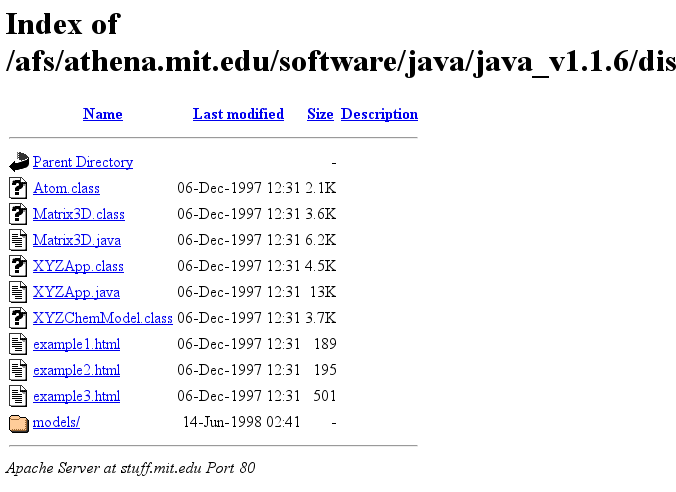
<p><img src="/blog/assets/images/oscheminfo.png" alt="" /></p>

<p>One of my first encounters with open source cheminformatics was the <a href="http://stuff.mit.edu/afs/athena.mit.edu/software/java/java_v1.1.6/distrib/i386_rh9/demo/MoleculeViewer/">XYZ file
viewer applet by Sun</a>.
I extended it back then with minimal PDB support for our Woordenboek Organische
Chemie website (started in 1995, now extinct). This applet dates back to at
least 1997, as shown by the screenshot.</p>]]></content><author><name>Egon Willighagen</name></author><category term="opensource" /><category term="cheminf" /><summary type="html"><![CDATA[ ]]></summary><media:thumbnail xmlns:media="http://search.yahoo.com/mrss/" url="http://egonw.github.io/blog/blog/assets/images/oscheminfo.png" /><media:content medium="image" url="http://egonw.github.io/blog/blog/assets/images/oscheminfo.png" xmlns:media="http://search.yahoo.com/mrss/" /></entry><entry><title type="html">re: Commercial or Proprietary?</title><link href="http://egonw.github.io/blog/2010/12/21/re-commercial-or-proprietary.html" rel="alternate" type="text/html" title="re: Commercial or Proprietary?" /><published>2010-12-21T00:10:00+00:00</published><updated>2010-12-21T00:10:00+00:00</updated><id>http://egonw.github.io/blog/2010/12/21/re-commercial-or-proprietary</id><content type="html" xml:base="http://egonw.github.io/blog/2010/12/21/re-commercial-or-proprietary.html"><![CDATA[<p>OK, the second paper I ran into today is a perfect match for the paper by Khanna
and Ranganathan I just dicussed in the <a href="http://chem-bla-ics.blogspot.com/2010/12/blog-post.html">Commercial or Proprietary?</a>
post. So perfect, in fact, that it I should have really combined them. But since
the other post is already infecting the WWW, I’ll have to post this update.</p>

<p>Yap wrote up a paper on <em>PaDEL-descriptor: An open source software to calculate
molecular descriptors and fingerprints</em> (doi:<a href="http://dx.doi.org/10.1002/jcc.21707">10.1002/jcc.21707</a>),
and Table 2 is quite like Table 1 in the paper by Khanna and Ranganathan. Not
only does Yap correctly differentiates between product cost and license, it
also details the descriptor type count and descriptor value count. It is a good
exercise to compare those two tables yourself.</p>]]></content><author><name>Egon Willighagen</name></author><category term="cheminf" /><category term="opensource" /><category term="justdoi:10.1002/jcc.21707" /><summary type="html"><![CDATA[OK, the second paper I ran into today is a perfect match for the paper by Khanna and Ranganathan I just dicussed in the Commercial or Proprietary? post. So perfect, in fact, that it I should have really combined them. But since the other post is already infecting the WWW, I’ll have to post this update.]]></summary></entry><entry><title type="html">Commercial or Proprietary?</title><link href="http://egonw.github.io/blog/2010/12/21/blog-post.html" rel="alternate" type="text/html" title="Commercial or Proprietary?" /><published>2010-12-21T00:00:00+00:00</published><updated>2010-12-21T00:00:00+00:00</updated><id>http://egonw.github.io/blog/2010/12/21/blog-post</id><content type="html" xml:base="http://egonw.github.io/blog/2010/12/21/blog-post.html"><![CDATA[<p>Khanna and Ranganathan wrote up a review paper on molecular similarity (doi:<a href="http://dx.doi.org/10.1002/ddr.20404">10.1002/ddr.20404</a>).
I have not fully read it yet, but my eye fell on Table 1, which lists a number
of programs that can be used to calculate QSAR descriptors, both open source
and proprietary. However, the table features a column <em>Availability</em> which has
two options: Public, Commercial. They qualify Bioclipse, CDK, and RDKit as <em>public</em>,
and Dragon, MOE, CODESSA and others are commercial. Effectively, it seems to
suggest that they classify them as open source versus commercial, though I am
not entirely sure what they mean with <em>public</em>.</p>

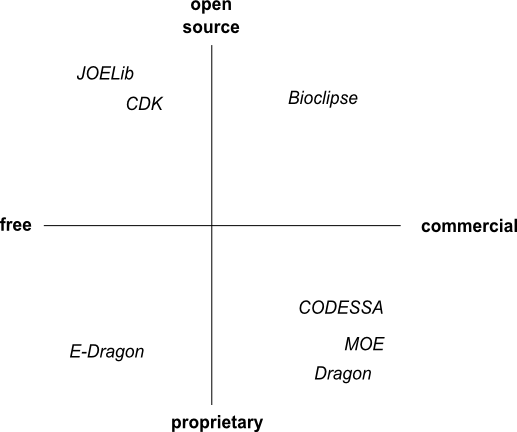
<p>The authors and referees would not be the first to make this common mistake:
not express the difference between two orthogonal axis: free-versus-commercial
and open source-versus-proprietary. To clarify these axes, I created this diagram
(CC-BY, <a href="http://en.wikipedia.org/wiki/Scalable_Vector_Graphics">SVG</a> source
available upon request):</p>

<p><img src="/blog/assets/images/prop_vs_commercial.png" alt="" /></p>

<p>It is very important to realize the Open Source software can be commercial.
For example, you can get commercial support for <a href="http://www.bioclipse.net">Bioclipse</a>
and <a href="http://cdk.sf.net">CDK</a> with <a href="http://www.genettasoft.com/">GenettaSoft</a>.
It is also really important to realize that free software (public?) does not
mean it is Open Source (or visa versa). <a href="http://www.vcclab.org/lab/edragon/start.html">E-Dragon</a>
is an example here: you can freely use, but the source code is proprietary.
Some years after open source cheminformatics took off, commercial providers
started to provide free-for-academic-use packages, which fits into this category
too.</p>

<p>Readers of my blog know that I advocate Open Source, not gratis software (see
also <a href="http://chem-bla-ics.blogspot.com/2010/12/re-why-i-and-you-should-avoid-nc.html">Re: Why I and you should avoid NC licences</a>),
even though you can download many of the Open Source cheminformatics tools I
worked on for free. Here it is important to realize that the CDK and Bioclipse
are not free: it is just that the tax-payer covered the cost via academic institutes
mostly, as well as hobbyists working out-of-office, like I have done for many,
many years, and companies who saw mutual benefit. Maybe something to consider
the next time you are wondering about donating money to an Open Source cheminformatics
project, and <em>pay</em> some respect to the project contributors of the software
you use.</p>

<p>Off-topic: there is a second inaccuracy in this table. For each software, they
list the number of descriptors, but without <em>units</em>. Units, units?? Yes. For
example, for the CDK they list “&gt;40” descriptors, while for Dragon “3,224” (it
puzzles me why you can count accurately above 3000, but not below 50. But the
point here is that the CDK count is really the number of Java classes, reflecting <em>descriptor
algorithms</em>. One algorithm can calculate more than one <em>descriptor value</em>, and
those are counted for Dragon. The columns is comparing apples with oranges.
While I have never really counted it, and you every CDK user can in fact tune
it, the number of calculated CDK descriptor values approaches a thousand. Well,
I guess that is “&gt;40” too :(</p>]]></content><author><name>Egon Willighagen</name></author><category term="cheminf" /><category term="opensource" /><category term="justdoi:10.1002/ddr.20404" /><summary type="html"><![CDATA[Khanna and Ranganathan wrote up a review paper on molecular similarity (doi:10.1002/ddr.20404). I have not fully read it yet, but my eye fell on Table 1, which lists a number of programs that can be used to calculate QSAR descriptors, both open source and proprietary. However, the table features a column Availability which has two options: Public, Commercial. They qualify Bioclipse, CDK, and RDKit as public, and Dragon, MOE, CODESSA and others are commercial. Effectively, it seems to suggest that they classify them as open source versus commercial, though I am not entirely sure what they mean with public.]]></summary><media:thumbnail xmlns:media="http://search.yahoo.com/mrss/" url="http://egonw.github.io/blog/blog/assets/images/prop_vs_commercial.png" /><media:content medium="image" url="http://egonw.github.io/blog/blog/assets/images/prop_vs_commercial.png" xmlns:media="http://search.yahoo.com/mrss/" /></entry><entry><title type="html">Open Research Computation, ORC, #openrescomp</title><link href="http://egonw.github.io/blog/2010/12/14/bmc-open-research-computation.html" rel="alternate" type="text/html" title="Open Research Computation, ORC, #openrescomp" /><published>2010-12-14T00:10:00+00:00</published><updated>2010-12-14T00:10:00+00:00</updated><id>http://egonw.github.io/blog/2010/12/14/bmc-open-research-computation</id><content type="html" xml:base="http://egonw.github.io/blog/2010/12/14/bmc-open-research-computation.html"><![CDATA[<p>Yesterday, a new journal launched, but your regular new journal. This journal
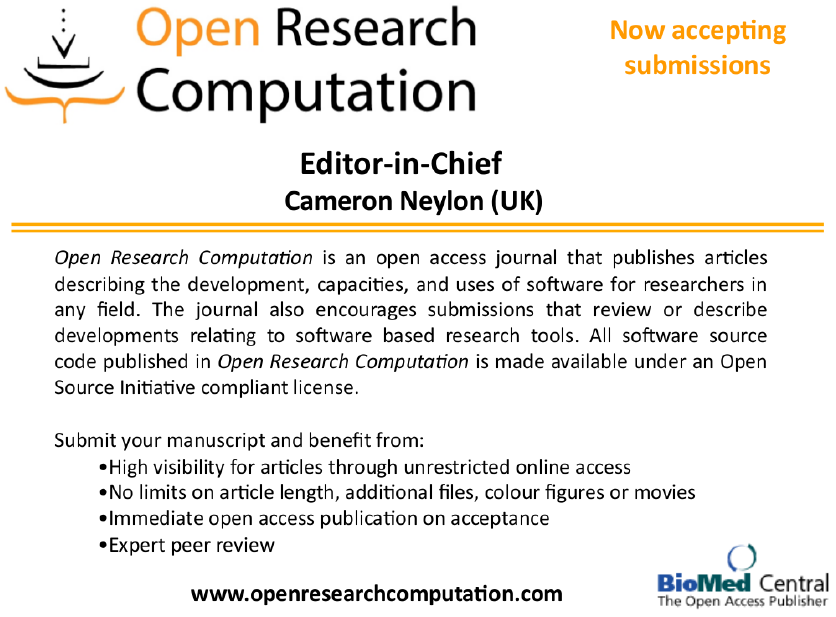
is about scientific software. Tested software. Documented software. Open Source
software. I am on the editorial board, so I am biased here. But, this journal
is special. This new journal is called <a href="http://www.openresearchcomputation.com/">Open Research Computation</a>
(<a href="en.wikipedia.org/wiki/Orc_%28Middle-earth%29">ORC</a>?). Several others <a href="http://cameronneylon.net/blog/open-research-computation-an-ordinary-journal-with-extraordinary-aims/?utm_source=feedburner&amp;utm_medium=feed&amp;utm_campaign=Feed:+ScienceInTheOpen+%28Science+in+the+open%29&amp;utm_content=FriendFeed+Bot">blogged</a>
<a href="http://saaientist.blogspot.com/2010/12/open-research-computation-new-journal.html">about</a>
<a href="http://nsaunders.wordpress.com/2010/12/13/can-a-journal-make-a-difference-lets-find-out/">it</a>
<a href="http://plindenbaum.blogspot.com/2010/12/new-journal-bmc-open-research.html">too</a>.</p>

<p><img src="/blog/assets/images/orc.png" alt="" /></p>]]></content><author><name>Egon Willighagen</name></author><category term="opensource" /><category term="publishing" /><category term="orc" /><summary type="html"><![CDATA[Yesterday, a new journal launched, but your regular new journal. This journal is about scientific software. Tested software. Documented software. Open Source software. I am on the editorial board, so I am biased here. But, this journal is special. This new journal is called Open Research Computation (ORC?). Several others blogged about it too.]]></summary><media:thumbnail xmlns:media="http://search.yahoo.com/mrss/" url="http://egonw.github.io/blog/blog/assets/images/orc.png" /><media:content medium="image" url="http://egonw.github.io/blog/blog/assets/images/orc.png" xmlns:media="http://search.yahoo.com/mrss/" /></entry><entry><title type="html">ChemWriter, Google Chrome, and Many Eyes in Open Source</title><link href="http://egonw.github.io/blog/2010/12/03/chemwriter-google-chrome-and-many-eyes.html" rel="alternate" type="text/html" title="ChemWriter, Google Chrome, and Many Eyes in Open Source" /><published>2010-12-03T00:00:00+00:00</published><updated>2010-12-03T00:00:00+00:00</updated><id>http://egonw.github.io/blog/2010/12/03/chemwriter-google-chrome-and-many-eyes</id><content type="html" xml:base="http://egonw.github.io/blog/2010/12/03/chemwriter-google-chrome-and-many-eyes.html"><![CDATA[<p><strong>Update</strong>: Wow, how tired can you be. I have to apologize for this post: as Andrew points out in the comments, Rich
did not analyze the Chrome source code, but his own source code. That is not so special indeed. I have misread Rich’
post. This completely ruins the point I was making. He did not take advantage of Chrome being Open Source, and find
the problem that way, but in an old fashion debugging session on ChemWriter. The below could have happened, but it
didn’t.</p>

<p><a href="http://en.wikipedia.org/wiki/Linus'_Law">Linus’ law</a>:</p>

<blockquote>
  <p>given enough eyeballs, all bugs are shallow.</p>
</blockquote>

<p><a href="http://depth-first.com/">Rich</a> of <a href="http://metamolecular.com/">MetaMolecular</a> works on Open Source and closed source cheminformatics
solutions. <a href="http://chemwriter.com/">ChemWriter</a> is one product he is working on which uses JavaScript and <a href="http://en.wikipedia.org/wiki/SVG">SVG</a>
(two Open Standards), and recently asked feedback on the new version. Test users found a problem on Google’s
<a href="http://www.google.com/chrome">Chrome</a> browser, and Rich then <a href="https://doi.org/10.59350/x4j7q-m6h98">did something <i class="fa-solid fa-recycle fa-xs"></i></a>
that is only possible in an Open Source environment: he downloaded the buggy product (Chrome), started looking for the cause, found it, and
filed a <a href="http://code.google.com/p/chromium/issues/detail?id=65238">detailed bug report</a>. Just think that would have happened
if this problem was in MS Internet Explorer…</p>

<p>Well done!</p>]]></content><author><name>Egon Willighagen</name></author><category term="opensource" /><category term="justdoi:10.59350/x4j7q-m6h98" /><summary type="html"><![CDATA[Update: Wow, how tired can you be. I have to apologize for this post: as Andrew points out in the comments, Rich did not analyze the Chrome source code, but his own source code. That is not so special indeed. I have misread Rich’ post. This completely ruins the point I was making. He did not take advantage of Chrome being Open Source, and find the problem that way, but in an old fashion debugging session on ChemWriter. The below could have happened, but it didn’t.]]></summary></entry><entry><title type="html">Quo vadis, CDK?</title><link href="http://egonw.github.io/blog/2010/09/26/quo-vadis-cdk.html" rel="alternate" type="text/html" title="Quo vadis, CDK?" /><published>2010-09-26T00:10:00+00:00</published><updated>2010-09-26T00:10:00+00:00</updated><id>http://egonw.github.io/blog/2010/09/26/quo-vadis-cdk</id><content type="html" xml:base="http://egonw.github.io/blog/2010/09/26/quo-vadis-cdk.html"><![CDATA[<p>Tomorrow it is <a href="https://sourceforge.net/apps/mediawiki/cdk/index.php?title=10th_Anniversary">10 years ago that the CDK was founded</a>.
The project has considerably grown and has a <a href="http://chem-bla-ics.blogspot.com/2010/09/cdk-2003-paper-is-now-cited-99-times.html">high impact on science</a>.
The CDK code base did not start 10 years ago, but was founded on the code bases
of CompChem, JChemPaint, and <a href="http://www.jmol.org">Jmol</a>, but has seen several
reincarnations since the start.</p>

<p>The CDK project by now is so large, it is hardly possible to keep up, and I
am very grateful to particularly <a href="http://www.steinbeck-molecular.de/steinblog/">Chris</a>
and <a href="http://blog.rguha.net/">Rajarshi</a> for actively keeping the project going,
to all those that submit patches and bug reports, and to all that use the CDK
in their software. This created a healthy development and user community, as
is visible from the blog aggregator <a href="http://pele.farmbio.uu.se/planetcdk/">Planet CDK</a>.</p>

<p>But, reflecting on the past, it is also clear where the project needs help.
The flow of <a href="http://cdknews.org">CDK News</a> papers is effectively void, the documentation
needs serious updating, we still need way more unit testing, as well as more
in-depth validation of algorithm implementations. And we all know we are short
on code reviewers to control the flow of patches going into the library. There
is also still some functionality missing, like a simple force field (the Jmol
LGPL UFF code could be ported, doi:<a href="http://dx.doi.org/10.1021/ja00051a040">10.1021/ja00051a040</a>)
and support for popular file formats like Symyx V3000 molfiles and the <a href="http://depth-first.com/articles/2010/09/21/making-sense-of-the-chemdraw-cdx-file-format-with-cdxhexdumper">ChemDraw
CDX formats</a>.</p>

<p>I am really positive about the future of the CDK project and the current future
is mostly limited by the number of people working on maintenance, code quality,
and releases. For example, I would love more frequent releases, but making a
release takes about half a day. It is not merely creating the files to distribute,
but also to ensure that the branch is in a releasable state, that it has no
important outstanding bugs and at least does not have more unit test fails than
the past release (preferably fewer…), and writing a release message.</p>

<p>This maintenance also involves writing unit tests for reported bugs, and ensuring
that someone fixes the bug. This is a second important challenge to the project:
how to keep the original code authors involved, and make them feel responsible
for making bug fixes in the code they wrote. Cheminformatics is very much a
field of <em>write once, go off to another job, and forget about it</em>. This is why
I am so strong on having unit tests, proper JavaDoc, and clean code, so that
others can do this required code maintenance.</p>

<p>If we look at <a href="https://sourceforge.net/tracker/?group_id=20024">the current numbers</a>,
we see about 170 open bugs out of 1115 ever reported, and 24 open patch reports
out of 276 reported. Those are acceptable numbers, though they need to go further
down.</p>

<p>I really hope that 2011 will be the year that commercial CDK support is picking
up, providing value for users by providing dedicated support. Right now, to
get something fixed, you need to wait for someone to fix the problem; however,
none of the CDK developers actually is working solely on the CDK and many contributions
are done in spare time. That nicely shows the power of Open Source, but also
well illustrates the need of proper funding. That said, this is merely limited
by people actually willing to pay for such support, or even just to donate financial
support to the project. If you are interested in that, please contact me offline,
as we have the means in place to do this.</p>

<p>In short, I have no clue where the CDK will go, except that it will continue
to grow. This is another power of Open Source: the accumulated effort cannot
be lost. Seriously, back in 2004 I wrote a <a href="http://www.steinbeck-molecular.de/cdknews/index.php/CDKNews/article/view/6">What’s 2004 going to bring?</a>,
and here’s a lousy attempt for 2011:</p>

<ul>
  <li>a new stable series, 2.4 or 3.0 (versioning has not been decided on yet)</li>
  <li>it will be faster and support parallel computing</li>
  <li>we will have a UFF implementation</li>
  <li>more extensive chirality support (EZ, …)</li>
  <li>rendering and editor will be integrated</li>
  <li>we will use JExample for unit testing</li>
  <li>cheminformatics in the webbrowser (using the CDK)</li>
  <li>we will have books about the CDK</li>
  <li>more molecular descriptors</li>
</ul>

<p>But we will also have to overcome these issues, for which we need your help:</p>

<ul>
  <li>CDK News needs a new editorial board</li>
  <li>we need an second release managers (one for stable, one for the development
branch)</li>
  <li>we need more code reviewers</li>
  <li>making patches is easier than ever</li>
</ul>]]></content><author><name>Egon Willighagen</name></author><category term="cdk" /><category term="cheminf" /><category term="opensource" /><category term="justdoi:10.1021/ja00051a040" /><summary type="html"><![CDATA[Tomorrow it is 10 years ago that the CDK was founded. The project has considerably grown and has a high impact on science. The CDK code base did not start 10 years ago, but was founded on the code bases of CompChem, JChemPaint, and Jmol, but has seen several reincarnations since the start.]]></summary></entry></feed>