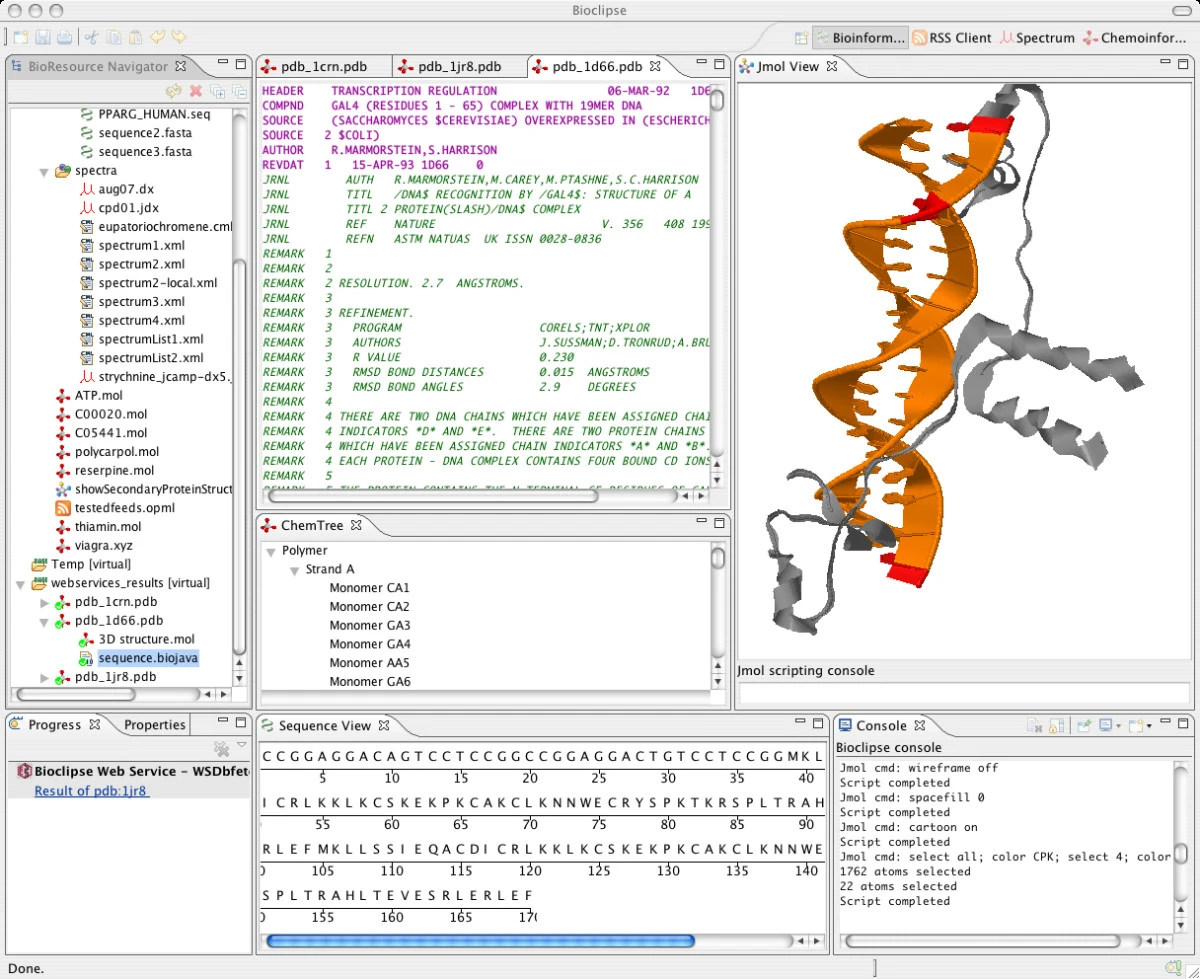
<?xml version="1.0" encoding="utf-8"?><feed xmlns="http://www.w3.org/2005/Atom" ><generator uri="https://jekyllrb.com/" version="4.3.4">Jekyll</generator><link href="http://egonw.github.io/blog/feed/by_tag/protein.xml" rel="self" type="application/atom+xml" /><link href="http://egonw.github.io/blog/" rel="alternate" type="text/html" /><updated>2026-11-22T10:22:45+00:00</updated><id>http://egonw.github.io/blog/feed/by_tag/protein.xml</id><title type="html">chem-bla-ics</title><subtitle>Chemblaics (pronounced chem-bla-ics) is the science that uses open science and computers to solve problems in chemistry, biochemistry and related fields.</subtitle><author><name>Egon Willighagen</name></author><entry><title type="html">Getting Jmol’s ‘cartoon on’ to work in Bioclipse</title><link href="http://egonw.github.io/blog/2006/04/10/getting-jmols-cartoon-on-to-work-in.html" rel="alternate" type="text/html" title="Getting Jmol’s ‘cartoon on’ to work in Bioclipse" /><published>2006-04-10T00:00:00+00:00</published><updated>2006-04-10T00:00:00+00:00</updated><id>http://egonw.github.io/blog/2006/04/10/getting-jmols-cartoon-on-to-work-in</id><content type="html" xml:base="http://egonw.github.io/blog/2006/04/10/getting-jmols-cartoon-on-to-work-in.html"><![CDATA[<p><a href="https://web.archive.org/web/20060420034219/http://www.bioclipse.net/">Bioclipse</a> 1.0 is to be released in May, and the cartoon on script command is
still not working in the <a href="http://www.jmol.org/">Jmol</a> viewer. For those who do not know yet, <a href="http://www.eclipse.org/">Bioclipse</a> is a cool Eclipse
RCP based Java chemo-and bioinformatics workbench. To have a better idea what goes on inside Bioclipse, I wrote a new BioPolymer tree to show me the
strands in the protein. After <a href="http://bioclipse.blogspot.com/">Ola</a> wrote code to show properties for IChemObject’s, I extended it with PDB properties
for the atoms, strands and monomers.</p>

<p>The contents of the ChemTree view in the middle and the Properties view below that look fine:</p>

<p><img src="https://media.springernature.com/full/springer-static/image/art%3A10.1186%2F1471-2105-8-59/MediaObjects/12859_2006_Article_1431_Fig4_HTML.jpg?as=webp" alt="" /></p>

<p>So I’ll have to dig a bit further.</p>]]></content><author><name>Egon Willighagen</name></author><category term="bioclipse" /><category term="jmol" /><category term="protein" /><summary type="html"><![CDATA[Bioclipse 1.0 is to be released in May, and the cartoon on script command is still not working in the Jmol viewer. For those who do not know yet, Bioclipse is a cool Eclipse RCP based Java chemo-and bioinformatics workbench. To have a better idea what goes on inside Bioclipse, I wrote a new BioPolymer tree to show me the strands in the protein. After Ola wrote code to show properties for IChemObject’s, I extended it with PDB properties for the atoms, strands and monomers.]]></summary></entry><entry><title type="html">InChI’s in LaTex and CDK News</title><link href="http://egonw.github.io/blog/2006/03/31/inchis-in-latex-and-cdk-news.html" rel="alternate" type="text/html" title="InChI’s in LaTex and CDK News" /><published>2006-03-31T00:00:00+00:00</published><updated>2006-03-31T00:00:00+00:00</updated><id>http://egonw.github.io/blog/2006/03/31/inchis-in-latex-and-cdk-news</id><content type="html" xml:base="http://egonw.github.io/blog/2006/03/31/inchis-in-latex-and-cdk-news.html"><![CDATA[<p>An <a href="http://www.iupac.org/inchi/">InChI</a> (or see the <a href="http://www.iupac.org/inchi/">FAQ</a>) is a line notation
for a molecular structure that was recently developed by the <a href="http://www.nist.gov/">NIST</a> and the
<a href="http://www.iupac.org/">IUPAC</a>. Principally they can be applied to protein too (see below), but because
proteins would give lenghty InChI’s and are quite well defined in terms of connectivity anyway, those can
better be described by their amino acid sequence.</p>

<p>The March 2006 issue of <a href="http://almost.cubic.uni-koeln.de/cdk/cdk_top/cdk_news/">CDK News</a>, the
<a href="http://cdk.sf.net/">Chemistry Development Kit</a> project newsletter, will be
<a href="http://sourceforge.net/project/showfiles.php?group_id=20024&amp;package_id=124796">released</a> later today,
and had, for the second time, the requirment that authors provide InChI’s for molecular structures mentioned in the articles.
Different from the previous issue is how InChI’s are marked up in LaTeX. I’ve setup a <code class="language-plaintext highlighter-rouge">\inchi{}</code>
for this that automatically creates a <a href="http://www.google.com/">Google</a> search query as link behind the InChI:</p>

<div class="language-latex highlighter-rouge"><div class="highlight"><pre class="highlight"><code><span class="k">\newcommand</span><span class="p">{</span>
  <span class="k">\inchi</span><span class="p">}</span>[1]<span class="p">{</span><span class="k">\href</span><span class="p">{</span>http://www.google.com/search?q=#1<span class="p">}</span>
                  <span class="p">{</span><span class="k">\normalfont\texttt</span><span class="p">{</span>InChI=#1<span class="p">}</span>
            <span class="p">}</span>
<span class="p">}</span>
</code></pre></div></div>

<p>Now, googling for InChI’s only works if one removes the <code class="language-plaintext highlighter-rouge">InChI=</code> part of the InChI. As an example I will show how it works
for methane. The InChI for this compound is <code class="language-plaintext highlighter-rouge">InChI=1/CH4/h1H4</code>, so in LaTex one enters <code class="language-plaintext highlighter-rouge">\inchi{1/CH4/h1H4}</code>.
This will create a link like: <a href="http://www.google.com/search?q=1/CH4/h1H4">InChI=1/CH4/h1H4</a>.</p>

<p>BTW, if you are interested in InChI’s for proteins, here is the InChI for <a href="http://www.pdb.org/pdb/explore.do?structureId=1CRN">1CRN</a>,
created with <a href="http://openbabel.sourceforge.net/">OpenBabel</a>:</p>

<div class="language-plaintext highlighter-rouge"><div class="highlight"><pre class="highlight"><code>InChI=1/C202H439N55O64S6/c1-28-92(12)149-188(308)237-127-84-323-324-
85-128(176(296)225-114(46-37-63-212-202(209)210)165(285)232-122(69-89(6)7)195(315)253-64-38-
47-132(253)179(299)215-80-143(274)241-158(107(27)265)199(319)257-68-42-51-136(257)182(302)226-
115(60-61-144(275)276)164(284)218-100(20)162(282)244-149)236-187(307)148(91(10)11)242-172(292)
120(74-138(204)269)229-168(288)117(70-108-43-34-33-35-44-108)228-169(289)119(73-137(203)268)
230-173(293)124(81-258)234-166(286)113(45-36-62-211-201(207)208)224-159(279)99(19)221-186(306)
147(90(8)9)243-189(309)150(93(13)29-2)245-174(294)125(82-259)235-183(303)135-50-41-66-255(135)
196(316)130-87-326-322-83-126(223-142(273)79-216-185(305)154(103(23)261)251-171(291)118(72-
110-54-58-112(267)59-55-110)231-192(312)155(104(24)262)250-163(283)101(21)220-175(127)295)178
(298)246-151(94(14)30-3)190(310)247-152(95(15)31-4)191(311)248-153(96(16)32-5)198(318)256-67-
40-49-134(256)181(301)213-77-140(271)217-97(17)161(281)249-156(105(25)263)194(314)240-131
(88-327-325-86-129(177(297)239-130)238-193(313)157(106(26)264)252-184(304)146(206)102(22)260)197
(317)254-65-39-48-133(254)180(300)214-78-141(272)222-121(76-145(277)278)170(290)227-116(71-
109-52-56-111(266)57-53-109)167(287)219-98(18)160(280)233-123(200(320)321)75-139(205)270/h89-
202,211-252,258-321H,28-88,203-210H2,1-27H3/t92-,93-,94-,95-,96-,97-,98-,99-,100-,101-,102+,
103+,104+,105+,106+,107+,109-,110-,111+,112+,113-,114-,115-,116-,117-,118-,119-,120-,121-,122-,
123-,124-,125-,126-,127-,128-,129-,130-,131-,132-,133-,134-,135-,136-,137?,138-,139-,140-,141+,
142-,143+,146-,147-,148-,149-,150-,151-,152-,153-,154-,155-,156-,157-,158-,159+,160?,161-,162?,
163-,164-,165?,166+,167?,168+,169+,170+,171-,172+,173+,174+,175?,176-,177?,178+,179+,180-,
181?,182-,183+,184?,185+,186+,187-,188-,189-,190+,191?,192-,193?,194-,195-,196-,197-,198-,199-/m0/s1
</code></pre></div></div>]]></content><author><name>Egon Willighagen</name></author><category term="inchi" /><category term="cdk" /><category term="cdknews" /><category term="iupac" /><category term="nist" /><category term="google" /><category term="protein" /><category term="openbabel" /><category term="inchikey:VNWKTOKETHGBQD-UHFFFAOYSA-N" /><summary type="html"><![CDATA[An InChI (or see the FAQ) is a line notation for a molecular structure that was recently developed by the NIST and the IUPAC. Principally they can be applied to protein too (see below), but because proteins would give lenghty InChI’s and are quite well defined in terms of connectivity anyway, those can better be described by their amino acid sequence.]]></summary></entry></feed>