<?xml version="1.0" encoding="utf-8"?><feed xmlns="http://www.w3.org/2005/Atom" ><generator uri="https://jekyllrb.com/" version="4.3.4">Jekyll</generator><link href="http://egonw.github.io/blog/feed/by_tag/publishing.xml" rel="self" type="application/atom+xml" /><link href="http://egonw.github.io/blog/" rel="alternate" type="text/html" /><updated>2026-11-17T07:22:51+00:00</updated><id>http://egonw.github.io/blog/feed/by_tag/publishing.xml</id><title type="html">chem-bla-ics</title><subtitle>Chemblaics (pronounced chem-bla-ics) is the science that uses open science and computers to solve problems in chemistry, biochemistry and related fields.</subtitle><author><name>Egon Willighagen</name></author><entry><title type="html">Supplementary files, publishing, and standards</title><link href="http://egonw.github.io/blog/2011/03/24/supplementary-files-publishing-and.html" rel="alternate" type="text/html" title="Supplementary files, publishing, and standards" /><published>2011-03-24T00:00:00+00:00</published><updated>2011-03-24T00:00:00+00:00</updated><id>http://egonw.github.io/blog/2011/03/24/supplementary-files-publishing-and</id><content type="html" xml:base="http://egonw.github.io/blog/2011/03/24/supplementary-files-publishing-and.html"><![CDATA[<p>The publishing world is slowly changes. Things a small community has been screaming
for more than a decade now (and possible before that), that data standards in
publishing are inadequate. PDF has not helped (fortunately <a href="http://www.downes.ca/cgi-bin/page.cgi?post=55051">there</a>
<a href="http://ptsefton.com/2009/03/31/scholarly-html.htm">are</a> <a href="http://blogs.ch.cam.ac.uk/pmr/2011/03/14/scholarly-html-%E2%80%93-major-progress/">replacement</a>
<a href="http://blogs.plos.org/mfenner/2011/03/19/a-very-brief-history-of-scholarly-html/">initiatives</a>).
Even new journals do not do everything right from the start, but at least there
is the effort, such as I discussed in these posts:</p>

<ul>
  <li><a href="http://chem-bla-ics.blogspot.com/2009/03/journal-of-cheminformatics-i-hope.html">Journal of Cheminformatics: I hope the Instructions to the Authors improve</a>,</li>
  <li><a href="http://chem-bla-ics.blogspot.com/2010/09/biomed-central-is-going-to-support-open.html">BioMed Central is going to support Open Data</a>,
and</li>
  <li><a href="http://chem-bla-ics.blogspot.com/2009/03/nature-chemistry-improves-publishing.html">Nature Chemistry improves publishing chemistry: a detailed analysis</a>.</li>
</ul>

<p>This week BioMed Central’s <a href="http://blogs.openaccesscentral.com/blogs/bmcblog/entry/dear_scientist_help_us_to">Iain asked the community how to put their Open Data
initiative into practice</a>.
There are some good points in the write up, such as:</p>

<blockquote>
  <p>Editors and publishers are acutely aware of the limited pool of peer reviewers who are increasingly called upon to help try and
ensure the integrity of the published record. The online availability of research data as a supplementary (additional) files
has prompted debate about the role of peer review in this non-written material, and indeed the role of journals in publishing
this material.</p>
</blockquote>

<p>I can very much relate to this problem, and spent about an hour this morning
reviewing <em>Additional files</em> to a paper I was reviewing for BioMed Central.
And I had quite a few comments, and overall, the section was inadequate.</p>

<p>I tried to reply in the blog, but my comment was marked as SPAM because it had
more than 1000 characters (<strong>update</strong>: this seems to have been manually fixed
now, thanx!). So much for constructive comments :) So, here goes:</p>

<blockquote>
  <p>Dear Iain,</p>

  <p>thank you for this interesting and important post! I absolutely agree that some standards need to be set. Scientists have been
unable to do this, and publishers can distinguish themselves from competition in doing this right.</p>

  <p>Without going into detail what ‘right’ is (I have very strong opinions on that :), what is important for BioMedCentral right now,
is put the advantages so closely in front of the scientist, they can no longer ignore it, or say ‘whatever’ (which they do now).</p>

  <p>BMC must therefore demonstrate what this reuse, reproducibility, etc, practically means. So, Goal 0 must be: do something with
the ‘additional files’: process them yourself and 1) associate every single additional file with facts about that file; 2) index
them, and create a search engine to search additional files based on their content, <em>cross</em> all BMC journals; 3) provide
alternative download formats, showing what it means to use Open Standards.</p>

  <p><strong>Open Data is not the goal; it’s the means to do science better.</strong></p>

  <p>About 1. Every additional file should have a separate web page (or page section), listing not just size, but also the exact format
(MS-Excel 2000, rather than ‘Excel’… versioning matters!), metadata present in that file (author, creation data, does it have
Macro’s defined, etc), and statistics about that file (number of sheets in the spreadsheet, number of filled cells, etc).</p>

  <p>About 2. It is of utmost importance that we can discover this supplementary information, and it must be easy to search for stuff
using free text (e.g. I want to find all additional files across all BMC journals that have ‘tryptamine’ somewhere in the
additional file, even if that information is stored in Excel files <em>inside</em> zip files. Current technology makes that very easy,
such as <a href="http://strigi.sf.net/">Strigi</a>.</p>

  <p>About 3. As reuse is the key here, the use of Open Standards are important. This could be stressed by showing that files with
Open Standards can easily be interconverted, such as spreadsheets into CSV or HTML tables. Just alternative download formats
makes the ‘Additional files’ more useful, and encourages the authors to ensure that they provide data in the right formats.</p>
</blockquote>]]></content><author><name>Egon Willighagen</name></author><category term="publishing" /><category term="opendata" /><summary type="html"><![CDATA[The publishing world is slowly changes. Things a small community has been screaming for more than a decade now (and possible before that), that data standards in publishing are inadequate. PDF has not helped (fortunately there are replacement initiatives). Even new journals do not do everything right from the start, but at least there is the effort, such as I discussed in these posts:]]></summary></entry><entry><title type="html">Supplementary files, publishing, and standards #2</title><link href="http://egonw.github.io/blog/2011/03/24/supplementary-files-publishing-and_24.html" rel="alternate" type="text/html" title="Supplementary files, publishing, and standards #2" /><published>2011-03-24T00:00:00+00:00</published><updated>2011-03-24T00:00:00+00:00</updated><id>http://egonw.github.io/blog/2011/03/24/supplementary-files-publishing-and_24</id><content type="html" xml:base="http://egonw.github.io/blog/2011/03/24/supplementary-files-publishing-and_24.html"><![CDATA[<p>You must read <a href="http://chem-bla-ics.blogspot.com/2011/03/supplementary-files-publishing-and.html">this previous post</a>
first.</p>

<p>Now, it is important to realize there are standards at many levels. Open specifications
allow people to implement the specification without having to pay fees, run
into patents, etc. To me, an Open Specification is something you can take, modify,
and propose to the community as new Standard.</p>

<p>Standards themselves are basically something orthogonal (IMHO, not uncriticized):
if something is a standard is just the result of the community picking up and
using the specification. Something doesn’t have to be Open to be a standard,
nor does it have to undergone year-long debates (like HTML5). A standard doesn’t
even have to be fixed to a version (they can be backwards compatible). There
are therefore many kinds of standards, including <em>de facto</em> standards.</p>

<p>These distinctions are crucial. Another is that standards rarely cover everything.
For example, it is ridicule to talk about Excel as a <em>de facto</em> standard in
data exchange in science. Now, the Microsoft formats are ‘Open Standards’ (they
sneaked in, when the world was complaining). But, they are standards at the
wrong level for scientific computation: they define a standard container, and
not any semantics. That’s up to the user: “Hey, why should I waste a column
on units… everyone knows we put in temperatures as Kelvin, ummm, Fahrenheit,
ummm… Kelcius, or what is it again the eurotrash uses?”</p>

<p>This problem holds for very many fields, and you see it in many different formulation.
Or the whole discussion about ScHTML and PDF, on what is more semantic. Or this
one: “Oh, let’s use a database so that our statisticians can do there work.”
Been there, done that.</p>

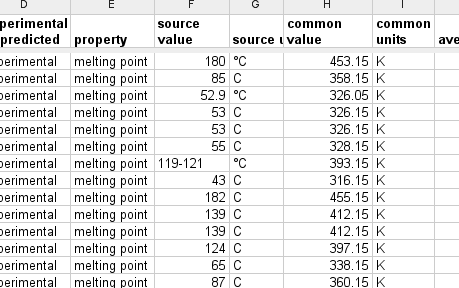
<p>Now, just to end a bit more positively, here’s a <a href="http://usefulchem.blogspot.com/2011/03/open-modeling-of-melting-point-data.html">group of bright, visionary
people</a>
using the standards at the right levels in <a href="https://spreadsheets.google.com/ccc?key=0Ak1R8T6wt4YQdDdNd0wzRVBQdWRMSWpxZjd3X2QtVUE&amp;hl=en#gid=0">this spreadsheet</a>:</p>

<p><img src="/blog/assets/images/excel.png" alt="" /></p>]]></content><author><name>Egon Willighagen</name></author><category term="excel" /><category term="publishing" /><summary type="html"><![CDATA[You must read this previous post first.]]></summary><media:thumbnail xmlns:media="http://search.yahoo.com/mrss/" url="http://egonw.github.io/blog/blog/assets/images/excel.png" /><media:content medium="image" url="http://egonw.github.io/blog/blog/assets/images/excel.png" xmlns:media="http://search.yahoo.com/mrss/" /></entry><entry><title type="html">Pharmaceutical Bioinformatics</title><link href="http://egonw.github.io/blog/2011/03/11/pharmaceutical-bioinformatics.html" rel="alternate" type="text/html" title="Pharmaceutical Bioinformatics" /><published>2011-03-11T00:00:00+00:00</published><updated>2011-03-11T00:00:00+00:00</updated><id>http://egonw.github.io/blog/2011/03/11/pharmaceutical-bioinformatics</id><content type="html" xml:base="http://egonw.github.io/blog/2011/03/11/pharmaceutical-bioinformatics.html"><![CDATA[<p>The <a href="http://www.farmbio.uu.se/research/researchgroups/proteochemometrics/">Wikberg group</a>
at <a href="http://www.uu.se/">Uppsala University</a> where I did my first two years of
post-docing in Sweden has a (free) course on <a href="http://www.pharmbio.org/">pharmaceutical bioinformatics</a>.
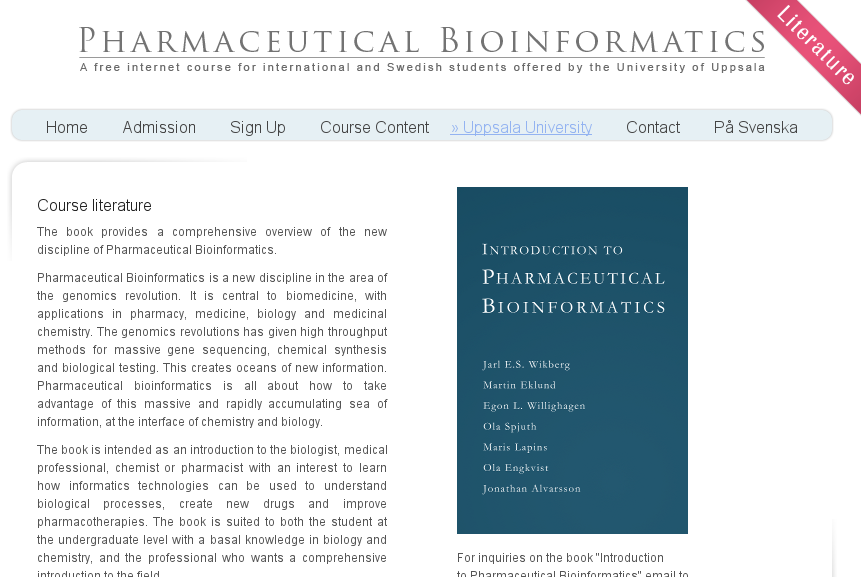
We worked hard on a course book, which after a year got printed. It ended up
with 400 pages, 15 chapters, and 3 appendices. It also includes examples on
how to do discussed topics in <a href="http://www.bioclipse.net/">Bioclipse</a>:</p>

<p><img src="/blog/assets/images/pharmbioBook.png" alt="" /></p>

<p>The chapters are:</p>

<ol>
  <li>
    <p>Introduction</p>
  </li>
  <li>
    <p>Background</p>
  </li>
  <li>
    <p>Drug discovery and development</p>
  </li>
  <li>
    <p>Bioinformatics, drugs and omics</p>
  </li>
  <li>
    <p>Representing molecules in computers</p>
  </li>
  <li>
    <p>Representation of 3D structures</p>
  </li>
  <li>
    <p>Molecular descriptors</p>
  </li>
  <li>
    <p>Sequence analysis</p>
  </li>
  <li>
    <p>Macromolecular descriptors</p>
  </li>
  <li>
    <p>Design of experiments</p>
  </li>
  <li>
    <p>Data analysis</p>
  </li>
  <li>
    <p>Databases</p>
  </li>
  <li>
    <p>QSAR</p>
  </li>
  <li>
    <p>Proteochemometrics</p>
  </li>
  <li>
    <p>Semantic web</p>
  </li>
  <li>
    <p>Answers</p>
  </li>
</ol>

<p>And three appendices:</p>

<p>A. Basic probability theory</p>

<p>B. Basic matrix algebra</p>

<p>C. Introduction to Bioclipse</p>

<p>The book is currently undergoing proof review and available to course participants
only, and should become available in a couple of months for the general public.</p>]]></content><author><name>Egon Willighagen</name></author><category term="bioclipse" /><category term="cdk" /><category term="cheminf" /><category term="chemometrics" /><category term="publishing" /><summary type="html"><![CDATA[The Wikberg group at Uppsala University where I did my first two years of post-docing in Sweden has a (free) course on pharmaceutical bioinformatics. We worked hard on a course book, which after a year got printed. It ended up with 400 pages, 15 chapters, and 3 appendices. It also includes examples on how to do discussed topics in Bioclipse:]]></summary><media:thumbnail xmlns:media="http://search.yahoo.com/mrss/" url="http://egonw.github.io/blog/blog/assets/images/pharmbioBook.png" /><media:content medium="image" url="http://egonw.github.io/blog/blog/assets/images/pharmbioBook.png" xmlns:media="http://search.yahoo.com/mrss/" /></entry><entry><title type="html">ToxBank: a data warehouse for (computational) toxicology</title><link href="http://egonw.github.io/blog/2011/03/08/toxbank-data-warehouse-for.html" rel="alternate" type="text/html" title="ToxBank: a data warehouse for (computational) toxicology" /><published>2011-03-08T00:00:00+00:00</published><updated>2011-03-08T00:00:00+00:00</updated><id>http://egonw.github.io/blog/2011/03/08/toxbank-data-warehouse-for</id><content type="html" xml:base="http://egonw.github.io/blog/2011/03/08/toxbank-data-warehouse-for.html"><![CDATA[<p>Last week I was in sunny <a href="http://en.wikipedia.org/wiki/Cascais">Cascais</a>, and
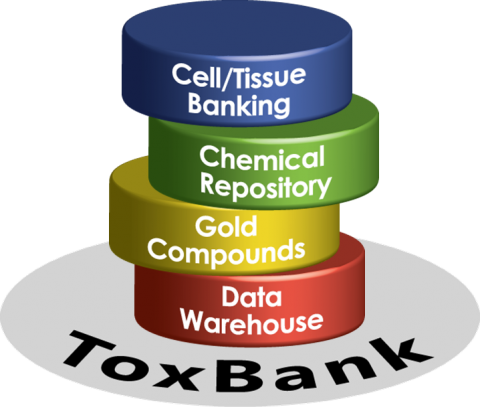
in three days experienced -23<sup>o</sup>C and +18<sup>o</sup>C. The reason
I was there was the kick-off meeting of the EU FP7 cluster SEURAT, which includes
‘our’ <a href="http://toxbank.net/">ToxBank</a> project.</p>

<p><img src="/blog/assets/images/ToxBankComponents.png" alt="" /></p>

<p>Data types we will host include many different types, including my favorite
metabolomics. Don’t ask me what this will practically mean, but some keywords
we already know include RDF, <a href="http://opentox.org/">OpenTox</a>, and <a href="http://www.leadscope.com/toxml.php">ToxML</a>.
With metabolomics, I hope to squeeze in metabolomics.</p>

<p>And that data warehousing for metabolomics is important was only recently shown
be the retraction (via <a href="http://retractionwatch.wordpress.com/">RetractionWatch</a>)
of <a href="http://www.nature.com/nature/journal/v434/n7030/full/nature03356.html">this Nature paper</a>
(doi:<a href="http://dx.doi.org/10.1038/nature03356">10.1038/nature03356</a>). The reason
was that it critically depended on conclusions from another <a href="http://pubs.acs.org/doi/abs/10.1021/jf902670b">retracted</a>
<a href="http://pubs.acs.org/doi/abs/10.1021/jf021166h">paper</a> (doi:<a href="http://dx.doi.org/10.1021/jf021166h">10.1021/jf021166h</a>),
from J. Agric. Food Chem. in 2009.</p>

<p>In this paper, they identified ten chemicals from arabidopsis: <a href="http://en.wikipedia.org/wiki/Butanoic_acid">butanoic acid</a>;
<a href="http://en.wikipedia.org/wiki/Trans-cinnamic_acid">trans-cinnamic acid</a>; o-<a href="http://en.wikipedia.org/wiki/Coumaric_acid">coumaric
acid</a>; p-coumaric acid; <a href="http://en.wikipedia.org/wiki/Ferulic_acid">ferulic
acid</a>; p-hydroxybenzamide; <a href="http://en.wikipedia.org/wiki/Methyl_p-hydroxybenzoate">methyl
p-hydroxybenzoate</a>; 3-indolepropanoic
acid; <a href="http://en.wikipedia.org/wiki/Syringic_acid">syringic acid</a>; and, <a href="http://en.wikipedia.org/wiki/Vanillic_acid">vanillic
acid</a>. I hope I have the links to
Wikipedia correct, as this was based on names only, as the paper does not seem
to list InChIs or even SMILESes. The ten chemical were identified with HPLC
and NMR. No experimental data seems to be given. What NMR data did they base
the identification on? I have seen pretty interesting assignments of chemical
identity in GC/MS and LC/MS, so was quite disappointed to not see the gory details
here.</p>

<p>But fortunately, I could look at the raw data. Yeah, sure! Dream on.</p>

<p>In fact, it seems the characterizations of the 10 chemicals was challenged,
causing the authors to look again at their data. Unfortunately, they could not
find experimental data anymore. The authors write in the <a href="http://pubs.acs.org/doi/full/10.1021/jf902670b">retraction</a>:</p>

<blockquote>
  <p>We have been unable to find experimental data that document the actual isolation of butanoic acid,
trans-cinnamic acid, …</p>
</blockquote>

<p>Now, readers of my blog I care about raw data (see <a href="http://chem-bla-ics.blogspot.com/2010/08/molecular-chemometrics-principles-1.html">McPrinciple #1</a>).
For example, it was a key feature of our <a href="http://chem-bla-ics.blogspot.com/search?q=MetWare">MetWare</a>
project. It is not entirely clear to me that they could no longer find the raw
data, or whether they were no longer able to correlate their extracted characteristics
with the know NMR for those ten compounds. This only strengthens the importance
of NMR databases in metabolite identification, something <a href="http://www.steinbeck-molecular.de/steinblog/">Christoph</a>
would only agree with.</p>

<p>I am not sure we will see the bottom of this, and see if the authors could have
prevented this retraction. However, I do believe the paper was flawed in the
first place: it did not give experimental detail allowing the referees to judge
the metabolite identification. The referees failed, as the apparently did not
find this aspect important enough to have this data in the paper. And, the journal
failed clearly, by not having a good editorial requirement in place around availability
of data. This is not specific to this retracted paper, nor of this journal.
It’s pretty much the community standard, despite many calling for years for
better standards, e.g. via minimal reporting standards.</p>

<p>Well, maybe journal editors will soon wake up, and make availability of experimental
data in papers of this kind (and any type, IMHO) a community standard, and strong
standard, such strong that referees can reject papers of papers do not provide
this minimal information.</p>

<p>Why? It would have saved a lot of people from doing the wrong thing. The original
paper was cited 54 times (according to WoS) and the Nature paper 52 times (up
one since the RetractionWatch post). We’re bound to see a few more retractions
as a result of this, I guess.</p>

<p>So, where I failed to get MetWare going within the <a href="http://www.metabolomicscentre.nl/">Netherlands Metabolomics
Center</a>, let’s hope ToxBank does better.
But given the list of ToxBank partners, I have no doubt about that.</p>]]></content><author><name>Egon Willighagen</name></author><category term="metabolomics" /><category term="metware" /><category term="nature" /><category term="nmr" /><category term="opendata" /><category term="publishing" /><category term="justdoi:10.1038/nature03356" /><category term="justdoi:10.1021/jf902670b" /><category term="justdoi:10.1021/jf021166h" /><summary type="html"><![CDATA[Last week I was in sunny Cascais, and in three days experienced -23oC and +18oC. The reason I was there was the kick-off meeting of the EU FP7 cluster SEURAT, which includes ‘our’ ToxBank project.]]></summary><media:thumbnail xmlns:media="http://search.yahoo.com/mrss/" url="http://egonw.github.io/blog/blog/assets/images/ToxBankComponents.png" /><media:content medium="image" url="http://egonw.github.io/blog/blog/assets/images/ToxBankComponents.png" xmlns:media="http://search.yahoo.com/mrss/" /></entry><entry><title type="html">Is Nature really clueless about Blogs, Twitter, etc? WTF ?!</title><link href="http://egonw.github.io/blog/2011/01/20/is-nature-really-clueless-about-blogs.html" rel="alternate" type="text/html" title="Is Nature really clueless about Blogs, Twitter, etc? WTF ?!" /><published>2011-01-20T00:00:00+00:00</published><updated>2011-01-20T00:00:00+00:00</updated><id>http://egonw.github.io/blog/2011/01/20/is-nature-really-clueless-about-blogs</id><content type="html" xml:base="http://egonw.github.io/blog/2011/01/20/is-nature-really-clueless-about-blogs.html"><![CDATA[<p>My apologies for this rant in the early morning, but WTF?? (what the fuzz??)
I just got pointed to this <em>Peer review: Trial by Twitter</em> (doi:<a href="http://dx.doi.org/10.1038/469286a">10.1038/469286a</a>)
by Mandavilli. Cool title, but before I even finished seventeen words of the
intro… WTF?? Here it is:</p>

<blockquote>
  <p>Blogs and tweets are ripping papers apart within days of publication, leaving researchers unsure how to react.</p>
</blockquote>

<p>What?? Is she mocking me? I know (I have been a reported of a university news
paper) that intros must encourage the reader to read on… but What?? (And I
read the intro a third time…)</p>

<p>I’ll have to read the full thing later, if that makes more sense. But is she
clueless? Are all people clueless about blogging, tweeting, etc?? Remember <a href="http://chem-bla-ics.blogspot.com/2010/10/royce-murray-and-caveat-emptor.html">Royce
Murray</a>?
Has she actually read the <em>Trial by Twitter</em> only so recently?</p>

<p>Dear Mandavilli, in case you do run into this blog post, here’s my reply to
your intro: “The researchers have no problems how to react, they just did.”</p>

<p>Now, after I cooled down a bit, and anticipating I got it all wrong, she might
refer to <em>the</em> researchers of the publication being ripped apart. In that case,
I am tempted to believe that also in the English language one is expected to
use (well, forgive me I do not know the exact term) “leaving the researchers
…”, where ‘the’ links ‘researchers’ to something said earlier. Now, I read,
probably wrong, researchers as any researcher interested in that publication.
Mandavilli could even have written “leaving the authors…”. But what do we
have Nature editors for, right?</p>

<p>Anyways, I do believe this will be an interesting read once I managed to read
past (for the fourth time) the intro of this article.</p>

<p>&lt;/ripping&gt;</p>]]></content><author><name>Egon Willighagen</name></author><category term="blogging" /><category term="nature" /><category term="publishing" /><category term="science" /><category term="twitter" /><category term="justdoi:10.1038/469286a" /><summary type="html"><![CDATA[My apologies for this rant in the early morning, but WTF?? (what the fuzz??) I just got pointed to this Peer review: Trial by Twitter (doi:10.1038/469286a) by Mandavilli. Cool title, but before I even finished seventeen words of the intro… WTF?? Here it is:]]></summary></entry><entry><title type="html">Re: How can cancer research be open-sourced?</title><link href="http://egonw.github.io/blog/2011/01/19/re-how-can-cancer-research-be-open.html" rel="alternate" type="text/html" title="Re: How can cancer research be open-sourced?" /><published>2011-01-19T00:00:00+00:00</published><updated>2011-01-19T00:00:00+00:00</updated><id>http://egonw.github.io/blog/2011/01/19/re-how-can-cancer-research-be-open</id><content type="html" xml:base="http://egonw.github.io/blog/2011/01/19/re-how-can-cancer-research-be-open.html"><![CDATA[<p><a href="http://www.quora.com/Mark-Fortner">Mark</a> asked on <a href="http://www.quora.com/">Quora</a>
on <a href="http://www.quora.com/How-can-cancer-research-be-open-sourced">how can cancer research be open-sourced</a>.
So, far I found Quora to be rather noisy, even after signing up only to science
related groups, themes, whatever it is called. However, every now and then there
is an interesting question like this one.</p>

<p>The question resonated with discussions I had earlier this week. During Peter’s
Symposium the discussion was restarted on why publishing data in databases is
currently not rewarded. I think the answer is really simple: there is no independent
organization counting citation statistics. What if Thomson did not calculate
citation counts and impact factors? Would we be using them to judge the careers
of fellow scientists? If FooBar would calculate H-indices based on data citations
would we ignore that? I hardly think so. However, FooBar does not exists, and
FooBar is not getting rich because of its citation counts.</p>

<p>From a scientist point of perspective, we see people hold back data and source
code, because releasing it reduces the time for the scientist to bring the idea
to Nature and Science. Now, in cheminformatics this is hardly a problem, because
Nature and Science do generally not recognize fundamental, methodological work
from informatics and statistics, despite their now crucial role in many Nature
and Science papers. However, for data this is different. By releasing your data
Openly (think Panton Principles), you remove your intellectual property that
gives you a nice list of co-author papers for your publication list long tail.
Mind you, this is not an argument I make up here, but actual practice: “Sure
you can use my data/method, but I like to be co-author on your paper then.”</p>

<p>Why this is actual practice? Even a paper in the long tail is rewarding. “Wow,
he has 250 papers!” As <a href="depth-first.com">Rich</a> nicely characterizes it: game
theory.</p>

<p>So, what if we would replace the papers in that publication list long tail,
by points for releasing Open Data and Open Source? I’m all in favor. And no
worries about Handles and DOIs. Forget about them. We had Thomson calculate
impact factors very long before we had DOIs.</p>

<p>My reply to Mark’s question?</p>

<blockquote>
  <p>First thing that needs to be changed is the academic reward system. At this
moment, it is rewarding to hold back information, source code, etc. Because
if you do, you make yourself more competitive with respect to publishing in
high-ranked journals. Now, if we would reward releasing data into public
(Open) databases, that would change. Likewise for software. The new journal
<a href="http://www.openresearchcomputation.com/">http://www.openresearchcomputation.com/</a>
is an attempt at changing this situation (disclaimer: I’m on the editorial
board). Of course, there are many kind of rewards. BMC giving out awards for
Open Data is another. Another important reward would be financial. If
organizations, foundation, etc, would start giving out financial support for
Open projects, that will be a great change too. We are starting to see this
with a couple of national founding agencies in Europe to have dedicated
funding for Open Access publishing</p>
</blockquote>]]></content><author><name>Egon Willighagen</name></author><category term="opendata" /><category term="opensource" /><category term="publishing" /><summary type="html"><![CDATA[Mark asked on Quora on how can cancer research be open-sourced. So, far I found Quora to be rather noisy, even after signing up only to science related groups, themes, whatever it is called. However, every now and then there is an interesting question like this one.]]></summary></entry><entry><title type="html">The 100th Blue Obelisk 2006 paper citation</title><link href="http://egonw.github.io/blog/2010/12/30/100th-blue-obelisk-2006-paper-citation.html" rel="alternate" type="text/html" title="The 100th Blue Obelisk 2006 paper citation" /><published>2010-12-30T00:20:00+00:00</published><updated>2010-12-30T00:20:00+00:00</updated><id>http://egonw.github.io/blog/2010/12/30/100th-blue-obelisk-2006-paper-citation</id><content type="html" xml:base="http://egonw.github.io/blog/2010/12/30/100th-blue-obelisk-2006-paper-citation.html"><![CDATA[<p>Two and a half months after the CDK milestone, the Blue Obelisk paper also reached
100 citations. Here the lucky paper is <em>Design, Synthesis, and Preclinical Evaluation
of New 5,6- (or 6,7-) Disubstituted-2-(fluorophenyl)quinolin-4-one Derivatives
as Potent Antitumor Agents</em> by Chou et al (doi:<a href="http://dx.doi.org/10.1021/jm100780c">10.1021/jm100780c</a>).
The Blue Obelisk paper (doi:<a href="http://dx.doi.org/10.1021/ci050400b">10.1021/ci050400b</a>)
is cited because the authors used OpenBabel. About half of the 100 citations
is because <a href="http://www.openbabel.org/">OpenBabel</a> was used, whereas OpenBabel
is only mentioned as one of the Blue Obelisk-associated unprojects in the Blue
Obelisk paper.</p>

<p>I am not sure how this habit started, but with citation practices, it is unlikely
to go away. But who am I to complain….</p>]]></content><author><name>Egon Willighagen</name></author><category term="blue-obelisk" /><category term="publishing" /><category term="doi:10.1021/CI050400B" /><category term="justdoi:10.1021/jm100780c" /><summary type="html"><![CDATA[Two and a half months after the CDK milestone, the Blue Obelisk paper also reached 100 citations. Here the lucky paper is Design, Synthesis, and Preclinical Evaluation of New 5,6- (or 6,7-) Disubstituted-2-(fluorophenyl)quinolin-4-one Derivatives as Potent Antitumor Agents by Chou et al (doi:10.1021/jm100780c). The Blue Obelisk paper (doi:10.1021/ci050400b) is cited because the authors used OpenBabel. About half of the 100 citations is because OpenBabel was used, whereas OpenBabel is only mentioned as one of the Blue Obelisk-associated unprojects in the Blue Obelisk paper.]]></summary></entry><entry><title type="html">Open Research Computation, ORC, #openrescomp</title><link href="http://egonw.github.io/blog/2010/12/14/bmc-open-research-computation.html" rel="alternate" type="text/html" title="Open Research Computation, ORC, #openrescomp" /><published>2010-12-14T00:10:00+00:00</published><updated>2010-12-14T00:10:00+00:00</updated><id>http://egonw.github.io/blog/2010/12/14/bmc-open-research-computation</id><content type="html" xml:base="http://egonw.github.io/blog/2010/12/14/bmc-open-research-computation.html"><![CDATA[<p>Yesterday, a new journal launched, but your regular new journal. This journal
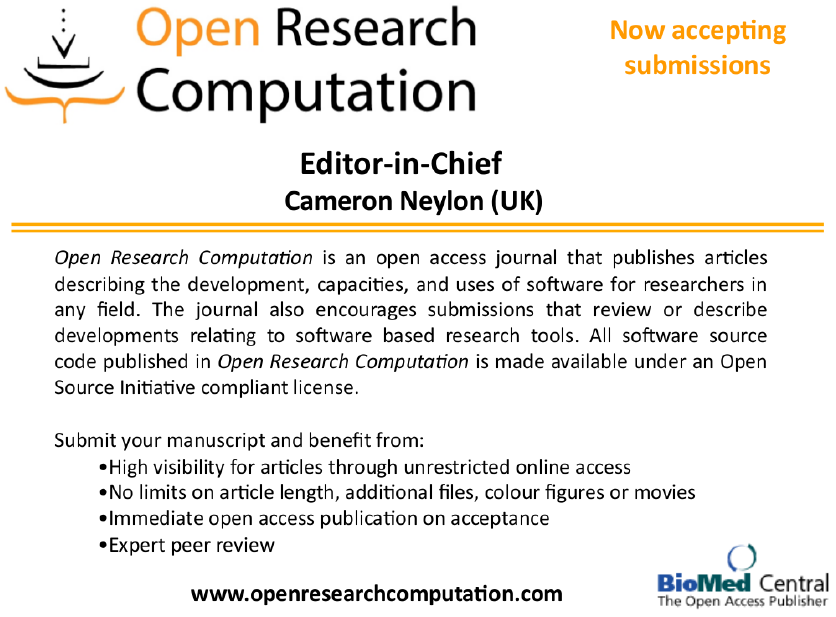
is about scientific software. Tested software. Documented software. Open Source
software. I am on the editorial board, so I am biased here. But, this journal
is special. This new journal is called <a href="http://www.openresearchcomputation.com/">Open Research Computation</a>
(<a href="en.wikipedia.org/wiki/Orc_%28Middle-earth%29">ORC</a>?). Several others <a href="http://cameronneylon.net/blog/open-research-computation-an-ordinary-journal-with-extraordinary-aims/?utm_source=feedburner&amp;utm_medium=feed&amp;utm_campaign=Feed:+ScienceInTheOpen+%28Science+in+the+open%29&amp;utm_content=FriendFeed+Bot">blogged</a>
<a href="http://saaientist.blogspot.com/2010/12/open-research-computation-new-journal.html">about</a>
<a href="http://nsaunders.wordpress.com/2010/12/13/can-a-journal-make-a-difference-lets-find-out/">it</a>
<a href="http://plindenbaum.blogspot.com/2010/12/new-journal-bmc-open-research.html">too</a>.</p>

<p><img src="/blog/assets/images/orc.png" alt="" /></p>]]></content><author><name>Egon Willighagen</name></author><category term="opensource" /><category term="publishing" /><summary type="html"><![CDATA[Yesterday, a new journal launched, but your regular new journal. This journal is about scientific software. Tested software. Documented software. Open Source software. I am on the editorial board, so I am biased here. But, this journal is special. This new journal is called Open Research Computation (ORC?). Several others blogged about it too.]]></summary><media:thumbnail xmlns:media="http://search.yahoo.com/mrss/" url="http://egonw.github.io/blog/blog/assets/images/orc.png" /><media:content medium="image" url="http://egonw.github.io/blog/blog/assets/images/orc.png" xmlns:media="http://search.yahoo.com/mrss/" /></entry><entry><title type="html">Really free chemistry books #2: @bookboon</title><link href="http://egonw.github.io/blog/2010/10/26/really-free-chemistry-books-2-bookboon.html" rel="alternate" type="text/html" title="Really free chemistry books #2: @bookboon" /><published>2010-10-26T00:00:00+00:00</published><updated>2010-10-26T00:00:00+00:00</updated><id>http://egonw.github.io/blog/2010/10/26/really-free-chemistry-books-2-bookboon</id><content type="html" xml:base="http://egonw.github.io/blog/2010/10/26/really-free-chemistry-books-2-bookboon.html"><![CDATA[<p>About a year ago I wrote about <a href="http://chem-bla-ics.blogspot.com/2009/09/really-free-chemistry-books.html">free chemistry books</a>.
No, not illegal copied books, but really free books (though, not necessarily
Open). Actually, the books I discussed last year, those are out of copyright,
as they are old. But, just today I ran into an advertisement for free books
by <a href="http://bookboon.com/">bookboon.com</a> (twitter:<a href="http://twitter.com/#!/bookboon">bookboon</a>),
and these are <em>new</em> books. I have not browsed them yet, but you can download
textbook PDFs from these sections: <a href="http://bookboon.com/us/textbooks/biology">biology</a>,
<a href="http://bookboon.com/us/textbooks/chemistry">chemistry</a>, <a href="http://bookboon.com/us/textbooks/chemical">chemical engineering</a>,
<a href="http://bookboon.com/us/textbooks/mathematics">math</a>, <a href="http://bookboon.com/us/textbooks/nano">nanotechnology</a>,
and several more. I do not know about the quality of these books yet, and they
author names do not immediately ring a bell. Does anyone have experience with
these books?</p>]]></content><author><name>Egon Willighagen</name></author><category term="publishing" /><summary type="html"><![CDATA[About a year ago I wrote about free chemistry books. No, not illegal copied books, but really free books (though, not necessarily Open). Actually, the books I discussed last year, those are out of copyright, as they are old. But, just today I ran into an advertisement for free books by bookboon.com (twitter:bookboon), and these are new books. I have not browsed them yet, but you can download textbook PDFs from these sections: biology, chemistry, chemical engineering, math, nanotechnology, and several more. I do not know about the quality of these books yet, and they author names do not immediately ring a bell. Does anyone have experience with these books?]]></summary></entry><entry><title type="html">Royce Murray and Caveat Emptor</title><link href="http://egonw.github.io/blog/2010/10/16/royce-murray-and-caveat-emptor.html" rel="alternate" type="text/html" title="Royce Murray and Caveat Emptor" /><published>2010-10-16T00:00:00+00:00</published><updated>2010-10-16T00:00:00+00:00</updated><id>http://egonw.github.io/blog/2010/10/16/royce-murray-and-caveat-emptor</id><content type="html" xml:base="http://egonw.github.io/blog/2010/10/16/royce-murray-and-caveat-emptor.html"><![CDATA[<p><a href="http://pipeline.corante.com/archives/2010/10/15/those_chemistry_bloggers.php">Derek’s blog</a>
pointed me to an editorial by Royce Murray <em>Science Blogs and Caveat Emptor</em>
(doi:<a href="http://dx.doi.org/10.1021/ac102628p">10.1021/ac102628p</a>). He is warning
us, science scholars, for blogs. He is accusing bloggers for not being scholarly,
not checking facts etc.</p>

<p>He did himself and the journal a <strong>big</strong> disfavor with this editorial: in his
blog he does precisely what he is accusing the blogger of: fail to check facts.
Even worse, particularly for the ‘Analytical Chemistry’ journal, he showed inadequate
in analyzing the problem, putting his scholarly skills at questionable levels:
he <strong>failed</strong> to see what ‘blogging’ is and what it is not, and he failed to
ascribe his concerns to the proper source; effectively, he failed to see the
difference between correlation and cause-effect for ‘blogging’ (unworthy to
any scholar, particularly if you start complaining). I invite Royce to blog
his full analysis of the problem, with proper underlying data, facts, etc, so
that I (and others) can explain to him the true factors involved in this problem
he is noticing.</p>

<p>The editorial is a sad piece, and an editorial unworthy for the journal.</p>

<p>Actually, the fact that he mentions the <em>Impact Factor</em> is amusing. It must
be noted that his editorial will have a huge impact, but not because the writing
is any good, but because it is utterly wrong. And that reflects only one thing
that is wrong with impact factors.</p>

<p>I strongly suggest Royce to checks his facts before he starts writing. The ethics
expressed in the editorial seems only to apply to other scholars.</p>

<p>I you wonder about my strong language. That was triggered by these words from
the editorial: <em>In the above light, I believe that the current phenomenon of
“bloggers” should be of serious concern to scientists.</em> I consider myself a
blogger, not unreasonable giving the fact that I blog, and feel personally attacked.
Hence, the title of this post: <strong>Royce Murray and Caveat Emptor</strong>.</p>]]></content><author><name>Egon Willighagen</name></author><category term="blogging" /><category term="publishing" /><category term="science" /><category term="justdoi:10.1021/ac102628p" /><summary type="html"><![CDATA[Derek’s blog pointed me to an editorial by Royce Murray Science Blogs and Caveat Emptor (doi:10.1021/ac102628p). He is warning us, science scholars, for blogs. He is accusing bloggers for not being scholarly, not checking facts etc.]]></summary></entry></feed>