<?xml version="1.0" encoding="utf-8"?><feed xmlns="http://www.w3.org/2005/Atom" ><generator uri="https://jekyllrb.com/" version="4.3.4">Jekyll</generator><link href="http://egonw.github.io/blog/feed/by_tag/rdf.xml" rel="self" type="application/atom+xml" /><link href="http://egonw.github.io/blog/" rel="alternate" type="text/html" /><updated>2026-11-19T06:09:00+00:00</updated><id>http://egonw.github.io/blog/feed/by_tag/rdf.xml</id><title type="html">chem-bla-ics</title><subtitle>Chemblaics (pronounced chem-bla-ics) is the science that uses open science and computers to solve problems in chemistry, biochemistry and related fields.</subtitle><author><name>Egon Willighagen</name></author><entry><title type="html">Importing RDF input in R for analysis</title><link href="http://egonw.github.io/blog/2011/04/28/importing-rdf-input-in-r-for-analysis.html" rel="alternate" type="text/html" title="Importing RDF input in R for analysis" /><published>2011-04-28T00:00:00+00:00</published><updated>2011-04-28T00:00:00+00:00</updated><id>http://egonw.github.io/blog/2011/04/28/importing-rdf-input-in-r-for-analysis</id><content type="html" xml:base="http://egonw.github.io/blog/2011/04/28/importing-rdf-input-in-r-for-analysis.html"><![CDATA[<p>August last year I asked on BioStar about <a href="http://biostar.stackexchange.com/questions/2069/how-do-i-import-rdf-data-into-r">how to import RDF into the R statistical
package</a>
and at the time nothing seemed existing. Over the past few weeks I ported code
I wrote for <a href="http://www.bioclipse.net/">Bioclipse</a> to create the <a href="http://cran.r-project.org/web/packages/rrdf/index.html">rrdf package</a>
for <a href="http://www.r-project.org/">R</a>, which is now available from <a href="http://cran.r-project.org/">CRAN</a>.
RDF can be loaded from RDF/XML, Notation3, and Turtle files, using <a href="http://jena.sourceforge.net/">Jena</a>,
and read data can be queried using <a href="http://www.w3.org/TR/rdf-sparql-query/">SPARQL</a>.
I have not yet ported the remote SPARQL functionality we used in <a href="http://www.jbiomedsem.com/content/2/S1/S6">our recent
paper</a>, but that will make a nice
alternative to <a href="http://chembl.blogspot.com/2011/04/access-to-chembl-through-pipeline-pilot.html">using ChEMBL data in Pipeline Pilot</a>
or <a href="http://www.jbiomedsem.com/content/2/S1/S6">in Bioclipse</a> :)</p>]]></content><author><name>Egon Willighagen</name></author><category term="chembl" /><category term="rstats" /><category term="rdf" /><category term="sparql" /><summary type="html"><![CDATA[August last year I asked on BioStar about how to import RDF into the R statistical package and at the time nothing seemed existing. Over the past few weeks I ported code I wrote for Bioclipse to create the rrdf package for R, which is now available from CRAN. RDF can be loaded from RDF/XML, Notation3, and Turtle files, using Jena, and read data can be queried using SPARQL. I have not yet ported the remote SPARQL functionality we used in our recent paper, but that will make a nice alternative to using ChEMBL data in Pipeline Pilot or in Bioclipse :)]]></summary></entry><entry><title type="html">ChEMBL 09 as RDF</title><link href="http://egonw.github.io/blog/2011/04/21/chembl-09-as-rdf.html" rel="alternate" type="text/html" title="ChEMBL 09 as RDF" /><published>2011-04-21T00:00:00+00:00</published><updated>2011-04-21T00:00:00+00:00</updated><id>http://egonw.github.io/blog/2011/04/21/chembl-09-as-rdf</id><content type="html" xml:base="http://egonw.github.io/blog/2011/04/21/chembl-09-as-rdf.html"><![CDATA[<p><em>Update 2021-02</em>: this post is still the second-most read post in my blog. Welcome! Some updates:</p>

<ul>
  <li>Ammar Ammar in our BiGCaT group has set up a <a href="https://chemblmirror.rdf.bigcat-bioinformatics.org/">new SPARQL endpoint</a>. Please use and tweet. blog, or otherwise let others now how you use the ChEMBL RDF.</li>
  <li>Since this post I have <a href="https://chem-bla-ics.blogspot.com/search/label/chembl">blogged a lot more about ChEMBL</a>.</li>
</ul>

<p><em>Update</em>: this work is now written down in <a href="https://chem-bla-ics.linkedchemistry.info/2013/05/09/new-paper-chembl-database-as-linked.html">this paper</a>.</p>

<p>I’m having a really bad month, as you can see from the number of posts. Too much to do, too little time. One of the things
I have been doing in the past weeks is update the RDF for <a href="https://www.ebi.ac.uk/chembldb/">ChEMBL</a>, now up to
version 09. The <a href="https://web.archive.org/web/20121123055403/http://rdf.farmbio.uu.se/chembl/sparql">SPARQL end point <i class="fa-solid fa-box-archive fa-xs"></i></a> has not been updated yet (which is
still at ChEBML 04), but you can now download the triples for self-hosting here. Like the database itself, the RDF is
available under the <a href="http://creativecommons.org/licenses/by-sa/3.0/">CC-SA-BY license</a>, requiring attribution to both
the ChEMBL team as well as our efforts to create the RDF (see this
<a href="https://github.com/egonw/chembl.rdf/blob/master/README.markdown">README</a>).</p>]]></content><author><name>Egon Willighagen</name></author><category term="chembl" /><category term="rdf" /><summary type="html"><![CDATA[Update 2021-02: this post is still the second-most read post in my blog. Welcome! Some updates:]]></summary></entry><entry><title type="html">Bioclipse-CDK-ChEMBL-SPARQL-Chemometrics mashup paper published</title><link href="http://egonw.github.io/blog/2011/03/07/bioclipse-cdk-chembl-sparql.html" rel="alternate" type="text/html" title="Bioclipse-CDK-ChEMBL-SPARQL-Chemometrics mashup paper published" /><published>2011-03-07T00:00:00+00:00</published><updated>2011-03-07T00:00:00+00:00</updated><id>http://egonw.github.io/blog/2011/03/07/bioclipse-cdk-chembl-sparql</id><content type="html" xml:base="http://egonw.github.io/blog/2011/03/07/bioclipse-cdk-chembl-sparql.html"><![CDATA[<p>Our (peer-reviewed) <a href="http://www.bioclipse.net/">Bioclipse</a>-<a href="http://cdk.sf.net/">CDK</a>-SPARQL-Chemometrics
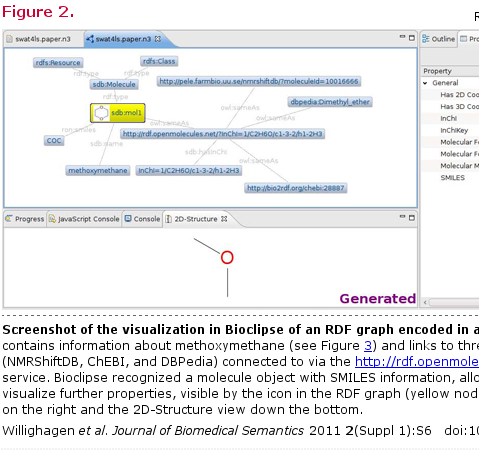
mashup paper was just published online (doi:<span class="Apple-style-span" style="font-family: Verdana, Geneva, Arial, Helvetica, sans-serif; font-size: 11px; line-height: 14px;"><a href="http://dx.doi.org/10.1186/2041-1480-2-S1-S6">10.1186/2041-1480-2-S1-S6</a></span>)
as part of the <a href="http://www.swat4ls.org/2009/">SWAT4LS 2009</a> <a href="http://www.jbiomedsem.com/supplements/2/S1">supplement</a>,
where we use the CC-SA-BY-licensed <a href="https://www.ebi.ac.uk/chembldb/">ChEMBL database</a>
as example data source, based on a <a href="http://chem-bla-ics.blogspot.com/2009/11/swat4ls-linking-open-drug-data-to.html">presentation I gave</a>
in Amsterdam back then.</p>

<p><img src="/blog/assets/images/jbiomedPaper.png" alt="" /></p>

<p>This is a Figure from our paper, but the other papers are very interesting too,
and are worth checking out!</p>]]></content><author><name>Egon Willighagen</name></author><category term="bioclipse" /><category term="cdk" /><category term="chembl" /><category term="rdf" /><category term="semweb" /><category term="sparql" /><category term="doi:10.1186/2041-1480-2-S1-S6" /><summary type="html"><![CDATA[Our (peer-reviewed) Bioclipse-CDK-SPARQL-Chemometrics mashup paper was just published online (doi:10.1186/2041-1480-2-S1-S6) as part of the SWAT4LS 2009 supplement, where we use the CC-SA-BY-licensed ChEMBL database as example data source, based on a presentation I gave in Amsterdam back then.]]></summary><media:thumbnail xmlns:media="http://search.yahoo.com/mrss/" url="http://egonw.github.io/blog/blog/assets/images/jbiomedPaper.png" /><media:content medium="image" url="http://egonw.github.io/blog/blog/assets/images/jbiomedPaper.png" xmlns:media="http://search.yahoo.com/mrss/" /></entry><entry><title type="html">CKAN and RDF: a nice example of why ontologies matter</title><link href="http://egonw.github.io/blog/2011/02/21/ckan-and-rdf-nice-example-on-why.html" rel="alternate" type="text/html" title="CKAN and RDF: a nice example of why ontologies matter" /><published>2011-02-21T00:00:00+00:00</published><updated>2011-02-21T00:00:00+00:00</updated><id>http://egonw.github.io/blog/2011/02/21/ckan-and-rdf-nice-example-on-why</id><content type="html" xml:base="http://egonw.github.io/blog/2011/02/21/ckan-and-rdf-nice-example-on-why.html"><![CDATA[<p><img src="https://assets.okfn.org/p/ckan/img/ckan_logo_box.png" style="width: 30%; display: block; margin-left: auto; margin-right: auto; float: right" />
For a while now I have been a so-called <a href="http://www.w3.org/2004/08/invexp">invited expert</a>
to the <a href="http://www.w3.org/wiki/HCLSIG/LODD">Linking Open Drug Data</a> (LODD) task
force of the W3C’s <a href="http://www.w3.org/wiki/HCLSIG">Health Care and Life Sciences Interest Group</a>
(HCLSIG). I also participate in the <a href="http://wiki.okfn.org/OpenScience">open-science</a>
group of the <a href="http://okfn.org/">Open Knowledge Foundation</a> (OKF). This is not
really worth blogging about if the two are not being mashed up. Members from
both sides are interested in learning how Open (think <a href="http://www.isitopendata.org/">Is It Open Data?</a>)
the <em>open data</em> from the LODD network really is.</p>

<p>In fact, the Open Data definition as outlined in the <a href="http://chem-bla-ics.blogspot.com/2010/02/open-data-panton-principles.html">Panton Principles</a>
does not allow for a non-commercial clause, which several LODD data sets are
labeled with. Clear copyright and license statements are really important. This
<a href="http://chem-bla-ics.blogspot.com/2009/06/making-patches-attribution-copyright.html">applies to source code</a>,
but most certainly to data too.</p>

<p>So, early March there will be a virtual, online hack session on making a start
clarifying the licensing and copyrights of the various LODD data sets. CKAN,
the OKF’s registry of data sets sounds like a suitable place to organize things.
And, they support RDF making it even a nicer match. Or…</p>

<p><strong>Records, data sets, packages, lists, …</strong><br />
Well, I am running into a number of problems that need to be solved. The first
one is, in fact, rather fundamental. A record in the CKAN catalog is typed as
a <a href="http://www.w3.org/ns/dcat#CatalogRecord">CatalogRecord</a>. Nothing more, nothing
less. However, looking at the database content each record is like a data set.
The GUI confirms that with links like ‘Add a dataset’. Then again, <a href="http://ckan.net/package/new">following
the link</a>, it is described as a ‘data package’
as well as a ‘dataset’. This is confusing.</p>

<p>Yes, it is! Really! Just look at how people are using it.</p>

<p>Take for example the record for <a href="http://ckan.net/package/linking-open-drug-data">LODD</a>
(well, there is <a href="http://ckan.net/package/lodd_group">a second LODD record</a> and
I haven’t found a way to delete records). But, the LODD data is not a single
data set, but a aggregation (package?) of data sets. This is basically one of
the standing issues with Linked Open Data: license incompatibilities, just like
with mixing GPL v2 and v3 in source code. As such, these records which are basically
lists of datasets typically not have a license listed, as multiple license apply.</p>

<p>There seem two solutions: the use of <a href="http://ckan.net/group/">groups</a> and of
<a href="http://ckan.net/tag/">tags</a>. I opted for a new <a href="http://ckan.net/group/hclsig_lodd">W3C’s HCLSIG LODD task force</a>
group.</p>

<p><strong>Small issues</strong><br />
As said, I could not find a way yet to remove datasets, so cleaning up the catalog
is a bit difficult. You can add comments, but I am not sure if these get read.
Earlier, I noted that the GNU FDL license was missing, but that is available
from the list now, so I have updated the <a href="http://ckan.net/package/nmrshiftdb">NMRShiftDB record</a>.
The combination of Attribution and Share-Alike for the Creative Commons license
is missing from the list though, affecting the <a href="http://ckan.net/package/chembl">ChEMBL record</a>.</p>

<p><strong>Redistribution?</strong><br />
Another issue that must be addressed in CKAN is how to deal with redistributions.
For example, the above cited ChEMBL data is also available as <a href="http://chem-bla-ics.blogspot.com/2010/02/chembl-rdf-1sparql-end-point.html">SPARQL end</a>
point by me, and this end point currently has a <a href="http://ckan.net/package/farmbio-chembl">different record</a>.
Should those records be merged? I guess not, because there is only place for
one maintainer. So, perhaps a CKAN catalog record is not even a dataset, but
a data set provider?</p>

<p>Well, this does make a really nice example of what can go wrong if terms are
not well-defined, e.g. using an ontology. People do not know how to fill the
database, leading to noisy content, limiting the usefulness of the data. I do
hope we get to see definitions for what groups and datasets are in the catalog
before our hack session in March.</p>]]></content><author><name>Egon Willighagen</name></author><category term="chembl" /><category term="nmrshiftdb" /><category term="rdf" /><summary type="html"><![CDATA[For a while now I have been a so-called invited expert to the Linking Open Drug Data (LODD) task force of the W3C’s Health Care and Life Sciences Interest Group (HCLSIG). I also participate in the open-science group of the Open Knowledge Foundation (OKF). This is not really worth blogging about if the two are not being mashed up. Members from both sides are interested in learning how Open (think Is It Open Data?) the open data from the LODD network really is.]]></summary></entry><entry><title type="html">Converting JSON to RDF/XML with Groovy</title><link href="http://egonw.github.io/blog/2010/12/29/converting-json-to-rdfxml-with-groovy.html" rel="alternate" type="text/html" title="Converting JSON to RDF/XML with Groovy" /><published>2010-12-29T00:00:00+00:00</published><updated>2010-12-29T00:00:00+00:00</updated><id>http://egonw.github.io/blog/2010/12/29/converting-json-to-rdfxml-with-groovy</id><content type="html" xml:base="http://egonw.github.io/blog/2010/12/29/converting-json-to-rdfxml-with-groovy.html"><![CDATA[<p>Mark’s new <a href="http://www.science3point0.com/blog/2010/12/29/cc0-rdf-hosting-for-scientists/">CCO/RDF hosting functionality</a>
(see also <a href="http://chem-bla-ics.blogspot.com/2010/12/what-should-free-cc0-rdf-hosting-for.html">my post two days ago</a>)
requires <a href="http://www.w3.org/TR/REC-rdf-syntax/">RDF/XML format</a>, so I updated my code to convert the
<a href="http://chempedia.com/substances">Chempedia Substances</a> data into RDF/XML instead of N3 (I have asked
<a href="http://depth-first.com/">Rich</a> to put a new download link online). This is the
<a href="http://groovy.codehaus.org/">Groovy</a> code I used:</p>

<div class="language-groovy highlighter-rouge"><div class="highlight"><pre class="highlight"><code><span class="kn">import</span> <span class="nn">groovy.xml.MarkupBuilder</span>
<span class="kn">import</span> <span class="nn">groovy.util.IndentPrinter</span>

<span class="n">input</span> <span class="o">=</span> <span class="k">new</span> <span class="n">File</span><span class="o">(</span><span class="s2">"substances.json"</span><span class="o">)</span>
<span class="n">json</span> <span class="o">=</span> <span class="k">new</span> <span class="n">JsonSlurper</span><span class="o">().</span><span class="na">parse</span><span class="o">(</span><span class="n">input</span><span class="o">);</span>

<span class="kt">def</span> <span class="n">writer</span> <span class="o">=</span> <span class="k">new</span> <span class="n">StringWriter</span><span class="o">()</span>
<span class="kt">def</span> <span class="n">xml</span> <span class="o">=</span> <span class="k">new</span> <span class="n">MarkupBuilder</span><span class="o">(</span>
  <span class="k">new</span> <span class="nf">IndentPrinter</span><span class="o">(</span><span class="k">new</span> <span class="n">PrintWriter</span><span class="o">(</span><span class="n">writer</span><span class="o">))</span>
<span class="o">)</span>
<span class="n">xml</span><span class="o">.</span><span class="s1">'rdf:RDF'</span><span class="o">(</span>
  <span class="s1">'xmlns:rdf'</span><span class="o">:</span>
    <span class="s1">'http://www.w3.org/1999/02/22-rdf-syntax-ns#'</span><span class="o">,</span>
  <span class="s1">'xmlns:dc'</span> <span class="o">:</span>
    <span class="s1">'http://purl.org/dc/elements/1.1/'</span><span class="o">,</span>
  <span class="s1">'xmlns:iupac'</span> <span class="o">:</span>
    <span class="s1">'http://www.iupac.org/'</span><span class="o">,</span>
  <span class="s1">'xmlns:cp'</span> <span class="o">:</span>
    <span class="s1">'http://rdf.openmolecules.net/chempedia/onto#'</span><span class="o">,</span>
  <span class="s1">'xmlns:owl'</span> <span class="o">:</span>
    <span class="s1">'http://www.w3.org/2002/07/owl#'</span>
<span class="o">)</span> <span class="o">{</span>
  <span class="n">json</span><span class="o">.</span><span class="na">each</span> <span class="o">{</span> <span class="n">substance</span> <span class="o">-&gt;</span>
    <span class="n">xml</span><span class="o">.</span><span class="s1">'rdf:Description'</span><span class="o">(</span>
      <span class="s1">'rdf:about'</span><span class="o">:</span> <span class="n">substance</span><span class="o">.</span><span class="na">uri</span>
    <span class="o">)</span> <span class="o">{</span>
      <span class="n">xml</span><span class="o">.</span><span class="s1">'dc:identifier'</span><span class="o">(</span><span class="n">substance</span><span class="o">.</span><span class="na">gsid</span><span class="o">)</span>
      <span class="n">xml</span><span class="o">.</span><span class="s1">'owl:sameAs'</span><span class="o">(</span>
        <span class="s1">'rdf:resource'</span> <span class="o">:</span>
        <span class="s1">'http://rdf.openmolecules.net/?'</span> <span class="o">+</span>
        <span class="n">substance</span><span class="o">.</span><span class="na">inchi</span>
      <span class="o">)</span>
      <span class="n">xml</span><span class="o">.</span><span class="s1">'iupac:inchi'</span><span class="o">(</span>
        <span class="s1">'http://rdf.openmolecules.net/?'</span> <span class="o">+</span>
        <span class="n">substance</span><span class="o">.</span><span class="na">inchi</span>
      <span class="o">)</span>
      <span class="k">for</span> <span class="o">(</span><span class="kt">int</span> <span class="n">i</span> <span class="o">=</span> <span class="mi">0</span><span class="o">;</span> <span class="n">i</span><span class="o">&lt;</span><span class="n">substance</span><span class="o">.</span><span class="na">namings</span><span class="o">.</span><span class="na">size</span><span class="o">();</span> <span class="n">i</span><span class="o">++)</span>
      <span class="o">{</span>
        <span class="n">naming</span> <span class="o">=</span> <span class="n">substance</span><span class="o">.</span><span class="na">namings</span><span class="o">.</span><span class="na">get</span><span class="o">(</span><span class="n">i</span><span class="o">);</span>
        <span class="n">namingURI</span> <span class="o">=</span> <span class="n">substance</span><span class="o">.</span><span class="na">uri</span> <span class="o">+</span> <span class="s2">"/naming"</span> <span class="o">+</span> <span class="n">i</span><span class="o">;</span>
        <span class="n">xml</span><span class="o">.</span><span class="s1">'cp:hasNaming'</span> <span class="o">{</span>
          <span class="n">xml</span><span class="o">.</span><span class="s1">'rdf:Description'</span> <span class="o">{</span>
            <span class="n">xml</span><span class="o">.</span><span class="s1">'cp:hasName'</span><span class="o">(</span><span class="n">naming</span><span class="o">.</span><span class="na">name</span><span class="o">)</span>
            <span class="n">xml</span><span class="o">.</span><span class="s1">'cp:hasStatus'</span><span class="o">(</span><span class="n">naming</span><span class="o">.</span><span class="na">status</span><span class="o">)</span>
            <span class="n">xml</span><span class="o">.</span><span class="s1">'cp:hasScore'</span><span class="o">(</span><span class="n">naming</span><span class="o">.</span><span class="na">score</span><span class="o">)</span>
          <span class="o">}</span>
        <span class="o">}</span>
      <span class="o">}</span>
    <span class="o">}</span>
  <span class="o">}</span>
<span class="o">}</span>
<span class="n">println</span> <span class="n">writer</span><span class="o">.</span><span class="na">toString</span><span class="o">();</span>
</code></pre></div></div>]]></content><author><name>Egon Willighagen</name></author><category term="groovy" /><category term="chemistry" /><category term="rdf" /><category term="json" /><summary type="html"><![CDATA[Mark’s new CCO/RDF hosting functionality (see also my post two days ago) requires RDF/XML format, so I updated my code to convert the Chempedia Substances data into RDF/XML instead of N3 (I have asked Rich to put a new download link online). This is the Groovy code I used:]]></summary></entry><entry><title type="html">What should a free CC0 RDF hosting for scientists look like?</title><link href="http://egonw.github.io/blog/2010/12/27/what-should-free-cc0-rdf-hosting-for.html" rel="alternate" type="text/html" title="What should a free CC0 RDF hosting for scientists look like?" /><published>2010-12-27T00:00:00+00:00</published><updated>2010-12-27T00:00:00+00:00</updated><id>http://egonw.github.io/blog/2010/12/27/what-should-free-cc0-rdf-hosting-for</id><content type="html" xml:base="http://egonw.github.io/blog/2010/12/27/what-should-free-cc0-rdf-hosting-for.html"><![CDATA[<p> </p>

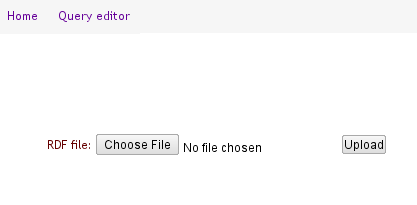
<p><img src="/blog/assets/images/rdfHostS30.png" alt="" /></p>

<p>What if scientists could host small amounts of <a href="http://creativecommons.org/publicdomain/zero/1.0/">CC0</a>
data for free? Something like computation results, e.g. outputted as <a href="http://chem-bla-ics.blogspot.com/2010/07/scripts-logs-as-htmlrdfa-mix-free-text.html">HTML+RDFa</a>?
Without having to worry about setting up triple store, etc? Well, that future
might be near. The above screenshot shows a first go. Not by me, but in response
to a feature request by me. So, the question right now is, what would be like
to see on the summary page. Some things I can think of are:</p>

<ul>
  <li>clear statement of CC0 waiver, possible the <a href="http://www.opendefinition.org/buttons/">opendata icon</a></li>
  <li>basic stats: # of triples, # unique predicates, etc</li>
  <li>a <a href="http://www.wordle.net/">Wordle</a> of all rdfs:labels in the data set</li>
  <li>the upload page should probably a separate tab</li>
</ul>

<p>That would be a good start. What else should be there?</p>]]></content><author><name>Egon Willighagen</name></author><category term="copyright" /><category term="rdf" /><summary type="html"><![CDATA[ ]]></summary><media:thumbnail xmlns:media="http://search.yahoo.com/mrss/" url="http://egonw.github.io/blog/blog/assets/images/rdfHostS30.png" /><media:content medium="image" url="http://egonw.github.io/blog/blog/assets/images/rdfHostS30.png" xmlns:media="http://search.yahoo.com/mrss/" /></entry><entry><title type="html">RDFa support in CiteULike</title><link href="http://egonw.github.io/blog/2010/10/03/rdfa-support-in-citeulike.html" rel="alternate" type="text/html" title="RDFa support in CiteULike" /><published>2010-10-03T00:00:00+00:00</published><updated>2010-10-03T00:00:00+00:00</updated><id>http://egonw.github.io/blog/2010/10/03/rdfa-support-in-citeulike</id><content type="html" xml:base="http://egonw.github.io/blog/2010/10/03/rdfa-support-in-citeulike.html"><![CDATA[<p>Last month I reported a <a href="http://chem-bla-ics.blogspot.com/2010/09/list-of-things-i-miss-in-citeulike.html">A list of things I miss in CiteULike</a>
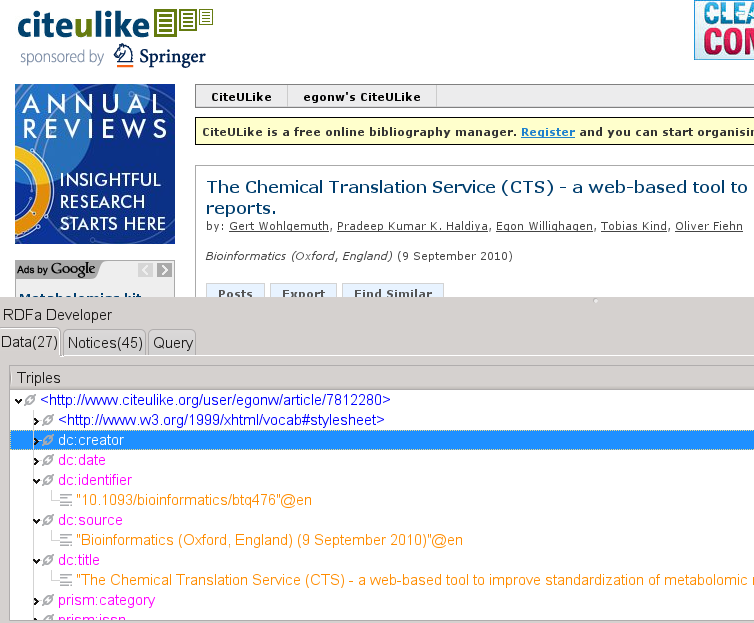
and the developers have not been sitting still. Only <em>one</em> of the things they
started to adopt is <a href="http://www.w3.org/TR/xhtml-rdfa-primer/">RDFa</a> in the <a href="http://www.citeulike.org/user/egonw/article/7812280">CiteULike
web interface</a>. Of course,
you will not see this in the browser, unless you use something like the <a href="http://chem-bla-ics.blogspot.com/2010/07/rdfadev-htmlrdfa-development-with.html">RDFaDev
plugin in Firefox</a>:</p>

<p><img src="/blog/assets/images/culRDFa.png" alt="" /></p>

<p>Cheers to the <a href="http://blog.citeulike.org/">CiteULike developers team</a>!</p>]]></content><author><name>Egon Willighagen</name></author><category term="citeulike" /><category term="rdf" /><category term="rdfa" /><summary type="html"><![CDATA[Last month I reported a A list of things I miss in CiteULike and the developers have not been sitting still. Only one of the things they started to adopt is RDFa in the CiteULike web interface. Of course, you will not see this in the browser, unless you use something like the RDFaDev plugin in Firefox:]]></summary><media:thumbnail xmlns:media="http://search.yahoo.com/mrss/" url="http://egonw.github.io/blog/blog/assets/images/culRDFa.png" /><media:content medium="image" url="http://egonw.github.io/blog/blog/assets/images/culRDFa.png" xmlns:media="http://search.yahoo.com/mrss/" /></entry><entry><title type="html">Visualizing data embedded in XHTML+RDFa</title><link href="http://egonw.github.io/blog/2010/09/27/visualizing-data-embedded-in-xhtmlrdfa.html" rel="alternate" type="text/html" title="Visualizing data embedded in XHTML+RDFa" /><published>2010-09-27T00:00:00+00:00</published><updated>2010-09-27T00:00:00+00:00</updated><id>http://egonw.github.io/blog/2010/09/27/visualizing-data-embedded-in-xhtmlrdfa</id><content type="html" xml:base="http://egonw.github.io/blog/2010/09/27/visualizing-data-embedded-in-xhtmlrdfa.html"><![CDATA[<p><a href="https://web.archive.org/web/20160826091118/http://www.pharmash.com/posts/2010-09-27-sparql-to-chart.html">Orion</a>
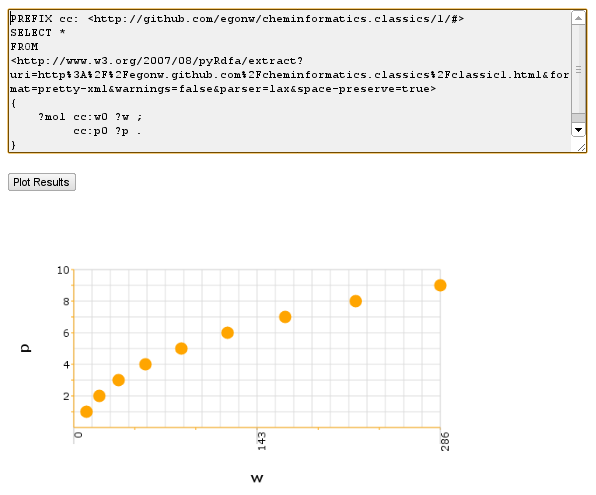
picked up <a href="http://chem-bla-ics.blogspot.com/2010/09/pulling-out-data-as-json-from-xhtmlrdfa.html">my challenge</a>
and made an web based application to graph data from one of my <a href="http://egonw.github.com/cheminformatics.classics/classic1.html">XHTML-RDFa pages</a>.
Well done! He wrote <a href="http://www.pharmash.com/posts/2010-09-27-sparql-to-chart.html">his work</a>
up in his blog of which the results looks like:</p>

<p><img src="/blog/assets/images/sparqlGraphing.png" alt="" /></p>

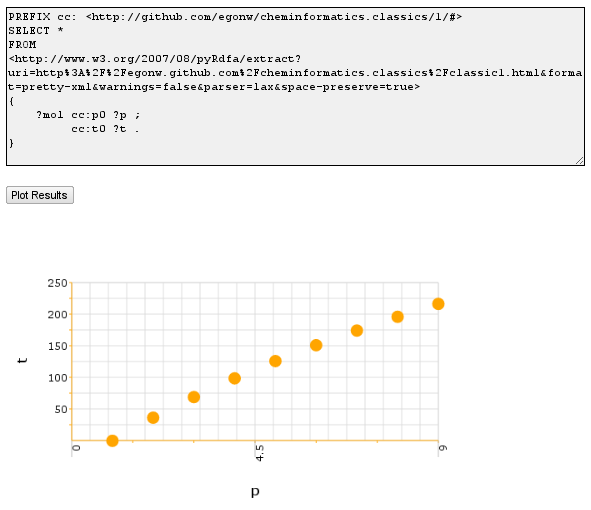
<p>The text field shows the SPARQL used to aggregate the data, which is then visualized
in the plot below that field. You can edit the SPARQL and, for example, plot
the boiling point (t) as function of the number of carbons (p):</p>

<p><img src="/blog/assets/images/sparqlGraphing1.png" alt="" /></p>

<p>This work nicely shows some interesting McPrinciples: it shows what happens
if we allow reuse and share our knowledge; it shows that nice graphics and semantic
access to original data are very compatible. All in all, this is an important
step forward to semantic publishing of chemical data! Orion, thanx for this
really nice work!</p>]]></content><author><name>Egon Willighagen</name></author><category term="chemistry" /><category term="rdf" /><category term="sparql" /><category term="mcprinciples" /><summary type="html"><![CDATA[Orion picked up my challenge and made an web based application to graph data from one of my XHTML-RDFa pages. Well done! He wrote his work up in his blog of which the results looks like:]]></summary><media:thumbnail xmlns:media="http://search.yahoo.com/mrss/" url="http://egonw.github.io/blog/blog/assets/images/sparqlGraphing.png" /><media:content medium="image" url="http://egonw.github.io/blog/blog/assets/images/sparqlGraphing.png" xmlns:media="http://search.yahoo.com/mrss/" /></entry><entry><title type="html">Presentation at AstraZeneca</title><link href="http://egonw.github.io/blog/2010/09/22/presentation-at-astrazeneca.html" rel="alternate" type="text/html" title="Presentation at AstraZeneca" /><published>2010-09-22T00:00:00+00:00</published><updated>2010-09-22T00:00:00+00:00</updated><id>http://egonw.github.io/blog/2010/09/22/presentation-at-astrazeneca</id><content type="html" xml:base="http://egonw.github.io/blog/2010/09/22/presentation-at-astrazeneca.html"><![CDATA[<p>Today and tomorrow I am guest at AstraZeneca in Mölndal. This is the presentation
I gave today about the work on Bioclipse-RDF:</p>

<p><a href="https://doi.org/10.5281/zenodo.3597662"><img src="/blog/assets/images/az_presentation_semwebLS.png" alt="" /></a></p>]]></content><author><name>Egon Willighagen</name></author><category term="chemistry" /><category term="rdf" /><category term="semweb" /><category term="mcprinciples" /><category term="justdoi:10.5281/zenodo.3597662" /><summary type="html"><![CDATA[Today and tomorrow I am guest at AstraZeneca in Mölndal. This is the presentation I gave today about the work on Bioclipse-RDF:]]></summary><media:thumbnail xmlns:media="http://search.yahoo.com/mrss/" url="http://egonw.github.io/blog/blog/assets/images/az_presentation_semwebLS.png" /><media:content medium="image" url="http://egonw.github.io/blog/blog/assets/images/az_presentation_semwebLS.png" xmlns:media="http://search.yahoo.com/mrss/" /></entry><entry><title type="html">Call for Papers: Thematic Series about RDF in Chemistry</title><link href="http://egonw.github.io/blog/2010/09/16/call-for-papers-thematic-series-about.html" rel="alternate" type="text/html" title="Call for Papers: Thematic Series about RDF in Chemistry" /><published>2010-09-16T00:00:00+00:00</published><updated>2010-09-16T00:00:00+00:00</updated><id>http://egonw.github.io/blog/2010/09/16/call-for-papers-thematic-series-about</id><content type="html" xml:base="http://egonw.github.io/blog/2010/09/16/call-for-papers-thematic-series-about.html"><![CDATA[<p>As a follow up of the <a href="http://egonw.github.com/acsrdf2010/">ACS RDF 2010 Symposium</a>
we just had in Boston, I can announce that we are preparing a thematic series
in the <a href="http://www.jcheminf.com/">Journal of Cheminformatics</a> around this theme,
and that at least six speakers will present their work in this series.</p>

<p>However, as it was the goal of the meeting to create an active and collaborating
community, we feel it important to open up, and make encourage others too to
submit papers to the series that are about the use of <a href="http://en.wikipedia.org/wiki/Resource_Description_Framework">Resource Description
Framework</a> in chemistry.
The exact scope of the series is that of the symposium, of which all abstracts
and some slide sets are available <a href="https://egonw.github.io/acsrdf2010/">here <i class="fa-solid fa-recycle fa-xs"></i></a>.</p>

<p>Therefore, it is my pleasure to send around this encouragement to submit papers:</p>

<blockquote>
  <p>L.S.,</p>

  <p>As organizers of the ACS RDF 2010 Symposium held at the American Chemical
Society meeting in Boston in August 2010
(<a href="https://egonw.github.io/acsrdf2010/">http://egonw.github.com/acsrdf2010/</a>),
we would like to encourage you to submit a paper to a Thematic Series of papers
around the use of Resource Description Framework (RDF) in chemistry, in the
Journal of Cheminformatics (http://www.jcheminf.com/). Six speakers have
already agreed to participate.</p>

  <p>Journal of Cheminformatics was launched in March 2009 as a fully Open Access
cheminformatics journal. Papers published in this journal benefit the
cheminformatics community through the free, widespread and unrestricted
readership that Open Access offers. As organizers of the ACS RDF 2010
symposium, we believe that it is important to share research in this area
within the cheminformatics community as much as possible. The journal is
peer reviewed, has unrestricted article length, and unlimited use of color
illustrations, supplementary files, etc., making it an excellent platform to
both give an overview of scientific progress, but being able to go into detail
at the same time. Authors retain complete copyright to their published paper.</p>

  <p>An example Thematic Series is available at:
<a href="http://www.biomedcentral.com/series/ENSEMBL2010">http://www.biomedcentral.com/series/ENSEMBL2010</a>.</p>

  <p>We would be pleased to explore this opportunity further with you, so if you
have any comments or questions e.g. about the scope of the thematic issue,
article type, or otherwise, please don’t hesitate to get in touch.</p>

  <p>Submission Deadline: <strong>28 November 2010</strong> Submission Info (process, fees, policies):
<a href="http://www.jcheminf.com/info/instructions/">http://www.jcheminf.com/info/instructions/</a>
Looking forward to hearing from you,
with kind regards, Egon Willighagen Martin Braendle</p>
</blockquote>]]></content><author><name>Egon Willighagen</name></author><category term="chemistry" /><category term="jcheminf" /><category term="rdf" /><summary type="html"><![CDATA[As a follow up of the ACS RDF 2010 Symposium we just had in Boston, I can announce that we are preparing a thematic series in the Journal of Cheminformatics around this theme, and that at least six speakers will present their work in this series.]]></summary></entry></feed>