<?xml version="1.0" encoding="utf-8"?><feed xmlns="http://www.w3.org/2005/Atom" ><generator uri="https://jekyllrb.com/" version="4.3.4">Jekyll</generator><link href="http://egonw.github.io/blog/feed/by_tag/science.xml" rel="self" type="application/atom+xml" /><link href="http://egonw.github.io/blog/" rel="alternate" type="text/html" /><updated>2026-11-19T06:09:00+00:00</updated><id>http://egonw.github.io/blog/feed/by_tag/science.xml</id><title type="html">chem-bla-ics</title><subtitle>Chemblaics (pronounced chem-bla-ics) is the science that uses open science and computers to solve problems in chemistry, biochemistry and related fields.</subtitle><author><name>Egon Willighagen</name></author><entry><title type="html">Is Nature really clueless about Blogs, Twitter, etc? WTF ?!</title><link href="http://egonw.github.io/blog/2011/01/20/is-nature-really-clueless-about-blogs.html" rel="alternate" type="text/html" title="Is Nature really clueless about Blogs, Twitter, etc? WTF ?!" /><published>2011-01-20T00:00:00+00:00</published><updated>2011-01-20T00:00:00+00:00</updated><id>http://egonw.github.io/blog/2011/01/20/is-nature-really-clueless-about-blogs</id><content type="html" xml:base="http://egonw.github.io/blog/2011/01/20/is-nature-really-clueless-about-blogs.html"><![CDATA[<p>My apologies for this rant in the early morning, but WTF?? (what the fuzz??)
I just got pointed to this <em>Peer review: Trial by Twitter</em> (doi:<a href="http://dx.doi.org/10.1038/469286a">10.1038/469286a</a>)
by Mandavilli. Cool title, but before I even finished seventeen words of the
intro… WTF?? Here it is:</p>

<blockquote>
  <p>Blogs and tweets are ripping papers apart within days of publication, leaving researchers unsure how to react.</p>
</blockquote>

<p>What?? Is she mocking me? I know (I have been a reported of a university news
paper) that intros must encourage the reader to read on… but What?? (And I
read the intro a third time…)</p>

<p>I’ll have to read the full thing later, if that makes more sense. But is she
clueless? Are all people clueless about blogging, tweeting, etc?? Remember <a href="http://chem-bla-ics.blogspot.com/2010/10/royce-murray-and-caveat-emptor.html">Royce
Murray</a>?
Has she actually read the <em>Trial by Twitter</em> only so recently?</p>

<p>Dear Mandavilli, in case you do run into this blog post, here’s my reply to
your intro: “The researchers have no problems how to react, they just did.”</p>

<p>Now, after I cooled down a bit, and anticipating I got it all wrong, she might
refer to <em>the</em> researchers of the publication being ripped apart. In that case,
I am tempted to believe that also in the English language one is expected to
use (well, forgive me I do not know the exact term) “leaving the researchers
…”, where ‘the’ links ‘researchers’ to something said earlier. Now, I read,
probably wrong, researchers as any researcher interested in that publication.
Mandavilli could even have written “leaving the authors…”. But what do we
have Nature editors for, right?</p>

<p>Anyways, I do believe this will be an interesting read once I managed to read
past (for the fourth time) the intro of this article.</p>

<p>&lt;/ripping&gt;</p>]]></content><author><name>Egon Willighagen</name></author><category term="blogging" /><category term="nature" /><category term="publishing" /><category term="science" /><category term="twitter" /><category term="justdoi:10.1038/469286a" /><summary type="html"><![CDATA[My apologies for this rant in the early morning, but WTF?? (what the fuzz??) I just got pointed to this Peer review: Trial by Twitter (doi:10.1038/469286a) by Mandavilli. Cool title, but before I even finished seventeen words of the intro… WTF?? Here it is:]]></summary></entry><entry><title type="html">Trust has no place in science #2</title><link href="http://egonw.github.io/blog/2010/12/10/trust-has-no-place-in-science-2.html" rel="alternate" type="text/html" title="Trust has no place in science #2" /><published>2010-12-10T00:00:00+00:00</published><updated>2010-12-10T00:00:00+00:00</updated><id>http://egonw.github.io/blog/2010/12/10/trust-has-no-place-in-science-2</id><content type="html" xml:base="http://egonw.github.io/blog/2010/12/10/trust-has-no-place-in-science-2.html"><![CDATA[<p>Thanks to all who replied and shared their views. Particular thanx to <a href="http://scientopia.org/blogs/christinaslisrant/">Christina</a>
who replied in <a href="http://scientopia.org/blogs/christinaslisrant/2010/12/06/the-role-of-trust-in-science/">her blog</a>.
With <a href="http://chem-bla-ics.blogspot.com/2010/12/trust-has-no-place-in-science.html?showComment=1291834410259#c629729480067400710">Saml</a>,
and <a href="http://friendfeed.com/cpikas/ed2c2155/new-post-role-of-trust-in-science">Cameron and Bill</a>
they think this is about semantics. Linguistic tricks. I hope not; this is too
serious to get away with such. “Reliable, trustworthy, assumptions”: it’s all
working around the real issue. Similarly, splitting up ‘trust’ into ‘blind trust’
and ‘smart trust’ is just working around the real problem.</p>

<p>Indeed, my point is different. The key of science is to replace trust by facts.
Or, when talking about database, software, research papers in Nature, it is
replacing trust with <em>traceability</em>. Actually, we seem to have lost a long-standing
tradition of citing previous work when we write down the arguments we base our
argumentation on. Facts are backed up with references, providing the required
traceability.</p>

<p>Now, compare that to current electronic sciences. We ‘trust’ our database to
have done something sane. Well, don’t. They made an attempt, but made errors.
As they say with software, having zero bugs just means you have not found them
yet.</p>

<p>The real point with ‘trust’ is, is that it is completely irrelevant. It adds
zero to the scholarly discussion. Whether you trust the highly curated <a href="https://www.ebi.ac.uk/chembl/">ChEMBL
database</a> or not, it has errors. (<a href="http://baoilleach.blogspot.com/">Noel</a>
pointed out <a href="http://baoilleach.blogspot.com/2010/12/name-that-stereochemistry-when-mol.html">one source of ambiguity in the ChEMBL database</a>
this week). What does matter, instead, is if those errors are significant. Do
they affect the conclusions I draw when I use this data. That is what actually
matter. <strong>Trust has no place in science</strong>. Error has.</p>

<p>Sadly, this is basically the hypothesis of the VR grant I wrote up but <a href="http://chem-bla-ics.blogspot.com/2010/11/more-fails-aka-no-vr-grant-awarded.html">did
not get awarded</a>.
But I trust I do better next time.</p>

<p>Why this matters? Well, this is what <a href="http://www.acronymattic.com/ODOSOS.html">ODOSOS</a>
is about: bring back the traceability into science, and get rid of <em>trust</em>.</p>]]></content><author><name>Egon Willighagen</name></author><category term="chemistry" /><category term="odosos" /><category term="science" /><summary type="html"><![CDATA[Thanks to all who replied and shared their views. Particular thanx to Christina who replied in her blog. With Saml, and Cameron and Bill they think this is about semantics. Linguistic tricks. I hope not; this is too serious to get away with such. “Reliable, trustworthy, assumptions”: it’s all working around the real issue. Similarly, splitting up ‘trust’ into ‘blind trust’ and ‘smart trust’ is just working around the real problem.]]></summary></entry><entry><title type="html">Trust has no place in science</title><link href="http://egonw.github.io/blog/2010/12/06/trust-has-no-place-in-science.html" rel="alternate" type="text/html" title="Trust has no place in science" /><published>2010-12-06T00:10:00+00:00</published><updated>2010-12-06T00:10:00+00:00</updated><id>http://egonw.github.io/blog/2010/12/06/trust-has-no-place-in-science</id><content type="html" xml:base="http://egonw.github.io/blog/2010/12/06/trust-has-no-place-in-science.html"><![CDATA[<p>One discussion I had often had in the past year, is about trust in science.
I, for one, believe (hahahaha; you see the irony? ;) that <em>trust</em> has nothing
to do with science. Likewise, any scholar should be, IMHO, <a href="http://chem-bla-ics.blogspot.com/2010/12/what-is-hes.html">hes</a>
is suspicious when someone talks about trust. A scholarly scientist will never
trust any result: hes will accept it as true or false, but will take responsibility
for that decision; hes will not hide behind ‘but I trusted him’ or ‘but it was
published in Nature’.</p>

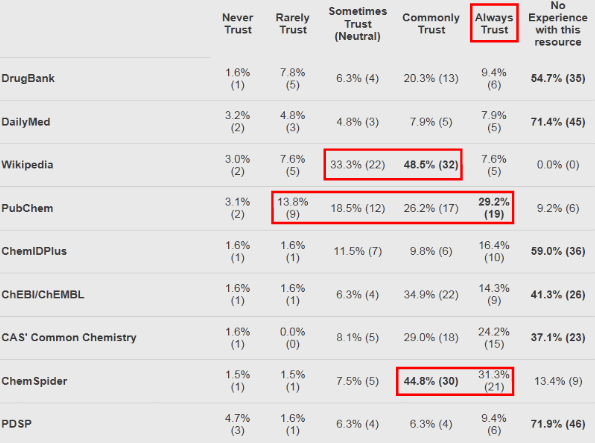
<p>Antony <a href="http://friendfeed.com/chemconnector/665d673f/please-participate-in-poll-about-public">asked</a>
last week the community to answer a questionnaire, which turned out the be about
our trust in online chemical database. He presented the <a href="http://www.slideshare.net/AntonyWilliams/chemspider-connecting-and-curating-online-chemistry-resources?from=ss_embed">results at the EBI</a>.
This is the slide that summarizes the results from that questionnaire:</p>

<p><img src="/blog/assets/images/trust.png" alt="" /></p>

<p>We see that trust clearly has a very significant place in science. How disappointing.
You can spot me in these results easily: I am the one that consequently answered
‘Never Trust’ for all databases. It’s not that I do not value those databases,
but there is no need for them to trust them. I verify. This is actually a point
visible in Tony’s presentation: we can compare databases.</p>

<p>This is the point that I and others have been making for more than a decade
now: if we do things properly, we can do this verification. Anyone can. With
Open Data, Open Source, and Open Standards we can. I can only stress once more
how important this is. We trust people, we trust government, but repeatedly
this trust is taken advantage of. Without transparency, people can hide. By
being able to hide, human loose there ability to decide what is right. With
transparency, we see things return to normal, as we saw this week with <a href="http://translate.google.com/translate?hl=en&amp;sl=nl&amp;tl=en&amp;u=http://www.volkskrant.nl/vk/nl/2668/Buitenland/article/detail/1068247/2010/12/04/Declaraties-Britse-politici-fors-lager.dhtml">UK politicians</a>.</p>

<p>Further reading in my blog:</p>

<ul>
  <li><a href="http://chem-bla-ics.blogspot.com/2010/11/why-you-have-not-heard-me-much-about.html">Why you have not heard me much about chemometrics recently…</a></li>
  <li><a href="http://chem-bla-ics.blogspot.com/2010/08/molecular-chemometrics-principles-3.html">The Molecular Chemometrics Principles #3: stand on shoulders</a></li>
  <li><a href="http://chem-bla-ics.blogspot.com/2010/08/molecular-chemometrics-principles-2-be.html">The Molecular Chemometrics Principles #2: be clear in what you mean</a></li>
  <li><a href="http://chem-bla-ics.blogspot.com/2010/08/molecular-chemometrics-principles-1.html">The Molecular Chemometrics Principles #1: access to data</a></li>
</ul>

<p><strong>Update</strong>: if you liked this post, you will also like blogs posts <a href="http://bjoern.brembs.net/news.php?item.684.11">like this</a>
one from Björn.</p>]]></content><author><name>Egon Willighagen</name></author><category term="chemistry" /><category term="science" /><summary type="html"><![CDATA[One discussion I had often had in the past year, is about trust in science. I, for one, believe (hahahaha; you see the irony? ;) that trust has nothing to do with science. Likewise, any scholar should be, IMHO, hes is suspicious when someone talks about trust. A scholarly scientist will never trust any result: hes will accept it as true or false, but will take responsibility for that decision; hes will not hide behind ‘but I trusted him’ or ‘but it was published in Nature’.]]></summary><media:thumbnail xmlns:media="http://search.yahoo.com/mrss/" url="http://egonw.github.io/blog/blog/assets/images/trust.png" /><media:content medium="image" url="http://egonw.github.io/blog/blog/assets/images/trust.png" xmlns:media="http://search.yahoo.com/mrss/" /></entry><entry><title type="html">Royce Murray and Caveat Emptor</title><link href="http://egonw.github.io/blog/2010/10/16/royce-murray-and-caveat-emptor.html" rel="alternate" type="text/html" title="Royce Murray and Caveat Emptor" /><published>2010-10-16T00:00:00+00:00</published><updated>2010-10-16T00:00:00+00:00</updated><id>http://egonw.github.io/blog/2010/10/16/royce-murray-and-caveat-emptor</id><content type="html" xml:base="http://egonw.github.io/blog/2010/10/16/royce-murray-and-caveat-emptor.html"><![CDATA[<p><a href="http://pipeline.corante.com/archives/2010/10/15/those_chemistry_bloggers.php">Derek’s blog</a>
pointed me to an editorial by Royce Murray <em>Science Blogs and Caveat Emptor</em>
(doi:<a href="http://dx.doi.org/10.1021/ac102628p">10.1021/ac102628p</a>). He is warning
us, science scholars, for blogs. He is accusing bloggers for not being scholarly,
not checking facts etc.</p>

<p>He did himself and the journal a <strong>big</strong> disfavor with this editorial: in his
blog he does precisely what he is accusing the blogger of: fail to check facts.
Even worse, particularly for the ‘Analytical Chemistry’ journal, he showed inadequate
in analyzing the problem, putting his scholarly skills at questionable levels:
he <strong>failed</strong> to see what ‘blogging’ is and what it is not, and he failed to
ascribe his concerns to the proper source; effectively, he failed to see the
difference between correlation and cause-effect for ‘blogging’ (unworthy to
any scholar, particularly if you start complaining). I invite Royce to blog
his full analysis of the problem, with proper underlying data, facts, etc, so
that I (and others) can explain to him the true factors involved in this problem
he is noticing.</p>

<p>The editorial is a sad piece, and an editorial unworthy for the journal.</p>

<p>Actually, the fact that he mentions the <em>Impact Factor</em> is amusing. It must
be noted that his editorial will have a huge impact, but not because the writing
is any good, but because it is utterly wrong. And that reflects only one thing
that is wrong with impact factors.</p>

<p>I strongly suggest Royce to checks his facts before he starts writing. The ethics
expressed in the editorial seems only to apply to other scholars.</p>

<p>I you wonder about my strong language. That was triggered by these words from
the editorial: <em>In the above light, I believe that the current phenomenon of
“bloggers” should be of serious concern to scientists.</em> I consider myself a
blogger, not unreasonable giving the fact that I blog, and feel personally attacked.
Hence, the title of this post: <strong>Royce Murray and Caveat Emptor</strong>.</p>]]></content><author><name>Egon Willighagen</name></author><category term="blogging" /><category term="publishing" /><category term="science" /><category term="justdoi:10.1021/ac102628p" /><summary type="html"><![CDATA[Derek’s blog pointed me to an editorial by Royce Murray Science Blogs and Caveat Emptor (doi:10.1021/ac102628p). He is warning us, science scholars, for blogs. He is accusing bloggers for not being scholarly, not checking facts etc.]]></summary></entry><entry><title type="html">I’m just a sucker with no self esteem</title><link href="http://egonw.github.io/blog/2010/06/15/im-just-sucker-with-no-self-esteem.html" rel="alternate" type="text/html" title="I’m just a sucker with no self esteem" /><published>2010-06-15T00:00:00+00:00</published><updated>2010-06-15T00:00:00+00:00</updated><id>http://egonw.github.io/blog/2010/06/15/im-just-sucker-with-no-self-esteem</id><content type="html" xml:base="http://egonw.github.io/blog/2010/06/15/im-just-sucker-with-no-self-esteem.html"><![CDATA[<p>Don’t let anyone fool you: <a href="http://en.wikipedia.org/wiki/The_Offspring">The Offspring</a> is really
just talking about Science:</p>

<blockquote>
  <p>When she’s saying that she wants only me <br />
Then I wonder why she sleeps with my friends <br />
When she’s saying that I’m like a disease <br />
Then I wonder how much more I can spend <br />
Well I guess I should speak up for myself <br />
But I really think it’s better this way <br />
The more you suffer <br />
The more it shows you really care <br />
Right? yeah yeah yeah</p>
</blockquote>

<p>Really! Just read the whole text:</p>

<blockquote>
  <p>Late at night she knocks on my door <br />
Drunk again and looking to score <br /></p>

  <p>Now I know I should say no <br />
But that’s kind of hard when she’s ready to go <br />
I may be dumb <br />
But I’m not a dweeb <br />
I’m just a sucker with no self esteem</p>
</blockquote>]]></content><author><name>Egon Willighagen</name></author><category term="science" /><summary type="html"><![CDATA[Don’t let anyone fool you: The Offspring is really just talking about Science:]]></summary></entry><entry><title type="html">Google Scholar allows downloading as BibTeX</title><link href="http://egonw.github.io/blog/2010/02/17/google-scholar-allows-downloading-as.html" rel="alternate" type="text/html" title="Google Scholar allows downloading as BibTeX" /><published>2010-02-17T00:00:00+00:00</published><updated>2010-02-17T00:00:00+00:00</updated><id>http://egonw.github.io/blog/2010/02/17/google-scholar-allows-downloading-as</id><content type="html" xml:base="http://egonw.github.io/blog/2010/02/17/google-scholar-allows-downloading-as.html"><![CDATA[<p> </p>

<p><img src="/blog/assets/images/googleScholar.png" alt="" /></p>]]></content><author><name>Egon Willighagen</name></author><category term="google" /><category term="science" /><summary type="html"><![CDATA[ ]]></summary><media:thumbnail xmlns:media="http://search.yahoo.com/mrss/" url="http://egonw.github.io/blog/blog/assets/images/googleScholar.png" /><media:content medium="image" url="http://egonw.github.io/blog/blog/assets/images/googleScholar.png" xmlns:media="http://search.yahoo.com/mrss/" /></entry><entry><title type="html">Nature Jobs - Google Map mashup</title><link href="http://egonw.github.io/blog/2009/04/07/nature-jobs-google-map-mashup.html" rel="alternate" type="text/html" title="Nature Jobs - Google Map mashup" /><published>2009-04-07T00:00:00+00:00</published><updated>2009-04-07T00:00:00+00:00</updated><id>http://egonw.github.io/blog/2009/04/07/nature-jobs-google-map-mashup</id><content type="html" xml:base="http://egonw.github.io/blog/2009/04/07/nature-jobs-google-map-mashup.html"><![CDATA[<p>Nothing much I need to say about the <a href="http://www.nature.com/naturejobs/science/map">NatureJobs Interactive World Map</a>,
I think. Thanx to <a href="http://pimm.wordpress.com/">Partial Immortalization</a> for the
<a href="http://friendfeed.com/e/7e1c5170-056f-aa14-185d-7a1d2ec6d158/checking-Naturejobs-Interactive-World-Map-http/">link on FriendFeed</a>!</p>

<p><img src="/blog/assets/images/naturejobs.png" alt="" /></p>]]></content><author><name>Egon Willighagen</name></author><category term="science" /><summary type="html"><![CDATA[Nothing much I need to say about the NatureJobs Interactive World Map, I think. Thanx to Partial Immortalization for the link on FriendFeed!]]></summary><media:thumbnail xmlns:media="http://search.yahoo.com/mrss/" url="http://egonw.github.io/blog/blog/assets/images/naturejobs.png" /><media:content medium="image" url="http://egonw.github.io/blog/blog/assets/images/naturejobs.png" xmlns:media="http://search.yahoo.com/mrss/" /></entry><entry><title type="html">Leaving to Science Blogging 2008 London</title><link href="http://egonw.github.io/blog/2008/08/29/leaving-to-science-blogging-2008-london.html" rel="alternate" type="text/html" title="Leaving to Science Blogging 2008 London" /><published>2008-08-29T00:00:00+00:00</published><updated>2008-08-29T00:00:00+00:00</updated><id>http://egonw.github.io/blog/2008/08/29/leaving-to-science-blogging-2008-london</id><content type="html" xml:base="http://egonw.github.io/blog/2008/08/29/leaving-to-science-blogging-2008-london.html"><![CDATA[<p>Have to leave to the airport any second now for the <a href="https://web.archive.org/web/20080508230626/http://network.nature.com/group/sciblog2008">Science Blogging 2008 <i class="fa-solid fa-box-archive fa-xs"></i></a>
in London, so nothing much I shall say. Hope to see you tomorrow at the Royal Institute!</p>

<p>Update: <a href="https://web.archive.org/web/20080901224608/http://friendfeed.com/rooms/science-blogging-2008">live coverage <i class="fa-solid fa-box-archive fa-xs"></i></a>
at <a href="https://web.archive.org/web/20080902020422/http://friendfeed.com/">Friend Feed <i class="fa-solid fa-box-archive fa-xs"></i></a>.</p>]]></content><author><name>Egon Willighagen</name></author><category term="blog" /><category term="science" /><summary type="html"><![CDATA[Have to leave to the airport any second now for the Science Blogging 2008 in London, so nothing much I shall say. Hope to see you tomorrow at the Royal Institute!]]></summary></entry></feed>