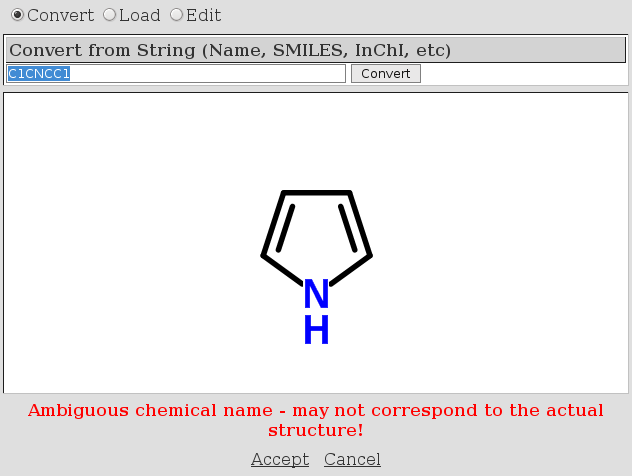
<?xml version="1.0" encoding="utf-8"?><feed xmlns="http://www.w3.org/2005/Atom" ><generator uri="https://jekyllrb.com/" version="4.3.4">Jekyll</generator><link href="http://egonw.github.io/blog/feed/by_tag/smiles.xml" rel="self" type="application/atom+xml" /><link href="http://egonw.github.io/blog/" rel="alternate" type="text/html" /><updated>2026-11-19T06:09:00+00:00</updated><id>http://egonw.github.io/blog/feed/by_tag/smiles.xml</id><title type="html">chem-bla-ics</title><subtitle>Chemblaics (pronounced chem-bla-ics) is the science that uses open science and computers to solve problems in chemistry, biochemistry and related fields.</subtitle><author><name>Egon Willighagen</name></author><entry><title type="html">ChemSpider fail #1: SMILES</title><link href="http://egonw.github.io/blog/2009/08/06/chemspider-fail-1-smiles.html" rel="alternate" type="text/html" title="ChemSpider fail #1: SMILES" /><published>2009-08-06T00:00:00+00:00</published><updated>2009-08-06T00:00:00+00:00</updated><id>http://egonw.github.io/blog/2009/08/06/chemspider-fail-1-smiles</id><content type="html" xml:base="http://egonw.github.io/blog/2009/08/06/chemspider-fail-1-smiles.html"><![CDATA[<p>Cheminformatics is difficult, I know. But I thought I used a simple SMILES when I typed <em>C1CNCC1</em>, but <a href="http://www.chemspider.com/">ChemSpider</a>
got it wrong :) The correct structure should be <a href="http://en.wikipedia.org/wiki/Pyrrolidine">pyrrolidine</a>, not
<a href="http://en.wikipedia.org/wiki/Pyrrole">pyrrole</a>. I always mix up those names, so defaulted to ChemSpider to give me the correct name, which
<a href="http://www.chemspider.com/RecordView.aspx?rid=3fdc7226-0f87-44c5-b367-f3fdbda4bbde">ChemSpider knows</a> and where it also has the
SMILES correct… there just seems something wrong with there search dialog:</p>

<p><img src="/blog/assets/images/chemSpiderFail.png" alt="" /></p>

<p>There has been <a href="http://www.chemspider.com/blog/?p=55">some talk about a ChemSpider Bugzilla</a>, but I don’t think this has
materialized yet, and I’ll have the default to <em>info-at-chemspider-dot-com</em> …</p>]]></content><author><name>Egon Willighagen</name></author><category term="chemspider" /><category term="smiles" /><category term="inchikey:RWRDLPDLKQPQOW-UHFFFAOYSA-N" /><summary type="html"><![CDATA[Cheminformatics is difficult, I know. But I thought I used a simple SMILES when I typed C1CNCC1, but ChemSpider got it wrong :) The correct structure should be pyrrolidine, not pyrrole. I always mix up those names, so defaulted to ChemSpider to give me the correct name, which ChemSpider knows and where it also has the SMILES correct… there just seems something wrong with there search dialog:]]></summary><media:thumbnail xmlns:media="http://search.yahoo.com/mrss/" url="http://egonw.github.io/blog/blog/assets/images/chemSpiderFail.png" /><media:content medium="image" url="http://egonw.github.io/blog/blog/assets/images/chemSpiderFail.png" xmlns:media="http://search.yahoo.com/mrss/" /></entry><entry><title type="html">DBPedia enters rdf.openmolecules.net</title><link href="http://egonw.github.io/blog/2009/02/17/dbpedia-enters-rdfopenmoleculesnet.html" rel="alternate" type="text/html" title="DBPedia enters rdf.openmolecules.net" /><published>2009-02-17T00:00:00+00:00</published><updated>2009-02-17T00:00:00+00:00</updated><id>http://egonw.github.io/blog/2009/02/17/dbpedia-enters-rdfopenmoleculesnet</id><content type="html" xml:base="http://egonw.github.io/blog/2009/02/17/dbpedia-enters-rdfopenmoleculesnet.html"><![CDATA[<p>As of tonight, <a href="http://rdf.openmolecules.net/">rdf.openmolecules.net</a> links to the chemistry <a href="http://www.dbpedia.org/">DBPedia</a> (1816 chemical compounds),
for which I used the SPARQL given in <a href="http://chem-bla-ics.blogspot.com/2009/02/dbpedia-lookup-and-autocomplete-of.html">DBPedia: lookup and autocomplete of chemistry</a>.
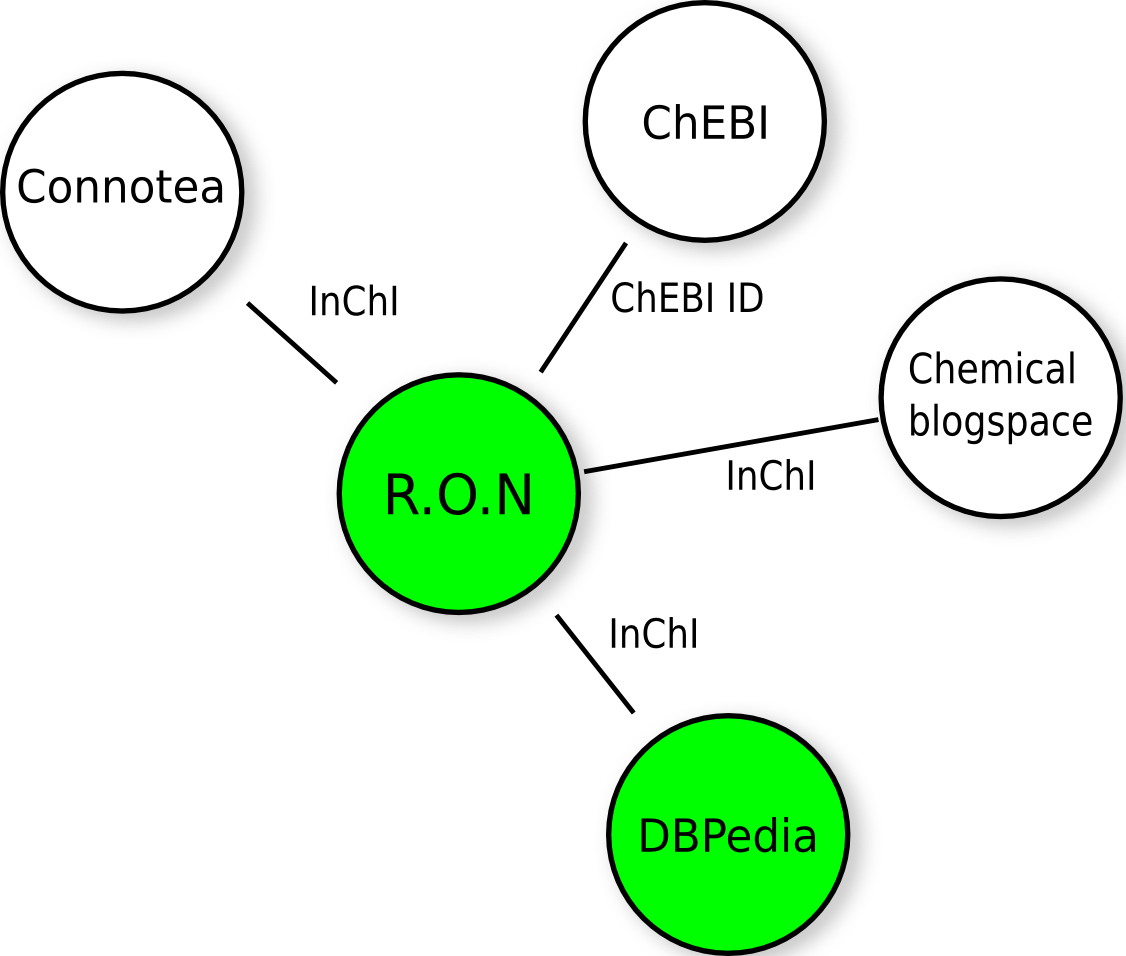
It’s first of several steps to extend rdf.openmolecules.net to link up various chemistry database. The below figure shows the current state, where the green nodes are fully RDF-ied:</p>

<p><img src="/blog/assets/images/ons.png" alt="" /></p>

<p>Drugs are still missing, but will add those too, and since not all entries had InChIs, SMILES were converted using
<a href="http://chem-bla-ics.blogspot.com/2009/02/cdk-12-release-candidate.html">CDK 1.1.5</a>.</p>]]></content><author><name>Egon Willighagen</name></author><category term="rdf" /><category term="dbpedia" /><category term="sparql" /><category term="inchi" /><category term="smiles" /><category term="chebi" /><category term="cb" /><summary type="html"><![CDATA[As of tonight, rdf.openmolecules.net links to the chemistry DBPedia (1816 chemical compounds), for which I used the SPARQL given in DBPedia: lookup and autocomplete of chemistry. It’s first of several steps to extend rdf.openmolecules.net to link up various chemistry database. The below figure shows the current state, where the green nodes are fully RDF-ied:]]></summary><media:thumbnail xmlns:media="http://search.yahoo.com/mrss/" url="http://egonw.github.io/blog/blog/assets/images/ons.png" /><media:content medium="image" url="http://egonw.github.io/blog/blog/assets/images/ons.png" xmlns:media="http://search.yahoo.com/mrss/" /></entry><entry><title type="html">DBPedia: lookup and autocomplete of chemistry</title><link href="http://egonw.github.io/blog/2009/02/11/dbpedia-lookup-and-autocomplete-of.html" rel="alternate" type="text/html" title="DBPedia: lookup and autocomplete of chemistry" /><published>2009-02-11T00:00:00+00:00</published><updated>2009-02-11T00:00:00+00:00</updated><id>http://egonw.github.io/blog/2009/02/11/dbpedia-lookup-and-autocomplete-of</id><content type="html" xml:base="http://egonw.github.io/blog/2009/02/11/dbpedia-lookup-and-autocomplete-of.html"><![CDATA[<p>On the <a href="http://dbpedia.org/">DBPedia</a> <a href="https://lists.sourceforge.net/lists/listinfo/dbpedia-discussion">discussion mailing list</a> there was a post on a
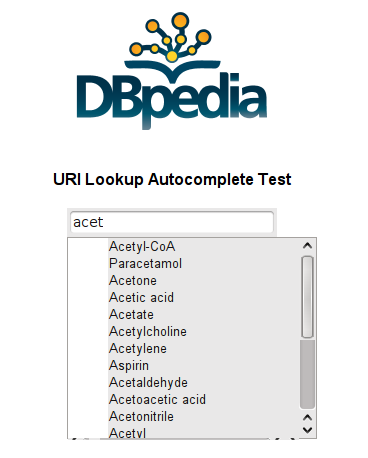
nice web page which allows you to look up things, and which features a autocomplete edit field. The below screenshot show lookup of molecular structures:</p>

<p><img src="/blog/assets/images/dbpediaAutocomplete.png" alt="" /></p>

<p>If you are not ware of this, adding content to DBPedia is as easy as adding something to <a href="http://www.wikipedia.org/">WikiPedia</a>. Literally: DBPedia is
the <a href="http://en.wikipedia.org/wiki/Resource_Description_Framework">RDF</a> flavour of WikiPedia. It extracts the information from the info boxes, as I
discussed before (see <a href="http://chem-bla-ics.blogspot.com/2007/08/molecules-in-wikipedia.html">Molecules in Wikipedia</a>).</p>

<p>BTW, one can take advantage of DBPedia to see what WikiPedia has to offer in terms of chemistry. For example, to list all molecules which have a SMILES, one can use this simple SPARQL query:</p>

<script src="http://gist.github.com/57559.js"></script>

<p>Or, to list those which have an InChI:</p>

<script src="https://gist.github.com/57571.js"></script>

<p>And this is actually quite useful, e.g. it can be used in quality control. Running the above queries will show up several broken SMILES and InChIs. I have not had time to fix those yet, so please go ahead and beat me to those fixes, and get some WikiPedia Fame :) Alternatively, invert the queries and add missing InChIs, PubChem CID or SMILES. When I have a bit more free time again, after the new stable CDK and Bioclipse releases, I’ll runs these analyses again, and summarize them in a web page.</p>]]></content><author><name>Egon Willighagen</name></author><category term="rdf" /><category term="dbpedia" /><category term="wikipedia" /><category term="smiles" /><category term="inchi" /><summary type="html"><![CDATA[On the DBPedia discussion mailing list there was a post on a nice web page which allows you to look up things, and which features a autocomplete edit field. The below screenshot show lookup of molecular structures:]]></summary><media:thumbnail xmlns:media="http://search.yahoo.com/mrss/" url="http://egonw.github.io/blog/blog/assets/images/dbpediaAutocomplete.png" /><media:content medium="image" url="http://egonw.github.io/blog/blog/assets/images/dbpediaAutocomplete.png" xmlns:media="http://search.yahoo.com/mrss/" /></entry><entry><title type="html">SMILES to become an Open Standard</title><link href="http://egonw.github.io/blog/2007/09/28/smiles-to-become-open-standard.html" rel="alternate" type="text/html" title="SMILES to become an Open Standard" /><published>2007-09-28T00:00:00+00:00</published><updated>2007-09-28T00:00:00+00:00</updated><id>http://egonw.github.io/blog/2007/09/28/smiles-to-become-open-standard</id><content type="html" xml:base="http://egonw.github.io/blog/2007/09/28/smiles-to-become-open-standard.html"><![CDATA[<p>Craig James wants <a href="http://sourceforge.net/mailarchive/forum.php?thread_name=46FA7584.9080902%40emolecules.com&amp;forum_name=blueobelisk-discuss">to make SMILES an open standard</a>,
and this has been received with much enthusiasm. SMILES (<a href="http://en.wikipedia.org/wiki/SMILES">Simplified molecular input line entry specification</a>)
is a de facto standard in chemoinformatics, but the specification is not overly clear, which Craig wants to address. The
<a href="http://blueobelisk.svn.sf.net/svnroot/blueobelisk/smiles-spec/trunk/smiles_spec.html">draft</a> is CC-licensed and will be discussed on the new
<a href="http://www.blueobelisk.org/">Blue Obelisk</a> <a href="http://sourceforge.net/mailarchive/forum.php?forum_name=blueobelisk-smiles">blueobelisk-smiles</a>
mailing list.</p>

<p>Illustrative is my confusion about the sp2 hybridized atoms, which use lower case element symbols in SMILES. Very often this is seen as
indicating aromaticity. I have written up <a href="http://wiki.cubic.uni-koeln.de/cdkwiki/doku.php?id=smiles_aromaticity">the arguments supporting both views</a>
in the <a href="http://wiki.cubic.uni-koeln.de/cdkwiki/doku.php?id=start">CDK wiki</a>. I held the position that lower case elements indicated
sp2 hybridization, and the CDK SMILES parser was converted accordingly some years ago. A recent discussion, however, stirred up the
discussion once more (which led to the aforementioned wiki page).</p>

<p>You can imagine my excitement when I looked up the meaning in the new draft. It states: <em>The formal meaning of a lowercase “aromatic”
element in a SMILES string is that the atom is in the sp2 electronic state. When generating a normalized SMILES, all sp2 atoms are
written using a lowercase first character of the atomic symbol. When parsing a SMILES, a parser must note the sp2 designation of each
atom on input, then when the parsing is complete, the SMILES software must verify that electrons can be assigned without violating the
valence rules, consistent with the sp2 markings, the specified or implied hydrogens, external bonds, and charges on the atoms.</em></p>]]></content><author><name>Egon Willighagen</name></author><category term="smiles" /><category term="blue-obelisk" /><summary type="html"><![CDATA[Craig James wants to make SMILES an open standard, and this has been received with much enthusiasm. SMILES (Simplified molecular input line entry specification) is a de facto standard in chemoinformatics, but the specification is not overly clear, which Craig wants to address. The draft is CC-licensed and will be discussed on the new Blue Obelisk blueobelisk-smiles mailing list.]]></summary></entry><entry><title type="html">CDK Workshop - Days #3 and #4</title><link href="http://egonw.github.io/blog/2007/02/03/cdk-workshop-days-3-and-4.html" rel="alternate" type="text/html" title="CDK Workshop - Days #3 and #4" /><published>2007-02-03T00:00:00+00:00</published><updated>2007-02-03T00:00:00+00:00</updated><id>http://egonw.github.io/blog/2007/02/03/cdk-workshop-days-3-and-4</id><content type="html" xml:base="http://egonw.github.io/blog/2007/02/03/cdk-workshop-days-3-and-4.html"><![CDATA[<p>Days #3 and #4 of the <a href="http://wiki.cubic.uni-koeln.de/cdkwiki/doku.php?id=spring2007workshop">CDK Workshop</a> have been
quite busy indeed, and I have not been able to summarize them so far. After <a href="http://chem-bla-ics.blogspot.com/2007/01/cdk-workshop-day-2.html">a rather interesting day #2</a>,
the third day was the last one with scheduled presentations. Kai Hartmann showed how he used the CDK in his systems
biology research, and contributed the code he wrote to predict Gibbs energies based on fragment contributions.
Miguel Rojas showed his MS prediction work, which is based on the CDK too.</p>

<p>Much of the rest of day and Thursday continued on the work started yesterday: making the 3D structure builder a
singleton class, and applying and testing an optimization for the AllRingsFinder to address
<a href="http://chem-bla-ics.blogspot.com/2007/01/cdk-workshop-day-2.html">molecules like Choloyl-CoA</a>. The trick
basically consists of applying the all rings finding algorithm to isolated systems only. The effect is
considerable: the total computation time for Choloyl-CoA decreases by a 93 fold! We found that the
fingerprints used in the template library for the 3D structure builder are outdated, and Christoph worked
on updating that, which required searching into old archives to find the tool to do just this.</p>

<p>Because the above performance fix did not fix the current slow SMILES parsing, Kai looked at the
<code class="language-plaintext highlighter-rouge">DeduceBondOrderTool</code> which is the slow component, and optimized the used algorithm by reusing determined
molecular ring systems. Nevertheless, on users requests, a time out mechanism is now available for SMILES
parsing. Additionally, several of the bugs found on the second workshop day have been fixed. Meanwhile,
I was distracted by other things. For example, fixing <a href="http://www.bioclipse.net/">Bioclipse</a> bugs for
<a href="http://bioclipse.blogspot.com/2007/02/bioclipse-101-released.html">the version 1.0.1 released yesterday</a>.
The SENECA tool is not forgotten too, and last weekend I made some good progress with it,
<a href="http://wiki.cubic.uni-koeln.de/blog/pivot/entry.php?id=15">which Christoph blogged about</a>.</p>]]></content><author><name>Egon Willighagen</name></author><category term="cdk" /><category term="smiles" /><summary type="html"><![CDATA[Days #3 and #4 of the CDK Workshop have been quite busy indeed, and I have not been able to summarize them so far. After a rather interesting day #2, the third day was the last one with scheduled presentations. Kai Hartmann showed how he used the CDK in his systems biology research, and contributed the code he wrote to predict Gibbs energies based on fragment contributions. Miguel Rojas showed his MS prediction work, which is based on the CDK too.]]></summary></entry><entry><title type="html">CDK Workshop - Day #2</title><link href="http://egonw.github.io/blog/2007/01/30/cdk-workshop-day-2.html" rel="alternate" type="text/html" title="CDK Workshop - Day #2" /><published>2007-01-30T00:00:00+00:00</published><updated>2007-01-30T00:00:00+00:00</updated><id>http://egonw.github.io/blog/2007/01/30/cdk-workshop-day-2</id><content type="html" xml:base="http://egonw.github.io/blog/2007/01/30/cdk-workshop-day-2.html"><![CDATA[<p>Because of other obligations, I was unable to attend the first day of the <a href="http://wiki.cubic.uni-koeln.de/cdkwiki/doku.php?id=spring2007workshop">CDK Workshop</a>,
though Christoph had set up Skype so that at least I could hear the talks from <a href="http://www.inf.uni-konstanz.de/bioml/staff/berthold/">Prof. Berthold</a>
(Konstanz, Germany) about <a href="http://www.knime.org/">KNIME</a> and <a href="http://almost.cubic.uni-koeln.de/cosi/curriculumVitae_zielesny.htm">Prof. Zielesny</a>
about <a href="http://cdk-taverna.de/">CDK-Taverna</a>.</p>

<p>Today, Miguel Rojas and Stefan Kuhn discussed their research. Miguel showed the state of mass spectrum prediction using the <a href="http://cdk.sf.net/">CDK</a>
and the MEDEA plugin for <a href="http://www.bioclipse.net/">Bioclipse</a>. Stefan demonstrated the <a href="http://www.nmrshiftdb.org/">NMRShiftDB</a>
and a new lab systems for NMR experiment scheduling and management system based on that. <a href="http://www2.cmbi.ru.nl/who-and-where/staff/27/">Dr. Ott</a>
(Nijmegen, Netherlands) showed the <a href="http://biometa.cmbi.ru.nl/">BioMeta Database</a> which contains metabolite and reaction information derived from the
<a href="http://www.genome.jp/kegg/ligand.html">KEGG</a>, but which fixes a set of chemical problems in the latter (see also the article,
DOI:<a href="https://doi.org/10.1186/1471-2105-7-517">10.1186/1471-2105-7-517</a>).</p>

<p>The afternoons of CDK workshops traditionally have discussion sessions and hackathons. Two groups were formed: one consisted of the KNIME guys who,
together with Miguel and Federico focused in QSAR descriptor calculations in KNIME, while Stefan, Martin and me looked at the fingerprinter
peculiarities that Martin found (see also this <a href="http://almost.cubic.uni-koeln.de/cdk/cdk_top/cdk_news/archive/cdknews2.2.article22.pdf">CDK News article</a>),
and came up with a possible further performance improvement of the AllRingsFinder. Because one class of molecules that is causing trouble consist of two
ring systems connected by a long linker, like Choloyl-CoA (below), we anticipate that splitting the molecule up into ring systems prior to using the
SSSR algorithm should speed up the complete all-ring finding process.</p>

<p><img src="/blog/assets/images/choloyl-coa.png" alt="" /></p>

<p>Currently, the spanning tree is calculated before deciding on using the SSSR finder, which, we think, can be used to partition the molecule
into separate ring systems. On each of them, then, the further steps of the ring search can be applied.</p>

<p>After dinner (pasta/pizza), during the Spanish-German handball game, we continued the hacking and discussions, now focusing as a whole group
on QSAR descriptors in KNIME. We looked at each descriptor and decided if it should go into a QSAR calculator node, or even in a node of its own.</p>

<h2 id="bugs-found">Bugs found</h2>
<p>I won’t close this blog entry without giving a list of problems we found in the current CDK; some minor and small, some more troublesome.
Here goes: typos all over the place; the OrderQueryBond lack a return statement in an else clause; the Mol2Reader does not mark atom and
bond aromaticity properly and reads a single bond as aromatic, and an aromatic bond as single; the Renderer2D does not always highlight
both atoms when hovering over a bond; SmilesGenerator.parseBond() should output bond orders correctly; the SSSR finder seems to have a
messed up if-else statement for the ringBondCount limit of 37; the BondCount descriptor should count all bonds by default, not just the
single bonds; <code class="language-plaintext highlighter-rouge">IDescriptor.getParameters()</code> should return null instead of <code class="language-plaintext highlighter-rouge">Object[0];</code> several programs use the SYBYL atomtype S.o2, while
the specification and the CDK config defines S.O2; the IP descriptor now returns a variable length descriptor.</p>]]></content><author><name>Egon Willighagen</name></author><category term="cdk" /><category term="kegg" /><category term="knime" /><category term="smiles" /><category term="taverna" /><category term="justdoi:10.1186/1471-2105-7-517" /><category term="inchikey:ZKWNOTQHFKYUNU-JGCIYWTLSA-N" /><summary type="html"><![CDATA[Because of other obligations, I was unable to attend the first day of the CDK Workshop, though Christoph had set up Skype so that at least I could hear the talks from Prof. Berthold (Konstanz, Germany) about KNIME and Prof. Zielesny about CDK-Taverna.]]></summary><media:thumbnail xmlns:media="http://search.yahoo.com/mrss/" url="http://egonw.github.io/blog/blog/assets/images/choloyl-coa.png" /><media:content medium="image" url="http://egonw.github.io/blog/blog/assets/images/choloyl-coa.png" xmlns:media="http://search.yahoo.com/mrss/" /></entry><entry><title type="html">SMILES, CAS and InChI in blogs: Greasemonkey</title><link href="http://egonw.github.io/blog/2006/12/17/smiles-cas-and-inchi-in-blogs.html" rel="alternate" type="text/html" title="SMILES, CAS and InChI in blogs: Greasemonkey" /><published>2006-12-17T00:00:00+00:00</published><updated>2006-12-17T00:00:00+00:00</updated><id>http://egonw.github.io/blog/2006/12/17/smiles-cas-and-inchi-in-blogs</id><content type="html" xml:base="http://egonw.github.io/blog/2006/12/17/smiles-cas-and-inchi-in-blogs.html"><![CDATA[<p>As follow up on my <a href="http://chem-bla-ics.blogspot.com/2006/12/including-smiles-cml-and-inchi-in.html">Including SMILES, CML and InChI in blogs</a>
blog last week, I had a go at <a href="http://en.wikipedia.org/wiki/Greasemonkey">Greasemonkey</a>. Some time ago already,
<a href="http://www.ghastlyfop.com/blog/2006/09/postgenomic-pubmed-mashup.html">Flags and Lollipops</a> and
<a href="http://www.nodalpoint.org/2006/05/16/postgenomic_greasemonkey_script">Nodalpoint</a> showed with two cool mashups (one Connotea/Postgenomic
and one Pubmed/Postgenomic) that userscripts are rather useful in science too. I can very much recommend the PubMed/Postgenomic mashup,
as PubMed has several organic chemistry journals indexed too!</p>

<p>So, how does this relate to my blog of last week? Well, would it not be nice that if your blog uses the markup as suggested in that
<a href="http://chem-bla-ics.blogspot.com/2006/12/including-smiles-cml-and-inchi-in.html">blog</a>, that you automatically get links to
<a href="http://pubchem.ncbi.nlm.nih.gov/">PubChem</a> and <a href="http://google.com/">Google</a>? That is now possible with a small GPL-ed Greasemonkey script
called <a href="http://www.woc.science.ru.nl/devel/egonw/blogchemistry.user.js">blogchemistry.user.js</a>.</p>

<p>The <a href="http://greasemonkey.mozdev.org/">Greasemonkey plugin</a> requires <a href="http://getfirefox.com/">Firefox</a> to be installed. If ready, install
the script by cli·cking this link earlier, and the Greasemonkey will ask you if you want to install the script. After, check the output
for this RDFa markup content:</p>

<ul>
  <li>a SMILES: <span xmlns:chem="http://www.blueobelisk.org/chemistryblogs/" class="chem:smiles">CCO</span></li>
  <li>a CAS registry number: <span xmlns:chem="http://www.blueobelisk.org/chemistryblogs/" class="chem:casnumber">50-00-0</span></li>
  <li>and an InChI: <span xmlns:chem="http://www.blueobelisk.org/chemistryblogs/" class="chem:inchi">InChI=1/CH4/h1H4</span></li>
</ul>

<p>It should look like the output for this blog item:</p>

<p><img src="/blog/assets/images/sechemticWebScript.png" alt="" /></p>

<p>Note the superscript PubChem and Google links.</p>]]></content><author><name>Egon Willighagen</name></author><category term="chemistry" /><category term="userscript" /><category term="smiles" /><category term="pubchem" /><category term="inchi" /><category term="rdfa" /><summary type="html"><![CDATA[As follow up on my Including SMILES, CML and InChI in blogs blog last week, I had a go at Greasemonkey. Some time ago already, Flags and Lollipops and Nodalpoint showed with two cool mashups (one Connotea/Postgenomic and one Pubmed/Postgenomic) that userscripts are rather useful in science too. I can very much recommend the PubMed/Postgenomic mashup, as PubMed has several organic chemistry journals indexed too!]]></summary><media:thumbnail xmlns:media="http://search.yahoo.com/mrss/" url="http://egonw.github.io/blog/blog/assets/images/sechemticWebScript.png" /><media:content medium="image" url="http://egonw.github.io/blog/blog/assets/images/sechemticWebScript.png" xmlns:media="http://search.yahoo.com/mrss/" /></entry></feed>