<?xml version="1.0" encoding="utf-8"?><feed xmlns="http://www.w3.org/2005/Atom" ><generator uri="https://jekyllrb.com/" version="4.3.4">Jekyll</generator><link href="http://egonw.github.io/blog/feed/by_tag/textmining.xml" rel="self" type="application/atom+xml" /><link href="http://egonw.github.io/blog/" rel="alternate" type="text/html" /><updated>2026-11-19T06:09:00+00:00</updated><id>http://egonw.github.io/blog/feed/by_tag/textmining.xml</id><title type="html">chem-bla-ics</title><subtitle>Chemblaics (pronounced chem-bla-ics) is the science that uses open science and computers to solve problems in chemistry, biochemistry and related fields.</subtitle><author><name>Egon Willighagen</name></author><entry><title type="html">Text mining chemistry from Dutch or Swedish texts</title><link href="http://egonw.github.io/blog/2010/12/30/text-mining-chemistry-from-dutch-or.html" rel="alternate" type="text/html" title="Text mining chemistry from Dutch or Swedish texts" /><published>2010-12-30T00:10:00+00:00</published><updated>2010-12-30T00:10:00+00:00</updated><id>http://egonw.github.io/blog/2010/12/30/text-mining-chemistry-from-dutch-or</id><content type="html" xml:base="http://egonw.github.io/blog/2010/12/30/text-mining-chemistry-from-dutch-or.html"><![CDATA[<p><a href="http://oscar3-chem.sf.net/">Oscar</a> is a text miner. It mines in text for chemistry.
<a href="https://bitbucket.org/wwmm/oscar4/">Oscar4</a> is the next iteration of Oscar
code that I worked on in the past three months, with Lezan, Sam, and David. I blogged about
aspects of Oscar4 at several occasions:</p>

<ul>
  <li><a href="https://chem-bla-ics.linkedchemistry.info/2010/10/15/working-on-oscar-for-three-months.html">Working on Oscar for three months <i class="fa-solid fa-recycle fa-xs"></i></a></li>
  <li><a href="https://chem-bla-ics.linkedchemistry.info/2010/10/21/oscar-text-mining-in-taverna.html">Oscar text mining in Taverna <i class="fa-solid fa-recycle fa-xs"></i></a></li>
  <li><a href="https://chem-bla-ics.linkedchemistry.info/2010/10/26/multiple-unit-test-inheritance-with.html">Multiple unit test inheritance with JExample <i class="fa-solid fa-recycle fa-xs"></i></a></li>
  <li><a href="https://chem-bla-ics.linkedchemistry.info/2010/10/28/oscar4-java-api-chemical-name.html">Oscar4 Java API: chemical name dictionaries <i class="fa-solid fa-recycle fa-xs"></i></a></li>
  <li><a href="https://chem-bla-ics.linkedchemistry.info/2010/11/18/oscar4-command-line-utilities.html">Oscar4 command line utilities <i class="fa-solid fa-recycle fa-xs"></i></a></li>
  <li><a href="http://chem-bla-ics.blogspot.com/2010/11/installing-oscar.html">Installing Oscar</a></li>
  <li><a href="https://chem-bla-ics.linkedchemistry.info/2010/11/29/adding-new-dictionary-to-oscar.html">Adding a new dictionary to Oscar <i class="fa-solid fa-recycle fa-xs"></i></a></li>
  <li><a href="https://chem-bla-ics.linkedchemistry.info/2010/12/11/status-update-on-bjoc-analysis-with.html">Status update on BJOC analysis with Oscar and ChemicalTagger <i class="fa-solid fa-recycle fa-xs"></i></a></li>
  <li><a href="https://chem-bla-ics.linkedchemistry.info/2010/12/11/status-update-on-bjoc-analysis-with_11.html">Status update on BJOC analysis with Oscar and ChemicalTagger #2 <i class="fa-solid fa-recycle fa-xs"></i></a></li>
  <li><a href="https://chem-bla-ics.linkedchemistry.info/2010/12/11/supramolecular-chemistry.html">Supramolecular chemistry <i class="fa-solid fa-recycle fa-xs"></i></a></li>
  <li><a href="https://chem-bla-ics.linkedchemistry.info/2010/12/23/status-update-on-bjoc-analysis-with_23.html">Status update on BJOC analysis with Oscar and ChemicalTagger #3 <i class="fa-solid fa-recycle fa-xs"></i></a></li>
  <li><a href="https://chem-bla-ics.linkedchemistry.info/2010/12/26/oscar-training-data-models-etc.html">Oscar: training data, models, etc <i class="fa-solid fa-recycle fa-xs"></i></a></li>
</ul>

<p>These posts will server is a some initial critical mass for a draft report I plan to finish
today. I might have to blog some further posts with diagrams, here and there. This post is
actually one of them, and discusses something where Oscar can be expected to go next, now
that the design is cleaned up (though this effort is not halted now) and it has become
possible again to extend it. The over <a href="https://hudson.ch.cam.ac.uk/job/oscar4/lastBuild/testReport/">250 unit tests</a>
make this a lot easier too.</p>

<p>One aspect where I expect Oscar to go in 2011 is the support for other languages. To a very
large extend this is based on multi-language support in the dictionaries, as well as having
training data in a particular language. This also provides some context to my earlier post
about the <a href="https://chem-bla-ics.linkedchemistry.info/2010/12/26/oscar-training-data-models-etc.html">need for a Oscar training data repository <i class="fa-solid fa-recycle fa-xs"></i></a>.</p>

<p>This extension opens a number of options: analysis of patent literature in other languages,
monitoring of press releases in other languages, and news items in local news papers, etc.
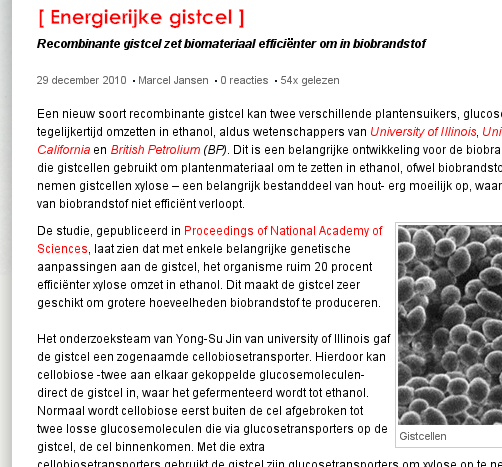
For example, it could analyse <a href="http://www.c2w.nl/energierijke-gistcel.119621.lynkx">this C2W news item</a>
on <a href="http://en.wikipedia.org/wiki/Yeast">yeast</a> cells:</p>

<p><img src="/blog/assets/images/c2w.png" alt="" /></p>

<p>There are many use cases for such localized text mining. And it surely matters for determining
the impact of research.</p>

<p>Oscar has various places where language specifics are found. For example, in tokenization of a
text. One step here is the detection of sentence ends. This is done in most western languages
with a period, exclamation mark, question mark, etc. But periods (dots) are also used in
abbreviations. Similarly, colons can be used in chemical names. But the every language comes in
with different abbreviations that need to be recognized.</p>

<p>Currently, some abbreviations are found in <a href="https://bitbucket.org/wwmm/oscar4/src/005ffa00a69d/oscar4-core/src/main/java/uk/ac/cam/ch/wwmm/oscar/document/NonSentenceEndings.java">NonSentenceEndings</a>.
In the past three months, we have been cleaning up the code, and restructured the source code,
making it easier to detect such places. This class will likely undergo further refactoring, to
making the list of such non-sentence-endings configurable via files or so. What I expect to see,
is that we you initiate Oscar like this:</p>

<div class="language-java highlighter-rouge"><div class="highlight"><pre class="highlight"><code><span class="nc">Oscar</span> <span class="n">oscar</span> <span class="o">=</span> <span class="k">new</span> <span class="nc">Oscar</span><span class="o">(</span><span class="nc">Locale</span><span class="o">.</span><span class="na">US</span><span class="o">);</span>
</code></pre></div></div>

<p>This might actually even make a nice student summer project. The biggest challenge will be in making a good
corpus of training data, like the SciBorg training data that was used for training Oscar3.</p>

<p>But the whole normalization is tainted with English language specifics too. For example, the normalizer
will have to ‘normalize’ the question marks, for which there exist several
<a href="http://en.wikipedia.org/wiki/Question_mark#Stylistic_variants">unicode variations</a>.
But the normalized variant is language dependent. For example, greek and armenian have different characters
(see <a href="http://en.wikipedia.org/wiki/Question_mark#Opening_and_closing_question_marks">this page</a>),
and then we have not even started talking about the right to left.</p>

<p>Besides localized dictionaries, this Oscar will also benefit from a localized <a href="http://opsin.ch.cam.ac.uk/">OPSIN</a>.
It seem to recognize the Dutch <a href="https://opsin.ch.cam.ac.uk/opsin/propaan.png">propaan</a>, but not
<a href="https://opsin.ch.cam.ac.uk/opsin/benzeen.png">benzeen</a>. I am not going to look at that soon, but if you are
interested, I recommend checking out Rich’
<a href="https://doi.org/10.59350/bbrwt-e5n35">posts <i class="fa-solid fa-recycle fa-xs"></i></a>
<a href="https://doi.org/10.59350/vtadn-tdt17">about <i class="fa-solid fa-recycle fa-xs"></i></a>
<a href="https://doi.org/10.59350/nbtxd-kdz73">forking <i class="fa-solid fa-recycle fa-xs"></i></a>
OPSIN and writing patches.</p>

<p>Getting Oscar going for other languages is a challenge, but also offers new opportunities. Just email the
<a href="http://sourceforge.net/mailarchive/forum.php?forum_name=oscar3-chem-developers">oscar mailing list</a>
if you are interested and need help.</p>]]></content><author><name>Egon Willighagen</name></author><category term="oscar" /><category term="textmining" /><category term="justdoi:10.59350/vtadn-tdt17" /><category term="justdoi:10.59350/nbtxd-kdz73" /><category term="justdoi:10.59350/bbrwt-e5n35" /><summary type="html"><![CDATA[Oscar is a text miner. It mines in text for chemistry. Oscar4 is the next iteration of Oscar code that I worked on in the past three months, with Lezan, Sam, and David. I blogged about aspects of Oscar4 at several occasions:]]></summary><media:thumbnail xmlns:media="http://search.yahoo.com/mrss/" url="http://egonw.github.io/blog/blog/assets/images/c2w.png" /><media:content medium="image" url="http://egonw.github.io/blog/blog/assets/images/c2w.png" xmlns:media="http://search.yahoo.com/mrss/" /></entry><entry><title type="html">Oscar: training data, models, etc</title><link href="http://egonw.github.io/blog/2010/12/26/oscar-training-data-models-etc.html" rel="alternate" type="text/html" title="Oscar: training data, models, etc" /><published>2010-12-26T00:00:00+00:00</published><updated>2010-12-26T00:00:00+00:00</updated><id>http://egonw.github.io/blog/2010/12/26/oscar-training-data-models-etc</id><content type="html" xml:base="http://egonw.github.io/blog/2010/12/26/oscar-training-data-models-etc.html"><![CDATA[<p><a href="https://sourceforge.net/projects/oscar3-chem/">Oscar</a> uses a Maximum Entropy Markov Model (MEMM) based on <a href="http://en.wikipedia.org/wiki/N-gram">n-grams</a>.
Peter Corbett has written this up (doi:<a href="https://doi.org/10.1186/1471-2105-9-S11-S4">10.1186/1471-2105-9-S11-S4</a>). So, it basically is statistics
once more. If you really want a proper bioinformatics education, so do your PhD at a (proteo)chemometrics department.</p>

<p>N-grams are word parts of n characters. For example, the trigrams of <a href="http://en.wikipedia.org/wiki/Acetic_acid">acetic acid</a>
include <code class="language-plaintext highlighter-rouge">ace</code>, <code class="language-plaintext highlighter-rouge">cid</code>, <code class="language-plaintext highlighter-rouge">tic</code>, <code class="language-plaintext highlighter-rouge">eti</code>, and <code class="language-plaintext highlighter-rouge">aci</code>. N-grams of length four include acid, etic, and acet. The MEMM assigns weights to
these n-grams, and based on that decided if something is in deed a <em>named entity</em> (in Oscar terminology). For example,
consider the <code class="language-plaintext highlighter-rouge">acet</code> n-gram: acetone should be matched, but the n-gram <code class="language-plaintext highlighter-rouge">facet</code> not.</p>

<p>Put this in perspective in the ongoing refactoring of the Oscar software. We are changing normalization (e.g. converting
all unicode hyphen alternatives into one specific hyphen), updating the tokenizer (e.g. changing the list of
non-sentence-endings like <em>Prof.</em>). It is clear this changes the n-grams typical for chemical-like things. Worse,
the weights are tuned towards to know n-grams, and statistical models are generally a bit overtrained for the
data, or, at least, specific for it.</p>

<p>Now, if the distribution of n-grams changes, the weights in the model need to be updated too, to not degrade
the model performance. So, Oscar is useless if we cannot retrain its MEMM component after a refactoring. If
that would be impossible, we would have effectively created an <em>intellectual monopoly</em>.</p>

<p>Thus, what the Oscar project needs, is one or more free sets of annotated literature, which can be used to
train new MEMM models. The SciBorg corpus was used to train the current Oscar3 and Oscar4 models. This data
(copyright <a href="http://rsc.org/">RSC</a>) will very likely be available under a <a href="http://creativecommons.org/licenses/">Creative Commons</a>
license (RSC++), but may have the NC clause, which would not be good for developing a business model around
the opensource Oscar (such as providing a high-performance web service via a subscription service). I have
recently written up <a href="http://chem-bla-ics.blogspot.com/2010/12/re-why-i-and-you-should-avoid-nc.html">the problems the NC clause introduces</a>,
and some <a href="http://chem-bla-ics.blogspot.com/2010/12/blog-post.html">examples of commercial Open Source cheminformatics projects</a>.</p>

<p>We need not focus only on this SciBorg data, however. In fact, we will need multiple models anyway. For
example, the SciBorg papers (42 if not mistaken) are around a particular kind of literature. So, it
introduces the risk of using it to analyse papers out of the application domain. Furthermore, I am very
interested (and others indicated so too) to use Oscar for other languages. Surely, English is the major
language, but there are many use cases for Oscar when useful for other languages.</p>

<p>Therefore, for what we need in the Oscar project, is a registry of training (/test) data, annotated itself
with metadata around how that data was created (what quality assurance, what kind of named entity types,
how many domain experts were involved, etc), test results for those data sets, etc. My time on the Oscar
project is almost over, and I have no clue when I will be able to invest the same amount of time into the
project as I did in the past three months. But the creation of this registry is clear step that must be
taken in the Oscar4 development.</p>]]></content><author><name>Egon Willighagen</name></author><category term="oscar" /><category term="textmining" /><category term="justdoi:10.1186/1471-2105-9-S11-S4" /><category term="inchikey:QTBSBXVTEAMEQO-UHFFFAOYSA-N" /><category term="inchikey:CSCPPACGZOOCGX-UHFFFAOYSA-N" /><summary type="html"><![CDATA[Oscar uses a Maximum Entropy Markov Model (MEMM) based on n-grams. Peter Corbett has written this up (doi:10.1186/1471-2105-9-S11-S4). So, it basically is statistics once more. If you really want a proper bioinformatics education, so do your PhD at a (proteo)chemometrics department.]]></summary></entry><entry><title type="html">Installing Oscar</title><link href="http://egonw.github.io/blog/2010/11/22/installing-oscar.html" rel="alternate" type="text/html" title="Installing Oscar" /><published>2010-11-22T00:10:00+00:00</published><updated>2010-11-22T00:10:00+00:00</updated><id>http://egonw.github.io/blog/2010/11/22/installing-oscar</id><content type="html" xml:base="http://egonw.github.io/blog/2010/11/22/installing-oscar.html"><![CDATA[<p>About half-way my Oscar project now. I blogged about the Oscar <a href="http://chem-bla-ics.blogspot.com/2010/10/oscar4-java-api-chemical-name.html">Java API</a>,
the <a href="http://chem-bla-ics.blogspot.com/2010/11/oscar4-command-line-utilities.html">command line utility</a>,
and the <a href="http://chem-bla-ics.blogspot.com/2010/10/oscar-text-mining-in-taverna.html">Taverna plugin</a>
(all in development). Also, David Jessop joined in, boosting the refactoring.
The meeting with the <a href="http://www.ebi.ac.uk/chebi/">ChEBI</a> team last week was
great too. We worked out details for the use cases, involving Oscar and Lezan’s
<a href="http://www-ucc.ch.cam.ac.uk/products/software/chemicaltagger">ChemicalTagger</a>.</p>

<p>Here follow some install instructions to get going. Please give things a try,
even though we are under heavy development. You can monitor the stability of
the code via these Hudson pages for <a href="https://hudson.ch.cam.ac.uk/job/oscar4/">oscar4</a>,
<a href="https://hudson.ch.cam.ac.uk/job/oscar4-cli/">oscar4-cli</a>, <a href="https://hudson.ch.cam.ac.uk/job/ChemicalTagger/">ChemicalTagger</a>,
and <a href="https://hudson.ch.cam.ac.uk/">others</a>. This continuous building of software
should be set up for any scientific code.</p>

<p><strong>Requirements</strong>
The follow the below instructions, you will need a working environment with
a tool to process <a href="http://en.wikipedia.org/wiki/ZIP_%28file_format%29">zip files</a>
(or equivalent), <a href="http://en.wikipedia.org/wiki/Java_Development_Kit">Java DK</a>,
and <a href="http://maven.apache.org/">Maven</a>. Having wget makes things easier. Oh,
and you need a working internet connection.</p>

<p>The pattern is otherwise the same for all above tools. I will demonstrate the
process with oscar4-cli.</p>

<p>Ubuntu and Debian users can use:</p>

<div class="language-shell highlighter-rouge"><div class="highlight"><pre class="highlight"><code><span class="nb">sudo </span>aptitude <span class="nb">install </span>unzip maven2 <span class="se">\\</span>
  openjdk-6-jdk wget
</code></pre></div></div>

<p><strong>Downloading the source</strong>
The source code for the above tools is all hosted on <a href="http://bitbucket.org">BitBucket</a>,
using the <a href="http://mercurial.selenic.com/">Mercurial</a> version control system.
However, there is no need to worry about that, because BitBucket provides source
drops. At <a href="http://bitbucket.org/egonw/oscar4-cli/downloads">this page</a> you can
download a .zip file for the command line utilities, which you can unzip with
your favorite tool.</p>

<p>If you have <em>wget</em> installed you could do from the command line:</p>

<div class="language-shell highlighter-rouge"><div class="highlight"><pre class="highlight"><code>wget http://bitbucket.org/egonw/oscar4-cli/get/tip.zip
unzip tip.zip
</code></pre></div></div>

<p>which downloads and unzips the latest version in the repository. (This is where
monitoring Hudson comes in; there you can check if there are failing unit tests.)</p>

<p><strong>Compiling the code</strong>
With the source code locally installed, it is same for Maven to come into action.
Again, I have no clue how to do this on Windows (other than with Cygwin, which
every Windows users should have installed, if a virtual machine with a full
Linux is no option), but maven should run the ‘<a href="http://maven.apache.org/plugins/maven-assembly-plugin/single-mojo.html">assembly:single</a>’
target. Or, from the command line:</p>

<div class="language-shell highlighter-rouge"><div class="highlight"><pre class="highlight"><code><span class="nb">cd </span>oscar4-cli/
mvn assembly:assembly
<span class="nb">cp </span>target/oscar4-cli-4.0-SNAPSHOT-jar-with-dependencies.jar <span class="se">\\</span>
  ./oscar4-cli-4.0-SNAPSHOT.jar
</code></pre></div></div>

<p>That should do: the created <em>oscar4-cli-4.0-SNAPSHOT.jar</em> can be used now to
run the <a href="http://chem-bla-ics.blogspot.com/2010/11/oscar4-command-line-utilities.html">command line utilities</a>.
Actually, it should also do fine for using the <a href="ttp://chem-bla-ics.blogspot.com/2010/10/oscar4-java-api-chemical-name.html">Oscar4 Java API</a>.</p>

<p><strong>Provide feedback</strong>
We most welcome feedback, or any kind. Feature requests can be posted <a href="http://sourceforge.net/tracker/?group_id=169991&amp;atid=852565">here</a>,
and bug reports <a href="http://sourceforge.net/tracker/?group_id=169991&amp;atid=852562">here</a>.
You can also send email to the <a href="http://sourceforge.net/mailarchive/forum.php?forum_name=oscar3-chem-developers">oscar3-chem-developers</a>
mailing list.</p>

<p><strong>Update</strong>: <em>mvn assembly:assembly</em> should be used instead of <em>mvn assembly:single</em>.</p>]]></content><author><name>Egon Willighagen</name></author><category term="oscar" /><category term="textmining" /><summary type="html"><![CDATA[About half-way my Oscar project now. I blogged about the Oscar Java API, the command line utility, and the Taverna plugin (all in development). Also, David Jessop joined in, boosting the refactoring. The meeting with the ChEBI team last week was great too. We worked out details for the use cases, involving Oscar and Lezan’s ChemicalTagger.]]></summary></entry><entry><title type="html">Oscar4 command line utilities</title><link href="http://egonw.github.io/blog/2010/11/18/oscar4-command-line-utilities.html" rel="alternate" type="text/html" title="Oscar4 command line utilities" /><published>2010-11-18T00:00:00+00:00</published><updated>2010-11-18T00:00:00+00:00</updated><id>http://egonw.github.io/blog/2010/11/18/oscar4-command-line-utilities</id><content type="html" xml:base="http://egonw.github.io/blog/2010/11/18/oscar4-command-line-utilities.html"><![CDATA[<p>One goal of my three month project is to take Oscar4 to the community. We want to get it used more, and we need
a larger development community. Oscar4 and the related technologies do a good, sometimes excellent, job, but
have to be maintained, just like any other piece of code. To make using it easier, we are developing new APIs,
as well as two user-oriented applications: <a href="https://chem-bla-ics.linkedchemistry.info/2010/10/21/oscar-text-mining-in-taverna.html">a Taverna 2 plugin <i class="fa-solid fa-recycle fa-xs"></i></a>,
and command line utilities. The <a href="https://chem-bla-ics.linkedchemistry.info/2010/10/28/oscar4-java-api-chemical-name.html">Oscar4 Java API <i class="fa-solid fa-recycle fa-xs"></i></a>
has slightly evolved in the last three weeks, removing some complexity. In this post, I will introduce the command
line utilities.</p>

<h2 id="oscar4">Oscar4</h2>

<p>Most people will be mostly interested into the full Oscar4 program, to extract chemical entities. Oscar3 was
also capable of extracting data (like <a href="https://chem-bla-ics.linkedchemistry.info/2006/09/08/chemical-archeology-oscar3-to.html">NMR spectra <i class="fa-solid fa-recycle fa-xs"></i></a>),
but that is not yet being ported. The OscarCLI program takes input, extracts chemicals, and where possible resolves
them into connection tables (viz. InChI).</p>

<p>To extract chemicals from a line of text (e.g. <em>“This is propane.”</em>, you do:</p>

<div class="language-shell highlighter-rouge"><div class="highlight"><pre class="highlight"><code><span class="nv">$ </span>java <span class="nt">-cp</span> oscar4-cli-4.0-SNAPSHOT.jar <span class="se">\</span>
  uk.ac.cam.ch.wwmm.oscar.oscarcli.OscarCLI <span class="se">\</span>
  This is propane.
propane: <span class="nv">InChI</span><span class="o">=</span>1/C3H8/c1-3-2/h3H2,1-2H3
</code></pre></div></div>

<p>For larger chunks of texts it is easier to route it via <a href="http://en.wikipedia.org/wiki/Standard_streams">stdin</a>,
for which we can use the <code class="language-plaintext highlighter-rouge">-stdin</code> option:</p>

<div class="language-shell highlighter-rouge"><div class="highlight"><pre class="highlight"><code><span class="nv">$ </span><span class="nb">echo</span> <span class="s2">"This is propane."</span> | <span class="se">\</span>
  java <span class="nt">-cp</span> oscar4-cli-4.0-SNAPSHOT.jar <span class="se">\</span>
  uk.ac.cam.ch.wwmm.oscar.oscarcli.OscarCLI <span class="se">\</span>
  <span class="nt">-stdin</span>
propane: <span class="nv">InChI</span><span class="o">=</span>1/C3H8/c1-3-2/h3H2,1-2H3
</code></pre></div></div>

<p>That way, we can easily process large plain text files (output omitted):</p>

<div class="language-shell highlighter-rouge"><div class="highlight"><pre class="highlight"><code><span class="nv">$ </span><span class="nb">cat </span>largeFile.txt | <span class="se">\</span>
  java <span class="nt">-cp</span> oscar4-cli-4.0-SNAPSHOT.jar <span class="se">\</span>
  uk.ac.cam.ch.wwmm.oscar.oscarcli.OscarCLI <span class="se">\</span>
  <span class="nt">-stdin</span>
</code></pre></div></div>

<p>If you prefer RDF output, for further integration, use the <code class="language-plaintext highlighter-rouge">-output text/turtle</code>:</p>

<div class="language-shell highlighter-rouge"><div class="highlight"><pre class="highlight"><code><span class="nv">$ </span><span class="nb">cat </span>largeFile.txt | <span class="se">\</span>
  java <span class="nt">-cp</span> oscar4-cli-4.0-SNAPSHOT.jar <span class="se">\</span>
  uk.ac.cam.ch.wwmm.oscar.oscarcli.OscarCLI <span class="se">\</span>
  <span class="nt">-stdin</span> <span class="nt">-output</span> text/turtle
</code></pre></div></div>

<p>This returns RDF using the <a href="http://code.google.com/p/semanticchemistry/">CHEMINF</a> ontology like:</p>

<div class="language-turtle highlighter-rouge"><div class="highlight"><pre class="highlight"><code><span class="kd">@prefix</span><span class="w"> </span><span class="nn">dc:</span><span class="w">  </span><span class="p">.</span><span class="w">
</span><span class="kd">@prefix</span><span class="w"> </span><span class="nn">rdfs:</span><span class="w">  </span><span class="p">.</span><span class="w">
</span><span class="kd">@prefix</span><span class="w"> </span><span class="nn">ex:</span><span class="w">  </span><span class="p">.</span><span class="w">
</span><span class="kd">@prefix</span><span class="w"> </span><span class="nn">cheminf:</span><span class="w">  </span><span class="p">.</span><span class="w">
</span><span class="kd">@prefix</span><span class="w"> </span><span class="nn">sio:</span><span class="w"> </span><span class="p">.</span><span class="w">

</span><span class="nn">ex:</span><span class="n">entity0
</span><span class="w">  </span><span class="nn">rdfs:</span><span class="n">subClassOf</span><span class="w"> </span><span class="nn">cheminf:</span><span class="n">CHEMINF_000000</span><span class="w"> </span><span class="p">;</span><span class="w">
  </span><span class="nn">dc:</span><span class="n">label</span><span class="w"> </span><span class="s">"propane"</span><span class="w"> </span><span class="p">;</span><span class="w">
  </span><span class="nn">cheminf:</span><span class="n">CHEMINF_000200</span><span class="w"> </span><span class="p">[</span><span class="w">
    </span><span class="k">a</span><span class="w"> </span><span class="nn">cheminf:</span><span class="n">CHEMINF_000113</span><span class="w"> </span><span class="p">;</span><span class="w">
    </span><span class="nn">sio:</span><span class="n">SIO_000300</span><span class="w"> </span><span class="s">"InChI=1/C3H8/c1-3-2/h3H2,1-2H3"</span><span class="w"> </span><span class="p">.</span><span class="w">
  </span><span class="p">]</span><span class="w"> </span><span class="p">.</span><span class="w">
</span></code></pre></div></div>

<p>We can, however, also use <a href="http://jericho.htmlparser.net/docs/index.html">Jericho</a> to extract text from HTML pages, made
available with the <code class="language-plaintext highlighter-rouge">-html</code> option, and pulling in a <a href="http://www.beilstein-journals.org/bjoc/">Beilstein Journal of Organic Chemistry</a>
paper with <a href="http://en.wikipedia.org/wiki/Wget">wget</a>:</p>

<div class="language-shell highlighter-rouge"><div class="highlight"><pre class="highlight"><code><span class="nv">$ </span>wget <span class="nt">-qO-</span> https://doi.org/10.3762/bjoc.6.122 | <span class="se">\</span>
  java <span class="nt">-cp</span> oscar4-cli-4.0-SNAPSHOT.jar <span class="se">\</span>
  uk.ac.cam.ch.wwmm.oscar.oscarcli.OscarCLI <span class="se">\</span>
  <span class="nt">-stdin</span> <span class="nt">-html</span>
</code></pre></div></div>

<p>This will return 271 chemical entities recognized in the text, matching 48 unique chemical structures.</p>]]></content><author><name>Egon Willighagen</name></author><category term="oscar" /><category term="textmining" /><category term="beilstein" /><category term="inchikey:ATUOYWHBWRKTHZ-UHFFFAOYSA-N" /><summary type="html"><![CDATA[One goal of my three month project is to take Oscar4 to the community. We want to get it used more, and we need a larger development community. Oscar4 and the related technologies do a good, sometimes excellent, job, but have to be maintained, just like any other piece of code. To make using it easier, we are developing new APIs, as well as two user-oriented applications: a Taverna 2 plugin , and command line utilities. The Oscar4 Java API has slightly evolved in the last three weeks, removing some complexity. In this post, I will introduce the command line utilities.]]></summary></entry><entry><title type="html">Working on Oscar for three months</title><link href="http://egonw.github.io/blog/2010/10/15/working-on-oscar-for-three-months.html" rel="alternate" type="text/html" title="Working on Oscar for three months" /><published>2010-10-15T00:00:00+00:00</published><updated>2010-10-15T00:00:00+00:00</updated><id>http://egonw.github.io/blog/2010/10/15/working-on-oscar-for-three-months</id><content type="html" xml:base="http://egonw.github.io/blog/2010/10/15/working-on-oscar-for-three-months.html"><![CDATA[<p>As Peter <a href="https://blogs.ch.cam.ac.uk/pmr/2010/10/11/update-and-real-excitement/">announced <i class="fa-solid fa-recycle fa-xs"></i></a> in his blog, and I tweeted earlier, I have started as postdoctoral
research associate in <a href="http://www-pmr.ch.cam.ac.uk/wiki/Main_Page">Peter’s group</a> at the <a href="http://www.cam.ac.uk/">University of Cambridge</a>,
to work the next three months on <a href="https://oscar3-chem.sf.net">Oscar</a>, a chemical text mining tool. My tasks will focus on programmatical
plumbing instead of method development, and I am aiming at integration with <a href="http://cdktaverna.wordpress.com/installing-cdk-taverna/">CDK-Taverna</a>
(see doi:<a href="http://dx.doi.org/10.1186/1471-2105-11-159">10.1186/1471-2105-11-159</a>, and which is currently being ported to
<a href="http://www.taverna.org.uk/">Taverna 2.2</a> by Andreas). <a href="http://sea36.blogspot.com/">Sam</a> and Lezan having been working on the refactoring
as well, and will help me out with the gory details of the current code.</p>

<p>The source code of Oscar4 is available from <a href="https://bitbucket.org/wwmm/oscar4">this BitBucket project</a>, and you can monitor the code
state on <a href="https://hudson.ch.cam.ac.uk/job/oscar4/">this Hudson page</a>. The project I will be working on, is in collaboration with the
<a href="http://www.ebi.ac.uk/chebi/">ChEBI</a> project, and today we met up with various people in the group, and set out some really interesting
use cases.</p>]]></content><author><name>Egon Willighagen</name></author><category term="oscar" /><category term="textmining" /><category term="chebi" /><category term="doi:10.1186/1471-2105-11-159" /><summary type="html"><![CDATA[As Peter announced in his blog, and I tweeted earlier, I have started as postdoctoral research associate in Peter’s group at the University of Cambridge, to work the next three months on Oscar, a chemical text mining tool. My tasks will focus on programmatical plumbing instead of method development, and I am aiming at integration with CDK-Taverna (see doi:10.1186/1471-2105-11-159, and which is currently being ported to Taverna 2.2 by Andreas). Sam and Lezan having been working on the refactoring as well, and will help me out with the gory details of the current code.]]></summary></entry><entry><title type="html">Chemo::Blogs #2</title><link href="http://egonw.github.io/blog/2006/12/06/chemoblogs-2.html" rel="alternate" type="text/html" title="Chemo::Blogs #2" /><published>2006-12-06T00:00:00+00:00</published><updated>2006-12-06T00:00:00+00:00</updated><id>http://egonw.github.io/blog/2006/12/06/chemoblogs-2</id><content type="html" xml:base="http://egonw.github.io/blog/2006/12/06/chemoblogs-2.html"><![CDATA[<p>Because no one picked up my <a href="http://chem-bla-ics.blogspot.com/2006/09/chemoblogs-1.html">Chemo::Blogs</a> suggestion, I will now
officially claim the blog series title. However, unlike the original <a href="http://bioblogs.wordpress.com/">Bio::Blogs</a> series,
I will not summarize interesting blogs, but just spam you with websites I recently marked as
<a href="http://del.icio.us/egonw/toblog">toblog on del.icio.us</a>.</p>

<h2 id="semantics-and-text-mining">Semantics and Text Mining</h2>

<p><a href="http://evan.prodromou.name/">Evan Prodromou</a> wrote about <a href="http://evan.prodromou.name/RDFa_vs_microformats">RDFa vs microformats</a>.
The latter are commonly used in <a href="http://chem-bla-ics.blogspot.com/2006/02/tagging-blog-items.html">enhancing blog semantics</a>, and
for example used by <a href="http://postgenomic.com/wiki/doku.php?id=markup">PostGenomic.com</a>. While RDFa is more explicit, e.g. by using
namespaced markup, we have to wait until XHTML2 to see it working. I do not think chemists are using tags a log yet, but let me
propose the following microformats: <span class="inchi"><a href="http://google.com/search?q=1/CH4/h1H4">1/CH4/h1H4</a></span> and
<span class="chemicalcompound">methane<span>. Standard JavaScripts and CSS scripts will then do the rest. (Think: addressing newlines,
auto <a href="http://wwmm-svc.ch.cam.ac.uk/wwmm/html/googleinchiserver.html">googling-for-inchi</a>, etc).</span></span></p>

<p>The reason why using microformats is interesting, is text mining, of various kinds. Whether it is setting up a molecule-article
link database, or <a href="http://chem-bla-ics.blogspot.com/2006/02/hacking-inchi-support-into.html">find hot molecules in blogspace</a>,
adding semantics will help tools like <a href="http://chem-bla-ics.blogspot.com/2006/09/chemical-archeology-oscar3-to.html">OSCAR3 to mine chemistry</a>.
Some time ago <a href="http://chem-bla-ics.blogspot.com/2006/05/open-text-mining-interface-and.html">OTMI was proposed by Nature</a>,
and they now set up a <a href="http://www.opentextmining.org/wiki/Main_Page">dedicated web site</a> to explain there view on text mining.
<a href="http://www.zacker.com/">Zack Rosen</a> has a good idea why <a href="http://www.zacker.org/semantic-web-research-isnt-working">RDF Semantic web research isn’t working</a>.</p>

<h2 id="blogspace">Blogspace</h2>

<p>There are a few new chemistry blogs I want to mention (and already added to <a href="http://chem-bla-ics.blogspot.com/2006/08/chemical-blogspace.html">Chemical blogspace</a>):
<a href="http://blog.chembark.com/">ChemBark</a>, <a href="http://www.lirico.co.uk/wp/">lirico</a> which has an interesting
<a href="http://www.lirico.co.uk/wp/?cat=8">chemoinformatics section</a>, and <a href="http://ashutoshchemist.blogspot.com/">The Curious Wavefunction</a>.
Worth reading indeed.</p>

<p><a href="http://plindenbaum.blogspot.com/">Pierre’s YOKOFAKUN</a> deserves a paragraph of his own. He recently blogged about
<a href="http://plindenbaum.blogspot.com/2006/11/bio2rdf.html">bio2rdf</a> which provides an <a href="http://bio2rdf.org/">RDF interface to biochemical knowledge</a>
via <a href="http://lsid.sourceforge.net/">Life Science Identifiers</a> (LSID), <a href="http://plindenbaum.blogspot.com/2006/11/wwwoboeditorg.html">OBOEdit</a>
which is a Java-based ontology editor, and <a href="http://plindenbaum.blogspot.com/2006/12/visual-unix-pipeline.html">Amadea</a>
which is a <a href="http://taverna.sf.net/">Taverna</a>- and <a href="http://www.knime.org/">KNIME</a>-like tool for setting up UNIX pipes.</p>

<h2 id="online-embl-symposium">Online EMBL Symposium</h2>

<p>A few EMBL PhD students are having the <a href="http://virtualsymposium.predocs.org/">First Online EMBL PhD Symposium</a> (catchy name, or … ;)
Anyway, discussions are held on IRC, and it has a rather interesting Web2.0 session. All
<a href="http://virtualsymposium.predocs.org/media">media is available on the website</a> but requires registration right now.
After the conference it will become open access to all. <a href="http://www.blogger.com/profile/6833158">Jean-Claude</a> contributed
<em>The UsefulChem Project: Open Source Chemistry Research using Blogs and Wikis</em> to the
<a href="http://virtualsymposium.predocs.org/media/participants-contributions/">Participants’ Contributions section</a>, and I had
a poster on <em>Distributing molecular information over the Internet</em>, discussing CMLRSS, blog aggregators, CML and other things.
The IRC session was logged and is <a href="http://virtualsymposium.predocs.org/chat/discussion-about-the-influence-of-web-2-0-on-science-tuesday-december-6-2006-16-00-cet/">available here</a>.</p>

<h2 id="literature">Literature</h2>

<p>Finally, I want to mention three recent articles. First one is a recent write up by Bourne and Friedberg about
<em>Ten Simple Rules for Selecting a Postdoctoral Position</em> (DOI: <a href="https://doi.org/10.1371/journal.pcbi.0020121">10.1371/journal.pcbi.0020121</a>).
With the end of my current postdoc position nearing, rather useful reading. Some time ago I blogged about a
<a href="http://chem-bla-ics.blogspot.com/2006/05/new-open-access-journal-source-code.html">New open access journal Source Code for Biology and Medicine</a>,
and the journal is now up and running. Details can be read in the first editorial (DOI: <a href="https://doi.org/10.1186/1751-0473-1-1">10.1186/1751-0473-1-1</a>).
The third article I would like to mention is <em>Scientific Software Development Is Not an Oxymoron</em> by Baxter
(DOI: <a href="https://doi.org/10.1371/journal.pcbi.0020087">10.1371/journal.pcbi.0020087</a>), though I do not think it has new insights.</p>

<p>OK, this was a rather lengthy write up, but really needed to clean up my toblog section :)</p>]]></content><author><name>Egon Willighagen</name></author><category term="blog" /><category term="rdf" /><category term="textmining" /><category term="cb" /><category term="justdoi:10.1371/journal.pcbi.0020121" /><category term="justdoi:10.1186/1751-0473-1-1" /><category term="justdoi:10.1371/journal.pcbi.0020087" /><category term="rdfa" /><summary type="html"><![CDATA[Because no one picked up my Chemo::Blogs suggestion, I will now officially claim the blog series title. However, unlike the original Bio::Blogs series, I will not summarize interesting blogs, but just spam you with websites I recently marked as toblog on del.icio.us.]]></summary></entry><entry><title type="html">Chemical Archeology: OSCAR3 to NMRShiftDB.org</title><link href="http://egonw.github.io/blog/2006/09/08/chemical-archeology-oscar3-to.html" rel="alternate" type="text/html" title="Chemical Archeology: OSCAR3 to NMRShiftDB.org" /><published>2006-09-08T00:00:00+00:00</published><updated>2006-09-08T00:00:00+00:00</updated><id>http://egonw.github.io/blog/2006/09/08/chemical-archeology-oscar3-to</id><content type="html" xml:base="http://egonw.github.io/blog/2006/09/08/chemical-archeology-oscar3-to.html"><![CDATA[<p>Chemical Archeology (see <a href="http://wiki.cubic.uni-koeln.de/blog/pivot/entry.php?id=7#body">Christoph’s comment</a>) is the
process of extracting chemical information from old journal articles. Some time ago,
<a href="http://wwmm.ch.cam.ac.uk/blogs/corbett/">Peter Corbett</a> from the group of <a href="http://wwmm.ch.cam.ac.uk/blogs/murrayrust/">Peter Murray-Rust</a>
visited the <a href="http://almost.cubic.uni-koeln.de/jrg/">CUBIC</a> to talk to us about
<a href="http://wwmm.ch.cam.ac.uk/wikis/wwmm/index.php/Oscar3">Oscar3</a> which can do just that. That day, we already
<a href="https://chem-bla-ics.linkedchemistry.info/2006/06/22/text-mining-for-chemistry-using-oscar3.html">hooked OPSIN into Bioclipse <i class="fa-solid fa-recycle fa-xs"></i></a>.</p>

<p>Oscar3, however, is capable of more then the name2structure of OPSIN (see also
<a href="httpa://doi.org/10.1039/b411033a">10.1039/b411033a</a>; it can take a plain text file with an experimental section
with details on the synthesis of small organic compounds, and analyze the chemistry in that. This functionality has been
available as <a href="http://www.rsc.org/Publishing/ReSourCe/AuthorGuidelines/AuthoringTools/index.asp">an RSC authoring tool</a>
for some time now (see also <a href="https://doi.org/10.1039/b411699m">10.1039/b411699m</a>). Unfortunately, what publisher put
online (PDF and HTML) is much more difficult to process with Oscar3: those formats are often optimized for display,
not for machine processing. The HTML can be cleaned up, but there is no general approach.</p>

<p><a href="http://wiki.cubic.uni-koeln.de/blog/">Christoph Steinbeck</a> is going to present at the
<a href="http://www.chemistry.org/portal/a/c/s/1/acsdisplay.html?DOC=meetings%5Csanfrancisco2006%5Chome.html">upcoming ACS meeting</a>
the use of Oscar3 for extraction of NMR spectra from old journal article, in preperation for submission to the
<a href="http://www.nmrshiftdb.org/">NMRShiftDB.org</a> (see the <a href="http://wiki.cubic.uni-koeln.de/blog/pivot/entry.php?id=4#body">abstract</a>
of <a href="http://oasys2.confex.com/acs/232nm/techprogram/P981204.HTM">CINF 101</a>).</p>

<p>Since the full Oscar3 was not hooked into <a href="http://www.bioclipse.net/">Bioclipse</a> yet, I had some work to do. It took me
some time to figure out how to properly configure Oscar3, and what additional things I had to do to clean up the HTML
used by publishers to get Oscar3 to extract NMR spectra (thanx to PeterC for hints!). I also had to tweak the Oscar3
code itself here and there, but that’s what opensource is about :) (Peter, if you are reading this: I have a number
of patches for the Oscar3 code in <a href="http://svn.sourceforge.net/viewvc/bioclipse/trunk/bc_oscar/">bc_oscar</a>;
let me know if you’re interested in them.)</p>

<p>This is the end result:</p>

<p><img src="/blog/assets/images/oscar1.png" alt="" /></p>

<p>Note especially the hierarchy in the resource navigator on the left. The misc folder contains all the chemistry found in the article. But more importantly is that for six molecules it fully detected he experimental section! For 3-(2-Oxocyclooctanyl)-3-phenylpropan-1-al (InChI=1/C17H22O2/c18-13-12-15(14-8-4-3-5-9-14)16-10-6-1-2-7-11-17(16)19/h3-5,8-9,13,15-16H,1-2,6-7,10-12H2) it derived the molecular structure (with OPSIN), and a few spectra: H-NMR, high-resolution MS and IR.</p>

<p>So, if you attend the ACS meeting: make sure to visit Christoph’s CINF 101 presentation!</p>]]></content><author><name>Egon Willighagen</name></author><category term="oscar" /><category term="bioclipse" /><category term="acs" /><category term="chemistry" /><category term="justdoi:10.1039/b411033a" /><category term="textmining" /><category term="justdoi:10.1039/b411699m" /><summary type="html"><![CDATA[Chemical Archeology (see Christoph’s comment) is the process of extracting chemical information from old journal articles. Some time ago, Peter Corbett from the group of Peter Murray-Rust visited the CUBIC to talk to us about Oscar3 which can do just that. That day, we already hooked OPSIN into Bioclipse .]]></summary><media:thumbnail xmlns:media="http://search.yahoo.com/mrss/" url="http://egonw.github.io/blog/blog/assets/images/oscar1.png" /><media:content medium="image" url="http://egonw.github.io/blog/blog/assets/images/oscar1.png" xmlns:media="http://search.yahoo.com/mrss/" /></entry><entry><title type="html">Text mining for chemistry using OSCAR3</title><link href="http://egonw.github.io/blog/2006/06/22/text-mining-for-chemistry-using-oscar3.html" rel="alternate" type="text/html" title="Text mining for chemistry using OSCAR3" /><published>2006-06-22T00:00:00+00:00</published><updated>2006-06-22T00:00:00+00:00</updated><id>http://egonw.github.io/blog/2006/06/22/text-mining-for-chemistry-using-oscar3</id><content type="html" xml:base="http://egonw.github.io/blog/2006/06/22/text-mining-for-chemistry-using-oscar3.html"><![CDATA[<p><a href="http://wwmm.ch.cam.ac.uk/wikis/wwmm/index.php/User:ptc24">Peter Corbett</a> from <a href="http://wwmm.ch.cam.ac.uk/">Peter Murray-Rust’s group</a>
at the <a href="http://www-ucc.ch.cam.ac.uk/">Unilever Cambridge Centre for Molecular Informatics</a> visited
<a href="http://almost.cubic.uni-koeln.de/jrg/">Christoph Steinbeck’s junior Research Group on Molecular Informatics</a> at the
<a href="http://www.cubic.uni-koeln.de/">CUBIC</a> today, and spoke about the status of <a href="http://sourceforge.net/projects/oscar3-chem">Oscar3</a>,
a chemistry text mining program with the <a href="http://www.opensource.org/licenses/artistic-license.php">Artistic License</a>.
Oscar3, the successor of version 1 and 2, can detect and extract molecular structures and experimental details from plain text articles,
using a variety of text mining techniques.</p>

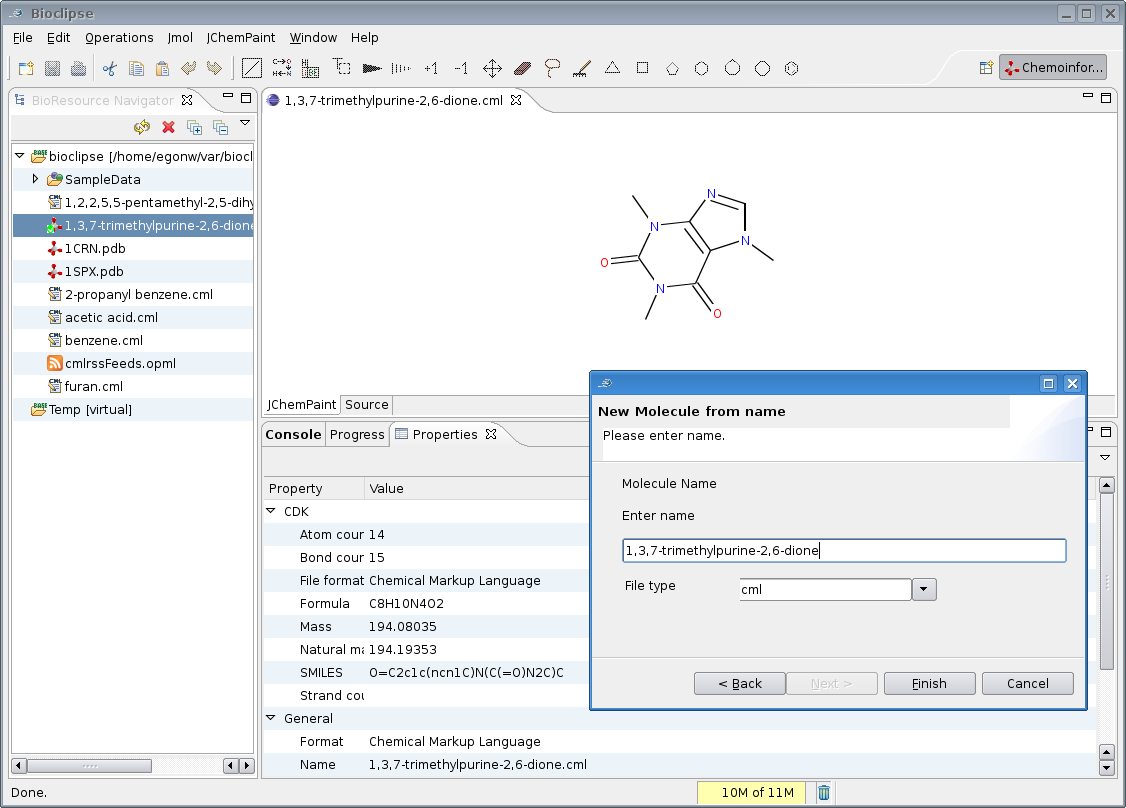
<p>The afternoon was spend on hacking Oscar3 into <a href="http://www.bioclipse.net/">Bioclipse</a>, with good success. It involved updating Oscar3
for the latest <a href="http://cdk.sf.net/">CDK</a> and setting up a plugin infrastructure for Bioclipse. This plugin will allow mining
(scientific) articles for chemical compounds and there properties from within Bioclipse. The outcome of today’s hacking session was
somewhat less ambitious and focused on the general infrastructure, and getting the OPSIN functionality in Oscar3 available as a wizard.
OPSIN is a IUPAC name 2 structure tool and, amongst many other names, is able to recognize <a href="http://pubchem.ncbi.nlm.nih.gov/summary/summary.cgi?cid=2519">caffeine</a>
(<code class="language-plaintext highlighter-rouge">InChI=1/C8H10N4O2/c1-10-4-9-6-5(10)7(13)12(3)8(14)11(6)2/h4H,1-3H3</code>):</p>

<p><img src="/blog/assets/images/opsin.png" alt="" /></p>]]></content><author><name>Egon Willighagen</name></author><category term="oscar" /><category term="bioclipse" /><category term="textmining" /><summary type="html"><![CDATA[Peter Corbett from Peter Murray-Rust’s group at the Unilever Cambridge Centre for Molecular Informatics visited Christoph Steinbeck’s junior Research Group on Molecular Informatics at the CUBIC today, and spoke about the status of Oscar3, a chemistry text mining program with the Artistic License. Oscar3, the successor of version 1 and 2, can detect and extract molecular structures and experimental details from plain text articles, using a variety of text mining techniques.]]></summary><media:thumbnail xmlns:media="http://search.yahoo.com/mrss/" url="http://egonw.github.io/blog/blog/assets/images/opsin.png" /><media:content medium="image" url="http://egonw.github.io/blog/blog/assets/images/opsin.png" xmlns:media="http://search.yahoo.com/mrss/" /></entry><entry><title type="html">Open Text Mining Interface and Bioclipse</title><link href="http://egonw.github.io/blog/2006/05/07/open-text-mining-interface-and.html" rel="alternate" type="text/html" title="Open Text Mining Interface and Bioclipse" /><published>2006-05-07T00:00:00+00:00</published><updated>2006-05-07T00:00:00+00:00</updated><id>http://egonw.github.io/blog/2006/05/07/open-text-mining-interface-and</id><content type="html" xml:base="http://egonw.github.io/blog/2006/05/07/open-text-mining-interface-and.html"><![CDATA[<p>Timo Hannay <a href="https://web.archive.org/web/20060620194249/http://blogs.nature.com/wp/nascent/2006/04/open_text_mining_interface.html">blogged <i class="fa-solid fa-box-archive fa-xs"></i></a>
in <a href="http://www.nature.com/">Nature</a>’s <a href="https://web.archive.org/web/20060504035155/http://blogs.nature.com/wp/nascent/">Nascent blog <i class="fa-solid fa-box-archive fa-xs"></i></a>
about the Open Text Mining Interface (OTMI), which is “a suggestion from Nature about how we might achieve text-mining
and indexing purposes”. The idea is that each article has a link pointing to a machine readable file
containing raw data about (and from?) the article. The standing example uses
<a href="http://atompub.org/2005/07/11/draft-ietf-atompub-format-10.html">Atom 1.0</a> as a container, allowing raw
data to be included using foreign namespaces, such as <a href="http://prismstandard.org/">Dublic Core</a>
(for metadata) and <a href="http://prismstandard.org/">Prism</a> (for bibliographic data), and the OTMI text
mining statistics uses a namespace too.</p>

<p>In a comment, <a href="http://www.ch.ic.ac.uk/rzepa/">Henry Rzepa</a> proposed inclusion of CML, and refers to earlier
work on CMLRSS where <a href="http://www.xml-cml.org/">Chemical Markup Language</a> is embedded in RSS news feeds
for which I wrote readers for <a href="http://www.jmol.org/">Jmol</a> and
<a href="http://jchempaint.sf.net/">JChemPaint</a> (DOI:<a href="https://doi.org/10.1021/ci034244p">10.1021/ci034244p</a>).</p>

<p>As readers of my blog know, the <a href="http://www.bioclipse.net/">Bioclipse</a> project has been working hard
on an integrated (bio)chemistry workbench, and the <a href="http://bioclipse.blogspot.com/2006/05/bioclipse-090-released.html">latest release</a>
includes a <a href="http://wiki.bioclipse.net/index.php?title=CMLRSS_plugin">CMLRSS reader plugin</a> too, which
supports CML embedded in Atom 0.3/1.0 and RSS 1.0/2.0 feeds. Now, adding support for other embedded
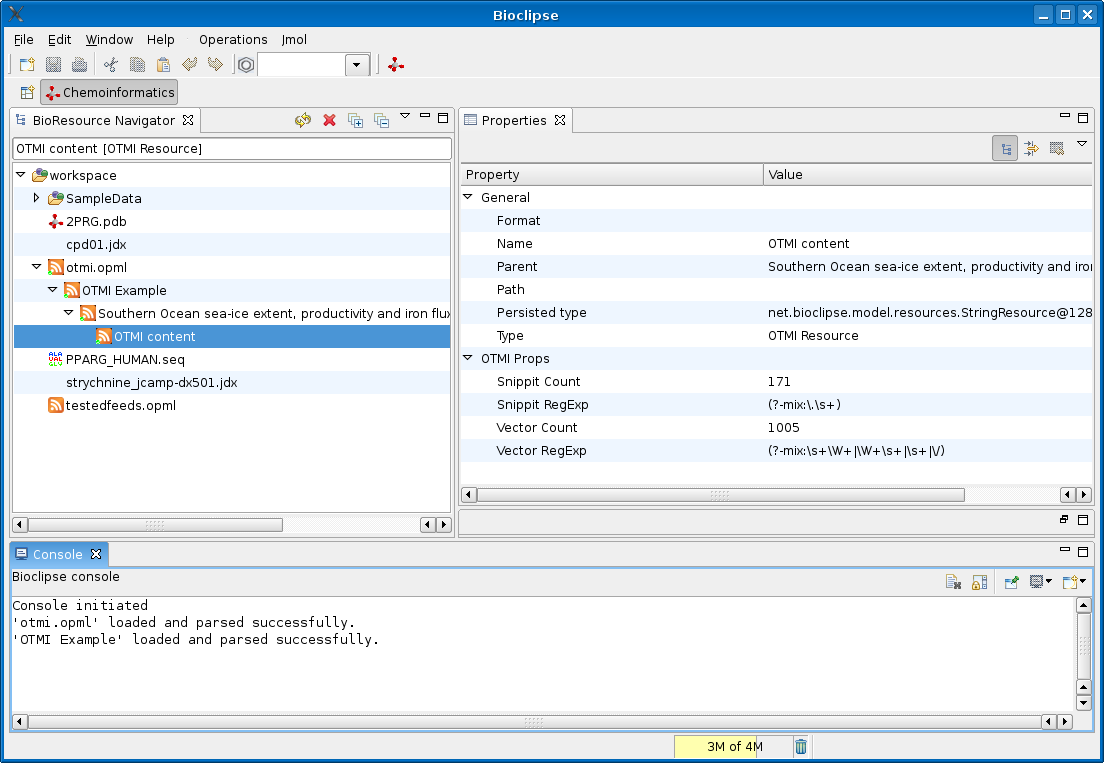
namespaces is trivial, and this morning I hacked in support for OTMI:</p>

<p><img src="/blog/assets/images/otmiSupport.png" alt="" /></p>

<p>This screenshot show the <a href="https://chem-bla-ics.blogspot.com/2006/05/open-text-mining-interface-and.html">original OTMI example</a>
with the Atom 1.0 entry now wrapped in an Atom 1.0 <code class="language-plaintext highlighter-rouge">&lt;feed&gt;</code> element. There is no nice OTMI icon for the OTMI content in the
Atom 1.0 entry, neither did I make a ‘view’ yet showing the actual vector’s or the snippet’s, but that’s a piece of cake too.</p>

<p>Now, the nice thing about this is that the Bioclipse code for the Atom and RSS feeds, just greps through the feed entry
and show whatever CML or OTMI content is present. When Nature decides to include CML in these OTMI files too,
I will not have to update the current code.</p>]]></content><author><name>Egon Willighagen</name></author><category term="cml" /><category term="bioclipse" /><category term="xml" /><category term="textmining" /><category term="rss" /><category term="doi:10.1021/CI034244P" /><summary type="html"><![CDATA[Timo Hannay blogged in Nature’s Nascent blog about the Open Text Mining Interface (OTMI), which is “a suggestion from Nature about how we might achieve text-mining and indexing purposes”. The idea is that each article has a link pointing to a machine readable file containing raw data about (and from?) the article. The standing example uses Atom 1.0 as a container, allowing raw data to be included using foreign namespaces, such as Dublic Core (for metadata) and Prism (for bibliographic data), and the OTMI text mining statistics uses a namespace too.]]></summary><media:thumbnail xmlns:media="http://search.yahoo.com/mrss/" url="http://egonw.github.io/blog/blog/assets/images/otmiSupport.png" /><media:content medium="image" url="http://egonw.github.io/blog/blog/assets/images/otmiSupport.png" xmlns:media="http://search.yahoo.com/mrss/" /></entry></feed>