-
Commercial or Proprietary?
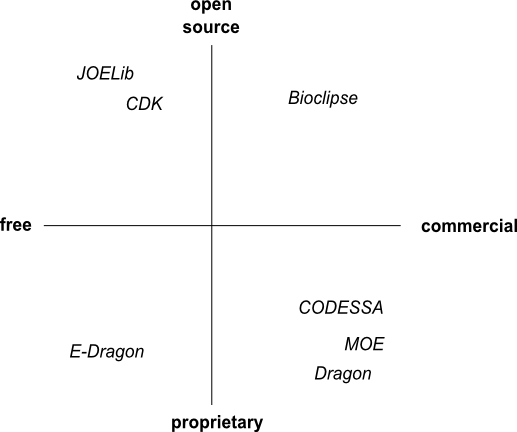
Khanna and Ranganathan wrote up a review paper on molecular similarity (doi:10.1002/ddr.20404). I have not fully read it yet, but my eye fell on Table 1, which lists a number of programs that can be used to calculate QSAR descriptors, both open source and proprietary. However, the table features a column Availability which has two options: Public, Commercial. They qualify Bioclipse, CDK, and RDKit as public, and Dragon, MOE, CODESSA and others are commercial. Effectively, it seems to suggest that they classify them as open source versus commercial, though I am not entirely sure what they mean with public.
-
Re: Why I and you should avoid NC licences
Peter blogged about an issue that recently came up: the role of the Non-Commercial clause in Creative Commons licenses. This clause goes like:
-

Open Research Computation, ORC, #openrescomp
Yesterday, a new journal launched, but your regular new journal. This journal is about scientific software. Tested software. Documented software. Open Source software. I am on the editorial board, so I am biased here. But, this journal is special. This new journal is called Open Research Computation (ORC?). Several others blogged about it too.
-
My talk at Imperial College
Yesterday I was guest with Judy at the Department of Surgery & Cancer at Imperial College, where I presented the what I am working on. As I met up in a pub with Ron (my former PhD supervisor, who now works on metabolomics at the Istituto Agrario San Michele all’Adige in Italy) the night before, the presentation does share many slides from previous talks, but also adds a few new ones.
-

Supramolecular chemistry
Some smart software developer once said to not optimize your code too early. However, not caring about it at all does not help either. Some basic knowledge of memory management can keep you going. That is, I just ran into the limits of Oscar and ChemicalTagger. As I blogged earlier today, I am analyzing the BJOC literature , but Lezan and I are running into a reproducible out-of-memory exception. At first I thought it was a memory leak, as it was the 95th paper if fell over on, but after we optimized our code a bit, by reusing classes, the problem remained and turned out to be not in recreating objects (though the code is significantly faster now), but in a single BJOC paper being too large.